
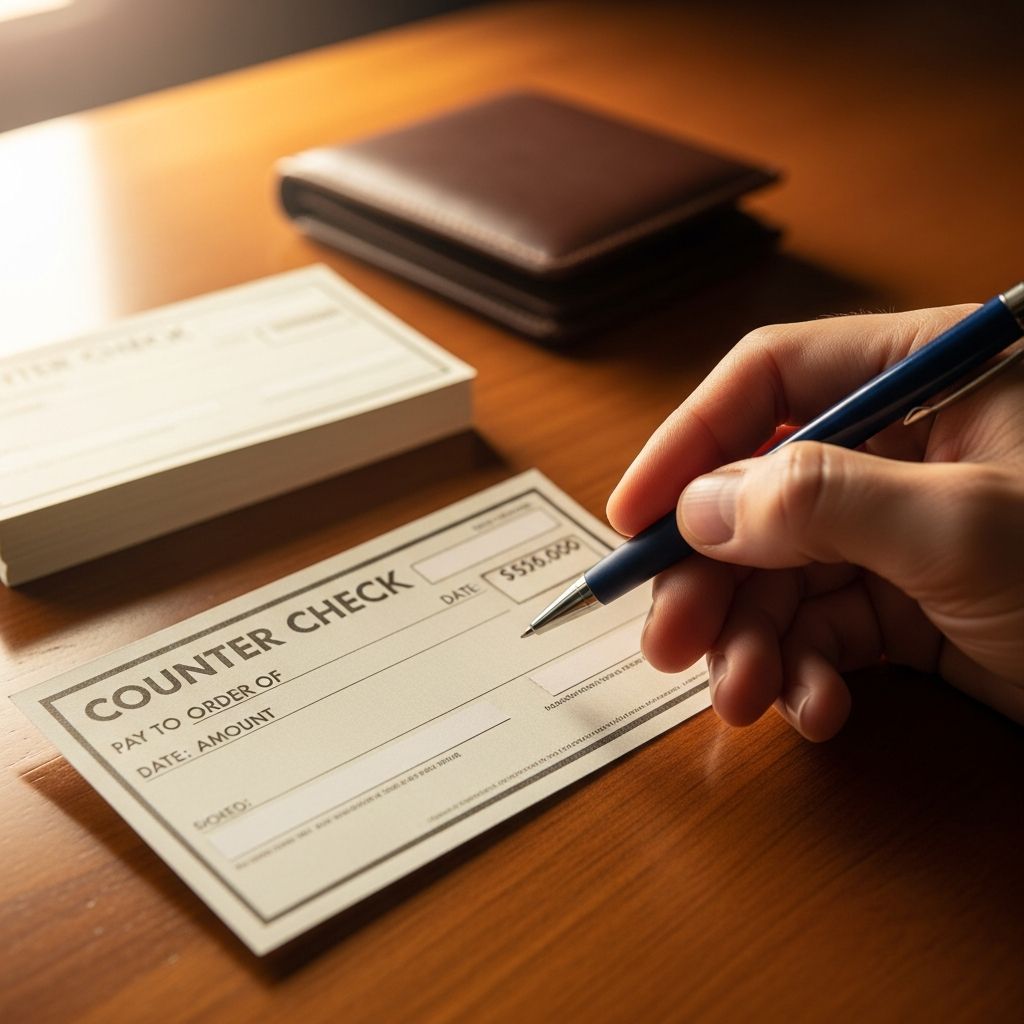
What Exactly Is a Counter Check?
A counter check is a temporary, plain check issued by a bank that functions similarly to a personal check but is printed on demand at a branch. Unlike the personalized checks you order for your checking account, counter checks are generic forms that include your account number and the bank’s routing number, allowing you to make payments when you don’t have your regular checks available.
These checks are often used in situations where someone needs to pay a bill or make a purchase by check but has either run out of their personal checks or hasn’t yet received their first checkbook after opening a new account. Because they are produced quickly at the bank counter, they are sometimes called “starter checks” or “temporary checks.”
How Counter Checks Are Created and Issued
When a customer requests a counter check, a bank teller or branch staff member prints it using the bank’s internal system. The check is filled with the necessary banking details: the bank’s name, address, routing number, and the customer’s account number. However, unlike a standard personal check, it usually lacks pre-printed personal information such as the customer’s full address or logo design.
To obtain a counter check, the account holder typically needs to:
- Visit a local branch of their bank
- Present valid government-issued photo ID
- Provide account information (often just the account number or by logging into online banking at the branch)
- Request a specific number of counter checks
Most banks charge a small fee per counter check, usually between $1 and $2, though some institutions may offer a limited number for free, especially for new account holders.
How to Fill Out and Use a Counter Check
Using a counter check is nearly identical to writing a personal check, but with a few extra steps because less information is pre-printed. Here’s how to complete one properly:
- Date: Write the current date in the designated field.
- Payee: Clearly write the name of the person or business receiving the payment.
- Amount in Numbers: Enter the payment amount in the box (e.g., 150.00).
- Amount in Words: Write the same amount in words on the line below (e.g., One hundred fifty and 00/100).
- Signature: Sign the check exactly as your name appears on the account.
- Personal Information: If not pre-printed, add your full name and address in the top-left corner.
- Optional: Some merchants may ask for your driver’s license number or phone number for verification, especially if they are unfamiliar with counter checks.
Once completed, the counter check can be handed to the payee like any other check. The funds will be drawn from your checking account when the recipient deposits or cashes it, just as with a personal check.
Key Differences Between Counter Checks and Other Types of Checks
It’s important to understand how counter checks differ from other common payment instruments, especially personal checks and cashier’s checks.
Counter Check vs. Personal Check
Both counter checks and personal checks are drawn against the account holder’s funds and are processed through the same banking system. However, there are several distinctions:
| Feature | Counter Check | Personal Check |
|---|---|---|
| Appearance | Plain, generic design | Custom design with personal details |
| Pre-printed Info | Account and routing numbers only | Name, address, bank details, sometimes logo |
| Availability | At bank branches only | Ordered by mail or online |
| Fees | Small per-check fee | Often free or low-cost for account holders |
| Acceptance | May be rejected by some merchants | Widely accepted |
Counter Check vs. Cashier’s Check
A cashier’s check is fundamentally different from a counter check. While both are issued by a bank, a cashier’s check is drawn on the bank’s own funds, not the customer’s account. Here’s how they compare:
| Feature | Counter Check | Cashier’s Check |
|---|---|---|
| Funds Source | Customer’s checking account | Bank’s funds |
| Guarantee | No guarantee; subject to insufficient funds | Guaranteed by the bank |
| Cost | Low per-check fee | Higher fee, often $10–$20 |
| Issuance | Customer writes the check | Bank issues and signs the check |
| Acceptance | Variable; some may refuse | Very high; often required for large payments |
When Should You Use a Counter Check?
Counter checks are best suited for specific, short-term situations where you need a check quickly but don’t have your personal checks on hand. Common scenarios include:
- New Account Holders: When you open a checking account, it may take several days or even weeks to receive your first checkbook. Counter checks allow you to pay bills or make purchases by check in the meantime.
- Running Out of Checks: If you’ve used up your personal checks and can’t wait for a reorder, counter checks provide a temporary solution.
- Emergency Payments: When a bill is due and you need to pay by check immediately, a counter check can prevent late fees or service interruptions.
- Merchants That Accept Checks: Some businesses, landlords, or service providers still prefer or require checks. A counter check can be used in these cases, provided the recipient is willing to accept it.
However, counter checks are not ideal for every situation. They are generally not recommended for large, high-stakes payments (like security deposits or down payments) where a cashier’s check or certified check is expected.
Advantages of Using Counter Checks
Despite their limitations, counter checks offer several practical benefits:
- Immediate Availability: You can get them the same day at a bank branch, avoiding delays associated with ordering and receiving personal checks.
- Convenience: They allow you to make check payments even when you’re out of personal checks or waiting for a new checkbook.
- Low Cost: Compared to cashier’s checks, counter checks are much cheaper, making them economical for small, routine payments.
- Same Processing: They are processed through the same banking channels as personal checks, so the recipient doesn’t need special handling.
- Temporary Solution: They bridge the gap between opening an account and receiving your first checks, or between reordering and receiving new checks.
Disadvantages and Risks of Counter Checks
While useful, counter checks come with several drawbacks that users should be aware of:
- Limited Acceptance: Some merchants, landlords, or individuals may be unfamiliar with counter checks and refuse them, fearing fraud or insufficient funds.
- Higher Scrutiny: Because they lack personalized details, recipients may ask for additional identification or verification, which can be inconvenient.
- Fees Add Up: If you need multiple checks, the per-check fee can become noticeable, especially if your bank charges on the higher end.
- No Check Numbers: Many counter checks are not pre-numbered, which can make tracking payments more difficult and increase the risk of duplicate payments.
- Security Concerns: If lost or stolen, a counter check can be misused, just like a personal check, though the risk is similar to that of any check drawn on your account.
Best Practices for Using Counter Checks
To use counter checks safely and effectively, follow these guidelines:
- Keep Them Secure: Treat counter checks like cash. Store them in a safe place and only carry as many as you need.
- Fill Them Out Carefully: Double-check the payee name, amount, and date to avoid errors that could lead to returned checks or disputes.
- Verify Acceptance First: If possible, confirm with the recipient (e.g., landlord, utility company, vendor) that they accept counter checks before writing one.
- Maintain Records: Keep a copy of the check or at least a detailed record of the payment (date, amount, payee, check number if any) for your own tracking.
- Monitor Your Account: After writing a counter check, watch your account balance and transaction history to ensure the check clears as expected and to catch any issues early.
- Order Personal Checks Promptly: Use counter checks only as a temporary measure. Order a full set of personal checks as soon as possible to avoid ongoing fees and acceptance issues.
Common Misconceptions About Counter Checks
Several myths and misunderstandings surround counter checks:
- Misconception: Counter checks are the same as cashier’s checks.
Reality: They are not. Cashier’s checks are guaranteed by the bank; counter checks are not and are subject to insufficient funds. - Misconception: Counter checks are not real checks.
Reality: They are legitimate checks drawn on your account and processed like personal checks, though they may look different. - Misconception: All banks offer counter checks.
Reality: Not all banks do, and policies vary. Some may limit the number of counter checks per customer or charge higher fees. - Misconception: Counter checks are always accepted.
Reality: Acceptance depends on the recipient’s policies, and some may refuse them outright.
Frequently Asked Questions (FAQs)
Is a counter check the same as a personal check?
No, but it functions similarly. A counter check is drawn from your account like a personal check, but it is a plain, generic form issued by the bank rather than a personalized checkbook. It may lack pre-printed personal details and is often not numbered.
Can I use a counter check to pay bills?
Yes, in many cases. However, some billers may be hesitant to accept counter checks. It’s wise to confirm with the recipient first, especially for recurring or large payments.
Are counter checks safe to use?
They are as safe as personal checks when used responsibly. Keep them secure, fill them out carefully, and monitor your account. Like any check, they can be misused if lost or stolen.
Do counter checks expire?
Like standard personal checks, counter checks are typically valid for six months from the date written. After that, banks may refuse to honor them, though some may still process them at their discretion.
Can I deposit a counter check?
Yes, if you receive a counter check as payment, you can deposit it into your account just like a personal check. The funds will clear through the same process, and the check will be drawn from the issuer’s account.
How many counter checks can I get?
There’s no universal limit, but banks often impose their own rules. Some may allow a small set (e.g., 5–10 checks) per visit or per month, especially for new accounts or to prevent abuse.
Are counter checks still common today?
They are less common than in the past due to the rise of electronic payments, but many banks still offer them as a convenience for customers who occasionally need a check. Their use is most frequent among new account holders and those who run out of personal checks.
References
- What Is a Counter Check? — SoFi. 2023-08-15. https://www.sofi.com/learn/content/what-is-a-counter-check/
- Countercheck — Merriam-Webster. 2023. https://www.merriam-webster.com/dictionary/countercheck
- Counter Check — Dictionary.com. 2023. https://www.dictionary.com/browse/counter-check

- Integrated M.A. in Applied Linguistics, University of Hyderabad
- 5+ years in editorial, instructional, SEO, and research-based writing
Sneha is a relationships and lifestyle writer with a strong foundation in applied linguistics and certified training in relationship coaching. She brings over five years of writing experience to theskillvault, crafting thoughtful, research-driven content that empowers readers to build healthier relationships, boost emotional well-being, and embrace holistic living. Her writing and insights reflect the belief that beauty, happiness, and wellness…