
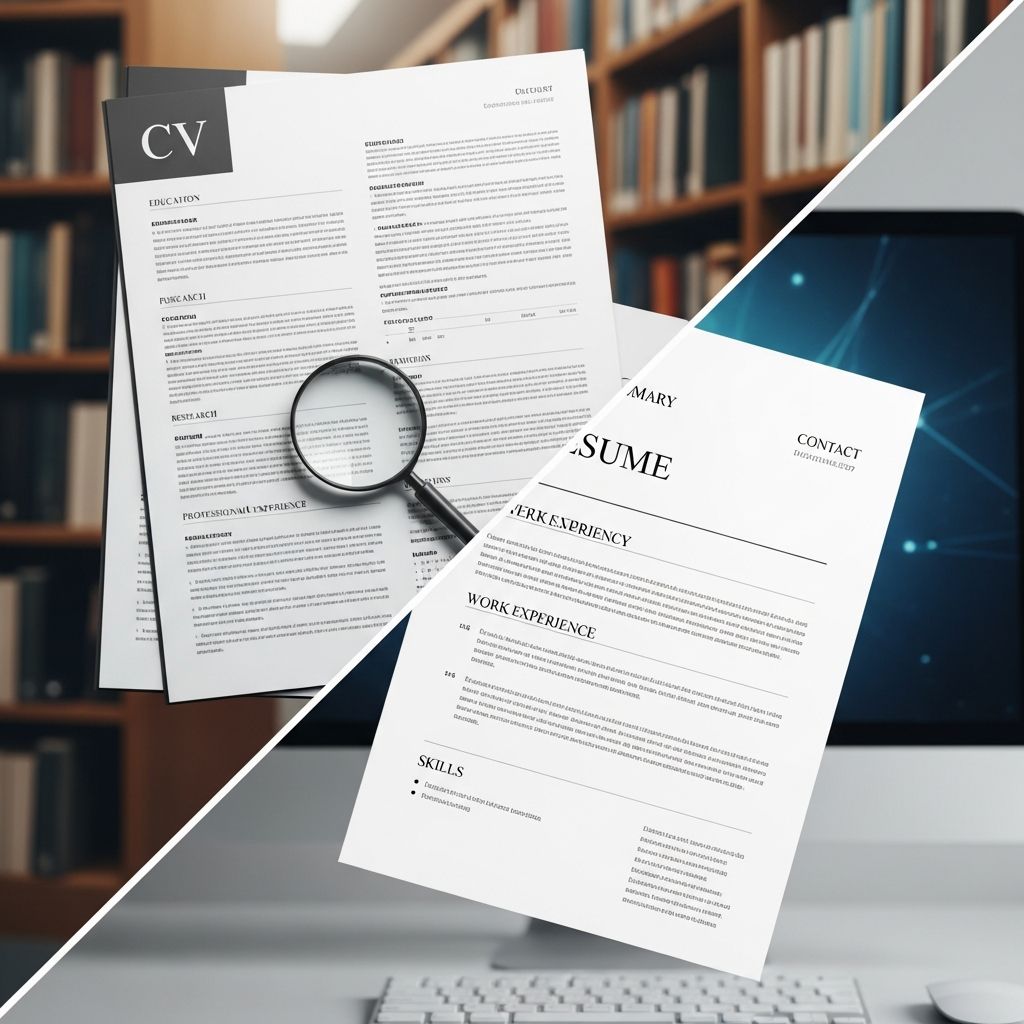
When you apply for a job, fellowship, or academic program, you will almost always be asked for either a CV (curriculum vitae) or a resume. Knowing which one to use, and how to build it, can determine whether your application moves forward or gets overlooked.
This guide explains the core differences between CVs and resumes, shows you when to use each one, and offers practical tips to structure and tailor them effectively.
CV and Resume: Clear Definitions
Both CVs and resumes are tools for presenting your qualifications, but they serve different purposes and audiences.
- Resume: A concise, targeted summary of your most relevant work experience, education, and skills for a specific job or role.
- Curriculum Vitae (CV): A comprehensive record of your academic, research, and professional history, often used in academic, research, medical, and some government contexts.
In many cases, a resume is about relevance, while a CV is about completeness.
Key Differences at a Glance
| Aspect | Resume | CV (Curriculum Vitae) |
|---|---|---|
| Primary use | Industry, business, non-profit, most public sector roles | Academic, research, medical, some government and fellowship roles |
| Typical length | 1–2 pages, focused on the target role | 2+ pages, no strict limit; grows with career |
| Focus | Most relevant skills, achievements, and responsibilities | Full academic and professional record: education, research, publications, etc. |
| Degree of detail | Selective, high-level bullet points | Detailed descriptions of roles, research, teaching, and outputs |
| Geographic norms | Standard in the U.S. for most jobs; often called “CV” in other regions | In the U.S., reserved for academic and similar contexts; standard document name in many other countries |
| Customization | Highly tailored for each application | Updated as you gain experience; less frequently customized |
Regional and Career-Path Differences
Which document you use depends heavily on where you are applying and for what kind of role.
By Region
- United States
- Resume is the default document for most roles in business, government, and non-profits.
- CV is typically requested for academic, research, and medical positions, as well as some fellowships and grants.
- United Kingdom, Europe, and many parts of Asia
- The term “CV” is often used for what U.S. employers call a resume—a 1–2 page job document.
- Academic CVs in these regions still follow the comprehensive format.
Always read the job posting carefully and, if in doubt, review application guidance on the employer’s official site.
By Career Type
- Industry / corporate roles (e.g., marketing, engineering, finance)
- Expect a resume that highlights impact, results, and relevant skills.
- Academic roles (faculty, postdoctoral positions, graduate school)
- Expect a CV listing education, publications, presentations, grants, and teaching.
- Research and medical positions
- Often require a CV because they evaluate research output, clinical training, and scholarly contributions.
- Government and international organizations
- May accept either format; some specify page limits that are closer to a resume.
When You Should Use a Resume
Use a resume when you need a tightly focused snapshot of your qualifications for a specific role.
Best Situations for a Resume
- Applying to most private-sector jobs (technology, consulting, sales, HR, etc.).
- Switching industries and emphasizing transferable skills instead of full history.
- Responding to postings that explicitly request a 1–2 page document.
- Submitting applications via online systems that truncate or disfavor lengthy documents.
Core Sections of a Strong Resume
While formats vary, most effective resumes contain these elements:
- Contact information (name, phone, professional email, location, optional LinkedIn).
- Professional summary or objective (2–4 lines tailored to the role).
- Work experience in reverse chronological order, focused on recent and relevant roles.
- Skills section highlighting technical and role-related capabilities.
- Education (degree, institution, graduation date or expected date).
- Optional: certifications, projects, leadership, or volunteer work when relevant.
Resume Writing Priorities
- Relevance first: Remove or condense experience unrelated to the target role.
- Impact-oriented bullets: Focus on achievements and measurable results where possible.
- ATS-friendly formatting: Use clear section headings and standard fonts to pass applicant tracking systems.
- One document per target: Adjust keywords and emphasis for each new posting.
When You Should Use a CV
Use a CV when selectors need a full picture of your academic and professional development, not just a short summary.
Best Situations for a CV
- Applying for faculty, lecturer, or researcher positions.
- Applying to PhD, postdoctoral, or research-intensive master’s programs.
- Seeking fellowships, grants, or academic honors that evaluate research contribution.
- Applying for medical residencies, clinical fellowships, or certain hospital roles.
Typical Sections of an Academic or Research CV
CVs often include the following, in addition to standard contact information:
- Education (degrees, institutions, thesis titles, advisors).
- Research experience (projects, labs, methodologies, outcomes).
- Teaching experience (courses taught, level, responsibilities).
- Publications (journal articles, book chapters, conference papers).
- Presentations and posters at conferences or symposia.
- Grants, scholarships, and fellowships awarded.
- Professional memberships in associations or societies.
- Awards and honors.
- Service and leadership (committee work, peer review, outreach activities).
Because academic evaluation emphasizes depth and continuity of contribution, these CV sections are often quite detailed.
Length and Level of Detail
The most visible difference between a CV and a resume is often length.
- Resume length: Commonly 1 page for early-career candidates and up to 2 pages for those with more experience.
- CV length: No strict limit; early-career CVs might be 2–3 pages, while experienced academics can easily exceed 10 pages.
Career centers and employers often stress brevity for resumes because recruiters have limited time to review each application. By contrast, academic selection committees expect detailed CVs, because they are specifically evaluating research productivity, teaching breadth, and scholarly impact over years or even decades.
How to Decide: CV or Resume?
If a posting is not explicit, use these guiding questions to decide:
- Is the role academic, research, or medical?
- If yes, a CV is often expected.
- Does the employer mention a page limit?
- 1–2 pages usually implies a resume format.
- Which country or system is this in?
- In the U.S., assume resume for non-academic roles.
- Outside the U.S., if they say “CV” but describe a short document, think of it as a resume in U.S. terms.
- What does the official careers or HR page say?
- Many universities and organizations provide explicit document guidance.
Common Mistakes to Avoid
- Sending a CV when a resume is expected: Long academic-style CVs can frustrate busy recruiters in non-academic roles.
- Under-sharing for academic roles: A 1-page summary is usually insufficient for faculty or research positions.
- Using the same document everywhere: You should update and adapt your resume or CV for new opportunities and audiences.
- Ignoring regional norms: Photos, personal data, or overly long documents may be inappropriate in some countries and standard in others; check local guidance.
- Overly generic content: Vague bullets like “responsible for various tasks” add little value; focus on actions and outcomes.
Practical Tips to Strengthen Both Documents
Even though resumes and CVs differ, strong applications share several qualities.
- Clarity: Use straightforward language, consistent formatting, and informative headings.
- Evidence: Show results with numbers, scope, or outcomes when possible (e.g., “Led a study of 150 participants” or “Improved processing time by 20%”).
- Relevance: Move the most important information for a given role closer to the top of the document.
- Accuracy: Dates, titles, and affiliations should be correct and consistent with official records.
- Professional tone: Avoid slang, overly casual phrasing, or unprofessional email addresses.
Sample High-Level Structures
The exact layout is up to you, but these skeletons can help you visualize the difference.
Example Resume Outline (1–2 pages)
- Contact Information
- Professional Summary
- Key Skills
- Professional Experience (reverse chronological)
- Education
- Certifications / Projects / Volunteer Experience (optional)
Example Academic CV Outline (Multi-page)
- Contact Information
- Education
- Research Interests (optional)
- Research Experience
- Teaching Experience
- Publications
- Conference Presentations
- Grants, Fellowships, and Awards
- Professional Memberships
- Academic Service and Outreach
- Skills (e.g., methods, languages, software)
Frequently Asked Questions (FAQs)
Q: Is a CV just a longer version of a resume?
A: Not exactly. A CV is more than a longer resume; it is structured to document your complete academic and professional history, including research, teaching, and scholarly outputs, while a resume selectively highlights only experience relevant to a specific job.
Q: Can I use my academic CV to apply for corporate jobs?
A: For most corporate roles, an academic-style CV is too detailed and not targeted enough. Career guidance from universities and employers recommends a focused 1–2 page resume for non-academic paths, even if you maintain a longer CV for academic purposes.
Q: Should students and recent graduates have a CV or a resume?
A: It depends on their goals. Students aiming for academic programs or research roles often benefit from a basic CV that includes projects, lab work, and presentations, while those pursuing internships or entry-level industry roles should prioritize a concise, targeted resume.
Q: How often should I update my CV or resume?
A: Update your resume whenever you pursue a new opportunity so it reflects the skills and achievements most relevant to that role. Update your CV regularly—at least a few times a year—to record new courses, publications, presentations, or responsibilities before details are forgotten.
Q: Do applicant tracking systems (ATS) treat CVs and resumes differently?
A: ATS tools primarily parse structure and keywords, regardless of document label. For online applications, use clear headings, avoid complex layouts, and incorporate language from the job description so both CVs and resumes are machine-readable and aligned with selection criteria.
References
- CV vs. Resume: Key Differences, Examples & Expert Tips — MyPerfectResume Career Center. 2024-01-05. https://www.myperfectresume.com/career-center/resumes/basics/cv-vs-resume
- Resume vs. CV (Curriculum Vitae): Key Differences — Indeed Career Guide. 2023-08-21. https://www.indeed.com/career-advice/resumes-cover-letters/difference-between-resume-and-cv
- Difference Between Curriculum Vitae and Resume — Southern New Hampshire University (SNHU). 2023-11-16. https://www.snhu.edu/about-us/newsroom/career/difference-between-curriculum-vitae-and-resume
- The Difference Between a Resume and a Curriculum Vitae (CV) — PennWest University Career Center. 2022-08-10. https://career.pennwest.edu/blog/2022/08/10/the-difference-between-a-resume-and-a-curriculum-vitae-cv/
- What’s the difference between a resume and a CV? — Oak Ridge Institute for Science and Education (ORISE). 2021-09-30. https://orise.orau.gov/internships-fellowships/blog/resume-vs-cv.html

Medha Deb is an editor with a master's degree in Applied Linguistics from the University of Hyderabad. She believes that her qualification has helped her develop a deep understanding of language and its application in various contexts. Medha specializes in the areas of beauty, health, sports, and wellness and is committed to ensuring that the content on the website is…