
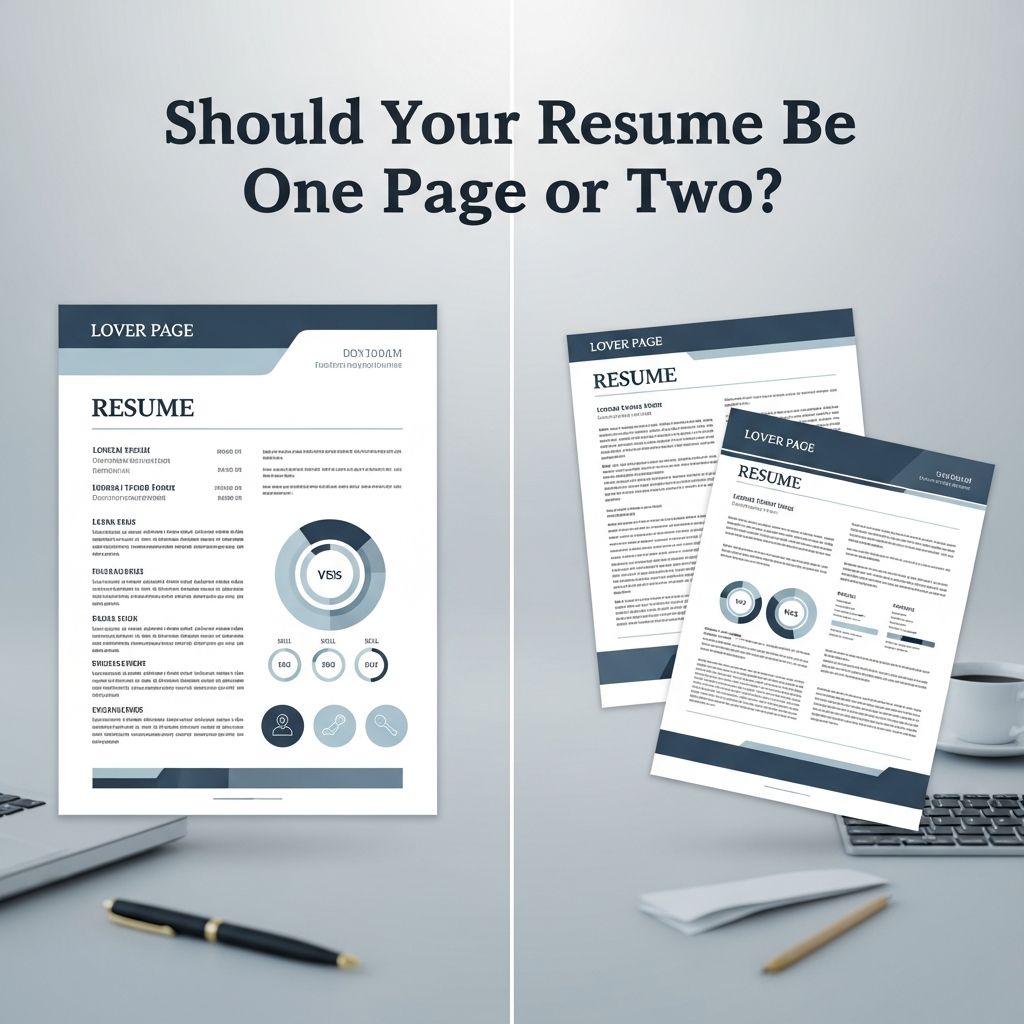
Resume length used to feel like a strict rule: keep it to exactly one page or risk being ignored. Today, hiring practices and applicant tracking systems (ATS) have changed that norm. For many professionals, a two-page resume can be not only acceptable but strategically smart—provided every line earns its place.
This guide explains how to decide between one and two pages, who benefits from a longer resume, and how to structure a two-page version so busy recruiters can quickly see why you are a strong match for the role.
Why Resume Length Matters Less Than Relevance
Recruiters skim resumes quickly, but they also need enough detail to evaluate your impact. The tension between brevity and substance is what makes resume length such a debated topic.
- Historically, many career centers recommended a strict one-page limit, especially for early-career candidates.
- Current research suggests that well-structured two-page resumes are often preferred when they showcase relevant experience and results clearly.
- Modern hiring tools, including ATS software, can parse multiple pages without difficulty, as long as the content uses clear headings and targeted keywords.
The real question is not “Is two pages allowed?” but “Does adding a second page make your application easier—not harder—to evaluate?”
Key Factors for Deciding One Page vs Two
Instead of starting with a page target, start with your experience and the job description. Then use these core factors to decide on length.
| Factor | Leans Toward One Page | Leans Toward Two Pages |
|---|---|---|
| Years of experience | Under ~5–7 years of experience | 10+ years or multiple career stages |
| Role level | Internship, entry-level, early professional | Manager, senior, director, executive |
| Complexity of work | Limited scope, few major projects | Large projects, leadership, cross-functional work |
| Relevance of history | Most value shown in last few roles | Long track record directly tied to target role |
| Job posting instructions | Explicit “1-page resume only” | Neutral, or asks for detailed work history |
When a One-Page Resume Is Usually Best
A concise, tightly edited one-page resume can be extremely effective when it captures your most relevant achievements at a glance. Many university career services and professional associations still recommend a single page for candidates early in their career.
Consider a one-page resume if you:
- Have fewer than 5–7 years of full-time experience in your field.
- Are applying to internships, entry-level, or junior roles.
- Have a straightforward career path without extensive side projects.
- Can clearly show your impact with selective, high-value bullet points.
- Find that a second page would be mostly repetition or minor detail.
In these situations, a single page forces you to prioritize the achievements and skills that matter most to the employer. Overcrowding that page, however, can make it harder to read than a clean two-page document.
When a Two-Page Resume Can Strengthen Your Application
For mid-career and senior professionals, a two-page resume often provides the right amount of space to show both depth and focus.
A two-page resume can be advantageous when you:
- Have 10 or more years of relevant experience across several roles.
- Led complex projects, teams, or budgets that merit explanation.
- Need room for specialized sections such as publications, patents, or speaking engagements.
- Work in research-intensive, academic, or technical fields where context and detail matter.
- Are targeting leadership roles where your long-term results and progression tell a strong story.
Studies of recruiter behavior indicate that, when the content is relevant and well-organized, hiring professionals are willing to spend more time reviewing a two-page resume than a packed one-page document.
Questions to Test Whether Page Two Is Justified
Before committing to a longer resume, challenge every item that would appear on the second page.
- Does this detail directly support the job I am targeting?
If a bullet, project, or older role does not connect to the required skills or outcomes, consider trimming or removing it. - Would a recruiter miss something important if I cut this?
Keep content that clarifies scope (budgets, team size), shows measurable results, or reveals specialized tools and methods. - Can I express the same idea in fewer words?
Many resumes expand to two pages simply because bullet points are wordy. Edit for clarity and precision first. - Is any content repeated elsewhere?
Avoid duplicating the same responsibility or achievement across multiple roles.
If you cannot clearly explain why an item earns space, it probably belongs in a condensed bullet, a combined role, or not at all.
Structuring a Two-Page Resume That Recruiters Will Read
Once you decide that two pages are warranted, the structure becomes critical. Page count will not help you if the document is hard to scan.
1. Make Page One a Powerful Snapshot
Think of the first page as a stand-alone marketing document. If a recruiter only read page one, they should already see your core qualifications.
- Contact information and headline at the top.
- Concise professional summary tailored to the target role.
- Key skills or areas of expertise that match the job description and common screening criteria.
- Your most recent and relevant roles with quantified achievements.
Earlier or less central positions can move to the second page once page one clearly communicates who you are as a candidate.
2. Use Page Two for Supporting Detail
The second page should extend your story, not distract from it.
- Include earlier jobs that show career progression and stability.
- Add major projects, certifications, or training that demonstrate specific expertise.
- List relevant volunteer work or board roles that build your leadership profile.
- Place education, licenses, and selected accomplishments where they logically support your career target.
Avoid starting the second page with minor or tangential content. Lead with sections that still matter for the role you want.
3. Prioritize Readability Over Word Count
Recruiters frequently scan for titles, employers, dates, and key metrics. Good formatting helps them do this quickly.
- Use clear headings (e.g., Experience, Education, Skills, Projects).
- Rely on short bullet points instead of dense paragraphs.
- Maintain consistent fonts, spacing, and alignment across both pages.
- Leave white space so the document feels skimmable, not crowded.
Recruiter surveys regularly highlight clarity and organization as more important than strict page limits.
Content to Cut Before Adding a Second Page
If your resume spills onto a second page by only a few lines, your first step should be editing, not expanding. Many candidates can return to one page—or create a stronger two-page version—by trimming low-value content.
- Irrelevant early roles that do not connect to your current field.
- Task-based bullets that simply restate your job description.
- Soft skills lists without evidence (e.g., “hard worker, team player”).
- Outdated technologies or methods no longer used in your industry.
- Personal details such as full address, unrelated hobbies, or references.
Focus your resume on measurable outcomes: increased revenue, reduced costs, improved efficiency, higher satisfaction scores, or research and publications in respected venues.
Adapting Resume Length for ATS and Online Applications
Many employers use ATS software to scan and rank applications. Modern systems can handle multiple pages, but they are sensitive to content structure.
- Use standard headings such as “Experience,” “Education,” and “Skills” so ATS can categorize your information.
- Incorporate keywords from the job description naturally into your bullet points, not just in a skills list.
- Avoid graphics-heavy layouts that may not parse correctly.
- Submit in the requested format (often PDF or DOCX), following any page-limit instructions exactly.
Because many ATS systems rank candidates partially based on matching skills and experience, using a second page to capture genuinely relevant history can improve your chances—so long as that content uses the right terminology.
Special Cases: When Two Pages Are Expected
Some fields and situations almost require more than one page due to the nature of the work.
- Academic and research roles often rely on a curriculum vitae (CV) that lists publications, grants, and teaching, which routinely exceeds two pages.
- Executive positions may demand a detailed record of strategic decisions, P&L responsibility, and board relationships.
- Consulting and project-based work can benefit from short case-style bullets that highlight outcomes across multiple clients or engagements.
Even in these scenarios, relevance and clarity remain essential. A long document that lacks structure will not compensate for weak content.
Practical Checklist: Is Your Two-Page Resume Working for You?
Use this quick checklist before sending out a two-page resume:
- Page one clearly communicates who you are, what you do, and why you fit the target role.
- Every major requirement from the job posting appears somewhere in the first page or top of page two.
- No bullet points run across the page break; each story is kept intact.
- Older roles are summarized with fewer bullets, focusing on standout results only.
- The second page would feel incomplete if removed, because it contains unique, relevant information—not filler.
Frequently Asked Questions About Two-Page Resumes
Does a two-page resume annoy recruiters who are short on time?
Not if it is organized and targeted. Industry research shows that recruiters are willing to spend more time on two-page resumes when the extra space clearly highlights relevant accomplishments, instead of padding or repetition.
Should early-career candidates ever use two pages?
Most students and professionals with under five years of experience are better served by a one-page resume. An exception might be someone with extensive research, military, or project work directly related to the target role, but even then the bar for relevance should be high.
Is it a problem if my resume is 1.3 or 1.5 pages?
A document that barely spills onto page two usually needs editing, not expansion. Try tightening bullets, consolidating older roles, and removing less relevant material to return to a strong single page. If, after trimming, you still have more high-value content, then build out a full second page.
How far back in my work history should I go on a two-page resume?
Many career experts recommend focusing primarily on the last 10–15 years, unless earlier roles are highly relevant to your current target. Older positions can be summarized in a brief section if they add important context.
Will ATS software reject my application if my resume is longer than one page?
Most modern ATS tools can process multi-page resumes, as long as the document uses clear text, standard headings, and job-related keywords. Following the employer’s instructions for file type and page limits is more important than strictly keeping to one page.
References
- Resume Length in 2025: One Page or Two? — Flavored Resume Blog. 2025-01-10. https://flavoredresume.com/blog/resume-length-2025-one-page-two
- A Two-Page Resume Is Great. Here’s How to Do It Right in 2025 — Teal. 2025-02-14. https://www.tealhq.com/post/two-page-resumes
- Can a Resume Be 2 Pages? Tips for 2025 — Zety. 2025-03-05. https://zety.com/blog/two-page-resume
- Is a Two Page Resume…Too Long? — Jobscan. 2025-04-22. https://www.jobscan.co/blog/3-things-to-know-about-two-page-resume-format/
- When to Use a Two-Page Resume (Tips + Templates for 2025) — LiveCareer. 2025-01-30. https://www.livecareer.com/resources/two-page-resume
- When to Use a Two-Page Resume in 2025 — ResumeGenius. 2025-02-03. https://resumegenius.com/blog/resume-help/can-a-resume-be-2-pages
- When to Use One Page Resume and Two Page Resume — Mployee.me Blog. 2025-01-18. https://www.mployee.me/blog/when-to-use-one-page-resume-and-two-page-resume

Medha Deb is an editor with a master's degree in Applied Linguistics from the University of Hyderabad. She believes that her qualification has helped her develop a deep understanding of language and its application in various contexts. Medha specializes in the areas of beauty, health, sports, and wellness and is committed to ensuring that the content on the website is…