
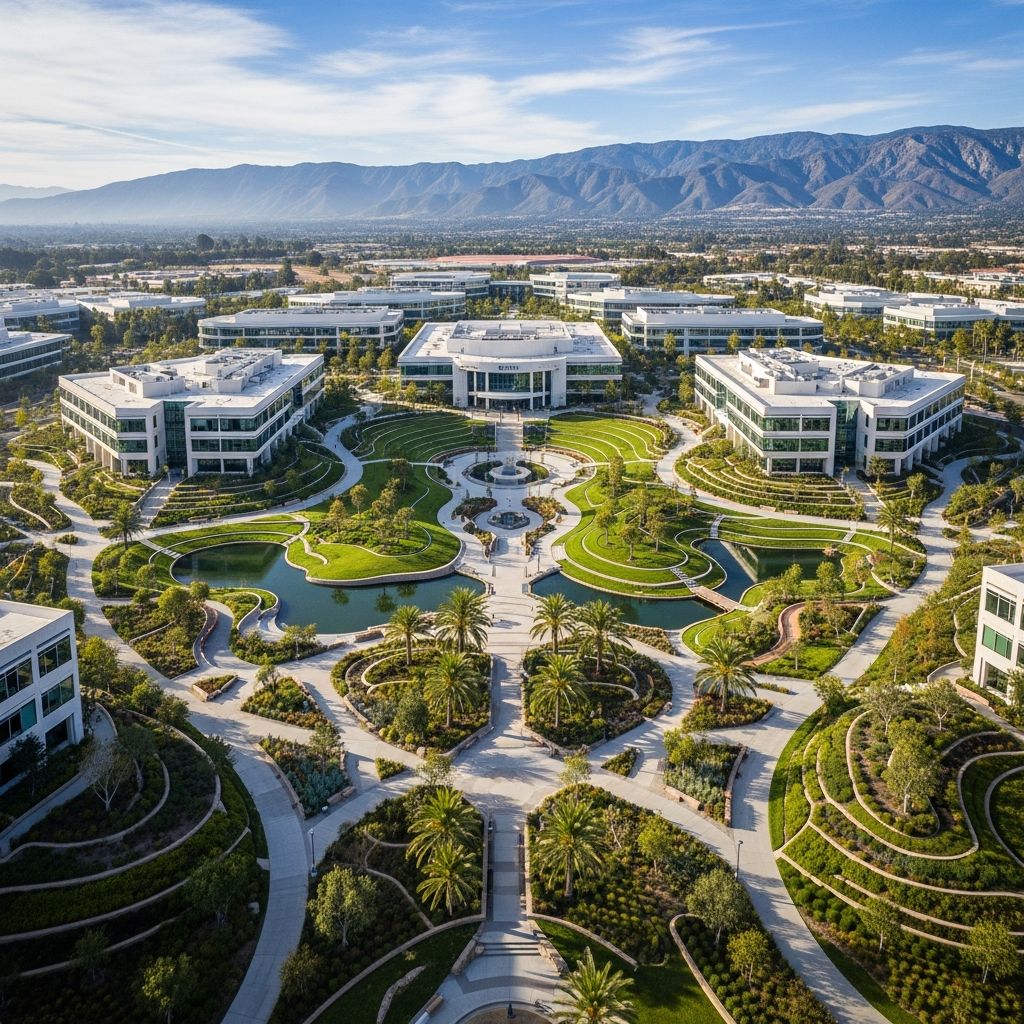
In Redlands, California, a few miles east of Los Angeles, Esri’s headquarters stretches across a college-style campus where geographic information system (GIS) technology and a strong sense of place come together. The site reflects the company’s roots in Redlands, its commitment to mapping the world, and its belief that a physical environment can encourage collaboration and long-term thinking.
The Story Behind Esri’s Redlands Home
Esri was founded in 1969 in Redlands by Jack and Laura Dangermond, who started the company as a land-use consulting firm focused on using spatial analysis for environmental planning. Over time, Esri shifted from services to software, becoming best known for its ArcGIS platform and related tools. Despite its global expansion, the company kept its headquarters in Redlands, gradually adding buildings and amenities rather than relocating to a larger metropolitan area.
Today, the Redlands headquarters serves as the operational and cultural center of a company with offices and R&D centers around the world. The campus remains privately held and deeply associated with its founders’ values, including environmental stewardship and long-term reinvestment in research and development.
Campus Overview: A Tech Company in a Park-Like Setting
Esri’s Redlands campus is often compared to a small college: multiple low-rise buildings, tree-lined walkways, and open green spaces spread across a sizable property. This is not a single office tower but a cluster of specialized buildings linked by outdoor paths, courtyards, and shared spaces.
- Location: Redlands, California, approximately 60 miles east of Los Angeles.
- Headquarters address: 380 New York Street, Redlands, CA 92373, USA.
- Scale: A multi-building corporate campus similar in size to a small university setting.
- Company type: Private GIS software firm best known for ArcGIS.
The campus has grown over decades through new construction, renovations, and retrofits aimed at improving both comfort and energy performance. Many buildings are dedicated to specific functions—engineering, support, executive operations, training, and events—yet are close enough that staff can move easily between them on foot.
Design Priorities: Human-Centered and Environmentally Aware
Esri’s work focuses on understanding the relationship between people and place, and that perspective is evident in the way its headquarters is planned. The campus attempts to balance productivity, sustainability, and a connection to landscape.
People-Friendly Campus Layout
The low- and mid-rise office buildings are arranged to encourage walking rather than driving between tasks, similar to a university or research institute environment. This form factor has several advantages:
- Easy informal encounters: Paths, courtyards, and shared entryways make unplanned conversations more likely.
- Reduced vertical barriers: Fewer high-rise elevators and more stairs and walkways encourage movement and visibility.
- Clear navigation: Distinct building identities (e.g., lettered or named structures) help staff and visitors orient themselves.
Sustainability and Building Performance
Over the years, Esri has invested in retrofitting older buildings and constructing new ones with an eye toward efficiency and long-term value. Design partners have implemented HVAC upgrades, lighting improvements, and the addition of rooftop solar photovoltaic systems across multiple buildings.
This reflects a broader pattern: Esri’s founders have longstanding ties to landscape architecture and environmental planning, and the company has consistently supported conservation initiatives worldwide. Aligning the campus infrastructure with energy efficiency is a natural extension of that philosophy.
| Design Focus | How It Shows Up on Campus |
|---|---|
| Energy efficiency | HVAC retrofits, efficient central plants, and lighting upgrades reduce energy use while improving comfort. |
| Renewable energy | Solar photovoltaic arrays installed on multiple building roofs supplement grid electricity. |
| Longevity | Ongoing modernization of existing facilities extends building lifespans instead of frequent tear-down and rebuild cycles. |
| Walkability | Network of paths and campus-style planning encourages walking between departments. |
Daily Life and Work Culture at the Redlands HQ
Although Esri now operates dozens of offices worldwide, the Redlands campus is where many core product teams, executives, and long-tenured staff work. The physical setting supports a culture that emphasizes long-term relationships, deep technical expertise, and sustained product development rather than short-term exits.
A Workspace Geared Toward Long-Term Projects
Esri reinvests a substantial portion of its revenue into research and development, supporting multi-year product roadmaps and foundational technology investments. That R&D-heavy mindset shapes the work environment in several ways:
- Teams often work on complex, multi-release initiatives rather than short-lived experiments.
- Domain experts in fields like urban planning, conservation, public safety, and utilities frequently collaborate onsite with software engineers.
- Stable ownership structure allows the company to prioritize mission and product over rapid financial swings.
Cross-Functional Collaboration
The campus design and departmental layout make it easy for staff to interact across functions. Product managers, developers, cartographers, designers, and technical support specialists often share buildings or adjacent spaces. Conference rooms and informal gathering areas are used for:
- Product demos and usability reviews
- GIS training sessions for staff and customers
- Planning meetings for major events such as the annual Esri User Conference, which now takes place in San Diego but began on the Redlands campus in the early years.
Connection to the Local Community
Esri is one of the largest employers in Redlands and has helped shape the city’s identity as a hub for geographic technology. The headquarters is integrated into the local fabric in several ways:
- Employment: Esri provides thousands of jobs worldwide, with a significant concentration at the Redlands campus.
- Local services: Visitors and staff rely on nearby hotels, restaurants, and transportation, which benefit from the steady flow of conference attendees, trainees, and partner meetings.
- Education and outreach: Esri partners with universities and schools globally, and its presence in Redlands contributes to internships, student visits, and local educational activities in GIS.
The company’s close relationship with the city is also reflected in its decision to remain headquartered there for more than 50 years, rather than relocating to a larger metropolitan tech corridor.
Global Reach from a Single Headquarters
Despite its strong local roots, Esri’s Redlands campus is the nerve center of a broad international network. The company has regional offices and distributors across the Americas, Europe, Asia-Pacific, and the Middle East and Africa.
From Redlands, teams coordinate and support:
- Regional and national deployments of ArcGIS software for governments and large enterprises.
- Collaboration with organizations such as the United Nations on data platforms for tracking Sustainable Development Goals.
- Disaster response initiatives, where Esri provides GIS tools and assistance for events ranging from earthquakes to public health crises.
This international orientation is reflected on campus in the diversity of visitors—government delegations, nonprofit leaders, researchers, and enterprise customers frequently travel to Redlands for training, product workshops, and strategic planning.
A Look at the Facilities: More Than Just Office Space
While detailed building-by-building schematics are internal, public information and partner descriptions shed light on the types of facilities that exist across the headquarters campus.
- Executive and leadership spaces: Dedicated buildings for executive leadership and strategic teams, including modern office layouts and meeting rooms.
- Engineering and R&D buildings: Spaces where developers, testers, and product leads work on ArcGIS and related technologies.
- Training and conference areas: Classrooms and auditoriums for customer training, partner meetings, and internal events.
- Cafés and shared amenities: On-campus food options and social spaces that support informal interaction.
- Outdoor areas: Landscaped gardens and shaded seating that give staff alternate places to meet, think, or relax between sessions.
Why the Redlands Campus Matters to Esri’s Identity
Esri’s headquarters is more than a set of office buildings; it is a physical expression of the company’s approach to geography, community, and long-term responsibility. Several themes stand out:
- Geography at the core: A GIS company headquartered in a walkable, landscape-focused campus reinforces the idea that place matters.
- Continuity over hype: Decades in the same city, steady private ownership, and ongoing reinvestment in campus infrastructure all align with a long-term view.
- Global work from a local base: The Redlands campus serves local employees and global partners simultaneously, bridging small-city roots with worldwide reach.
Frequently Asked Questions About Esri’s Redlands Headquarters
Q: Where is Esri’s headquarters located?
A: Esri’s global headquarters is located at 380 New York Street, Redlands, California, 92373, USA.
Q: Why did Esri choose Redlands as its headquarters?
A: Esri’s founders, Jack and Laura Dangermond, were both connected to the Redlands area and started the company there in 1969. The company has remained in Redlands as it expanded, emphasizing long-term community ties and continuity.
Q: What is special about the Esri campus design?
A: The headquarters is laid out like a small college campus, with multiple low-rise buildings, landscaped walkways, and shared outdoor spaces, supporting walkability, collaboration, and connection to the environment.
Q: Does the Redlands campus reflect Esri’s focus on sustainability?
A: Yes. Esri has invested in energy-efficient systems, including HVAC retrofits, central plants, and rooftop solar arrays, and it continues to modernize facilities with sustainability in mind.
Q: Is the Redlands headquarters open to visitors?
A: Esri hosts customers, partners, and trainees at the headquarters, often directing them to a visitor map that highlights nearby hotels, restaurants, and services in Redlands. Access to specific buildings or labs typically requires authorization, as it is an active corporate campus.
References
- Esri in Redlands, CA — The Muse. 2024-01-10. https://www.themuse.com/profiles/esri/location/redlands-hq
- Esri Headquarters – Overview — Esri/ArcGIS Online. 2020-03-01. https://www.arcgis.com/home/item.html?id=c7665d3c8e6f48a79f07b79677996bed
- Esri Locations | Headquarters & Global Offices — Esri. 2024-05-15. https://www.esri.com/en-us/about/about-esri/locations
- Esri — Wikipedia / cited corporate and historical sources. 2024-08-01. https://en.wikipedia.org/wiki/Esri
- ESRI Corporate Campus — Design West Engineering. 2021-06-30. https://designwesteng.com/work/esri-corporate-campus/
- Map of Esri Headquarters & Surrounding Area — Esri. 2023-02-10. https://www.esri.com/en-us/contact/visitor-map

Medha Deb is an editor with a master's degree in Applied Linguistics from the University of Hyderabad. She believes that her qualification has helped her develop a deep understanding of language and its application in various contexts. Medha specializes in the areas of beauty, health, sports, and wellness and is committed to ensuring that the content on the website is…