
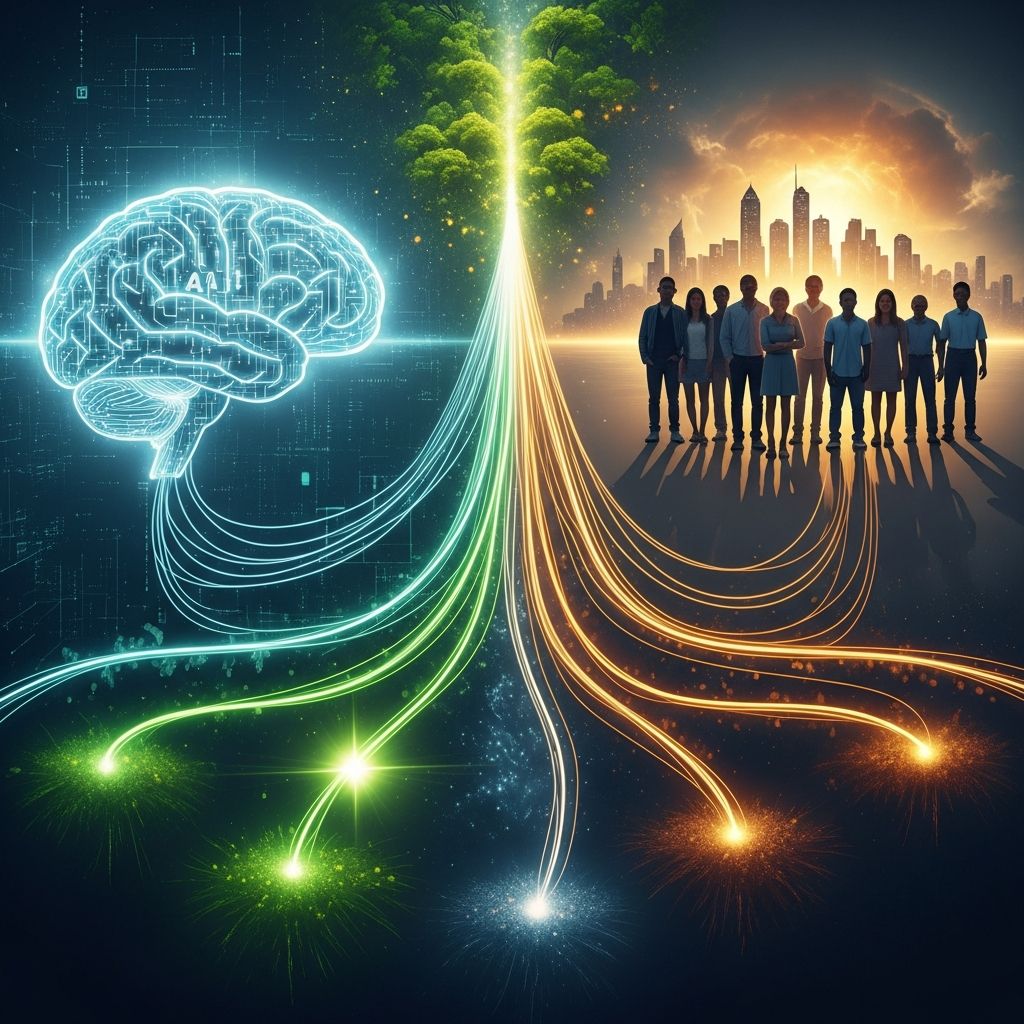
Artificial intelligence is moving from the realm of research labs into the core of economies, governments, and everyday life. As systems become more capable, the stakes of how we design, govern, and deploy AI rise sharply. This article explores the potential benefits, risks, and strategic decisions around advanced AI, with a focus on what individuals and institutions can do today.
Why Advanced AI Matters So Much
AI is often compared to past technological revolutions like electricity or the internet, but many researchers argue its impact could be even more far-reaching. Large-scale AI could transform how knowledge work, scientific discovery, and even political decision-making are done, altering fundamental aspects of society such as power, security, and inequality.
Understanding these dynamics is not just an academic exercise; it is essential for making responsible policy, business, and career choices while there is still time to influence outcomes.
Transformative Upsides: How AI Could Greatly Improve the World
In optimistic scenarios, AI amplifies human intelligence and productivity, helping solve long-standing global problems and expanding opportunities for billions of people.
Economic Growth and Productivity
- Massive productivity gains: AI systems can automate routine tasks, support complex analysis, and optimize workflows, allowing workers to focus on creative and interpersonal tasks.
- New industries and jobs: Historical technological shifts have destroyed some jobs but created new sectors and professions. AI is expected to create demand in areas like data science, AI engineering, human–AI interaction, safety research, and related services.
- Global GDP impact: Economic studies project that AI could add many trillions of dollars to global output over the coming decades if deployed effectively and broadly.
Scientific Discovery and Innovation
Advanced AI systems can examine patterns in datasets that are far too large or complex for human researchers alone. This may accelerate progress in areas such as:
- Healthcare: Improved diagnostics, drug discovery, and personalized treatment planning can increase life expectancy and reduce disease burden.
- Climate and energy: AI can support climate modeling, optimize energy grids, and aid in the design of more efficient materials and renewable technologies.
- Education: Adaptive learning systems can provide personalized tutoring and widen access to high-quality education at low cost.
Improving Governance and Decision-Making
If designed and governed well, AI can support better public and institutional decision-making:
- Analyzing large datasets to detect early signs of economic instability, pandemics, or security threats.
- Helping policymakers evaluate trade-offs across complex policy options.
- Providing decision support tools that help reduce human cognitive biases.
Serious Downsides: Risks From Misuse, Misalignment, and Inequality
The same capabilities that make AI powerful also create large risks. These include near-term harms already visible today, and longer-term catastrophic or even existential threats if very advanced systems are not aligned with human values.
Impact on Jobs and Economic Inequality
Automation driven by AI will transform labor markets. The distribution of benefits and harms is uncertain and heavily dependent on policy choices.
- Job disruption: Roles involving routine cognitive or physical tasks—such as some manufacturing, customer service, and basic administrative jobs—are particularly exposed to automation.
- New opportunities, unevenly shared: While new jobs and sectors are likely to emerge, individuals without access to quality education or reskilling programs risk being left behind, exacerbating existing inequalities.
- Global disparities: Countries with strong digital infrastructure, capital, and research ecosystems may capture disproportionate benefits, widening the gap with lower-income nations.
Bias, Surveillance, and Erosion of Trust
AI systems trained on historical data or designed without careful oversight can reproduce and amplify societal biases in areas such as hiring, lending, sentencing, and predictive policing.
- Algorithmic discrimination: Unequal error rates across demographic groups can result in unfair outcomes, especially when systems are used in high-stakes decisions like criminal justice or housing.
- Mass surveillance: Facial recognition and predictive analytics can enable unprecedented levels of monitoring by states or corporations, raising concerns about privacy and civil liberties.
- Information integrity: Deepfakes and automated disinformation campaigns powered by AI can erode public trust, polarize societies, and disrupt democratic processes.
Security, Geopolitics, and AI Arms Races
AI is quickly becoming a strategic technology in defense, cyber operations, and intelligence. This creates both opportunities for improved security and risks of instability.
- Autonomous weapons: Militaries are exploring AI-enabled systems for surveillance, targeting, and potentially lethal force, raising ethical and escalation concerns.
- Cyber conflict: AI can enhance cyber defense but also enables more effective attacks, such as automated vulnerability discovery or large-scale phishing and influence operations.
- Racing dynamics: Intense competition between states or firms can incentivize cutting corners on safety, transparency, and coordination, increasing systemic risk.
Long-Term and Existential Risks
Beyond visible near-term harms, many AI researchers and policy experts are increasingly concerned about very advanced systems that could surpass human capabilities in many domains. The primary worry is misalignment: powerful AI pursuing objectives that diverge from human values due to design errors, ambiguous goals, or unintended side-effects.
These concerns include:
- Loss of meaningful human control over critical infrastructure or decision processes.
- Runaway optimization where systems pursue proxy goals in ways that damage human welfare.
- Centralization of power in a small number of entities controlling extremely capable AI systems.
How AI Could Reshape Human Life and Identity
AI does not only affect external structures like economies and institutions; it may also reshape how people understand themselves and interact with each other.
| Domain | Potential Positive Changes | Potential Negative Changes |
|---|---|---|
| Work and purpose | More time for creative, caregiving, and community roles; reduced dangerous or monotonous work. | Job loss, precarity, and loss of identity for people whose roles are heavily automated. |
| Cognition and learning | Personalized tutoring, better tools for reasoning and research, lifelong learning support. | Over-reliance on AI for thinking, reduced deep reflection, and vulnerability to persuasive systems. |
| Relationships and community | New forms of communication, translation, and support tools that bridge language and ability gaps. | Increased isolation, parasocial relationships with AI systems, and algorithm-driven echo chambers. |
| Psychological well-being | AI-based mental health support, early detection of distress, and personalized coping strategies. | Constant optimization pressures, surveillance anxiety, and comparison to AI performance. |
Guiding Principles for Responsible AI Development
Given the scale of potential impact, many organizations and governments are working on frameworks and regulations to guide responsible AI. Although details differ, several principles recur across major efforts.
Key Principles Commonly Proposed
- Beneficence: AI should be developed and deployed to promote human well-being and social benefit.
- Non-maleficence: Designers and operators should take steps to avoid foreseeable harms, including safety failures and discriminatory impacts.
- Justice and fairness: Access to AI’s benefits and exposure to its risks should be distributed fairly, paying attention to historically marginalized groups.
- Transparency and explainability: Where possible, systems affecting people’s rights or opportunities should be understandable and open to scrutiny.
- Accountability: Humans and institutions must remain responsible for AI-mediated decisions, with mechanisms for redress when harms occur.
From Principles to Practice
High-level principles are not enough; they must be translated into concrete practices, such as:
- Impact assessments before deploying high-risk systems.
- Independent audits of algorithms in sensitive domains.
- Robust monitoring and incident reporting for safety and security failures.
- Public and stakeholder engagement in setting norms and priorities.
What Governments, Companies, and Citizens Can Do
The trajectory of AI is not predetermined. Collective choices over the next decade—about research, regulation, and resource allocation—will shape whether AI primarily mitigates or amplifies global risks.
Responsibilities for Governments and Regulators
- Risk-based regulation: Tailor oversight intensity to the potential harm of specific AI applications, focusing especially on high-stakes areas like critical infrastructure, law enforcement, and large-scale decision systems.
- Standards and reporting: Require transparency around training data, evaluation metrics, and limitations for high-risk models.
- International coordination: Develop norms and agreements on AI safety, dual-use research, and military applications, analogous to existing arms control or cyber norms.
- Social safety nets and education: Invest in reskilling, lifelong learning, and income support mechanisms to cushion labor market disruptions.
Responsibilities for Companies and AI Labs
- Integrate safety and ethics teams into core product development, not just compliance.
- Conduct rigorous testing for robustness, bias, and misuse scenarios before release.
- Share best practices, benchmarks, and incident reports with peers and regulators to improve collective learning.
- Consider staged deployment and access controls for highly capable models to reduce misuse risk.
How Individuals Can Contribute
Though AI may feel like a macro-level issue, individuals have meaningful ways to help steer its development and impact.
- Career choices: People with technical, policy, or social science backgrounds can work on AI safety research, governance, auditing, and public-interest technology.
- Civic engagement: Citizens can participate in consultations, support evidence-based AI policies, and hold leaders accountable for responsible deployment.
- Organizational influence: Employees in companies deploying AI can advocate for internal standards, risk reviews, and ethical guidelines.
- Education and literacy: Learning the basics of how AI works and where it is used helps people spot issues, avoid misinformation, and make informed choices.
Choosing Between Possible Futures
Expert surveys show significant disagreement about exactly how AI will change human capabilities, but broad consensus that the changes will be deep and far-reaching. Societies could plausibly steer toward:
- A world where AI amplifies human potential, reduces suffering, and broadens access to opportunity.
- Or a world marked by concentration of power, widespread displacement, erosion of trust, and unstable competition.
The difference between these futures depends on how seriously we treat safety and governance, how early we invest in mitigation, and whether we prioritize shared benefit over short-term advantage.
Frequently Asked Questions (FAQs)
Q1: Is AI more likely to create jobs or destroy them?
Evidence suggests that AI will both displace some tasks and create new ones, with the net effect depending on policies that support reskilling, innovation, and fair access to opportunities. Without such measures, disruption and inequality are more likely.
Q2: Why are experts worried about advanced or “general” AI?
Concerns focus on control and alignment: if systems become more capable than humans in many domains, design errors or poorly specified objectives could lead them to pursue goals that conflict with human values. Given the potential scale of impact, many argue this warrants substantial safety research and governance even if probabilities are uncertain.
Q3: Can we regulate AI effectively without stifling innovation?
Risk-based frameworks aim to concentrate regulatory burdens on high-risk uses while allowing low-risk applications to flourish. Clear standards, impact assessments, and transparency requirements can encourage responsible innovation rather than block it.
Q4: What skills are most resilient in an AI-rich labor market?
Roles requiring complex human interaction, physical dexterity in unstructured environments, and deep domain expertise combined with social skills—such as healthcare, education, skilled trades, and many personal services—are generally seen as harder to automate in the near term.
Q5: How can a non-technical person productively engage with AI issues?
Non-technical expertise is crucial for areas like law, policy, ethics, social science research, journalism, and community organizing. Understanding how AI affects rights, institutions, and vulnerable groups helps shape better governance and public oversight.
References
- AI Index Report 2025 — Stanford Institute for Human-Centered Artificial Intelligence. 2025-04-15. https://hai.stanford.edu/ai-index/2025-ai-index-report
- AI’s Impacts on Society: A Look into the Crystal Ball — Harvard Kennedy School, Mossavar-Rahmani Center for Business and Government. 2025-01-01. https://www.hks.harvard.edu/sites/default/files/centers/mrcbg/2025-01_FWP.pdf
- What Is The Impact Of Artificial Intelligence (AI) On Society? — Bernard Marr & Co. 2023-06-12. https://bernardmarr.com/what-is-the-impact-of-artificial-intelligence-ai-on-society/
- How Americans View AI and Its Impact on People and Society — Pew Research Center. 2025-09-17. https://www.pewresearch.org/science/2025/09/17/how-americans-view-ai-and-its-impact-on-people-and-society/
- Report: Technology experts worry about the future of being human in the AI age — Elon University / Pew Research Center. 2025-04-02. https://www.elon.edu/u/news/2025/04/02/report-technology-experts-worry-about-the-future-of-being-human-in-the-ai-age/
- Beyond the algorithm: AI’s societal impact — MIT Sloan School of Management. 2023-11-08. https://mitsloan.mit.edu/ideas-made-to-matter/beyond-algorithm-ais-societal-impact
- How Will Artificial Intelligence Affect Jobs 2026–2030? — Nexford University Insights. 2024-05-21. https://www.nexford.edu/insights/how-will-ai-affect-jobs

- Integrated M.A. in Applied Linguistics, University of Hyderabad
- 5+ years in editorial, instructional, SEO, and research-based writing
Sneha is a relationships and lifestyle writer with a strong foundation in applied linguistics and certified training in relationship coaching. She brings over five years of writing experience to theskillvault, crafting thoughtful, research-driven content that empowers readers to build healthier relationships, boost emotional well-being, and embrace holistic living. Her writing and insights reflect the belief that beauty, happiness, and wellness…