
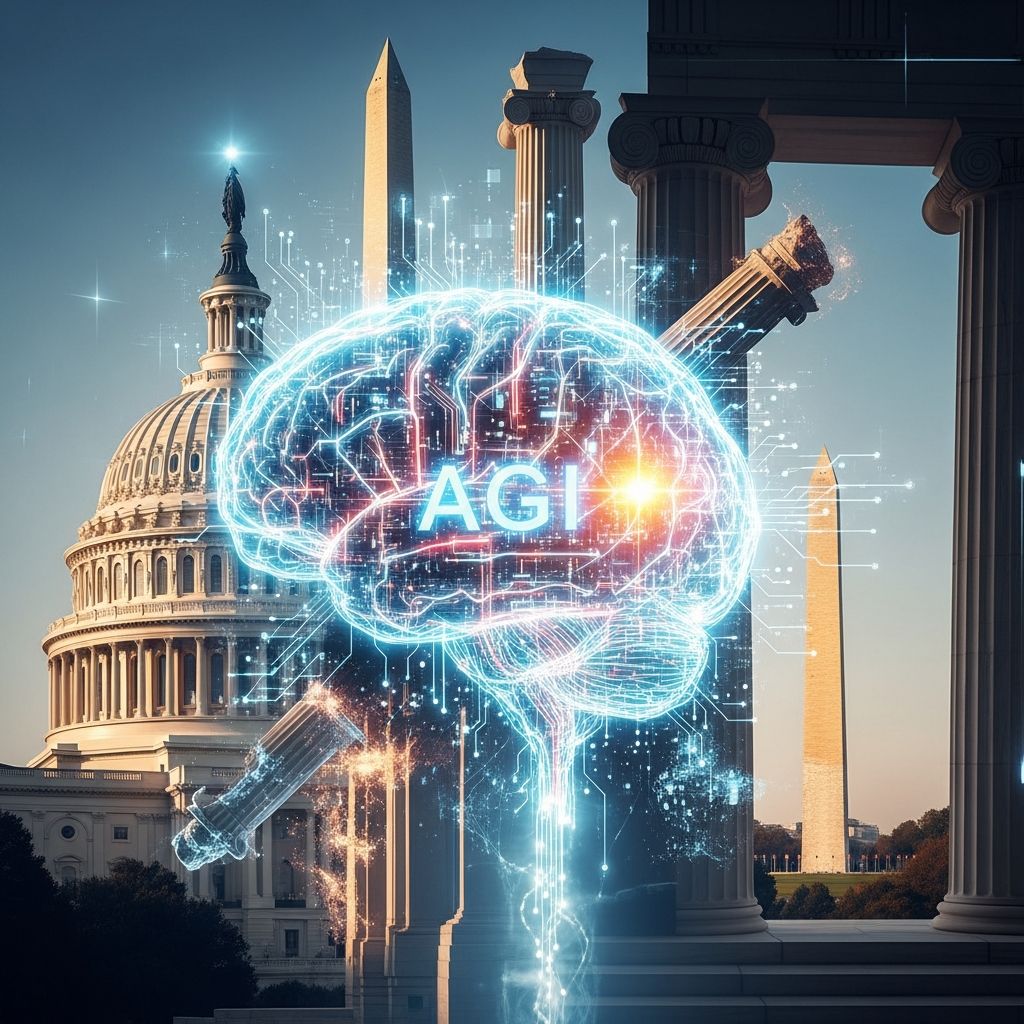
Artificial general intelligence (AGI) – systems able to perform essentially any cognitive task a human can – has moved from speculative fiction into the center of political debate, national security planning, and economic forecasting. In Washington, D.C., senior officials and policy advisers are being forced to design rules and institutions for technologies that may not yet exist, but which could profoundly reshape power, work, and risk around the world.
This article explores how AGI is changing conversations inside government, why timelines matter so much for policy, and how issues like labor disruption, U.S.–China competition, and AI safety are colliding in real time.
From Sci-Fi Concept to Live Policy Question
For decades, AGI was mainly a research aspiration. The rapid advance of large language models and multimodal systems has changed that. Systems now rival or surpass humans on many standardized tests and professional benchmarks, even though they remain unreliable and narrow in important ways. As a result:
- Senior government officials are briefed on AGI scenarios, not just narrow machine learning applications.
- National security strategies treat advanced AI as a source of military and intelligence advantage.
- Economic policymakers worry about large, rapid shocks to labor markets and productivity.
Yet there is deep scientific disagreement about when, or even whether, systems that merit the label “AGI” will emerge. Some leaders in industry and government warn that they could arrive within a few years; others argue current architectures may plateau or need radical rethinking before general intelligence is plausible.
Why AGI Timelines Dominate the Policy Debate
Policy design looks very different depending on whether you believe AGI is five, fifteen, or fifty years away. Timelines drive how urgently governments act, which tools they prioritize, and what kind of risks they accept in the name of innovation.
| Timeline View | Policy Mindset | Typical Priorities |
|---|---|---|
| AGI in ~2–5 years | Crisis preparation | Containment, compute controls, emergency governance, rapid safety research |
| AGI in ~10–20 years | Institution building | New regulators, international norms, workforce transitions, robust evaluation regimes |
| AGI unlikely or far off | Incremental regulation | Sectoral rules (health, finance), antitrust, data protection, innovation support |
In Washington, even a small shift in perceived timelines can unlock or stall entire policy packages. Arguments over how close AGI is are therefore, in practice, arguments over export controls, public investment, industrial policy, and what kinds of emergency powers the executive branch should hold.
Washington’s Emerging AI Policy Toolkit
Although U.S. AI policy is still fragmented, several tools have become central to how officials think about powerful AI and AGI-like systems:
- Compute and chip controls – Restrictions on the export of advanced chips and AI accelerators to strategic rivals, especially China, to maintain a lead in training frontier models and reduce proliferation risk.
- Safety and security standards – Technical and organizational requirements for frontier AI labs, such as model evaluations, red-team testing, and incident reporting.
- Government procurement – Using federal spending to shape the AI ecosystem, by favoring secure, safety-conscious systems and building internal capacity.
- Liability and accountability rules – Debates over how to allocate responsibility for harms from powerful systems: labs, deployers, or downstream users.
- Research and infrastructure investment – Public funding for AI research, compute, and data infrastructure, as well as support for alternative AI paradigms such as neurosymbolic methods.
Officials struggle with a core dilemma: move too slowly and risk being overtaken by events; move too quickly and risk locking in fragile assumptions about timelines, technical paths, or which firms should dominate the ecosystem.
National Security: AI as a Geopolitical Lever
Advanced AI is now a pillar of national security thinking in the United States, China, and other major powers. U.S. strategic documents frame leadership in AI as essential for both economic and military strength, and see China as the primary competitor.
Key national security concerns include:
- Military applications – Autonomous weapons, battlefield decision support, intelligence analysis, and cyber operations all stand to be transformed by more capable AI.
- Information advantage – AI-augmented intelligence processing, language translation, and open-source analysis could shift how states gather and use information.
- Cyber and bio risks – More capable models might lower barriers for designing cyber exploits or biological agents, depending on how they are trained and deployed.
- Strategic stability – Rapid AI advances might compress decision times in crises or create perceived first-mover advantages, complicating deterrence.
This has fueled aggressive U.S. export controls on advanced semiconductors and chipmaking tools, aimed at slowing rivals’ access to the most powerful AI hardware while preserving openness in less sensitive areas. The same policies, however, can push countries toward technological self-sufficiency and fragment global research ecosystems.
Jobs, Inequality, and the Future of Work
Beyond war and geopolitics, AGI-class systems raise enormous questions about work. Studies from the International Labour Organization and other bodies suggest that generative AI is most likely to reshape tasks within jobs, particularly high-skill cognitive work, rather than eliminate entire occupations overnight. But the scale and speed of potential change still worry policymakers.
Concerns cluster around three themes:
- Displacement vs. augmentation – Will AI mainly automate tasks that humans currently perform, or will it complement them in ways that raise productivity and wages? Existing evidence points to a mix of both, varying by sector and skill level.
- Compression of adjustment time – Past technological shifts unfolded over decades; frontier AI advances could transform occupations in a few years, leaving workers, training institutions, and safety nets struggling to adapt.
- Inequality – If AI tools are primarily owned and controlled by a small number of firms, productivity gains might accrue disproportionately to capital and to highly skilled workers who can best leverage the tools.
Governments are experimenting with responses, including subsidies for worker retraining, incentives for “pro-worker” AI systems that enhance rather than replace human labor, and updates to social insurance to better cover nontraditional and unstable work patterns.
Inside the Executive Branch: Using and Governing AI
One underappreciated piece of the story is how governments themselves are beginning to use AI. Large bureaucracies face immediate pressures to modernize operations, analyze massive datasets, and draft or review complex documents. Yet they must do so without exposing sensitive data or relying uncritically on opaque systems.
As a result, officials must answer two parallel questions:
- How should government agencies deploy AI safely and effectively? Issues include data security, vendor lock-in, bias mitigation, and maintaining human oversight for consequential decisions.
- How should they regulate private AI development and deployment? Here the same agencies must judge whether frontier models meet safety standards, whether they are being used in high-risk contexts, and what forms of monitoring are feasible.
The U.S. has begun issuing guidance and internal rules for federal agency use of AI, focusing on impact assessments, transparency, and oversight where AI affects individuals’ rights or access to public services. But the tools and expertise needed to properly evaluate frontier models remain scarce inside government.
Competing Philosophies: Acceleration, Caution, and Hard Limits
Debates in Washington increasingly mirror broader ideological divisions in the AI community. Three simplified camps shape how policymakers think about AGI:
- Accelerationists argue that rapid progress in AI, including the race toward AGI, is essential for economic growth, scientific discovery, and strategic advantage. They tend to oppose strong ex ante restrictions and favor self-regulation combined with competition.
- Safety-first advocates emphasize tail risks: catastrophic misuse, loss of control, or other low-probability, high-impact failures. They support rigorous pre-deployment testing, licensing, and in extreme cases, moratoria on training models above certain capability thresholds.
- Skeptics of the AGI narrative doubt that current systems are on a smooth path to general intelligence. They warn that overhyping AGI can distort policy, pushing governments to channel resources into a narrow technical paradigm while neglecting alternative research traditions or more mundane, but pressing, AI harms.
In practice, most serious policy proposals blend elements from these approaches, seeking to preserve innovation and open research while adding guardrails for the most powerful systems and high-risk uses.
Regulating Frontier Labs: Concentration, Power, and Responsibility
One striking feature of the AGI conversation is how much of it centers on a small group of frontier labs with the resources to train cutting-edge models. These firms sit at the intersection of massive compute budgets, high-stakes safety research, and public-private partnerships with governments.
Policy questions that frequently arise include:
- Should only a few companies be allowed to train the largest models? Some argue concentrated development allows for better safety practices and easier oversight; others fear it entrenches oligopolies and centralizes power.
- What obligations do frontier labs have? Proposals range from mandatory risk assessments and incident reporting to strict licensing with revocation powers if safety protocols are violated.
- How should conflicts of interest be handled? Many technical experts advising governments have ties to labs; conversely, regulators depend on these same labs for cutting-edge knowledge and evaluation tools.
There is growing interest in models where public or international institutions play a more direct role in governing or even operating some infrastructure for training the highest-risk systems, analogous in spirit to institutions that oversee nuclear materials or civil aviation.
Global Governance and the Risk of Fragmentation
AGI, if it emerges, will not respect national borders. Yet there is no consensus on how to create global governance mechanisms that are both effective and politically acceptable. Early efforts resemble those in other emerging technologies: non-binding principles, voluntary safety commitments, and high-level summits.
Challenges include:
- Divergent risk perceptions – Some countries emphasize immediate harms from bias and surveillance, while others focus on hypothetical existential risks or strategic imbalances.
- Great-power competition – The same governments that worry about catastrophe also fear giving rivals a decisive advantage by constraining their own AI sectors.
- Capacity gaps – Many states lack the technical expertise or resources to participate fully in shaping AI norms and standards.
Despite these obstacles, international bodies and alliances are experimenting with shared evaluation methods, information-sharing arrangements about dangerous capabilities, and guidelines for military use of AI, recognizing that unilateral approaches are unlikely to be sufficient in the long run.
Open Questions for Policymakers
Looking ahead, debates in Washington and other capitals are likely to pivot around a set of unresolved questions that the AGI discourse has brought into sharper relief:
- How can governments credibly update policy as technical understanding of AI capabilities and risks evolves?
- What mix of public and private institutions is best suited to oversee the training and deployment of frontier models?
- How can the benefits of advanced AI be broadly shared without entrenching extreme economic inequality or political manipulation?
- What forms of global coordination are realistic in an era of rising geopolitical tension?
- How should democratic societies weigh speculative catastrophic risks against concrete, present-day harms and opportunities?
These are not questions that technical experts or policymakers can answer alone. They implicate values, distributional choices, and long-term visions for how societies want to live with powerful technologies.
Frequently Asked Questions (FAQs)
Q: What exactly is artificial general intelligence (AGI)?
A: AGI usually refers to an AI system able to perform nearly any cognitive task a human can, across many domains, with at least comparable competence. It would go beyond today’s systems that excel in narrow tasks but struggle with robust reasoning, long-term planning, and real-world understanding.
Q: Why is Washington so focused on AGI instead of current AI harms?
A: Policymakers face pressure on both fronts. Bias, disinformation, and privacy harms from today’s systems already demand regulatory responses. At the same time, some officials fear that highly capable future systems could create qualitatively new risks or strategic shifts, so they are trying to build institutions that can handle more powerful models before they arrive.
Q: Is there a scientific consensus on when AGI will arrive?
A: No. Estimates vary widely among experts, from a few years to many decades, and some doubt that current techniques will ever yield fully general intelligence. Because timelines are uncertain, many researchers and policymakers argue for “intellectual humility” and flexible policies that can adapt as evidence accumulates.
Q: How might AGI affect jobs and the economy?
A: Studies suggest generative AI could substantially alter tasks in a large share of occupations, especially knowledge work, but the net effect on employment and wages depends on how quickly new tasks and industries emerge, how gains are shared, and what policies support worker transitions and bargaining power.
Q: What can individuals and organizations do now?
A: Individuals can focus on developing complementary skills—such as domain expertise, judgment, and social coordination—that are harder to automate. Organizations can invest in responsible adoption practices, robust evaluation of AI tools, and worker participation in deployment decisions, while staying informed about evolving regulatory expectations.
References
- Artificial Intelligence and National Security — Congressional Research Service. 2020-04-10. https://crsreports.congress.gov/product/pdf/R/R45178
- Artificial General Intelligence: Concept, State of the Art, and Future Prospects — Journal of Artificial General Intelligence. 2020-06-01. https://doi.org/10.1515/jagi-2020-0002
- National Security Commission on Artificial Intelligence Final Report — NSCAI. 2021-03-01. https://www.nscai.gov/2021-final-report/
- Blueprint for an AI Bill of Rights — The White House, Office of Science and Technology Policy. 2022-10-04. https://www.whitehouse.gov/ostp/ai-bill-of-rights/
- Generative AI and Jobs: A Global Analysis of Potential Effects on Job Quantity and Quality — International Labour Organization. 2023-08-21. https://www.ilo.org/global/publications/working-papers/WCMS_893126

Medha Deb is an editor with a master's degree in Applied Linguistics from the University of Hyderabad. She believes that her qualification has helped her develop a deep understanding of language and its application in various contexts. Medha specializes in the areas of beauty, health, sports, and wellness and is committed to ensuring that the content on the website is…