
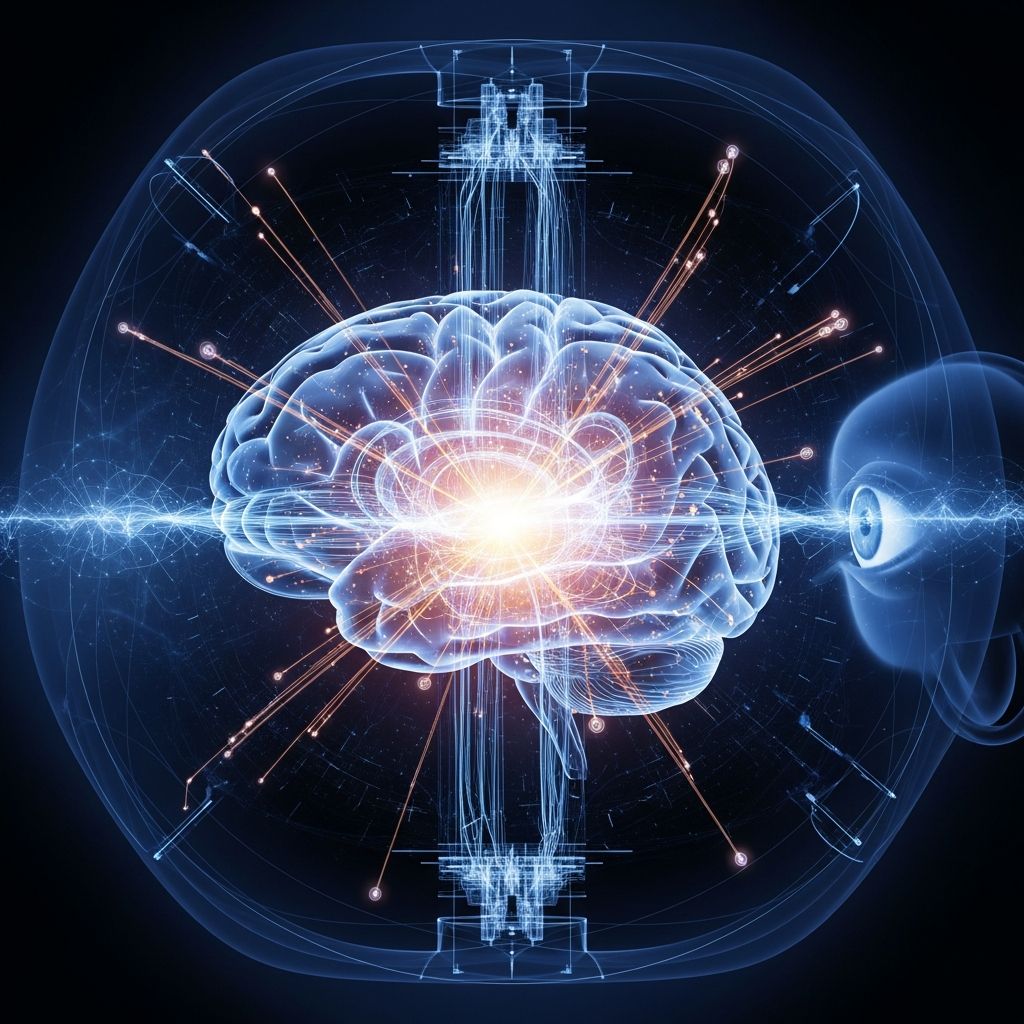
Neuroscientist Anil Seth has become one of the most prominent voices arguing that to understand consciousness, we must understand the brain as a machine that constantly predicts its own sensory inputs. This view reshapes how we think about perception, the self, nonhuman animals, and even the prospects for conscious AI.
This article offers an original, structured overview of that perspective, drawing on contemporary neuroscience and philosophy while remaining accessible to non-specialists.
From Mystery to Measurable Phenomenon
For much of scientific history, consciousness was treated as too subjective to study in a rigorous way. Today, that has changed. Research programs now treat conscious experience as something that can be related systematically to brain activity, behaviour, and information processing in the nervous system.1
- Consciousness in this context means what it feels like to be you right now: seeing colours, feeling emotions, having a sense of self.
- Neuroscientists investigate which brain mechanisms are necessary for those experiences and how different patterns of activity support different contents of consciousness.1
- This shift treats consciousness as a biological property, dependent on living brains and bodies, not a separate spiritual substance.
Within that broader effort, Seth’s work focuses on a unifying idea: that the brain’s primary task is not simply to register incoming data, but to anticipate it.
The Brain as a Prediction Engine
A central theme in contemporary neuroscience is that the brain continuously forms predictions about the causes of its sensory inputs and then updates those predictions in light of errors.2 This is sometimes described as predictive processing or the brain as a prediction machine.
- The brain receives streams of noisy, ambiguous signals from the senses.
- It uses internal models to guess what in the world (or body) most likely caused those signals.
- When prediction and input mismatch, prediction errors drive learning and updating.
Mathematically, many researchers model this in terms of Bayesian inference: the brain combines prior expectations with incoming evidence to arrive at a best current estimate about hidden causes of its sensory data.2
| Component | Bayesian Term | Intuitive Meaning |
|---|---|---|
| Prior | Prior probability | The brain’s expectations before new input arrives |
| Likelihood | Data likelihood | How compatible the sensory input is with a given hypothesis |
| Posterior | Posterior probability | The updated best guess after combining prior and data |
Seth’s distinctive proposal is that the contents of consciousness themselves are constituted by these ongoing perceptual predictions, not by a passive readout of sensory signals.
Perception as a World-Guided Hallucination
On the predictive view, what you experience at any moment is the brain’s current best hypothesis about the causes of sensory input rather than a direct copy of the world. Seth captures this with the slogan that perception is a kind of controlled hallucination, constrained by incoming data.
- Hallucinations illustrate the principle: they are experiences largely driven by internal predictions with weak or misleading sensory constraints.
- Ordinary perception differs not in kind but in degree of constraint: sensory signals keep the brain’s generative models anchored to environmental reality.
- This framework explains why perceptual illusions are so common: they reveal how strong priors can override noisy or ambiguous evidence.3
In this picture, your visual world is not a photograph constructed from the eyes upward, but a set of top-down predictions continuously corrected by errors from the retina and deeper sensory pathways.
Predicting the Body: The Roots of Selfhood
Seth extends the same logic inward. From the brain’s perspective, the internal state of the body is just as hidden as the external world. It only has access to signals such as heart rate, hormonal levels, and visceral nerve activity. To maintain physiological stability, the brain must predict and regulate these internal states.
- This regulation of internal variables is known as homeostasis (keeping critical quantities such as temperature within viable ranges).4
- Some researchers generalize this concept to allostasis – predictive regulation that anticipates future needs rather than merely correcting deviations after the fact.4
- Seth’s view is that our continuous feeling of “being an embodied self” arises from the brain’s ongoing predictions about the state of the body and its efforts to keep those states within bounds.
On this view, the self is not a separate entity inside the head, but a deeply rooted model of the organism constructed by the brain to keep a living body alive.
Lessons from Blindsight and Split-Brain Studies
Several landmark neuropsychological conditions support the idea that consciousness can come apart from information processing.
Blindsight
In blindsight, people with damage to primary visual cortex report being blind in part of their visual field yet can still guess correctly about the presence or location of stimuli in that region at rates far above chance.1
- Visual information is being processed sufficiently to guide behaviour.
- However, it fails to become part of conscious visual experience.
- This dissociation suggests that certain patterns or levels of cortical processing are required for contents to enter awareness.
Split-Brain Research
In classic split-brain cases, the main bundle of fibres connecting the brain’s hemispheres (the corpus callosum) is surgically cut, usually as a treatment for severe epilepsy. Under carefully controlled experiments, each hemisphere can operate with partial independence, sometimes generating different responses or preferences without the other hemisphere’s awareness.1
- This suggests that multiple, partially independent conscious streams can coexist within a single skull under some conditions.
- It challenges naive assumptions that there must be a single, indivisible “experiencer” in the brain.
For predictive theories, these cases are informative because they show how disrupting information flow between regions alters which predictive processes can coordinate into a unified conscious scene.
Searching for the Neural Basis of Consciousness
Any theory of consciousness must connect subjective experience to measurable brain activity. Large-scale research efforts now seek neural correlates of consciousness (NCCs): the minimal mechanisms in the brain whose activity is reliably associated with particular experiences.1
There are several prominent theoretical frameworks:
- Global Workspace Theory (GWT) proposes that information becomes conscious when it is globally broadcast across multiple specialized systems, enabling flexible report and control.5
- Integrated Information Theory (IIT) ties consciousness to the degree of integrated causal structure in a system, independent of its specific biological implementation.5
- Recurrent processing and predictive processing accounts emphasize feedback loops and top-down predictions in sensory cortex as crucial for conscious perception.2
Seth’s work uses the predictive framework as a tool for consciousness science: a way to generate testable hypotheses about which kinds of predictive circuitry must be in place for experiences of specific contents (like colour, shape, or bodily feeling) to arise.
Are Animals Conscious? A Predictive Perspective
Questions about animal consciousness carry both scientific and ethical weight. A growing body of evidence suggests that many nonhuman animals share brain architectures and behavioural capacities that support at least some forms of conscious experience.6
- Mammals and birds show complex learning, problem-solving, and flexible behaviour suggestive of rich internal models.
- Some species exhibit markers of pain, fear, and social emotions that align with human affective systems.
- Even some invertebrates (such as octopuses) display sophisticated exploratory and play behaviours.6
On a predictive view, where consciousness is tied to the complexity and integration of models that support perception and bodily regulation, it is unlikely that experience is limited to humans. Instead, different species probably instantiate different “flavours” of consciousness shaped by their sensory modalities, body plans, and ecological niches.
What About Conscious Machines?
The same frameworks used to think about animal minds are often applied to artificial intelligence. Current AI systems can achieve impressive performance on tasks like language modelling and image recognition. However, most neuroscientists and philosophers remain sceptical that present-day systems are conscious.
- Contemporary machine learning models typically lack ongoing embodied regulation of a living body, which is central to Seth’s picture of selfhood.
- They usually do not maintain unified, self-updating models of an environment and body across timescales in the way biological organisms do.
- On some interpretations of predictive processing, consciousness depends not only on information integration but on being part of a biological drive to resist disorder and remain alive.2
This does not rule out future artificial systems that might satisfy these conditions, but it cautions against equating task performance or language fluency with genuine subjective experience.
Ethical and Practical Implications
Reframing consciousness as prediction has far-reaching implications beyond philosophy.
- Mental health: Many psychiatric conditions can be interpreted as disruptions in predictive models of self and world, suggesting new avenues for diagnosis and treatment.
- Anesthesia and disorders of consciousness: Quantitative measures of brain dynamics, such as perturbational complexity, may help distinguish conscious from unconscious states in clinical contexts.5
- Animal welfare: Recognizing that various species likely possess at least basic conscious capacities strengthens arguments for more protective legislation and ethical treatment.6
- Human self-understanding: Seeing the self as a constructed model can foster humility, reduce stigma around mental illness, and encourage more compassionate social policy.
Key Takeaways
- Consciousness is increasingly studied as a biological phenomenon tied to brain and body processes.
- The predictive brain framework treats perception and selfhood as best guesses generated by top-down models constrained by sensory data.
- Cases like blindsight and split-brain patients reveal how consciousness can come apart from information processing and behavioural control.
- Multiple scientific theories compete to explain how brain dynamics give rise to conscious contents, and predictive processing provides tools rather than a complete solution.
- These ideas reshape how we think about animal minds, future AI, and ethical questions surrounding suffering and personhood.
Frequently Asked Questions (FAQs)
Q: Does the predictive brain view mean reality is an illusion?
No. The view is that conscious experience is an inferred representation of the world and body rather than a direct copy. The world still exists independently, but what it feels like to encounter it depends on how the brain models and predicts sensory causes.
Q: How is Anil Seth’s approach different from other theories like Global Workspace Theory?
Global Workspace Theory focuses on information becoming conscious when it is globally broadcast across the brain. Seth’s predictive approach instead emphasizes the role of top-down generative models and bodily regulation. In practice, these perspectives may be compatible: global broadcasting might operate over prediction-based representations.
Q: Can predictive processing be directly tested in the lab?
Yes. Experiments use sensory illusions, expectation manipulations, and brain imaging to test how prior beliefs and prediction errors shape neural responses. Findings that the brain’s activity reflects expectations even before stimuli appear support predictive models.2
Q: Are animals conscious according to this framework?
The predictive view suggests that any organism with sufficiently complex models of its environment and body, integrated over time for regulation and action, likely has some form of conscious experience. Evidence from behaviour, neuroanatomy, and learning supports consciousness in many vertebrates and potentially some invertebrates.6
Q: Does this theory tell us whether current AI systems are conscious?
No current theory can conclusively settle that question. However, the predictive, embodied perspective highlights missing ingredients in most AI: ongoing regulation of a vulnerable body, integration of perception and action over long timescales, and homeostatic drives. These absences give reasons for caution in attributing consciousness to today’s machines.
References
- Owen AM, et al. Detecting Awareness in the Vegetative State. — New England Journal of Medicine. 2006-09-08. https://www.nejm.org/doi/full/10.1056/NEJMoa060422
- Clark A. Whatever Next? Predictive Brains, Situated Agents, and the Future of Cognitive Science. — Behavioral and Brain Sciences. 2013-06-01. https://doi.org/10.1017/S0140525X12000477
- Eagleman DM. Visual Illusions and the Neurobiology of Perception. — Nature Reviews Neuroscience. 2001-10-01. https://doi.org/10.1038/35090048
- Sterling P, Laughlin S. Principles of Neural Design. — MIT Press. 2015-05-08. https://mitpress.mit.edu/9780262028707/principles-of-neural-design/
- Massimini M, et al. A Perturbational Approach for Evaluating the Brain’s Capacity for Consciousness. — Progress in Brain Research. 2009-01-01. https://doi.org/10.1016/S0079-6123(09)17704-2
- Birch J, Schnell AK, Clayton NS. Dimensions of Animal Consciousness. — Trends in Cognitive Sciences. 2020-10-01. https://doi.org/10.1016/j.tics.2020.07.007

- Integrated M.A. in Applied Linguistics, University of Hyderabad
- 5+ years in editorial, instructional, SEO, and research-based writing
Sneha is a relationships and lifestyle writer with a strong foundation in applied linguistics and certified training in relationship coaching. She brings over five years of writing experience to theskillvault, crafting thoughtful, research-driven content that empowers readers to build healthier relationships, boost emotional well-being, and embrace holistic living. Her writing and insights reflect the belief that beauty, happiness, and wellness…