
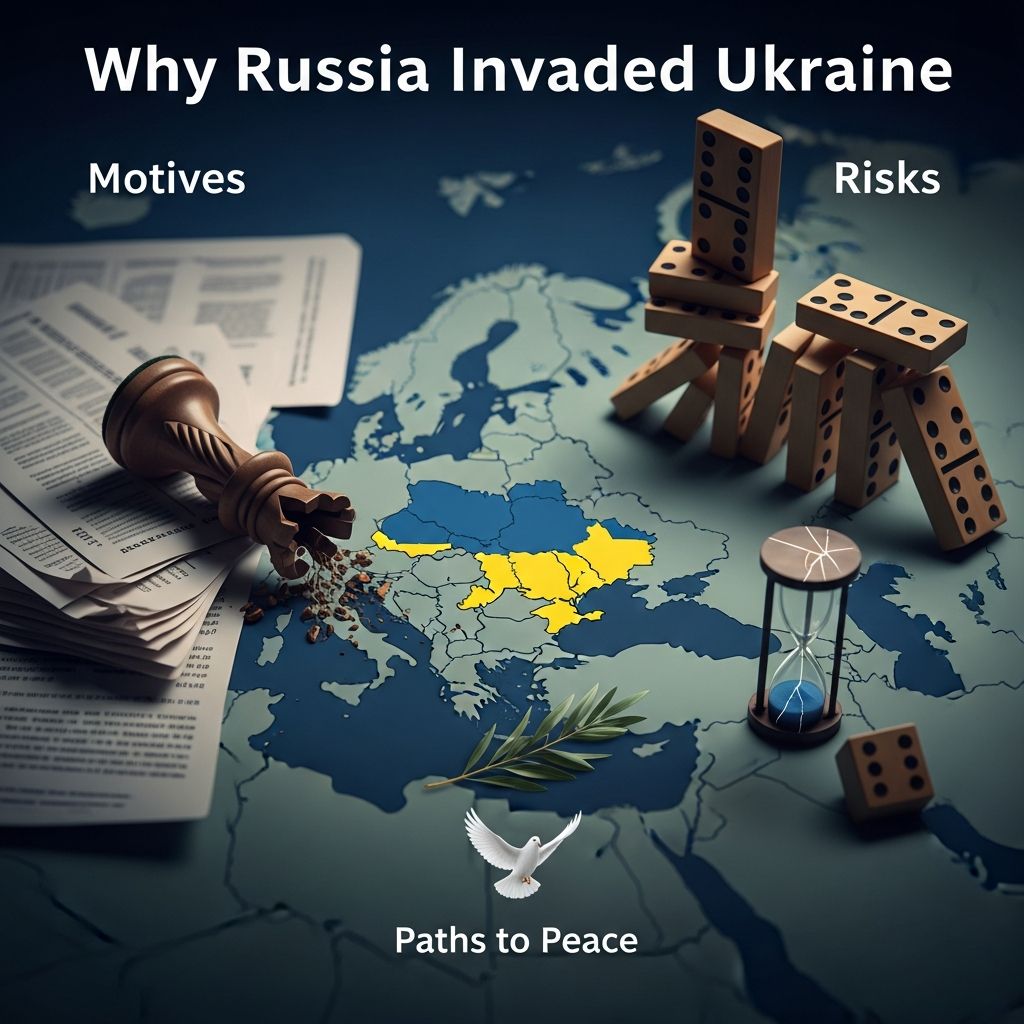
Russia’s full-scale invasion of Ukraine in February 2022 is one of the most consequential geopolitical shocks of the 21st century. Understanding why it happened, how it could escalate, and what might end it is essential for policymakers, citizens, and anyone concerned with global security.
- Why Russia chose war instead of continued coercion or diplomacy
- How NATO enlargement and Ukrainian independence shaped Russian threat perceptions
- The risks of nuclear and wider war and how escalation might occur
- What a negotiated settlement could look like and why it is so difficult
- How this war could reshape security in Europe for decades
1. The Road to War: From Post-Soviet Transition to Full-Scale Invasion
To understand why Russia invaded, it is necessary to see the war not as a sudden outburst, but as the culmination of long-running disputes about Ukraine’s sovereignty, European security, and Russia’s place in the post-Cold War order.
1.1 Ukraine’s independence and Russian strategic trauma
When the Soviet Union collapsed in 1991, Ukraine emerged as an independent state with internationally recognized borders, including Crimea and the Donbas region. For many Russian elites, however, losing Ukraine was not just a normal geopolitical setback; it was experienced as a historic loss and a profound security blow.
- Ukraine hosted major Soviet military-industrial assets and a large portion of the Soviet population.
- Kyiv’s political alignment was seen as central to whether Russia would be a regional empire or merely another large Eurasian state.
- Russian leaders repeatedly emphasized that Ukraine belonged to Russia’s “sphere of privileged interests.”
This created a deep tension between Ukraine’s legal right to sovereign choices and Russia’s self-perceived entitlement to a decisive say in Ukraine’s foreign and security policy.
1.2 NATO enlargement and Russian threat perceptions
Throughout the 1990s and 2000s, NATO expanded to include Central and Eastern European states and the Baltic countries. The alliance insists it is defensive and that sovereign states are free to apply to join. Yet Russian officials and strategic documents have consistently framed NATO expansion as a direct threat to Russian security.
From Moscow’s perspective:
- NATO’s move closer to Russian borders eroded the buffer zone that Soviet leaders once relied upon.
- The prospect of Ukraine and Georgia joining NATO, especially after NATO’s 2008 Bucharest summit declaration that they “will become members,” became a red line for many Russian decision makers.
- Western support for democratic movements in the post-Soviet space was often interpreted as regime-change operations aimed at weakening Russia’s influence.
These perceptions did not make an invasion inevitable, but they shaped what Russian leaders considered acceptable or intolerable outcomes in Ukraine.
1.3 The 2014 turning point: Crimea and Donbas
The immediate prelude to the 2022 invasion was the crisis of 2013–2015:
- Ukrainians protested then-president Viktor Yanukovych’s decision not to sign an association agreement with the European Union, leading to his ouster in early 2014.
- Russia responded by annexing Crimea and supporting separatist movements in the Donetsk and Luhansk regions of eastern Ukraine.
- The war in Donbas killed over 13,000 people before 2022 and left Moscow with significant leverage over Ukraine’s internal politics through the separatist-controlled territories.
To manage the conflict, the Minsk agreements (2014 and 2015) attempted to combine ceasefire provisions with a roadmap for reintegrating separatist-controlled areas into Ukraine under a special status. Disputes over sequencing and interpretation meant the agreements were never fully implemented.
By the late 2010s, Russia’s hybrid strategy – a mix of limited war, political influence, energy pressure, and diplomacy – was not delivering the outcome the Kremlin wanted: a reliably neutral, pro-Russian, or at least non-aligned Ukraine.
2. Why Moscow Chose Full-Scale War in 2022
Analysts typically point to three main clusters of motives behind the decision to launch a full invasion: perceived strategic deadlines, fear of Ukraine drifting irreversibly Westward, and the personal beliefs and risk tolerance of Vladimir Putin and his inner circle.
2.1 Seeing a closing window of opportunity
By 2021, Ukraine’s armed forces had become more capable and Western support more entrenched. US and European military aid, training, and intelligence cooperation had significantly improved Ukraine’s defenses. At the same time, Ukraine’s public opinion was shifting sharply in favor of EU and NATO integration.
From Moscow’s perspective, this created a sense of a “now or never” moment:
- Waiting would likely mean facing a stronger Ukrainian military and more entrenched Western backing.
- Ukraine’s domestic politics were increasingly resistant to any special status for Russia-backed regions or formal neutrality.
- Russian conventional forces appeared – on paper – to have a decisive advantage that could deliver a quick victory.
Russian leaders thus may have concluded that if they were ever going to coerce Ukraine into a desired security status, the costs of action would only rise over time.
2.2 Ukraine as an existential question for Russian elites
Vladimir Putin has repeatedly argued that Russians and Ukrainians are “one people” and portrayed Ukrainian sovereignty as an artificial, externally manipulated project. In Russian elite discourse, a Ukraine fully aligned with the West is not just a foreign policy setback but a threat to Russia’s internal stability and great-power status.
Key beliefs that likely shaped the invasion decision include:
- The idea that a democratic, Western-oriented Ukraine would undercut the legitimacy of Russia’s own authoritarian system.
- Fear that NATO-linked infrastructure on Ukrainian territory would permanently constrain Russia’s freedom of action and strategic depth.
- A conviction that losing influence over Kyiv would cement Russia’s relegation to a secondary power in Europe.
These beliefs do not justify aggression under international law, but they help explain why Russian leaders framed Ukraine as an existential security issue for Russia, while for the West it was largely a question of supporting a partner state and defending the post–Cold War European order.
2.3 Miscalculation, ideology, and intelligence failure
The invasion plan appears to have been built on several critical miscalculations:
- Underestimating Ukrainian resistance and assuming the government would quickly fall.
- Overestimating the Russian military’s ability to execute a complex, multi-axis offensive.
- Misreading Western unity and readiness to impose large-scale sanctions and supply Ukraine with advanced weapons.
In effect, strategic fears interacted with ideological narratives and flawed intelligence to produce a high-risk decision for which Russia was poorly prepared.
3. Risks of Escalation: From Prolonged War to Nuclear Danger
From the outset, the war raised concerns not only about Ukraine’s survival but also about the possibility of escalation to direct NATO–Russia conflict or even nuclear use.
3.1 How the war could widen beyond Ukraine
Western governments have sought to support Ukraine robustly while avoiding direct combat between NATO forces and Russia. Nonetheless, several pathways to wider war exist:
- Accidental escalation: Strikes that unintentionally hit NATO territory or assets could trigger crisis escalation.
- Deliberate horizontal escalation: If Russia felt it was losing decisively, it might threaten or attack other targets to raise costs for NATO.
- Cyber operations: Large-scale cyberattacks on Western infrastructure could blur lines between war and peace.
So far, both NATO and Russia have shown a degree of restraint in keeping direct combat confined to Ukrainian territory, but this balance is unstable and depends on continued careful crisis management.
3.2 Nuclear weapons: low probability, intolerable risk
Russia’s official nuclear doctrine allows for nuclear use if the state’s existence is threatened or if large-scale conventional attacks jeopardize key military capabilities. Russian officials and media have occasionally used nuclear rhetoric to signal that Western intervention in Ukraine could cross red lines.
Experts generally assess that:
- The probability of nuclear use remains low, as it would bring enormous international backlash and unpredictable military consequences.
- The risk increases if Russian leaders perceive a catastrophic defeat in Ukraine or a direct NATO–Russia war.
- Russia’s substantial losses in conventional forces in Ukraine could make its leadership more reliant on nuclear threats if it faced a broader conflict.
This underlines why Western support has largely focused on helping Ukraine defend its territory without crossing into direct NATO–Russia kinetic confrontation.
4. Why a Negotiated Settlement Is So Hard
Military dynamics alone are unlikely to produce a decisive, clean victory for either side. Yet diplomacy is blocked by fundamentally incompatible aims.
| Issue | Ukraine’s Core Position | Russia’s Core Position |
|---|---|---|
| Territorial control | Restoration of sovereignty over all internationally recognized territory | Recognition of Russian control over Crimea and Russia-backed entities in Donbas |
| Security alignment | Right to choose alliances, including NATO/EU | Legally binding guarantees that Ukraine will be neutral / non-aligned |
| Sanctions | Sanctions lifted only after Russian withdrawal and accountability | Substantial sanctions relief as part of any deal |
4.1 The problem of unacceptable concessions
Any agreement that permanently cedes territory or denies Ukraine the right to choose its alliances is politically toxic in Kyiv. At the same time, Russia appears unwilling to accept a fully independent Ukraine with Western military ties, especially regarding Crimea and the Donbas.
This creates a set of dilemmas:
- If Ukraine concedes too much, it risks destabilizing its own politics and sending a signal that military aggression is rewarded.
- If Russia concedes too much, it risks internal backlash and a narrative of defeat that could destabilize the regime.
- External guarantors of any deal would need to commit credible security guarantees that all sides currently distrust.
4.2 The role and limits of Western diplomacy
The United States and European allies have three overlapping objectives:
- Support Ukraine’s right to self-defense and sovereignty.
- Prevent direct NATO–Russia war or nuclear escalation.
- Discourage a global precedent that borders can be changed by force.
Balancing these objectives involves continuous tradeoffs:
- Providing powerful weapons while limiting their use against targets deep inside Russia.
- Maintaining sanctions pressure but leaving some room for future bargaining.
- Engaging Russian interlocutors on arms control and crisis management even amid intense political hostility.
Western diplomacy can influence incentives and constraints, but it cannot impose a settlement that is fundamentally unacceptable to either Kyiv or Moscow without risking long-term instability.
5. Long-Term Consequences for European and Global Security
However the war ultimately ends, it is already transforming the security architecture of Europe and global norms about the use of force.
5.1 A more militarized, divided Europe
The war has accelerated trends that were already visible but less pronounced:
- European states are increasing defense spending, with several pledging to meet or exceed NATO’s 2% of GDP guideline.
- Countries long committed to military non-alignment, such as Finland and Sweden, have moved toward or into NATO membership.
- Eastern European countries, particularly those bordering Russia and Belarus, are reinforcing their conventional and air defenses.
In practice, this means a more heavily armed frontline between NATO and Russia, with fewer cooperative mechanisms and greater reliance on deterrence and forward deployments.
5.2 The erosion of arms control and crisis management
Even before 2022, key arms control agreements between Russia and the West had eroded, including the Intermediate-Range Nuclear Forces (INF) Treaty and elements of the Conventional Forces in Europe (CFE) regime. The war has further undermined trust and reduced the political appetite for negotiated constraints.
Without renewed efforts, the result could be:
- Less transparency about military exercises and deployments.
- Higher risk of incidents or misinterpretations leading to escalation.
- Fewer channels for crisis communication at exactly the time they are most needed.
5.3 Global ripple effects
Beyond Europe, other states are watching how the war reshapes norms and expectations:
- Countries with territorial disputes are assessing whether major powers can forcibly change borders without incurring prohibitive costs.
- Energy and food price shocks are testing the resilience of economies and political systems worldwide.
- Non-aligned states are exploring how to navigate between Western sanctions regimes and continued relations with Russia.
This suggests that the war’s outcome will influence not just regional balances of power, but broader judgments about the viability of international law as a constraint on aggression.
Frequently Asked Questions (FAQs)
Q1: Did NATO expansion cause Russia’s invasion?
A: NATO expansion did not legally justify Russia’s invasion, which violates the UN Charter’s prohibition on the use of force against the territorial integrity or political independence of any state. However, Russian leaders have long framed NATO enlargement, and especially the possibility of Ukrainian membership, as a major security threat, and this perception was a central factor in their decision to go to war.
Q2: How likely is nuclear use in the Russia–Ukraine war?
A: Most expert assessments see nuclear use as unlikely but not impossible. The risk is highest if Russian leaders believe the regime or the state’s survival is at stake, or if the conflict escalates directly to a NATO–Russia war. This is why Western policy aims to support Ukraine robustly while avoiding steps that could trigger direct great-power confrontation.
Q3: Can sanctions alone force Russia to end the war?
A: Sanctions have significantly damaged Russia’s economy and constrained its access to technology and finance. However, history suggests that sanctions rarely alone compel leaders to reverse high-priority security decisions. They are more effective as part of a broader strategy that combines military realities on the ground, diplomatic options, and internal political dynamics.
Q4: What would a realistic peace deal look like?
A: Any realistic agreement would need to address three baskets: territory, security guarantees, and sanctions. That likely means some arrangement for the contested regions, limits or conditions on foreign military presence in Ukraine, and a phased approach to sanctions relief tied to verifiable implementation. At present, however, the political positions of both sides remain far apart.
Q5: Could Russia attack other countries after Ukraine?
A: Analysts debate this. Some argue that if Russia sees gains from aggression in Ukraine, it might be emboldened; others note that the war has exposed serious weaknesses in Russia’s conventional forces and strengthened NATO’s posture, reducing the feasibility of attacking NATO members. Most experts see opportunistic aggression as more likely against non-allied neighbors than against treaty-protected states with strong deterrent capabilities.
References
- Ukraine: Background, Conflict with Russia, and U.S. Policy — Congressional Research Service. 2024-05-29. https://crsreports.congress.gov/product/pdf/R/R45008
- Russia’s War on Ukraine: Military and Strategic Dimensions — International Institute for Strategic Studies (IISS). 2023-03-10. https://www.iiss.org/blogs/research-paper/2023/03/russias-war-on-ukraine
- Why Putin Went to War: The Invasion of Ukraine and the Miscalculation of Power — Carnegie Endowment for International Peace. 2022-04-28. https://carnegieendowment.org/2022/04/28/why-putin-went-to-war-pub-87020
- Will Putin Stop at Ukraine? That’s the Wrong Question — Samuel Charap & Elbridge Colby, The Washington Quarterly. 2024-09-01. https://blogs.gwu.edu/nonproliferation/wp-content/uploads/sites/2181/2024/09/Charap-Priebe_TWQ_47-3.pdf
- Understanding the Russo-Ukrainian War: A Guide from War on the Rocks — War on the Rocks Editorial Team. 2023-02-21. https://warontherocks.com/understanding-the-russo-ukrainian-war-a-guide-from-war-on-the-rocks/
- Pressuring Ukraine into a Premature Peace Would Only Encourage Putin — Atlantic Council. 2022-05-26. https://www.atlanticcouncil.org/blogs/ukrainealert/pressuring-ukraine-into-a-premature-peace-would-only-encourage-putin/

- Integrated M.A. in Applied Linguistics, University of Hyderabad
- 5+ years in editorial, instructional, SEO, and research-based writing
Sneha is a relationships and lifestyle writer with a strong foundation in applied linguistics and certified training in relationship coaching. She brings over five years of writing experience to theskillvault, crafting thoughtful, research-driven content that empowers readers to build healthier relationships, boost emotional well-being, and embrace holistic living. Her writing and insights reflect the belief that beauty, happiness, and wellness…