
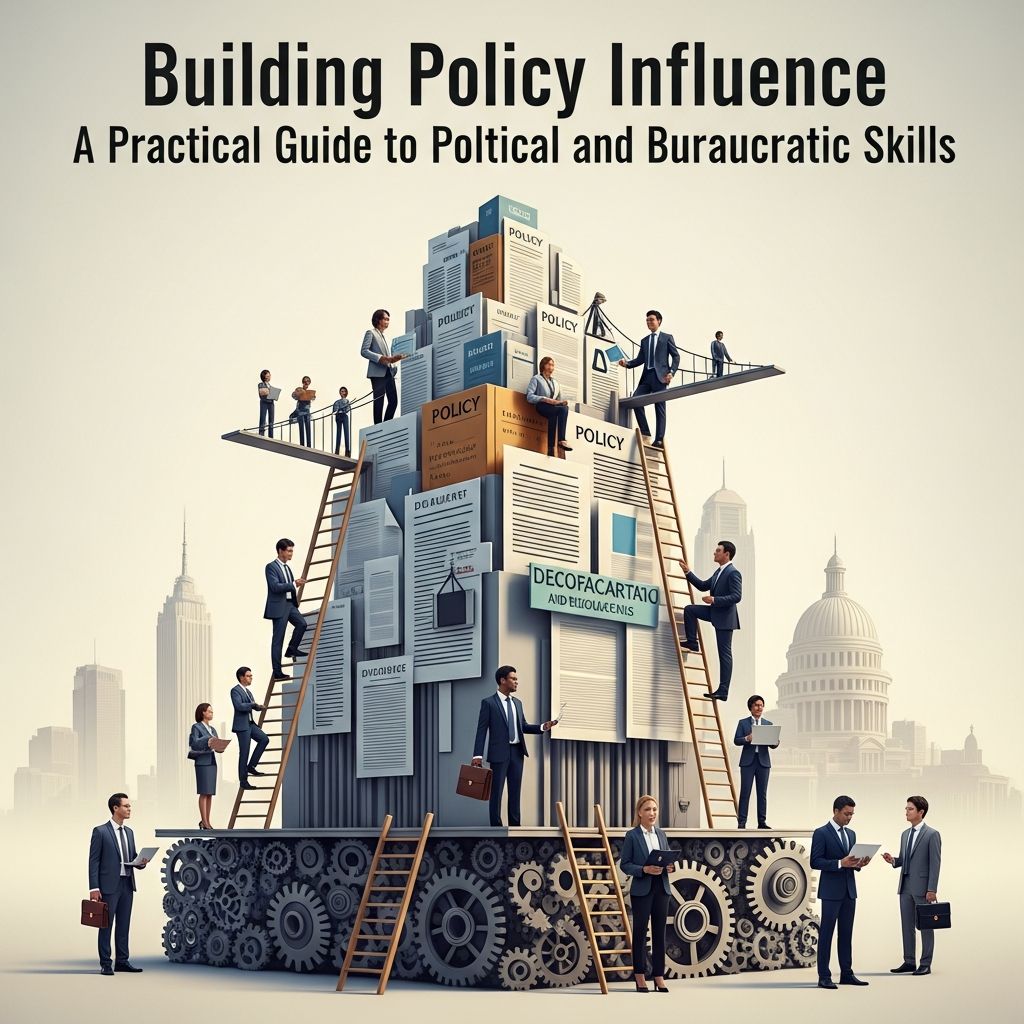
Governments and other powerful institutions routinely make decisions that affect millions of lives, the global economy, and even the long-term future of humanity. Learning how to operate effectively within these systems is one of the most leveraged ways to have a positive impact on the world.
This guide explains what political and bureaucratic skills are, why they matter, and how you can start building them if you want a career in policy, government, or related institutions.
1. Why Political and Bureaucratic Skills Matter
Bureaucracies and political institutions are sometimes criticized as slow or opaque, yet they remain essential for implementing laws, running public services, and responding to crises. Understanding how they work gives you a realistic path to contributing to large-scale change.
- Governments manage huge budgets and regulatory powers, influencing healthcare, education, infrastructure, defense, and environmental protection.
- Bureaucracies translate laws into practice by creating and enforcing detailed rules, procedures, and programs.
- Political leaders and their staff set strategic priorities, negotiate trade-offs, and oversee agencies that implement policy.
If you can navigate these systems well, you can help shape decisions that ripple outward to millions of people.
2. What Do We Mean by “Political” and “Bureaucratic” Skills?
The terms political and bureaucratic describe complementary but distinct capabilities that together allow you to influence public decisions.
| Skill Type | Main Focus | Typical Roles | Core Activities |
|---|---|---|---|
| Political skills | Winning support, building coalitions, navigating parties and elections | Elected officials, campaign staff, party organizers, political advisors | Messaging, negotiation, stakeholder management, media engagement |
| Bureaucratic skills | Working within formal organizations to design and implement policy | Career civil servants, analysts, regulators, program managers | Policy design, administration, compliance, project delivery |
In practice, many impactful careers blend elements of both. For example, senior civil servants must understand political priorities, and politicians depend on bureaucrats for technical and administrative expertise.
3. How Bureaucracies Work (And Why That Helps You)
Classic work in political science describes bureaucracies as organizations with clear hierarchies, specialized roles, formal rules, and professional staff. These structures can feel rigid, but they also create predictable channels for influence.
3.1 Key Features of Bureaucracies
- Hierarchy: Authority flows from top leadership to lower-level units, creating defined reporting lines.
- Specialization: Staff focus on narrow policy areas (e.g., health, transport, environment), building deep expertise.
- Formal rules and procedures: Written regulations and standard processes govern decisions, approvals, and oversight.
- Impersonality: Decisions are expected to follow rules rather than personal preference, reinforcing fairness and consistency.
- Professionalization: Many roles require technical qualifications, competitive exams, or specialized training.
These features mean that individuals who understand the rules, timelines, and informal norms of an organization can often unlock opportunities to improve how policies are shaped and implemented.
3.2 Bureaucrats and Political Appointees
In many systems, such as the United States, senior roles are divided between career officials and political appointees.
- Career officials are hired under merit-based rules and develop long-term expertise and institutional memory.
- Political appointees are selected by elected leaders and serve at their discretion, helping ensure agencies follow the administration’s priorities.
Research suggests that having both types in appropriate balance can support both professional competence and responsiveness to democratic mandates.
4. Core Capabilities for High-Impact Policy Work
To be effective in political or bureaucratic environments, you usually need a blend of technical knowledge and interpersonal skills. Below are some of the most important capabilities.
4.1 Policy Analysis and Research
Policy decisions often turn on technical questions: What will this regulation cost? Who will benefit? What are the unintended consequences? Strong analytical skills are crucial.
- Understanding how to read and interpret legislation, regulations, and official guidance.
- Designing and interpreting basic quantitative analyses, cost–benefit reasoning, or impact evaluations.
- Synthesizing expert evidence into clear, concise recommendations suitable for busy decision-makers.
These skills are central in roles such as legislative staff, think-tank researchers, and analysts within ministries or agencies.
4.2 Organizational Navigation
Influence in large institutions is rarely just about being right on the merits. You also need to understand where, when, and how decisions are made.
- Mapping decision chains: who must sign off, who can veto, and who has informal sway.
- Learning internal calendars: budget cycles, legislative sessions, planning rounds.
- Understanding compliance, accountability, and audit mechanisms that shape what is politically and legally feasible.
This is where bureaucratic skills—such as working with formal procedures and documentation—become an asset rather than an obstacle.
4.3 Relationship-Building and Coalition Management
The “bureaucratic politics” perspective highlights that policy outcomes often emerge from negotiation among actors with different goals and constraints. To succeed, you must be able to build and maintain alliances.
- Building trust with colleagues across departments and parties.
- Identifying shared interests and acceptable compromises.
- Maintaining credibility by being reliable, accurate, and fair-minded.
These skills are indispensable in public-facing political roles but also matter deeply in technical and administrative positions.
4.4 Communication and Framing
Clear communication bridges the gap between complex evidence and practical decisions.
- Writing succinct memos, talking points, and briefings tailored to non-specialist audiences.
- Presenting trade-offs honestly without overwhelming the recipient with detail.
- Adapting your framing to different stakeholders—politicians, civil servants, journalists, or the public—while staying accurate.
In many democratic systems, public justification and media scrutiny are critical, so the ability to explain why a policy makes sense is just as important as designing it well.
4.5 Integrity and Responsibility
Because political and bureaucratic roles involve access to sensitive information, resources, and decision-making power, personal integrity is not optional. It is foundational.
- Respecting legal and ethical constraints, including conflicts-of-interest and confidentiality rules.
- Thinking explicitly about long-term consequences and avoiding narrow, short-term wins that undermine trust.
- Cultivating peers and mentors who can challenge your reasoning and help you stay grounded.
Professional norms of impartiality and neutrality—sometimes called “neutral competence”—aim to ensure that bureaucrats serve the public interest rather than partisan goals.
5. Different Paths into Policy and Bureaucratic Influence
There is no single route into impactful policy work. Instead, there are several broad pathways that suit different personality types and skill sets.
5.1 Direct Entry into Government or Legislatures
Many people start their careers inside government institutions from the outset.
- Civil service or public administration tracks: Competitive exams or graduate schemes that lead to roles in ministries, regulators, or local government.
- Legislative support roles: Working for a member of parliament, congressperson, or committee as a researcher, caseworker, or policy aide.
- Regulatory and enforcement agencies: Joining specialized bodies that oversee areas like environmental standards, financial regulation, or public health.
These roles give early exposure to real decision-making processes and help you build institutional knowledge quickly.
5.2 Expertise-First Routes
Some people develop deep expertise outside government before moving into more influential positions later.
- Academic or technical careers: Building research profiles in fields such as economics, epidemiology, or technology policy and then advising or joining government bodies.
- Think tanks and research institutes: Producing policy-relevant research, reports, and recommendations that directly shape debates.
- Professional sectors: Gaining senior experience in law, consulting, or industry, and later transitioning into advisory or leadership roles in public agencies.
These routes tend to be more competitive at senior levels but can offer substantial influence, especially when specialized knowledge is rare.
5.3 Party Politics and Public-Facing Roles
For those attracted to campaigning, public communication, and electoral politics, party-based roles can be a natural fit.
- Working in party headquarters on policy platforms, communications, or strategy.
- Joining campaign teams to support candidates, organize volunteers, or manage digital outreach.
- Eventually running for office, where you directly vote on legislation and help set national or local agendas.
These paths demand high tolerance for public scrutiny and uncertainty, but can be extremely impactful when successful.
6. Practical Steps to Build Political and Bureaucratic Skills
Regardless of which route you choose, you can start building relevant skills and experience early on.
6.1 Early-Career Actions
- Seek public sector internships: Apply for short placements in legislatures, ministries, regulatory agencies, or city governments.
- Engage with student or local politics: Join student government, debate clubs, or community campaigns to practice advocacy and negotiation.
- Study relevant subjects: Coursework in political science, economics, public policy, or law helps build conceptual foundations.
- Develop writing samples: Practice writing short policy memos or op-eds on issues you care about.
6.2 Mid-Career Development
- Specialize in a problem area: Focus on a field where your expertise can be especially valuable—such as climate policy, biosecurity, AI governance, or public health.
- Take on management responsibilities: Leading small teams or projects teaches you how to deliver outcomes within institutional constraints.
- Invest in networks: Build relationships across departments, parties, or organizations working on related issues.
- Seek cross-sector exposure: Experience in NGOs, academia, or industry can improve your understanding of how policies land outside government.
6.3 Continuous Learning Habits
- Follow reputable news sources and policy journals that cover your region and issue area.
- Read official reports, white papers, and legislative summaries to stay updated on current initiatives.
- Reflect regularly on your own incentives and biases to guard against mission drift and capture.
7. Matching Roles to Your Strengths and Values
Not everyone is suited to front-line politics, and not everyone enjoys the structure of a large bureaucracy. To choose a path, consider where your strengths and motivations align.
- If you enjoy systems and process: Roles in public administration, regulation, or program delivery may be a strong fit.
- If you are energized by debate and persuasion: Political advising, campaigning, or communications roles may suit you better.
- If depth of expertise appeals to you: Aim for research-intensive positions in think tanks, academia, or technical agencies.
- If you value stability and professionalism: Merit-based civil service careers often provide clear structures and career paths.
Whichever direction you choose, deliberately cultivating political and bureaucratic skills can multiply your impact over time.
Frequently Asked Questions (FAQs)
Q1: Do I need a political science degree to work in policy or government?
No. While political science, public policy, or law degrees are helpful, many successful policy professionals come from economics, engineering, health sciences, or other fields. What matters most is developing strong analytical skills, clear communication, and an understanding of how institutions make decisions.
Q2: How competitive is it to get a job in government or policy?
Competitiveness varies by country, level of government, and specific role. Merit-based civil service exams can be demanding, and legislative or political staff roles often rely on networks. Building relevant experience through internships, volunteering, and strong writing samples can significantly improve your chances.
Q3: Can I have a big impact early in my career, or do I need to wait until I’m senior?
Junior staff can already have meaningful influence by doing excellent research, drafting high-quality memos, and ensuring that decision-makers see the strongest arguments and evidence available. Over time, as you build trust and expertise, your formal authority and impact can grow.
Q4: Is working in a bureaucracy always slow and frustrating?
Bureaucracies can be slow because they prioritize fairness, due process, and accountability, but they also provide stability, clear procedures, and professional standards that make large-scale governance possible. Understanding the rules and using them strategically can turn apparent rigidity into a tool for getting good work done.
Q5: How do I stay true to my values in a political or bureaucratic environment?
Clarify your ethical boundaries early, seek mentors who model integrity, and cultivate peer groups that encourage honest reflection. Remember that serving the public interest often involves compromise, but it does not require abandoning core principles such as honesty, respect for the law, and concern for long-term societal well-being.
References
- 10.7 What Are the Purpose and Function of Bureaucracies? — OpenStax / Rice University. 2021-08-01. https://openstax.org/books/introduction-political-science/pages/10-7-what-are-the-purpose-and-function-of-bureaucracies
- Chapter 9: State and Local Bureaucracy and Administration — Oregon State University. 2019-01-01. https://open.oregonstate.education/government/chapter/chapter-9/
- Political Appointees to the Federal Bureaucracy — Center for Effective Government, University of Chicago. 2016-01-01. https://effectivegov.uchicago.edu/primers/political-appointees-to-the-federal-bureaucracy
- Bureaucratic politics approach — Encyclopaedia Britannica. 2023-01-01. https://www.britannica.com/topic/bureaucratic-politics-approach
- The bureaucracy: lesson overview — Khan Academy. 2019-01-01. https://www.khanacademy.org/humanities/ap-us-government-and-politics/interactions-among-branches-of-government/the-bureaucracy/a/lesson-summary-functions-and-responsibilities-of-the-bureaucracy
- Bureaucracy — Stanford Encyclopedia of Philosophy. 2018-10-29. https://plato.stanford.edu/entries/bureaucracy/
- What Is Bureaucratic Leadership? Plus Examples — Academy to Innovate HR (AIHR). 2022-03-15. https://www.aihr.com/hr-glossary/bureaucratic-leadership/

- Integrated M.A. in Applied Linguistics, University of Hyderabad
- 5+ years in editorial, instructional, SEO, and research-based writing
Sneha is a relationships and lifestyle writer with a strong foundation in applied linguistics and certified training in relationship coaching. She brings over five years of writing experience to theskillvault, crafting thoughtful, research-driven content that empowers readers to build healthier relationships, boost emotional well-being, and embrace holistic living. Her writing and insights reflect the belief that beauty, happiness, and wellness…