
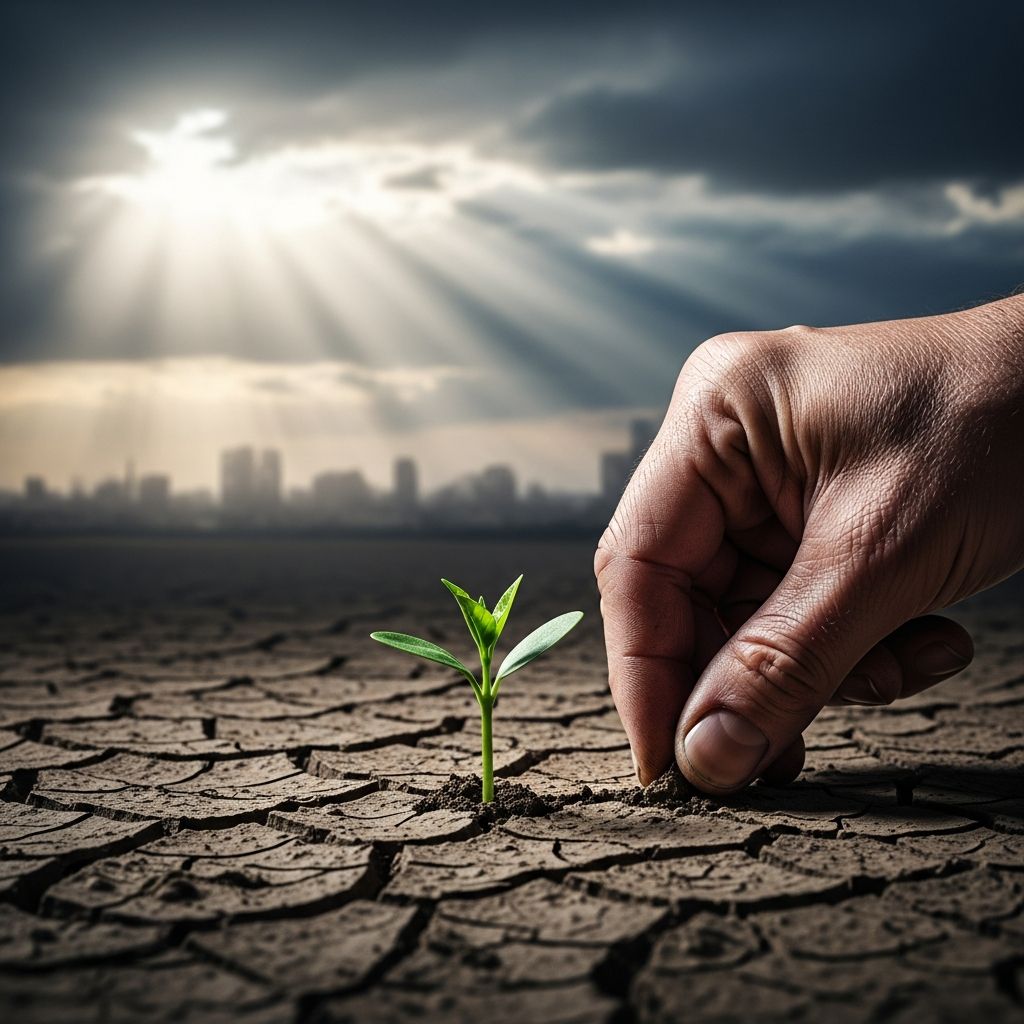
When the Sun Fades: Rethinking Food in a Global Emergency
Most of us assume that food will always be available. Supermarkets stay stocked, farms keep producing, and global trade routes remain open. But what happens if a sudden, extreme event—like a nuclear war, a massive asteroid impact, or a supervolcanic eruption—blocks sunlight for months or years? In such a scenario, conventional agriculture collapses. Crops fail, livestock starve, and the global food system unravels.
Yet even in these worst-case conditions, humanity might still survive. A growing body of research focuses on what are called resilient food systems: alternative ways to feed people when sunlight-dependent agriculture is no longer viable. These systems rely on technologies and resources that don’t depend on photosynthesis, such as repurposed industrial infrastructure and fast-growing marine crops like seaweed.
The Limits of Stockpiling and Bunkers
When people think about surviving a global catastrophe, they often imagine stockpiling food or retreating into underground bunkers. While these strategies make sense for short-term disruptions, they fall apart in prolonged scenarios.
- Stockpiling enough food to feed billions for years is astronomically expensive and logistically unfeasible.
- Bunkers require massive energy inputs to grow food artificially, often using inefficient methods like hydroponics powered by fossil fuels or nuclear energy.
- Even if some people survive in isolated shelters, the broader collapse of society, infrastructure, and trade would make long-term recovery extremely difficult.
The real challenge isn’t just keeping a few people alive for a few months. It’s maintaining a functioning global population—billions of people—through a years-long crisis, so that civilization can eventually rebuild.
Turning Paper Mills into Food Factories
One of the most counterintuitive ideas in resilient food planning is the repurposing of paper mills. These large industrial facilities are designed to process cellulose from wood into paper, but in a sunlight-starved world, they could be adapted to produce edible food.
The basic concept is simple: use the existing machinery and infrastructure of paper mills to break down cellulose into sugars, then ferment those sugars into edible products like single-cell proteins, fats, or even direct human food. This avoids the need to build entirely new factories from scratch, which would be impossible during a crisis.
Key advantages of this approach include:
- Existing infrastructure: Paper mills are already widespread, have large processing capacity, and are connected to energy and water supplies.
- Scalability: A single large mill can process thousands of tons of biomass per day, potentially feeding millions of people.
- Feedstock flexibility: In addition to wood, the system can use other cellulose-rich materials like agricultural residues, non-edible plant matter, and even some types of waste.
During a catastrophe, the focus would shift from producing paper to producing food. The same boilers, digesters, and drying systems that once made paper could instead produce nutrient-dense food products that can be distributed through existing supply chains.
Seaweed: The Ocean’s Emergency Crop
While paper mills offer a land-based solution, the ocean provides another powerful option: seaweed. Unlike traditional crops, seaweed doesn’t require arable land, freshwater, or fertilizers. It grows rapidly, absorbs carbon dioxide, and can be cultivated in vast offshore areas without competing with terrestrial agriculture.
In a global catastrophe, seaweed could become a primary food source for several reasons:
- Fast growth: Some species of seaweed can double in mass in just days, allowing for rapid scaling of production.
- Low input requirements: Seaweed farming needs minimal infrastructure—mainly ropes, buoys, and anchors—and can be expanded quickly with relatively modest investment.
- Nutritional value: Seaweed is rich in protein, fiber, vitamins, and minerals, making it a viable staple food, especially when combined with other resilient food sources.
One of the most promising strategies is large-scale offshore seaweed farming. By stringing ropes across the ocean surface and attaching small pieces of seaweed, entire “farms” can be created in areas with favorable currents and temperatures. These farms can be managed by relatively small crews and scaled up dramatically in a short time.
How Much Food Could These Systems Provide?
Estimates suggest that a combination of repurposed paper mills and expanded seaweed farming could supply a substantial portion of global calorie needs during a prolonged catastrophe.
For example:
- A single large paper mill, converted to food production, could potentially feed hundreds of thousands of people per year, depending on the efficiency of the conversion process and the type of food produced.
- Seaweed farming, if scaled aggressively, could theoretically produce enough calories to meet or even exceed current global human requirements, given sufficient ocean area and infrastructure.
While neither system alone would be sufficient to feed everyone, together they form a powerful backup. When combined with other resilient food strategies—such as using electricity to grow microbes that convert methane or hydrogen into protein—they could keep global starvation at bay even in the worst scenarios.
Energy and Nutrient Constraints
No food system can function without energy and nutrients. In a post-catastrophe world, both become critical bottlenecks.
Energy: Paper mills and seaweed farms still require energy for processing, transportation, and maintenance. In a crisis, energy would likely come from a mix of surviving fossil fuel reserves, nuclear power, and renewable sources like hydroelectric and wind. The key is to maximize the energy return on energy invested (EROEI) so that more energy is produced in food than is consumed in making it.
Nitrogen and phosphorus: These are essential for both microbial food production and seaweed growth. In a catastrophe, traditional fertilizer production may collapse, so alternative sources become vital. These could include:
- Recycling human and animal waste through advanced sanitation systems.
- Extracting nutrients from seawater or wastewater.
- Using nitrogen-fixing microbes in combination with seaweed or other crops.
Planning for nutrient cycling in advance—through research, infrastructure design, and policy—could dramatically improve the resilience of any backup food system.
From Theory to Practice: Building Resilience Now
The most important insight from this work is that preparation must happen before a catastrophe. Waiting until a crisis hits to figure out how to convert paper mills or scale seaweed farming is far too late.
Concrete steps that can be taken today include:
- Research and development: Funding studies on the most efficient ways to convert cellulose into food, optimize seaweed growth conditions, and integrate these systems into existing supply chains.
- Pilot projects: Running small-scale demonstrations of paper mill conversion and large-scale seaweed farming to test logistics, costs, and scalability.
- Policy and planning: Encouraging governments and international organizations to include resilient food systems in disaster preparedness and climate adaptation plans.
- Public awareness: Educating policymakers, engineers, and the public about the feasibility and importance of backup food options.
Investing in these areas now is vastly cheaper and more effective than trying to improvise during a crisis. A relatively small amount of funding today could save millions—or even billions—of lives in the future.
What Individuals Can Do
While large-scale food resilience depends on systemic changes, individuals can still contribute meaningfully.
- Support research organizations: Donate to or volunteer with groups working on resilient food systems, alternative proteins, and disaster preparedness.
- Advocate for preparedness: Encourage local and national governments to consider long-term food security in their emergency planning.
- Build personal resilience: Maintain a modest emergency food supply (e.g., a two-week stockpile) for short-term disruptions like storms or power outages. This is practical and widely recommended, even without considering extreme global catastrophes.
- Reduce waste and improve efficiency: In normal times, reducing food waste and supporting sustainable agriculture indirectly strengthens the overall food system’s resilience.
Individual actions alone won’t solve the problem, but they can help shift norms, increase funding, and build momentum for larger systemic changes.
Broader Implications for Resource Scarcity
The work on resilient food systems also sheds light on broader questions about resource scarcity and long-term sustainability.
Many fears about running out of resources—oil, minerals, arable land—assume that current technologies and systems are fixed. But history shows that when constraints tighten, innovation often accelerates. The same dynamic applies to food: if sunlight becomes scarce, humanity can adapt by using different energy sources and feedstocks.
This doesn’t mean resource limits aren’t real. But it does suggest that with foresight and investment, we can develop systems that are far more resilient than they appear at first glance. The key is to anticipate extreme scenarios and design solutions in advance, rather than waiting for crisis to force adaptation.
FAQs: Resilient Food Systems
Could seaweed really feed billions of people?
Yes, in principle. Seaweed grows extremely fast and can be cultivated over vast ocean areas. With sufficient infrastructure (ropes, buoys, processing facilities), it could supply a major portion of global calorie needs, especially when combined with other resilient food sources.
Would people actually eat food made from paper mills?
The food wouldn’t be made from paper, but from the same raw material: cellulose. This would be broken down and converted into edible products like microbial protein or sugars, similar to how some alternative proteins are already produced. The final product would be designed to be palatable and nutritious, not like raw paper.
How much would it cost to prepare these systems?
Exact costs depend on scale and location, but studies suggest that investing in resilient food research and pilot projects is extremely cost-effective compared to the potential lives saved. Even a few million dollars in targeted funding could significantly improve global preparedness.
What about vitamins and micronutrients?
Any resilient food system would need to ensure adequate intake of essential vitamins and minerals. This could be achieved through fortification, combining different food sources (e.g., seaweed plus microbial protein), and recycling nutrients from waste streams.
Are these ideas being implemented anywhere?
Some elements are already in use: seaweed farming is growing in several countries, and microbial protein production is being developed for both space missions and terrestrial food security. However, coordinated, large-scale planning for global catastrophe scenarios is still limited and needs more attention and funding.
References
- ALLFED: Alternative Food Network — ALLFED. 2023. https://www.allfed.info/
- Global Seaweed Production and Trade — Food and Agriculture Organization of the United Nations (FAO). 2022. https://www.fao.org/3/cc0467en/cc0467en.pdf
- Energy Return on Investment for Alternative Food Systems — Denkenberger, D. et al. 2019. https://doi.org/10.1016/j.fcr.2019.03.011
- Resilient Food Systems for Global Catastrophic Risks — 80,000 Hours Podcast with David Denkenberger and Sahil Shah. 2021. https://80000hours.org/podcast/episodes/david-denkenberger-sahil-shah-using-paper-mills-and-seaweed-in-catastrophes/

- Integrated M.A. in Applied Linguistics, University of Hyderabad
- 5+ years in editorial, instructional, SEO, and research-based writing
Sneha is a relationships and lifestyle writer with a strong foundation in applied linguistics and certified training in relationship coaching. She brings over five years of writing experience to theskillvault, crafting thoughtful, research-driven content that empowers readers to build healthier relationships, boost emotional well-being, and embrace holistic living. Her writing and insights reflect the belief that beauty, happiness, and wellness…