
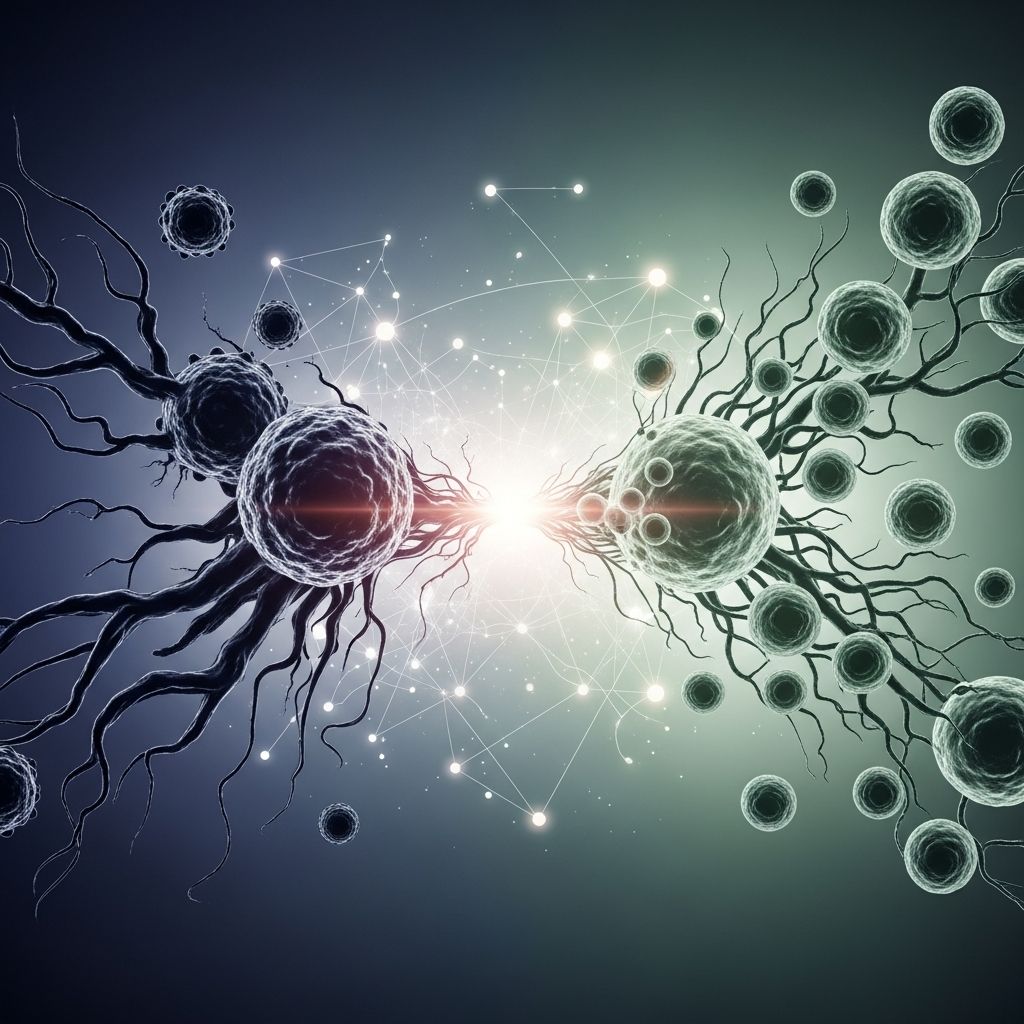
Cancer is often framed as a mysterious invader, something alien that suddenly appears within us. An alternative view from evolutionary biology is more unsettling and more illuminating: cancer is what happens when the fragile cooperation among our cells breaks down. Understanding that breakdown not only reshapes how we treat tumours; it also reveals deep lessons about human societies, technological risks, and how cooperation might scale if our civilisation spreads beyond Earth.
From Single Cells to Multicellular Societies
Every multicellular organism is effectively a vast society of cells. To create a functioning body, trillions of cells must coordinate their behaviour so that the organism can survive and reproduce. This coordination relies on a suite of cooperative rules, including:
- Controlled growth — cells divide when needed and stop when their job is done.
- Programmed cell death — damaged or dangerous cells self-destruct through apoptosis to protect the whole.
- Division of labour — different cell types specialise in tasks such as immunity, structural support, or signal transmission.
- Resource sharing — cells exchange nutrients, oxygen, and signals rather than hoarding them for short-term gain.
- Environmental stewardship — cells keep their local tissue environment stable so other cells can function.
Over evolutionary time, these rules emerged as adaptations that allowed collections of cells to become integrated organisms. When those rules are followed, you get a stable multicellular body. When they fail, you get cancer.
Cancer as Cellular Cheating
Evolutionary oncologists describe cancer cells as cheaters in the cellular commons. Instead of investing in the shared project of maintaining the organism, they divert resources for their own unchecked growth. Common cheating strategies include:
- Ignoring growth limits — continued proliferation even when signals say “stop.”
- Evading self-destruction — disabling apoptosis pathways so damaged cells survive.
- Abandoning specialised roles — reverting to more primitive, undifferentiated states.
- Resource monopolisation — promoting new blood vessels and hijacking nutrients.
- Damaging the neighbourhood — altering the extracellular matrix and local conditions to favour tumour growth at the expense of healthy tissue.
In this light, cancer is not a completely foreign process but an evolutionary strategy that reappears whenever cooperative safeguards are breached. That helps explain why cancer shows up in almost every complex multicellular lineage studied so far.
Why Cancer Appears Across the Tree of Life
Comparative research across animals and even some plants shows that cancer-like growths are widespread in multicellular life. According to evolutionary theory, this is expected:
- Any multicellular organism must manage conflicts between what is best for individual cells and what is best for the organism.
- Mutations that let cells exploit the system can arise repeatedly over evolutionary time.
- Natural selection can then act both on cheater cells within individuals and on mechanisms that organisms evolve to suppress cheating.
This tension sets up an evolutionary arms race: tumours evolve new ways to circumvent control, while organisms evolve new layers of defence.
| Level of organisation | Cooperation needed | Type of cheating |
|---|---|---|
| Cells within a body | Growth control, apoptosis, resource sharing | Cancer cells proliferating at the organism’s expense |
| Individuals in a group | Reciprocity, norm-following, public-good contributions | Free-riding, exploitation, rule-breaking |
| States in the international system | Arms control, climate cooperation, trade rules | Defection on treaties, arms races, resource grabs |
Seeing the parallels across scales suggests that tools for managing cheating in cellular systems may inform how we design robust human institutions — and vice versa.
How Bodies Evolve to Suppress Cancer
Given that larger bodies have more cells and more cell divisions, one might expect big animals to get much more cancer than small ones. Empirically, that is not what we see, a puzzle known as Peto’s paradox. Comparative studies show that large, long-lived species often evolve stronger anti-cancer mechanisms. For example:
- Elephants possess around twenty copies of the tumour-suppressor gene TP53, compared with one copy in humans, and their cells are more likely to undergo apoptosis in response to DNA damage.
- Species with extreme lifespans frequently display enhanced DNA repair, cell-cycle control, or immune surveillance compared with relatives that have shorter lifespans.
These adaptations illustrate a general rule: as cooperation becomes more elaborate, organisms must invest more in policing and repair. Too little oversight, and cheaters can bring the whole system down; too much, and growth, reproduction, or regeneration become impossible.
Rethinking Treatment: From Eradication to Containment
Traditional oncology aims to eliminate tumours entirely, often through maximum tolerated doses of chemotherapy or radiation. Evolutionary thinking suggests that this approach can backfire. Aggressive treatment may kill off sensitive cancer cells while strongly selecting for resistant ones, similar to how overuse of antibiotics selects for drug-resistant bacteria.
One proposed alternative is adaptive therapy, which views treatment as managing an evolving ecosystem within the body rather than waging total war. Core ideas include:
- Accepting that some tumours cannot be eradicated safely once they are advanced.
- Using lower or intermittent doses to contain tumour growth rather than driving it to zero.
- Maintaining a population of treatment-sensitive cells that can competitively suppress resistant clones when the drug is paused.
- Adjusting dosing dynamically based on how the tumour responds over time.
Early clinical trials in metastatic prostate cancer suggest that adaptive therapy can prolong time to progression and reduce cumulative drug exposure in some patients, although more research is needed to evaluate broader applicability and long-term outcomes.
When Cells Choose to Die
Apoptosis — programmed cell death — is one of the most striking cooperative behaviours in biology. A cell with severe DNA damage or abnormal signalling can pose a risk to the organism. Many cells therefore possess complex molecular circuits that monitor internal and external cues and trigger self-destruction when risk crosses a threshold.
From a cooperation perspective, apoptosis represents:
- Self-sacrifice — giving up cellular survival for the organism’s long-term benefit.
- Policing — eliminating potential cheaters before they expand.
- Information integration — combining signals about DNA damage, growth factors, and tissue context to decide whether to live or die.
Many cancers disable or circumvent apoptosis pathways, allowing damaged or abnormal cells to persist and accumulate further mutations. Restoring or mimicking these self-destruct signals is a major goal of some targeted therapies.
Deliberate Tumours and Controlled Proliferation
Not all tumour-like growth is purely pathological. The body sometimes harnesses similar mechanisms in tightly regulated ways. Examples include:
- Wound healing — rapid cell proliferation and migration that resembles some aspects of tumour growth, but is normally switched off once repair is complete.
- Developmental structures — transient growths or tissues that form during development and are later remodelled or removed.
The same cellular toolkit — division, migration, remodelling of the environment — can support either cooperative repair or destructive cancer, depending on how it is regulated and policed.
Human Societies as Multicellular Analogues
The analogy between bodies and societies is imperfect, but it is fruitful. Both are cooperative systems vulnerable to cheating. Lessons from cancer can therefore inform how we think about social breakdown and large-scale risk.
Parallels include:
- Public goods — just as cells contribute to the extracellular matrix and shared signalling environment, citizens support infrastructure, norms, and institutions.
- Cheating behaviour — corruption, fraud, or exploitation resemble cells that hoard resources or ignore growth controls.
- Policing and repair — legal systems, transparency mechanisms, and cultural norms act like tumour-suppressor genes and immune surveillance.
If control mechanisms are too weak, exploitative behaviour can spread and destabilise institutions. If they are too strong or inflexible, innovation and adaptation can be stifled. The challenge is to design systems where cooperation is stable yet flexible enough to handle shocks — a problem evolution has been testing for hundreds of millions of years.
Cooperation at Planetary and Cosmic Scales
Looking ahead, humanity faces collective risks — from climate change to engineered pathogens to uncontrolled artificial intelligence — that require unprecedented levels of cooperation between states, organisations, and generations. Insights from cancer research highlight several principles for building resilient large-scale cooperation:
- Early detection — just as screening can catch tumours before they metastasise, robust monitoring can identify emerging threats and norm violations early.
- Distributed defences — relying on a single barrier is fragile; multilayered safeguards, redundancy, and diversity (analogous to multiple tumour-suppressor pathways) make systems harder to corrupt or overwhelm.
- Adaptive governance — rigid, one-shot responses can select for more sophisticated forms of cheating; adaptive policies that update in response to behaviour may be more effective.
- Aligning incentives — where possible, design institutions so that individual success depends on maintaining the health of the whole, rather than extracting value from it.
These lessons become even more salient if humanity eventually spreads beyond Earth. Civilisations spanning planets or star systems would face the same underlying tension: local entities (colonies, corporations, autonomous systems) have incentives that may diverge from those of the broader civilisation. Avoiding a kind of “civilisational cancer” — expansion that undermines long-term survival — may require governance structures that echo the best features of multicellular control systems while avoiding their vulnerabilities.
Practical Implications for Medicine and Policy
Seeing cancer through the lens of cooperation and cheating does not replace molecular biology or clinical practice, but it reframes questions and suggests new strategies.
For cancer research and treatment
- Integrate evolutionary and ecological models into clinical decision-making, especially for advanced cancers where eradication is unlikely.
- Develop biomarkers of cooperation breakdown in tissues, such as changes in extracellular matrix or signalling networks.
- Design trials that compare containment-focused regimens like adaptive therapy with standard maximal-dose approaches.
- Study species with exceptional cancer resistance (e.g., elephants) to inspire human interventions.
For broader cooperation challenges
- Apply concepts like cheater detection, costly signalling, and multilevel selection to the design of institutions and treaties.
- Invest in early-warning systems for social and technological tipping points, analogous to cancer screening.
- Encourage cross-disciplinary work between evolutionary biologists, oncologists, economists, and political scientists to share tools for understanding cooperation and conflict.
Frequently Asked Questions (FAQs)
Q: Is cancer really inevitable in complex multicellular organisms?
A: Evidence across many animal species suggests that some level of cancer risk is an inherent byproduct of having large numbers of dividing cells, even though evolutionary processes can substantially reduce — but not entirely eliminate — that risk.
Q: Does thinking of cancer as cheating change how doctors treat it?
A: It does not replace existing treatments, but it encourages strategies that manage tumours as evolving ecosystems, such as adaptive therapy and combination regimens explicitly designed to slow resistance rather than simply maximise short-term tumour kill.
Q: Can society become “cancerous” in a literal sense?
A: Cancer is strictly a biological process, but the analogy helps illuminate how unchecked exploitative behaviour can damage the larger systems on which it depends, whether in economies, political systems, or global commons management.
Q: Why study cancer in animals like elephants or clams?
A: Comparing cancer incidence and defence mechanisms across species reveals how evolution has solved cooperation problems in different lineages, highlighting protective strategies that might inspire new human therapies or prevention approaches.
Q: Does better cancer suppression always come with trade-offs?
A: Often yes. Stronger policing mechanisms can carry costs, such as higher energy use, slower regeneration, or increased risk of diseases where the immune system or repair processes are overactive, reflecting the general trade-offs that shape all cooperative systems.
References
- The Cooperation Lab (Aktipis) — Arizona State University Department of Psychology. 2024-05-01. https://psychology.asu.edu/research/labs/cooperation-lab
- Harvard talk envisions path to containing cancer — Harvard Gazette (Athena Aktipis lecture summary). 2018-04-20. https://news.harvard.edu/gazette/story/2018/04/harvard-talk-envisions-path-to-containing-cancer/
- The Cheating Cell: How Evolution Helps Us Understand and Treat Cancer (Book Review) — JAMA Network. 2021-03-15. https://pmc.ncbi.nlm.nih.gov/articles/PMC7947955/
- Cancer across the tree of life: cooperation and cheating in multicellularity — Proceedings of the Royal Society B (Aktipis et al.). 2015-06-22. https://royalsocietypublishing.org/doi/10.1098/rstb.2014.0219
- Multicellular cooperation and the hallmarks of cancer — Evolution, Medicine, and Public Health. 2024-02-14. https://academic.oup.com/emph/advance-article/doi/10.1093/emph/eoaf026/8258661

Medha Deb is an editor with a master's degree in Applied Linguistics from the University of Hyderabad. She believes that her qualification has helped her develop a deep understanding of language and its application in various contexts. Medha specializes in the areas of beauty, health, sports, and wellness and is committed to ensuring that the content on the website is…