
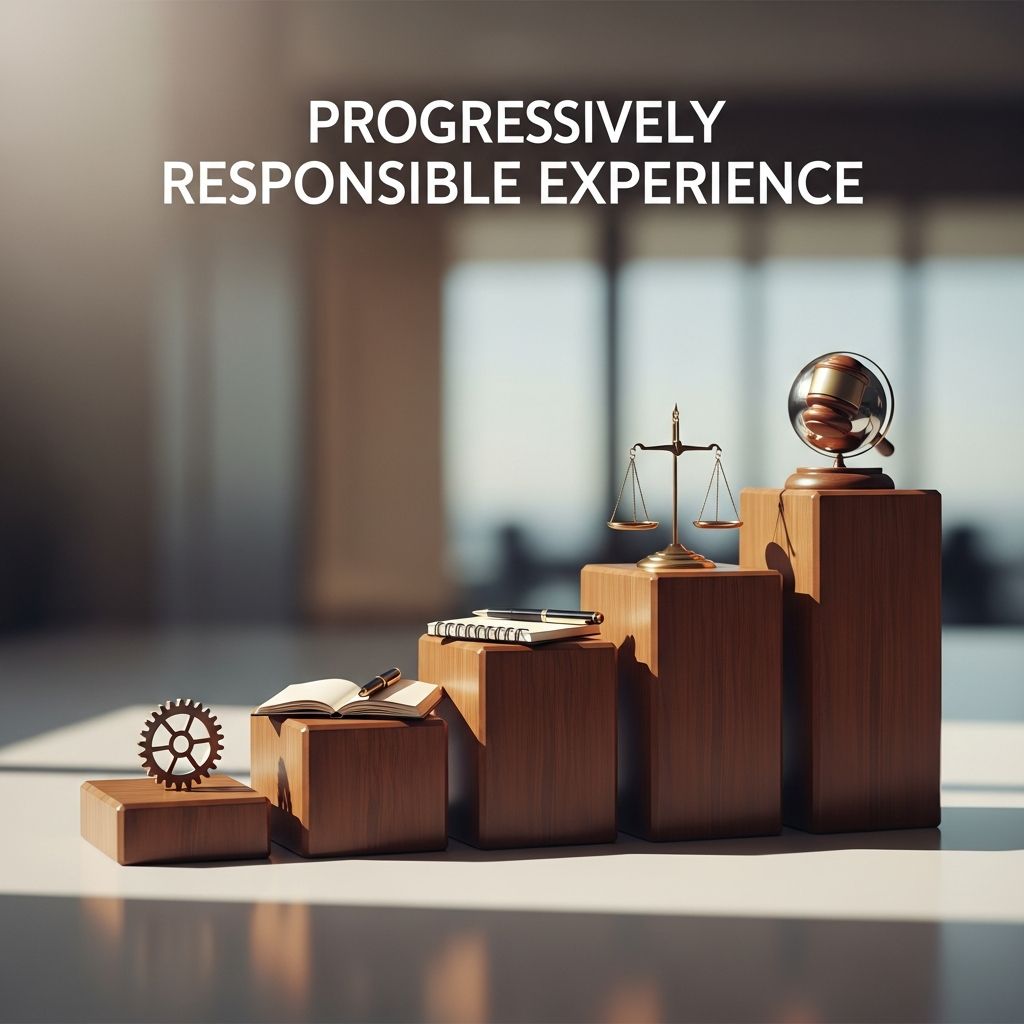
Employers often add a short but confusing phrase to job descriptions: “progressively responsible experience.” If you have ever wondered whether your background fits that requirement or how to present it effectively, you are not alone.
This article explains what hiring managers mean by progressively responsible experience, how to recognize it in your own history, and how to showcase it on your resume, LinkedIn profile, and in interviews.
What Does “Progressively Responsible Experience” Actually Mean?
When an employer asks for progressively responsible experience, they are looking for evidence that your responsibilities, autonomy, and impact have grown over time, rather than staying flat from year to year.
It usually implies that, as your career has advanced, you have:
- Taken on more complex tasks instead of repeating only basic work
- Handled greater autonomy and less day-to-day supervision
- Influenced larger projects, budgets, or decisions
- Shown that managers trusted you with higher-stakes work
- Possibly supervised, mentored, or trained others
In other words, they want reassurance that you have not simply been in the same kind of role for years without expanding your scope.
Why Employers Care About Progressive Responsibility
Employers use this phrase as a shorthand for several qualities they hope to see in applicants:
- Learning ability: you can move beyond entry-level tasks and master new skills over time.
- Judgment and reliability: managers trusted you with important work because you performed consistently.
- Adaptability: you can handle new tools, processes, stakeholders, and environments.
- Future potential: you are likely to keep growing and may be a candidate for promotion later.
These expectations align with broader hiring trends in which employers emphasize adaptability, problem-solving, and long-term potential as key selection criteria.
How to Tell if Your Background Shows Progressive Responsibility
You might have progressively responsible experience even if you have never had a fancy title change. Look for signs such as:
- You started with basic tasks and later moved into work that required decision-making or judgment.
- You went from following detailed instructions to designing processes or suggesting improvements.
- You initially supported projects and later owned deliverables or led workstreams.
- You were asked to train new hires, mentor peers, or step in when your manager was unavailable.
- Your involvement expanded from a narrow function to cross-team or cross-department work.
These patterns matter even in roles that do not include formal people management.
Common Misconceptions About Progressive Responsibility
| Misconception | What Employers Actually Mean |
|---|---|
| It only counts if I was promoted to a higher title. | Title changes help, but expanded duties, autonomy, and impact are often more important. |
| I must have managed a team to qualify. | Managing people is one form of responsibility, but owning complex work or critical processes also shows progressive responsibility. |
| If I stayed in one job for years, it doesn’t count. | Long tenure is fine if your role evolved and you can describe that evolution clearly. |
| Career breaks automatically disqualify me. | Employers mainly care that your responsibility increased during the times you were working. |
Signals of Progressive Responsibility Employers Look For
When reviewing your application, hiring managers scan for specific clues that your responsibilities have grown. Clear indicators include:
- Promotions or reclassifications (e.g., Analyst → Senior Analyst → Manager)
- Scope expansion (from one location or product line to multiple; from assisting to owning)
- Increased complexity (more technical, strategic, or cross-functional assignments)
- Budget or revenue responsibility (managing costs, revenue targets, or financial risk)
- Policy or process authority (creating, revising, or approving procedures)
- Representation roles (being the point of contact for clients, senior leadership, or regulators)
How to Show Progressive Responsibility on Your Resume
Your resume should help an employer see the arc of your growth at a glance. Some practical techniques:
Use Structure to Show Advancement
- Group multiple positions under the same employer to highlight promotion paths.
- Under a single job title held for several years, use subheadings by year or phase to show how your role expanded.
- List key achievements in order of responsibility, not just chronology.
Write Bullet Points that Emphasize Growth
Instead of repeating similar duties every year, emphasize how your work changed:
- Start with earlier, simpler responsibilities, then move toward later, more advanced tasks.
- Use strong verbs that reflect ownership, such as led, designed, implemented, negotiated, advised, approved.
- Quantify changes whenever possible: size of teams, budgets, number of clients, or performance improvements.
Highlight Trust and Autonomy
Sprinkle brief context that signals trust:
- “Selected by senior leadership to…”
- “Served as primary contact for…”
- “Trusted to handle escalated issues involving…”
These phrases show that someone in authority believed you could handle work above the basic level, which is a core part of progressive responsibility.
Making Your Cover Letter Work Harder for You
Your cover letter is the ideal place to connect the dots explicitly.
- Call out that your career shows a pattern of growing responsibility.
- Briefly describe how each role gave you more scope, complexity, or decision-making authority than the last.
- Use one short story that illustrates a moment when you handled work that was previously above your level and succeeded.
Employers often rely on cover letters to interpret non-linear histories or modest job titles, especially in competitive hiring markets.
Talking About Progressive Responsibility in Interviews
In an interview, you can reinforce this theme by framing your answers around growth and increasing impact.
Explain Your Career “Trajectory”
- Describe where you started, the skills you built, and how that prepared you for the next step.
- Point out moments when you stepped into more responsibility, formally or informally.
- Connect this pattern to the role you are seeking: show that the next logical step is the kind of work they need done.
Use Examples that Show Increasing Stakes
Choose interview stories that demonstrate:
- Handling a larger project than you had before
- Making a decision with real financial, operational, or reputational impact
- Resolving a complex or politically sensitive issue
- Influencing stakeholders more senior than you
Each of these illustrates that you can operate at a higher level of responsibility than a purely entry-level contributor.
What If Your Career Path Is Non-Linear?
Few people have perfectly linear careers. Employers increasingly recognize that careers often involve lateral moves, career changes, and breaks, especially as workers adapt to economic shifts and evolving family responsibilities.
You can still show progressive responsibility by:
- Explaining how you applied transferable skills (analysis, leadership, communication) in very different contexts.
- Highlighting how each major phase of your career involved more complexity or autonomy than the one before, even if the industry changed.
- Being transparent and brief about breaks, focusing on what you bring now rather than apologizing for gaps.
Examples of Progressive vs. Flat Experience
| Flat Experience | Progressively Responsible Experience |
|---|---|
| Repeating the same daily tasks for years with no change in scope, little initiative, and no new skills. | Starting with basic tasks, then taking ownership of a process, then improving or redesigning that process for better results. |
| Supporting meetings by taking notes and never engaging in planning or decision-making. | Beginning as a note-taker, then drafting agendas, and eventually leading meetings and driving decisions. |
| Serving customers only at a front-line level with no additional duties. | Serving customers, then handling escalations, then training others in customer service best practices. |
How Much Progressive Experience Do Employers Want?
Some job ads specify a particular number of years, such as “five years of progressively responsible experience.” This does not usually mean five years of management, only that:
- Your first year or two established a foundation of skills.
- Later years involved more independent work, decisions, and results.
If you are slightly below the posted requirement but can demonstrate very clear growth and strong results, many employers are willing to consider you, particularly in tight labor markets where skill shortages exist.
Practical Checklist: Do You Show Progressive Responsibility?
Use this quick checklist to evaluate the story your materials tell:
- Do at least some of your roles show a step up in scope, difficulty, or independence?
- Can you name 2–3 situations where your manager trusted you with work beyond your prior level?
- Does your resume use strong, specific verbs and metrics to signal impact?
- Does your cover letter explicitly mention your increasing responsibility over time?
- Can you tell a clear, concise story of your career trajectory in under two minutes?
If you can honestly answer “yes” to most of these questions, you likely have the kind of experience many employers mean when they say they want progressively responsible experience.
Frequently Asked Questions (FAQs)
Q: Does progressive responsibility always mean managing people?
A: No. Managing others is one kind of responsibility, but owning complex projects, processes, budgets, or decisions also counts as progressive responsibility.
Q: Can I show progressively responsible experience if I stayed at the same company for a long time?
A: Yes, as long as your role evolved. Emphasize changes in scope, decision-making, and impact even if your title did not change.
Q: What if I switched careers—does my earlier experience still help?
A: Earlier roles can still demonstrate growth in transferable skills like leadership, analysis, or stakeholder management. Make those connections explicit in your resume and interviews.
Q: How should new graduates think about progressive responsibility?
A: Look at internships, part-time jobs, volunteer roles, and campus activities. Any situation where your tasks became more complex or you earned more trust can illustrate early progressive responsibility.
Q: If a job asks for progressively responsible experience and I am unsure I qualify, should I still apply?
A: If you can show clear growth in duties and impact over time, it is usually worth applying, especially if you meet most other requirements and can explain your trajectory clearly.
References
- Employment Outlook 2023 — Organisation for Economic Co-operation and Development (OECD). 2023-09-01. https://www.oecd.org/employment/oecd-employment-outlook-19991266.htm
- The Future of Jobs Report 2023 — World Economic Forum. 2023-04-30. https://www.weforum.org/reports/the-future-of-jobs-report-2023/
- Job Market Signaling — Michael Spence, The Quarterly Journal of Economics. 1973-08-01. https://doi.org/10.2307/1882010
- Resumes and Cover Letters — Harvard Office of Career Services. 2022-11-01. https://ocs.fas.harvard.edu/resumes-cover-letters
- Resumes and CVs — MIT Career Advising & Professional Development. 2023-02-15. https://capd.mit.edu/resources/resumes-cvs/

- Integrated M.A. in Applied Linguistics, University of Hyderabad
- 5+ years in editorial, instructional, SEO, and research-based writing
Sneha is a relationships and lifestyle writer with a strong foundation in applied linguistics and certified training in relationship coaching. She brings over five years of writing experience to theskillvault, crafting thoughtful, research-driven content that empowers readers to build healthier relationships, boost emotional well-being, and embrace holistic living. Her writing and insights reflect the belief that beauty, happiness, and wellness…