
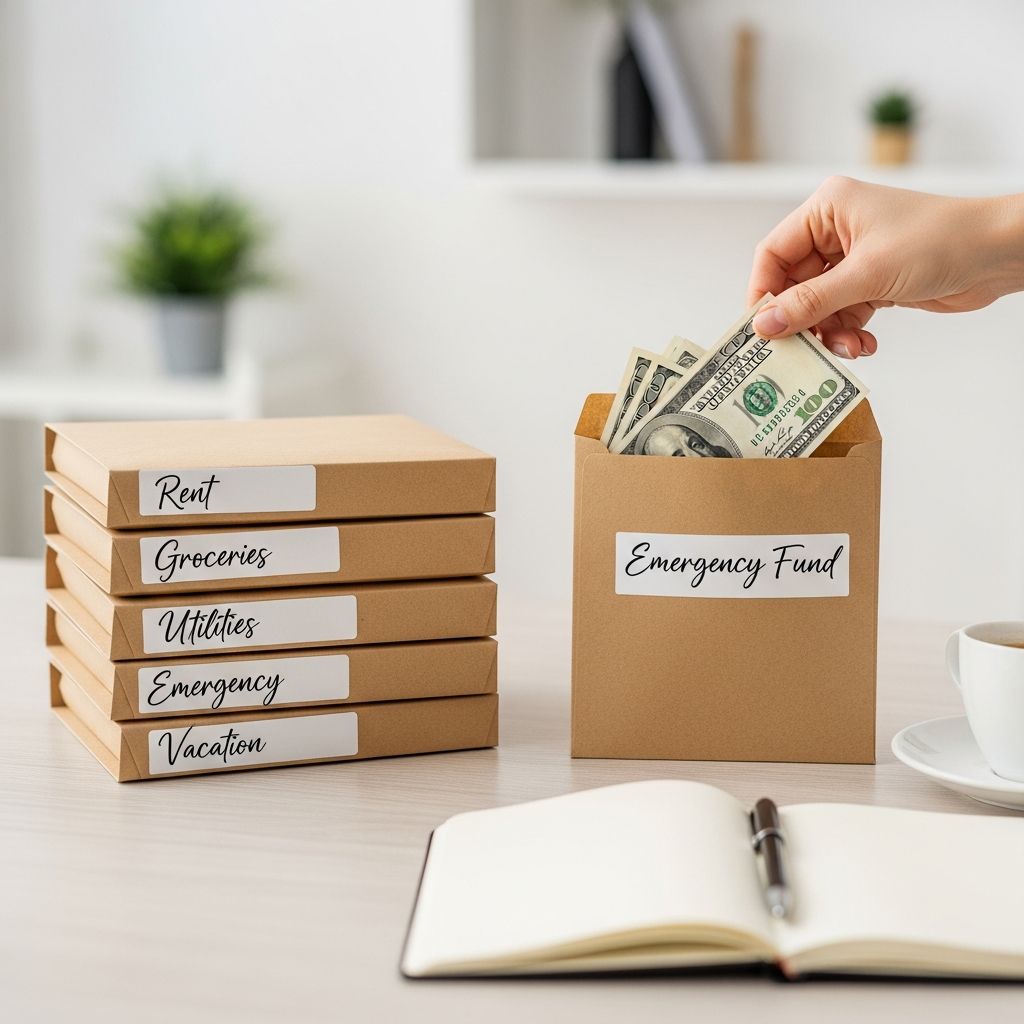
The envelope challenge has become a popular way to save because it is simple, visual, and even a little bit fun. Instead of treating saving as a vague intention, you turn it into a concrete game with clear rules, envelopes, and a visible pile of progress over time.
This guide explains how envelope challenges work, how to adapt them to different incomes and lifestyles, and how to avoid the most common pitfalls so your challenge becomes a lasting money habit rather than a one-time experiment.
What Is an Envelope Saving Challenge?
An envelope saving challenge is a short- or medium-term commitment to save specific amounts of money using individual envelopes (physical or digital). Each envelope represents a particular amount, date, or goal, and you gradually fill them until you reach a target total.
Financial educators often highlight that visual, rule-based systems like this can help people stick to plans better than vague resolutions, especially when goals are broken into smaller, manageable steps.
How It Differs from Traditional Budgeting
- Traditional budget: You plan monthly income and expenses by category, usually in a spreadsheet or app.
- Envelope challenge: You focus on a specific savings target and move set amounts into envelopes following pre-defined rules.
Many people use both together: a budget to manage overall finances and an envelope challenge to accelerate one particular goal, such as an emergency cushion or a vacation fund.
The Classic 100 Envelope Challenge Explained
The most famous version is the 100 envelope challenge, which has been widely discussed by banks and financial institutions as a hands-on savings method.
Basic Rules
In the standard 100-envelope version:
- You have 100 envelopes, each labeled with a number from 1 to 100.
- On each round (daily or weekly), you pick one envelope.
- You save the amount written on the envelope (for example, $32 in envelope 32).
- When all envelopes are filled, you have saved $5,050 in total.
| Parameter | Typical 100 Envelope Setup |
|---|---|
| Number of envelopes | 100 numbered 1–100 |
| Savings per envelope | Matches the envelope number (e.g., #47 → $47) |
| Common timeframe | 100 days or 100 weeks |
| Total saved at completion | $5,050 |
| Difficulty level | Moderate to high as amounts rise |
Step-by-Step: Starting the 100 Envelope Challenge
Here is a simple way to launch the challenge while keeping it organized and realistic.
1. Gather and Label Your Envelopes
- Collect 100 small envelopes (or create 100 digital “envelopes” in a spreadsheet or banking app).
- Label each envelope with a number from 1 to 100.
- Store them in a box, drawer, or folder so they stay together.
2. Choose Your Schedule
The original idea is one envelope per day for 100 days, but you can select a slower pace depending on your income and bills.
- Daily: Finish in about 3 months; requires frequent cash flow.
- Weekly: Finish in about 2 years; easier on tight budgets.
- Mixed pace: Some weeks you do more envelopes when income is higher; fewer when it is lower.
3. Pick and Fill Envelopes
- Draw a random envelope during each savings session, or choose specific numbers on purpose.
- Put in cash if you are using physical envelopes, or transfer the amount to a labeled savings account or sub-account if you are going digital.
- Mark envelopes as completed to avoid duplication.
4. Track Progress and Celebrate Milestones
- Record completed envelope numbers in a checklist or notes app.
- Define mini-milestones (for example, every $500) and celebrate with a free or low-cost reward.
- When all envelopes are complete, decide whether to roll directly into a new challenge or shift to another goal.
Pros and Cons of the Envelope Challenge
Like any savings method, envelope challenges work best when you understand their strengths and limits. Financial organizations emphasize that while these challenges can build discipline, they should not replace a basic budget or emergency plan.
Advantages
- Gamifies saving: Turning saving into a game can make it more engaging and easier to stick with.
- Clear, visible progress: You can see envelopes filling up, which can be more motivating than a single growing number in your bank app.
- Built-in structure: The rules (which envelope, which amount, which date) reduce decision fatigue and make saving automatic.
- Flexible formats: You can adapt the number of envelopes, amounts, and schedule to your circumstances.
Drawbacks
- Potential cash-flow strain: Toward the end of a 100 envelope challenge, you may hit several high-number envelopes in a row, which can clash with other bills.
- Not ideal as your only strategy: Experts note that long-term goals like retirement or paying off large debts still require broader planning beyond short challenges.
- Cash storage risk: If you use physical cash at home, there is some risk of loss or theft; banks and regulators typically recommend insured accounts as safer options.
Customizing the Challenge to Your Budget
The most important part of any envelope challenge is whether it fits your actual income and expenses. Sustainable saving comes from realistic targets rather than extreme short bursts.
Option 1: Fewer Envelopes, Smaller Total
If $5,050 is too ambitious for now, scale down the entire structure.
- 50-envelope version: Number envelopes 1–50. When all are filled, you reach $1,275.
- 30-envelope version: Number envelopes 1–30 for a total of $465.
- Goal-based version: Decide on your target (for example, $600) and divide it among however many envelopes feels manageable.
Option 2: Smaller Increments
You can also lower the difficulty by using smaller units instead of whole dollars.
- Label 100 envelopes with 0.10, 0.20, 0.30 … up to 10.00 (in your currency).
- This saves roughly one-tenth of the original total (about $505 in this example).
- This approach works well if your current cash flow is tight but you still want the full 100-envelope experience.
Option 3: Longer Timeframes
- Weekly draw: Pull one or two envelopes per week instead of daily.
- Monthly draw: Choose a few envelopes each month, perhaps timed to paydays.
- Seasonal cycles: Use higher-income seasons (such as bonus months) to cover larger numbered envelopes.
Spreading the challenge over months or a year can make it more compatible with a stable, long-term budget.
Other Fun Money-Saving Challenge Ideas
The spirit of the envelope challenge can be applied in many creative ways that keep things interesting while steadily growing your savings.
1. Weekly Step-Up Savings Challenge
This idea is inspired by the well-known 52-week challenge, which some financial educators recommend as a gentle introduction to saving.
- Week 1: Save a small amount (for example, $5).
- Each week: Add the same amount again (for example, increase by $5 per week).
- By week 52: You reach a meaningful total without large jumps at the start.
You can still use envelopes if you like: label each envelope with a week number and savings amount, then fill them as the year goes on.
2. Category Envelope Challenge
Borrowing from the traditional envelope budgeting method, you choose categories instead of numbers:
- Envelopes labeled “Groceries”, “Dining Out”, “Fun”, “Transport”, etc.
- You put a fixed cash allowance into each at the beginning of the month.
- When an envelope is empty, you stop spending in that category until next month.
Here, the challenge is to stick within the boundaries so that whatever is left over at month-end can be transferred to savings.
3. No-Spend Envelope Streaks
This challenge focuses on reducing spending rather than only filling envelopes.
- Pick certain days as “no-spend” days where you avoid discretionary purchases.
- For each successful no-spend day, you move a small predetermined amount (for example, $3 or $5) into a savings envelope.
- Track your longest streak and challenge yourself to beat it.
4. The Windfall Envelope Rule
To avoid lifestyle creep, you can commit to directing a portion of every unexpected income into envelopes:
- Tax refunds
- Bonuses
- Cash gifts
- Side-hustle earnings
Behavioral finance research often points out that people treat windfalls more casually than salary, so adding a rule around them helps turn surprises into progress.
Linking Envelope Challenges to Real Financial Goals
Envelope challenges are most effective when tied to a specific outcome. Personal finance guidance from major providers stresses the importance of prioritizing core goals such as emergency funds, high-interest debt repayment, and retirement planning.
Recommended Goal Priorities
- Emergency savings: Aim for a starter emergency fund (for example, $500–$1,000) if you do not yet have one; many households struggle with even small unexpected expenses, so this is a powerful first step.
- High-interest debt: Once an emergency cushion exists, redirect some challenge money toward credit card or other high-interest balances.
- Short-term dreams: Use envelope challenges for near-term goals like trips, moving costs, or education courses.
- Long-term investing: After high-interest debts are under control, consider shifting some challenge funds into retirement or investment accounts as allowed in your country’s rules.
Practical Tips to Stay on Track
Envelope challenges are simple, but life is not. Use these techniques to keep your plan realistic and resilient.
Protect Your Everyday Budget
- List all essential bills (housing, food, utilities, transport, minimum debt payments) before setting challenge amounts.
- Allocate savings from what remains, not from money already needed for basics.
- If a week is tight, pause or choose low-number envelopes instead of quitting entirely.
Use Digital Tools Wisely
If cash is inconvenient or unsafe, you can recreate envelopes digitally:
- Open multiple labeled sub-accounts or “vaults” in an online bank that permits it.
- Use a spreadsheet or note app with 100 lines, each representing one envelope and amount.
- Automate transfers on payday for specific envelopes to reduce forgetfulness.
Build Accountability and Motivation
- Share your envelope challenge with a trusted friend or partner.
- Consider doing mirrored challenges and checking in weekly.
- Join reputable online communities focused on saving and budgeting for mutual encouragement, keeping in mind that what works for others may need adjustment for your situation.
Frequently Asked Questions About Envelope Challenges
Q: Is the 100 envelope challenge safe to do with cash at home?
A: Using cash can be motivating because it is tangible, but storing large amounts at home carries a risk of loss or theft. Financial institutions and regulators generally recommend keeping significant savings in insured bank accounts instead, where they are protected up to set limits. A hybrid approach works well: track envelopes on paper, but move the actual money into a secure savings account.
Q: What if I cannot afford the larger numbered envelopes?
A: That is a signal to modify the challenge rather than push yourself into overdrafts or new debt. Try fewer envelopes, smaller increments (like 0.10 instead of 1.00), or a longer schedule. The goal is consistency, not perfection or speed.
Q: Should I do an envelope challenge if I still have credit card debt?
A: Many experts advise first building a small emergency cushion so you do not rely on credit cards for every surprise, and then prioritizing extra payments toward high-interest debt. You can design envelopes that direct savings specifically to that debt, combining the motivation of a challenge with a practical payoff.
Q: Can I stop and restart the challenge?
A: Yes. Life changes, and your finances should adapt. If you need a break, pause and protect what you have already saved. When conditions improve, restart with revised rules that better match your new income or obligations.
Q: How do I choose the right challenge for me?
A: Start by clarifying your main goal and how much you can realistically set aside each month without missing essential bills. Then pick a challenge (100 envelopes, weekly step-up, category limits, or a custom design) whose rules fit your income pattern and personality. If you enjoy games and visual progress, the classic envelope format can be especially effective.
References
- The 100 Envelope Challenge Explained — SoFi Bank, N.A. 2023-08-15. https://www.sofi.com/learn/content/100-envelope-challenge/
- The 100 Envelope Challenge: Steps and Tips for Success — Rule Money. 2023-09-01. https://blog.rulemoney.co.uk/the-ultimate-guide-to-the-100-envelope-challenge-steps-and-tips-for-success/
- Saving with the 100 Envelope Challenge: Pros, Cons and Other Budgeting Tips — Thrivent. 2023-05-04. https://www.thrivent.com/insights/budgeting-saving/saving-with-the-100-envelope-challenge-pros-cons-and-other-budgeting-tips
- How to Start the 100 Envelope Challenge — Webster Five. 2023-02-10. https://www.web5.com/how-to-start-the-100-envelope-challenge/
- What Is the 100 Envelope Challenge and How Do You Do It? — Fidelity Investments. 2023-11-03. https://www.fidelity.com/learning-center/smart-money/100-envelope-challenge
- Envelope Saving Method: Budgeting Guide — SmartAsset. 2022-06-21. https://smartasset.com/financial-advisor/envelope-saving-method

- Integrated M.A. in Applied Linguistics, University of Hyderabad
- 5+ years in editorial, instructional, SEO, and research-based writing
Sneha is a relationships and lifestyle writer with a strong foundation in applied linguistics and certified training in relationship coaching. She brings over five years of writing experience to theskillvault, crafting thoughtful, research-driven content that empowers readers to build healthier relationships, boost emotional well-being, and embrace holistic living. Her writing and insights reflect the belief that beauty, happiness, and wellness…