
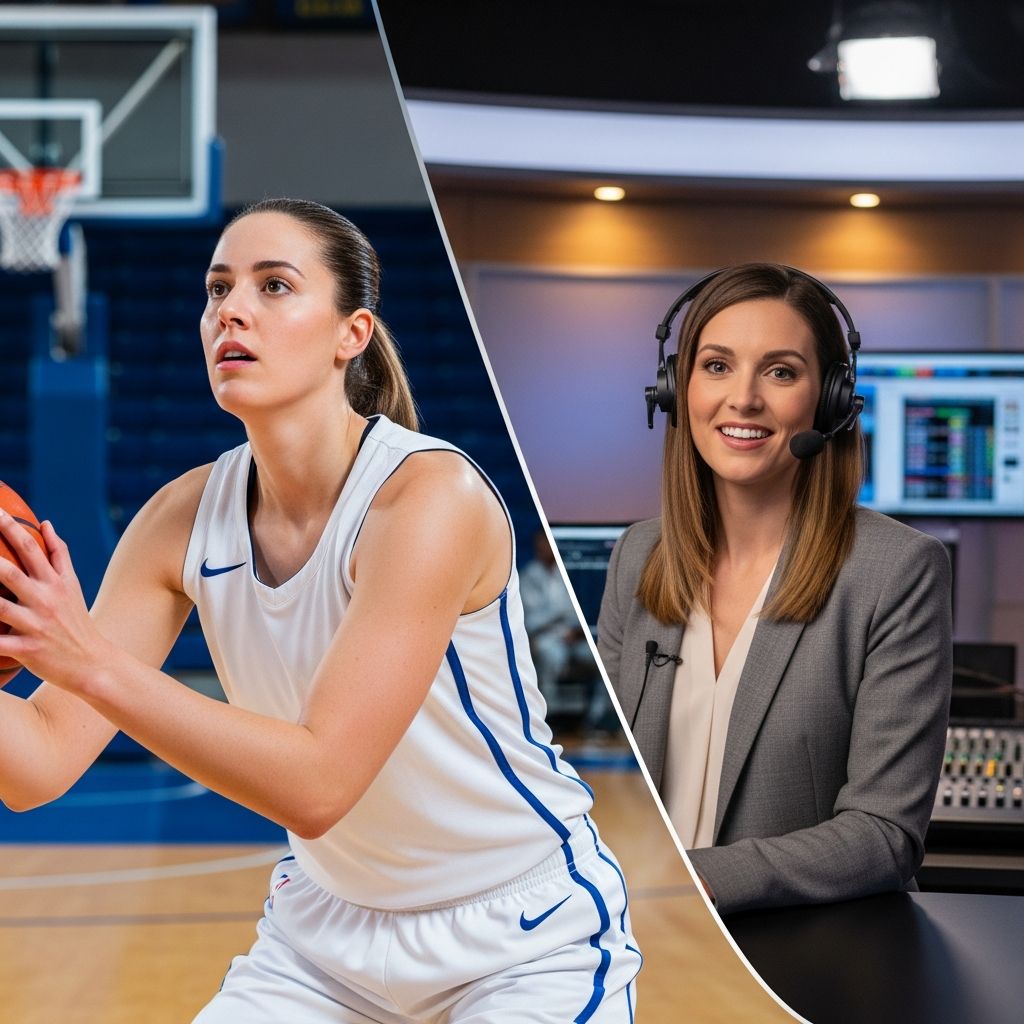
Brooke Weisbrod’s story is a blueprint for turning a major setback into a bold new career. After starring in college basketball and playing professionally in Germany, a serious back injury ended her playing days at just 21. Instead of walking away from the sport she loved, she built a new identity as a respected analyst and broadcaster with ESPN and the Big Ten Network.
This article uses her journey as inspiration to explore how to navigate sudden career changes, build a voice in a competitive industry, and stay grounded in who you are—even when your original plan disappears overnight.
1. The Athlete Who Thought She Had It All Figured Out
Brooke grew up in Ohio in a sports-focused family, playing multiple sports and eventually starring at Coastal Carolina University in basketball, along with competing in tennis and softball. She became one of the program’s standout players, earning honors like Big South Player of the Year and NCAA Woman of the Year for South Carolina. Those accolades reflected not just athletic excellence but also academics and leadership.
After college, she signed to play professionally in Germany, living what many young athletes see as the dream: travel, fans, and a paycheck to play the game she loved. Then, as happens to many athletes, her body had other plans.
When Your Dream Job Disappears Overnight
A back injury—eventually involving multiple herniated discs and surgeries—cut short her professional playing career. In an instant, the identity she had built for years was gone. Research on career transitions in elite athletes shows that forced retirement (especially due to injury) is often associated with loss of identity, anxiety, and depression if not navigated with support and new purpose.
Brooke’s story is not just about the injury; it is about what she did next.
2. Rediscovering Purpose: From Fan in the Stands to Voice on the Air
The turning point came almost by accident. During a visit back to Coastal Carolina for a homecoming game, she was pulled from the stands to join a live radio broadcast for a quick interview. What began as a spontaneous moment turned into an improvised, full-game commentary—and the discovery of a new calling.
She realized that the same instincts that made her a strong player—reading the floor, seeing patterns, understanding pressure and strategy—translated naturally to analyzing the game from behind a microphone. That spark became the seed for an entirely new career.
Transferrable Skills: How Playing Translates to Broadcasting
| On the Court | In the Broadcast Booth |
|---|---|
| Reading plays and anticipating moves | Breaking down strategy in real time for viewers |
| Communicating with teammates under pressure | Coordinating with producers, hosts, and co-analysts live |
| Handling high-stakes moments | Staying composed on-air during tight finishes and controversy |
| Studying opponents and game film | Preparing with research, stats, and storylines before broadcasts |
Brooke’s transition underscores a powerful lesson: your next chapter is rarely about starting from zero. It is often about translating what you already know into a new arena.
3. Building a Career in Sports Broadcasting from the Ground Up
Brooke did not instantly become a national TV analyst. She started with regional coverage and gradually expanded. Her early work with ESPN focused on women’s college basketball, where she first joined as an analyst in the early 2000s. Over time, she added sideline reporting and studio roles, and eventually called men’s college basketball games—something very few women in the U.S. were doing at the time.
What It Really Takes Behind the Scenes
People often see the on-air glamour but not the grind. For aspiring broadcasters, Brooke’s path highlights several essential behind-the-scenes habits:
- Relentless preparation: Analysts are expected to know rosters, trends, injuries, coaching philosophies, and historical context for every game.
- Performance training: Brooke invested in voice, improv, and acting classes to get comfortable on camera and develop a dynamic presence. Media training and communication coaching are common tools for modern broadcasters.
- Multiple income streams early on: While building her broadcasting reputation, she also worked outside of sports, including in metals recycling and advertising sales, before eventually going full-time in broadcasting.
- Networking through performance: Each assignment is essentially an audition for the next one. Showing professionalism, flexibility, and strong on-air chemistry creates future opportunities.
4. Being One of the Few Women in the Room
Brooke is part of a relatively small group of women who regularly analyze men’s college basketball games on national platforms. Historically, sports broadcasting has been dominated by men, particularly in analyst roles. Industry research and reports from advocacy groups point out that, although women’s representation on sports television has grown, they still remain underrepresented and often concentrated in studio host or sideline positions.
Breaking into analyst roles—where you are hired specifically for your expertise and judgment—is a different level of visibility and scrutiny.
Challenges Women Frequently Face in Sports Media
- Credibility tests: Women analysts often face more intense questioning of their knowledge and authority, especially when covering men’s sports.
- Appearance pressure: There is disproportionate focus on how women broadcasters look, versus how well they analyze the game.
- Limited role models: Fewer women at the top means fewer visible paths to emulate.
- Online harassment: Studies have documented disproportionate abuse aimed at women journalists and commentators via social media.
Brooke’s presence on major networks challenges those norms simply by doing the job—calling games, offering insights, and letting expertise speak for itself.
5. Lessons from Brooke’s Career Pivot You Can Apply Anywhere
Even if you never call a game on national TV, Brooke’s path offers broadly applicable career lessons for anyone facing change, uncertainty, or a stalled plan.
5.1 Say Yes Before You Feel Ready
Brooke did not wait until she had formal training or a polished reel to step into broadcasting. She said yes when opportunity unexpectedly called her down from the stands. Many pivotal career shifts begin with imperfect, unscripted moments—volunteering for a project, filling in for someone, or speaking up in a meeting.
Instead of waiting to be fully prepared, she used that unexpected opportunity as a test lab for a new identity.
5.2 Let Your Curiosity Rewrite Your Story
When injury closed the door on playing, she stayed curious about other ways to remain close to the game. Curiosity guided her into broadcasting, then into related roles across radio, studio analysis, and sideline reporting as she explored where her skills fit best.
Research on career development shows that people who treat their path as an ongoing experiment, rather than a rigid plan, adapt more successfully to economic and personal shocks.
5.3 Build a New Identity Around Core Values, Not Job Titles
For years, Brooke’s identity was “basketball player.” After the injury, she rebuilt her sense of self around something deeper: love of the game, respect for athletes, and the desire to tell the story of competition. Broadcasting became a new container for the same core passion.
When a job ends or changes, it helps to ask:
- What parts of this work do I actually love?
- Which skills energize me, not just pay me?
- Where else could these same skills and values apply?
5.4 Embrace the Long, Nonlinear Route
Brooke’s journey from injured player to ESPN personality was not instant. She freelanced, juggled non-sports jobs, took classes, and slowly expanded her role across various networks. Many modern careers are nonlinear—with detours, side gigs, and lateral moves rather than a straight ladder.
Understanding that detours are often part of the process can reduce the pressure to “have it all figured out” right away.
6. Practical Roadmap: How to Pivot into a New Field Like Broadcasting
Inspired by Brooke’s path, here is a practical framework for making a bold career pivot—whether it is into media, a new industry, or a different role altogether.
6.1 Audit Your Skills and Experiences
Start with a clear inventory of what you already bring to the table:
- Domain knowledge: For Brooke, that was deep familiarity with basketball strategy, training, and culture.
- Communication skills: Team leadership, film sessions, and dealing with coaches already taught her how to explain complex ideas under pressure.
- Work ethic: Elite athletic training instills discipline, resilience, and time management, which are valuable in any high-performance role.
6.2 Get Lightweight Experience Quickly
Instead of waiting for a perfect job posting, look for “low stakes” ways to try on the new identity:
- Guest on a podcast or student broadcast.
- Volunteer to host or moderate events.
- Create your own content: game breakdown videos, written analysis, or blogs.
- Shadow professionals who already do the job.
Brooke’s early on-air opportunity came from simply showing up to a game she loved and being willing to step into the booth.
6.3 Invest in Targeted Training
Once you confirm your interest, level up your skills with focused learning. Brooke enrolled in voice, improv, and acting classes to break out of a strict athlete mindset and grow into a more flexible, entertaining on-air personality.
Depending on your goal, this could mean:
- Public speaking or storytelling workshops
- Formal coursework or certificates in your new field
- Coaching in writing, presenting, or leadership
6.4 Accept the Transition Period
Brooke balanced sports broadcasting with other full-time work for years before shifting into ESPN full-time. Many people will go through a similar bridge period—holding onto a stable income while gradually building credibility in a new arena.
Key mindsets for this stage:
- See every freelance or side assignment as both income and education.
- Protect time for rest to avoid burnout during the overlap phase.
- Track tangible progress: portfolio pieces, new connections, skills mastered.
7. Resilience, Reinvention, and Staying True to Your Sports-Loving Self
What stands out in Brooke Weisbrod’s story is not just the impressive resume—college star, professional player, ESPN and Big Ten Network analyst—it is the way she stayed anchored to what she loved while allowing the form of her work to evolve.
Her journey illustrates that you can:
- Lose your original dream job and still build an equally meaningful career.
- Carry your passion into new formats, roles, and industries.
- Be one of the few in the room and help redefine what is considered “normal.”
If you are facing a career ending you did not choose—or simply feel pulled toward a completely different direction—Brooke’s path offers proof that it is possible to reinvent, without abandoning the parts of your past that made you who you are.
Frequently Asked Questions (FAQs)
Q1: Who is Brooke Weisbrod?
Brooke Weisbrod is a former college and professional basketball player who became a sports broadcaster. She has worked as a college basketball analyst and sideline reporter for ESPN, covering both men’s and women’s games, and has also appeared on other major sports networks.
Q2: How did Brooke transition from playing to broadcasting?
After a back injury ended her professional playing career in Germany, Brooke discovered broadcasting when she joined a live radio call at a college game and realized she had a natural talent for analyzing and describing the action. She then built her skills through classes, regional broadcasts, and freelancing before moving into full-time work with ESPN.
Q3: What makes her role in sports media significant?
Brooke is among a relatively small number of women who regularly serve as game analysts—rather than just hosts or sideline reporters—for men’s college basketball on national platforms. Her presence helps expand what viewers and networks see as “normal” in sports commentary and opens doors for more women to take on similar roles.
Q4: What can non-athletes learn from her career path?
Brooke’s journey demonstrates how to translate deep expertise from one field into another, how to leverage unexpected opportunities, and how to navigate forced career transitions with curiosity and resilience. Her approach—experimenting, investing in new skills, and staying close to core passions—applies to anyone considering a major career pivot.
Q5: How can someone start a career in sports broadcasting today?
Aspiring broadcasters can begin by creating their own content, seeking on-air opportunities at the college or local level, studying games closely, and developing communication skills through public speaking or media training. Building a portfolio of work and demonstrating strong preparation and on-air presence are key steps toward being noticed by larger networks.
References
- Career transitions in competitive sports: Conceptual and empirical perspectives — Wylleman, P., & Lavallee, D., Psychology of Sport and Exercise. 2004-01-01. https://doi.org/10.1016/S1469-0292(02)00048-1
- Planned Happenstance Theory of Career Development — Krumboltz, J., Stanford University. 2009-01-01. https://ed.stanford.edu/sites/default/files/krumboltz_planned_happenstance.pdf
- Sports Media Gender Report Card — Institute for Diversity and Ethics in Sport (TIDES). 2022-06-01. https://www.tidesport.org
- Online Violence Against Women Journalists: A Global Snapshot of Incidence and Impacts — UNESCO & International Center for Journalists. 2021-04-01. https://unesdoc.unesco.org/ark:/48223/pf0000377222
- Brooke Weisbrod — ESPN Press Room U.S. 2023-01-01. https://espnpressroom.com/us/bios/weisbrod_brooke/
- Brooke Weisbrod — Coastal Carolina University / Wikipedia entry (biographical summary). 2023-05-01. https://en.wikipedia.org/wiki/Brooke_Weisbrod
- CCU Alumna Brooke Weisbrod On and Off the Court — Grand Strand Magazine. 2019-03-01. https://grandstrandmag.com/feature/ccu_alumna_brooke_weisbrod_on_and_off_the_court

- Integrated M.A. in Applied Linguistics, University of Hyderabad
- 5+ years in editorial, instructional, SEO, and research-based writing
Sneha is a relationships and lifestyle writer with a strong foundation in applied linguistics and certified training in relationship coaching. She brings over five years of writing experience to theskillvault, crafting thoughtful, research-driven content that empowers readers to build healthier relationships, boost emotional well-being, and embrace holistic living. Her writing and insights reflect the belief that beauty, happiness, and wellness…