
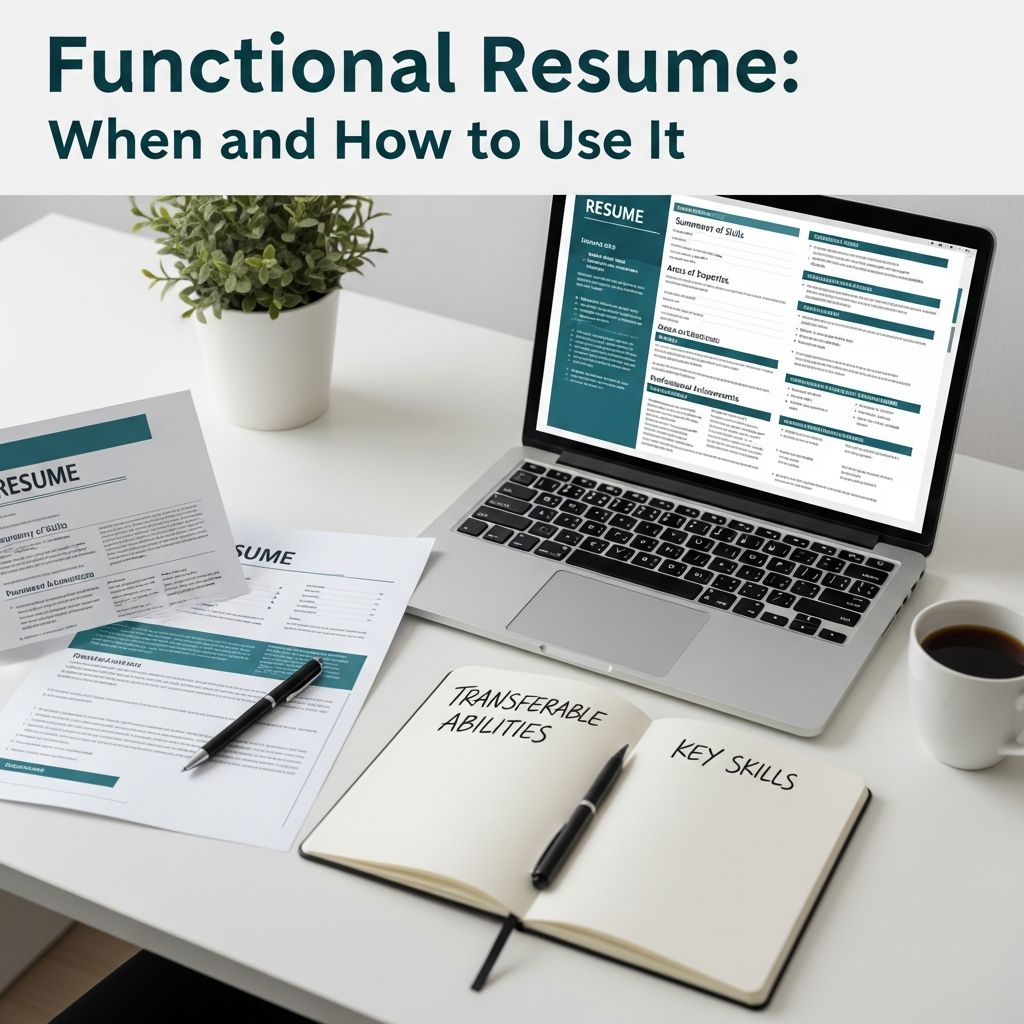
Understanding the Functional Resume Format
A functional resume is a resume style that puts your skills and abilities at the forefront, rather than organizing your background strictly by job history. Instead of leading with a timeline of past roles, this format groups your experience around key skill areas such as project management, customer service, technical proficiency, or leadership.
This approach is especially helpful when your work history doesn’t follow a traditional path. For example, if you’ve had long gaps between jobs, are switching industries, or are early in your career with limited formal experience, a functional resume can help you present your qualifications in the most favorable light.
How It Differs from Other Resume Types
Most job seekers are familiar with the reverse-chronological resume, which lists jobs in order from most recent to oldest. Each position includes the company name, job title, dates of employment, and a series of bullet points describing responsibilities and achievements.
In contrast, a functional resume:
- Starts with a strong summary or objective that aligns with the target role
- Groups accomplishments under skill categories instead of job titles
- Minimizes detailed descriptions of each past job
- Still includes work history, but in a condensed format at the end
There’s also a hybrid or combination resume, which blends elements of both formats. It highlights skills and achievements up front while still providing a clear, chronological work history with full job descriptions.
When a Functional Resume Makes the Most Sense
Not every job seeker benefits from a functional format. It’s most effective in specific situations where emphasizing skills over a linear career path is strategically advantageous.
Career Changers
If you’re moving into a new industry or role, your previous job titles may not clearly reflect the skills you’ll use in your next position. A functional resume lets you reframe your experience around transferable skills like communication, problem-solving, budgeting, or team leadership, making it easier for hiring managers to see your fit.
Returning to the Workforce
After an extended break—whether for caregiving, health reasons, education, or personal development—it can be difficult to explain gaps in a chronological format. A functional resume shifts the focus to what you can do now, rather than when or where you last worked.
Entry-Level Candidates
Recent graduates or those with limited professional experience can use a functional resume to highlight relevant coursework, internships, volunteer work, and projects. This allows them to demonstrate capabilities even when they don’t have a long list of full-time roles.
Freelancers and Gig Workers
If your work history consists of short-term contracts, freelance projects, or multiple part-time roles, a functional resume can help you present a cohesive narrative. Instead of appearing scattered, you can group experiences under skill themes like client management, content creation, or technical development.
Those with Employment Gaps
Periods of unemployment are common, but they can raise questions if they’re immediately visible at the top of a resume. A functional format allows you to lead with your strengths and accomplishments, reducing the immediate emphasis on gaps while still being honest about your timeline.
Benefits of Using a Functional Resume
When used appropriately, a functional resume offers several strategic advantages:
- Highlights transferable skills: Makes it easier to show how your experience applies to a new role or industry.
- Minimizes the impact of gaps: Shifts attention away from periods of unemployment or frequent job changes.
- Focuses on what you can do: Emphasizes abilities and achievements rather than job titles or company names.
- Allows for customization: You can tailor skill categories and examples to match specific job descriptions.
- Supports a strong narrative: Helps you tell a coherent story about your capabilities, even if your work history is non-traditional.
Potential Drawbacks to Consider
Despite its advantages, the functional resume format isn’t without risks. Many hiring managers and recruiters are accustomed to chronological resumes, and a functional format can sometimes raise red flags if not executed carefully.
May Raise Suspicion
Some employers interpret a functional resume as an attempt to hide a spotty work history, frequent job changes, or long gaps. If your resume appears to obscure your timeline too much, it could hurt your credibility rather than help it.
Challenges with Applicant Tracking Systems (ATS)
Many companies use ATS software to screen resumes before a human ever sees them. These systems are often optimized for chronological formats with clear job titles, dates, and company names. A heavily skills-focused functional resume may not parse as well, potentially reducing your chances of passing the initial screening.
Lack of Context
When accomplishments are grouped under skill categories without clear job context, it can be harder for employers to understand the scope of your responsibilities, the size of the teams or budgets you managed, or the specific environment in which you operated.
May Not Suit All Industries
In fields like finance, law, academia, or highly technical roles, a clear, chronological work history is often expected. In these cases, a functional resume may be seen as unconventional or even inappropriate.
How to Structure a Functional Resume Effectively
If you decide a functional resume is right for your situation, structure it in a way that maximizes clarity and credibility while still emphasizing your skills.
1. Start with a Strong Summary or Objective
Open with a concise 3–5 sentence summary that clearly states your professional identity, key skills, and career goals. Tailor this section to the specific role you’re applying for, using keywords from the job description.
2. Organize Skills into Clear Categories
Create 3–5 skill sections based on the requirements of your target job. Common categories include:
- Project Management & Operations
- Client Relations & Customer Service
- Technical & Digital Skills
- Leadership & Team Development
- Communication & Content Creation
Under each category, list 3–5 bullet points that describe relevant accomplishments. Use action verbs and, where possible, include metrics (e.g., “Increased customer satisfaction scores by 25%” or “Managed projects with budgets up to $150K”).
3. Include a Condensed Work History Section
Place your work history at the bottom of the resume. For each role, include:
- Company name
- Job title
- Dates of employment (month and year)
You can choose to include 1–2 brief bullets per role, but avoid repeating everything from your skills section. The goal is to provide enough detail to verify your experience without making it the main focus.
4. Add Education and Certifications
List your degrees, relevant coursework, and any certifications or training programs. If you’re a recent graduate or career changer, this section can help reinforce your qualifications.
5. Keep the Design Clean and Professional
Use a simple, easy-to-read layout with clear headings and consistent formatting. Avoid excessive graphics, columns, or unusual fonts that could interfere with ATS parsing. Stick to standard section titles like “Professional Skills,” “Work Experience,” and “Education.”
When to Avoid a Functional Resume
While useful in certain situations, a functional resume isn’t always the best choice. Consider avoiding it when:
- You have a strong, stable work history in the same field.
- The role you’re applying for requires a clear, linear progression of experience (e.g., senior management, specialized technical roles).
- The industry or company culture strongly favors traditional resumes.
- You’re applying through a large organization that relies heavily on ATS and may not parse non-traditional formats well.
In these cases, a reverse-chronological or hybrid resume is often a safer and more effective option.
Functional vs. Hybrid: Choosing the Right Format
If you’re unsure whether to go fully functional or stick with chronological, consider a hybrid approach. A hybrid resume:
- Starts with a summary and key skills section
- Includes a detailed, chronological work history with full job descriptions
- Uses skills and achievements to frame your experience without hiding your timeline
This format gives you the best of both worlds: it highlights your abilities while maintaining the clarity and credibility of a traditional resume.
Practical Tips for Writing a Strong Functional Resume
To make your functional resume as effective as possible, keep these best practices in mind:
- Tailor it to each job: Use the job description to identify the most important skills and mirror the language used by the employer.
- Use concrete examples: Back up each skill with specific accomplishments, not just general statements.
- Be honest about dates: Don’t omit or falsify employment dates; instead, focus on how your skills bridge any gaps.
- Keep it concise: Aim for one page if possible, especially if you’re early in your career.
- Proofread carefully: Typos and formatting errors can undermine your professionalism, regardless of the format.
Common Mistakes to Avoid
Even with the right format, a poorly executed functional resume can do more harm than good. Watch out for these common pitfalls:
- Omitting work history entirely: This can appear evasive. Always include a basic employment timeline.
- Being too vague: Phrases like “strong communication skills” or “team player” aren’t helpful without context or examples.
- Overloading with categories: Too many skill sections can make your resume feel scattered. Stick to 3–5 core areas.
- Ignoring ATS requirements: Use standard headings, avoid tables and graphics, and include relevant keywords from the job posting.
- Using the same resume for every application: A generic functional resume won’t stand out. Customize it for each role.
Sample Skill Categories and Bullet Points
Here are a few examples of how you might structure skill sections in a functional resume:
Project Management & Operations
- Planned and executed 15+ cross-functional projects, delivering all on time and within budget.
- Developed standardized workflows that reduced project turnaround time by 30%.
- Coordinated remote teams across three time zones to support a global product launch.
Client Relations & Customer Service
- Managed a portfolio of 50+ clients, maintaining a 95% retention rate over two years.
- Resolved complex customer issues, improving satisfaction scores from 78% to 92%.
- Trained and mentored 10 new team members on service protocols and CRM tools.
Technical & Digital Skills
- Built and maintained company websites using WordPress, HTML, and CSS.
- Automated reporting processes using Excel and Google Sheets, saving 10+ hours per week.
- Managed social media campaigns that increased engagement by 40% and followers by 60%.
Frequently Asked Questions
What is the main purpose of a functional resume?
The main purpose is to highlight your skills and accomplishments rather than your chronological work history. It’s designed to show employers what you can do, especially when your job history doesn’t clearly reflect your capabilities.
Can I use a functional resume for any job?
Not always. It works best for career changers, those with gaps, or people with non-traditional experience. For roles that require a clear, linear progression (like senior leadership or specialized technical positions), a chronological or hybrid resume is often preferred.
Should I include dates on a functional resume?
Yes. While the focus is on skills, you should still include dates of employment in your work history section. Omitting dates can raise concerns about transparency.
Will a functional resume pass through an ATS?
It depends on how it’s formatted. To improve ATS compatibility, use standard section headings, avoid complex layouts, and include relevant keywords from the job description. A hybrid format often performs better with ATS than a purely functional one.
How do I explain employment gaps on a functional resume?
You don’t need to explain gaps directly on the resume. Instead, focus on your skills and recent accomplishments. Be prepared to address gaps honestly in interviews, framing them in a positive light (e.g., caregiving, skill development, or personal growth).
Is a functional resume the same as a skills-based resume?
Yes, the terms are often used interchangeably. A functional resume is also commonly called a skills-based resume because it organizes content around skill categories rather than job titles and dates.
Can I switch back to a chronological resume later?
Absolutely. Many professionals use different resume formats at different stages of their careers. Once you’ve built a strong, relevant work history in your new field, a chronological or hybrid resume may become more appropriate.
References
- Resume Formats: Chronological, Functional, and Combination — U.S. Department of Labor, CareerOneStop. 2023. https://www.careeronestop.org/Toolkit/ResumesCoverLetters/resumes-resume-formats.aspx
- Applicant Tracking Systems (ATS): How They Work — Society for Human Resource Management (SHRM). 2023. https://www.shrm.org/resourcesandtools/hr-topics/talent-acquisition/pages/applicant-tracking-systems.aspx
- Writing a Resume: Functional Format — University of California, Berkeley Career Center. 2023. https://career.berkeley.edu/Resumes/ResumeFormat

- Integrated M.A. in Applied Linguistics, University of Hyderabad
- 5+ years in editorial, instructional, SEO, and research-based writing
Sneha is a relationships and lifestyle writer with a strong foundation in applied linguistics and certified training in relationship coaching. She brings over five years of writing experience to theskillvault, crafting thoughtful, research-driven content that empowers readers to build healthier relationships, boost emotional well-being, and embrace holistic living. Her writing and insights reflect the belief that beauty, happiness, and wellness…