
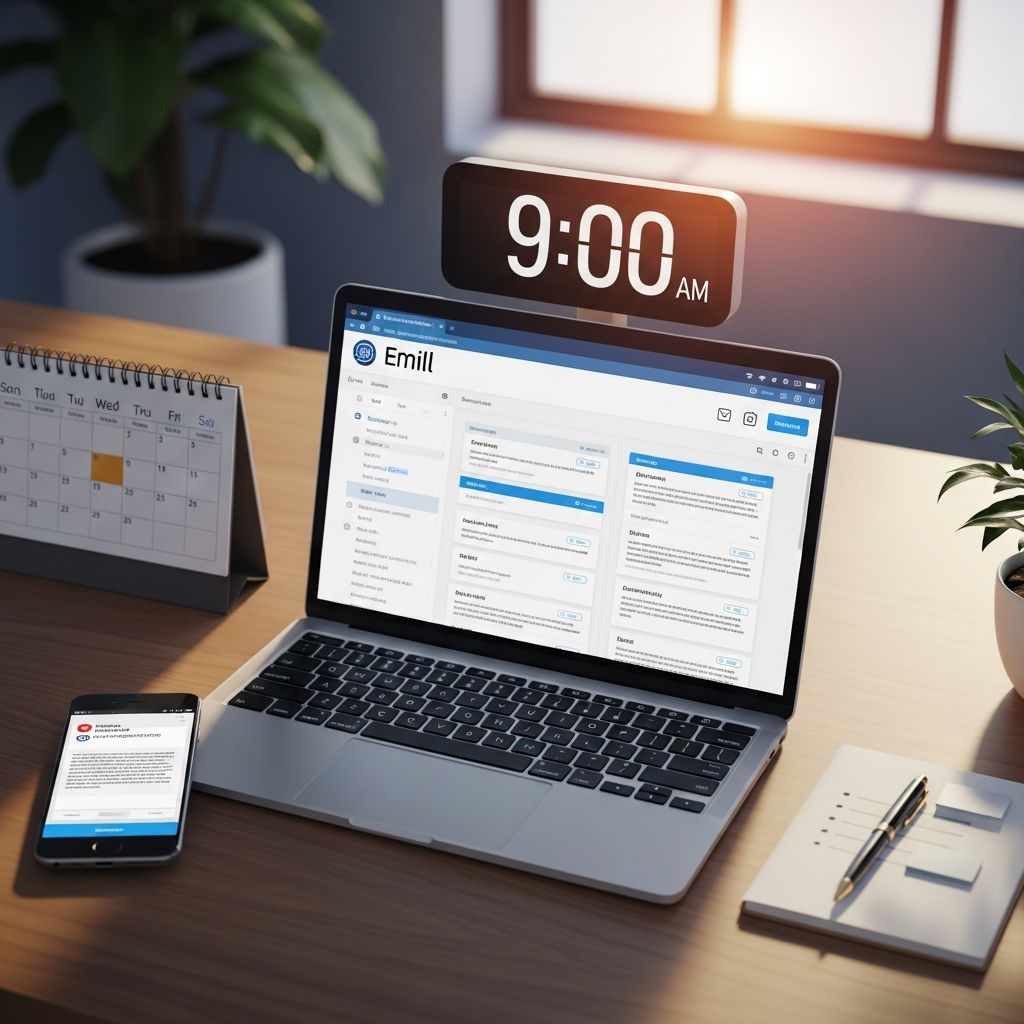
Understanding the Role of Timing in Email Success
Email remains one of the most powerful tools for communication and marketing, but even the most compelling message can fall flat if it arrives at the wrong moment. The timing of an email influences whether it’s opened, read, clicked, or ignored. While many marketers look for a universal ‘best time’ to send, the reality is more nuanced. The ideal send time depends on your audience, industry, goals, and even the type of email being sent.
Instead of chasing a one-size-fits-all answer, the smarter approach is to treat timing as a strategic variable. By aligning send times with audience behavior and business objectives, you can significantly improve engagement and conversion rates.
Why Timing Matters More Than You Think
Timing affects several key metrics in email performance:
- Open rates: Emails sent when recipients are most active are more likely to be seen and opened.
- Click-through rates: Well-timed emails often lead to higher engagement with links and calls to action.
- Conversion rates: When timing aligns with intent and availability, conversions from email campaigns improve.
- Deliverability: Consistently sending at times when your audience engages can signal to inbox providers that your emails are valuable, improving long-term deliverability.
However, timing is not a standalone fix. It works best when combined with strong subject lines, relevant content, and good segmentation. A perfectly timed email with a weak subject line or irrelevant offer will still underperform.
Common Myths About the ‘Best’ Time to Send
Over the years, many generalizations have emerged about the best time to send emails. While these can serve as starting points, they often oversimplify a complex reality.
Myth 1: There’s a single best time for all emails.
Some sources claim that Tuesday at 10 a.m. is the golden hour for all emails. In reality, this may work for some audiences but not others. A B2B SaaS company’s audience may be most active during work hours, while a B2C fashion brand’s subscribers might engage more in the evening or on weekends.
Myth 2: Weekdays are always better than weekends.
While many industries see higher engagement on weekdays, others—especially retail, travel, and lifestyle brands—often perform well on weekends when people have more leisure time to browse and shop.
Myth 3: Early morning is always ideal.
Early morning (e.g., 6–8 a.m.) can work well for time-sensitive or informational emails, but it may not be ideal for promotional content. Some audiences check email quickly in the morning and save shopping or detailed reading for later.
Factors That Influence the Ideal Send Time
To determine the best time for your emails, consider these key factors:
1. Audience Behavior and Habits
Your subscribers’ routines shape when they check email. Are they professionals checking inboxes during work hours? Parents reviewing messages in the evening? Students or freelancers with irregular schedules? Understanding their daily rhythms helps you choose times when they’re most likely to engage.
2. Industry and Use Case
Different industries see different patterns:
- B2B: Often performs best during business hours (9 a.m.–5 p.m.), especially mid-week.
- B2C (retail, e-commerce): May see strong engagement in the evening or on weekends when people browse for products.
- Newsletters and content: Often do well in the morning or early afternoon when people catch up on reading.
- Time-sensitive promotions: Benefit from sending when people are most likely to act, such as weekday afternoons or early evenings.
3. Geographic Location and Time Zones
If your audience spans multiple regions, sending at a single time can leave many people receiving emails at inconvenient hours. Using time-zone-based sending ensures that emails arrive at a consistent local time, improving relevance and engagement.
4. Email Type and Goal
The purpose of the email should guide timing:
- Transactional emails (order confirmations, password resets): Should be sent immediately, regardless of time.
- Newsletters: Often perform well in the morning or early afternoon.
- Promotional emails: May do better in the evening or on weekends when people have more time to shop.
- Re-engagement campaigns: Can be tested at different times to see when inactive subscribers are most likely to respond.
How to Find Your Audience’s Optimal Send Time
Instead of relying on generic advice, use a data-driven approach to identify the best times for your specific audience.
Step 1: Analyze Your Historical Data
Review your email analytics to see when your emails have historically performed best. Look at:
- Open rates by day of the week and hour of the day
- Click-through rates by send time
- Conversion rates (e.g., purchases, sign-ups) by time
Most email platforms provide this data in reports or dashboards. Focus on campaigns with similar goals (e.g., promotional emails) to get meaningful insights.
Step 2: Segment by Behavior and Profile
Not all subscribers behave the same way. Segment your list to uncover patterns:
- By engagement level (active vs. inactive)
- By purchase history (frequent buyers vs. one-time customers)
- By time zone
- By device (mobile vs. desktop users may check email at different times)
Test different send times for each segment to see what works best for each group.
Step 3: Run A/B Tests on Send Time
Set up controlled experiments to compare performance at different times:
- Send the same email to similar segments at different times (e.g., Tuesday 9 a.m. vs. Thursday 6 p.m.).
- Keep subject lines, content, and design consistent to isolate the impact of timing.
- Measure opens, clicks, and conversions to determine which time performs better.
Run multiple tests over several weeks to account for weekly variations and seasonal trends.
Step 4: Consider the Customer Journey
Timing should also align with where subscribers are in their journey:
- Onboarding emails: Send shortly after sign-up, when interest is highest.
- Cart abandonment emails: Send within 1–24 hours, depending on your audience’s typical purchase window.
- Post-purchase follow-ups: Time these to coincide with expected delivery or usage of the product.
- Re-engagement emails: Test sending at times when inactive users might be more receptive, such as weekends or evenings.
General Guidelines by Day and Time
While your own data should be the primary guide, here are some general patterns observed across many industries:
| Day of Week | Typical Performance | Best Use Cases |
|---|---|---|
| Monday | Moderate to high engagement, especially in B2B | Weekly updates, internal announcements, early-week promotions |
| Tuesday–Thursday | Often the strongest days for opens and clicks | Newsletters, product launches, mid-week offers |
| Friday | Declining engagement in many B2B contexts, but strong for B2C | Weekend deals, event invitations, Friday-only promotions |
| Saturday–Sunday | Lower for B2B, but often high for B2C and lifestyle brands | Weekend sales, content roundups, leisure-focused offers |
For time of day, common patterns include:
- Early morning (6–8 a.m.): Good for time-sensitive or informational emails.
- Late morning to early afternoon (9 a.m.–1 p.m.): Strong for B2B and general newsletters.
- Evening (5–8 p.m.): Often effective for B2C, especially retail and entertainment.
- Late evening (after 8 p.m.): Can work for highly engaged audiences but may increase unsubscribes if overused.
Practical Tips for Better Email Timing
Use these strategies to refine your email scheduling and maximize impact:
- Use time-zone-based sending: Ensure emails arrive at a consistent local time for each recipient.
- Align with business hours: For B2B, prioritize sending during standard work hours (9 a.m.–5 p.m.) on weekdays.
- Test weekends for B2C: If your audience shops or browses on weekends, experiment with Saturday and Sunday sends.
- Time promotions strategically: Send promotional emails a few hours before peak shopping times (e.g., early evening) to capture attention when people are ready to buy.
- Consider frequency and cadence: Even the best time can be undermined by sending too often. Balance timing with a sustainable sending frequency.
- Automate based on behavior: Use behavioral triggers (e.g., cart abandonment, page visits) to send emails at the most relevant moment, rather than a fixed schedule.
When Not to Obsess Over Timing
While timing is important, it’s not the only—or even the most important—factor in email success. Focus on these areas first:
- Subject lines: A compelling subject line has a bigger impact on opens than send time.
- Content relevance: Emails that match the recipient’s interests and needs will perform better regardless of timing.
- Segmentation and personalization: Targeted messages to specific groups outperform generic blasts.
- Mobile optimization: Most emails are opened on mobile devices, so design for small screens.
Once these fundamentals are strong, fine-tuning send time becomes a powerful way to squeeze out additional performance gains.
FAQs About Email Send Times
What is the best day of the week to send emails?
There’s no universal best day, but Tuesday through Thursday often see the highest engagement for many audiences. B2B tends to perform well mid-week, while B2C may see strong results on weekends. Test different days with your own audience to find what works best.
What is the best time of day to send emails?
For many audiences, late morning to early afternoon (9 a.m.–1 p.m.) works well, especially for B2B and newsletters. B2C and promotional emails often perform better in the evening (5–8 p.m.). The ideal time depends on your audience’s habits and industry.
Should I send emails on weekends?
Yes, if your audience is active on weekends. Retail, travel, entertainment, and lifestyle brands often see strong engagement on Saturdays and Sundays. B2B audiences may be less active, but it’s worth testing to see how your specific subscribers respond.
How often should I test my email send times?
Regular testing is important, especially as audience behavior changes. Run A/B tests on send time every few months or when launching a new campaign type. Seasonal trends (e.g., holidays, back-to-school) may also require adjustments.
Can I send emails at different times to different segments?
Absolutely. Advanced email platforms allow you to schedule the same campaign at different times for different segments (e.g., by time zone, engagement level, or behavior). This ensures each group receives emails at the most relevant moment.
Does sending time affect deliverability?
Directly, no—email providers don’t penalize specific send times. However, consistently sending at times when your audience engages can improve long-term deliverability by signaling that your emails are wanted and valuable.
Final Thoughts: Timing as Part of a Bigger Strategy
The best time to send an email isn’t a fixed rule—it’s a strategic decision based on your audience, goals, and data. While general patterns can provide a starting point, the real value comes from testing, analyzing, and refining your approach over time.
Start by understanding your audience’s behavior, then use segmentation and A/B testing to identify the most effective times for each type of email. Combine smart timing with strong subject lines, relevant content, and good design, and you’ll create email campaigns that not only get opened but also drive real results.
References
- 2025 Top Email Marketing Tips from Personalization to Performance — Litmus. 2025. https://www.litmus.com/blog/top-email-marketing-tips
- 26 Tested Email Marketing Best Practices [2025 Update] — Moosend. 2025. https://moosend.com/blog/email-marketing-best-practices/
- 37 Email Marketing Best Practices and Tips for 2025 — Twilio. 2025. https://www.twilio.com/en-us/resource-center/email-marketing-best-practices-tips

Medha Deb is an editor with a master's degree in Applied Linguistics from the University of Hyderabad. She believes that her qualification has helped her develop a deep understanding of language and its application in various contexts. Medha specializes in the areas of beauty, health, sports, and wellness and is committed to ensuring that the content on the website is…