
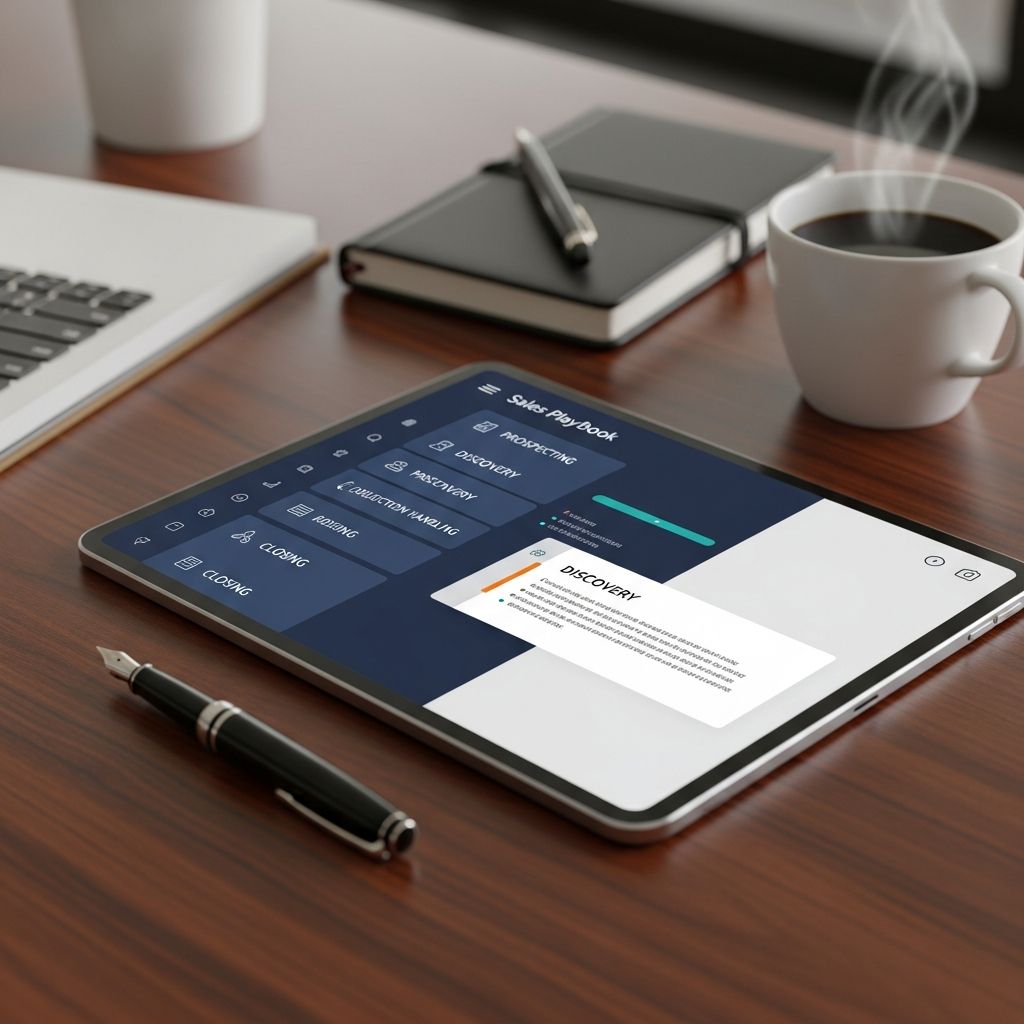
A well-designed sales playbook gives your team a clear, repeatable way to win deals. Instead of every rep improvising, your best strategies, talk tracks, and processes are captured in one place and continuously improved over time.
This guide walks through how to create a modern, practical playbook that your sales team will actually use, from defining your strategy to documenting plays, tools, and metrics.
1. What a Modern Sales Playbook Really Is
A sales playbook is more than a PDF of scripts. It is a living guide that captures how your company sells: goals, buyers, process, messaging, and the specific actions reps should take in different situations.
Authoritative sources describe a sales playbook as a document that outlines your sales strategy, processes, buyer personas, messaging, and tactical guidance for common scenarios.
- Strategy: How you position your product and win in your market.
- Process: The stages and steps from first touch to renewal.
- Plays: Step-by-step actions for specific situations (e.g., new leads, upsell, competitor takeaways).
- Tools: The tech stack and assets that support each stage.
- Metrics: How you measure success and coach performance.
Done well, a playbook becomes the single source of truth for your sales organization, helping new hires ramp faster and experienced reps improve execution.
2. Start With Strategy, Not Scripts
Before writing email templates or call talk tracks, clarify the strategic foundation. This ensures every play and piece of content aligns with your larger business goals.
2.1 Define your go-to-market focus
Capture the essentials of your sales strategy in clear, simple language:
- Target segments: Industries, company sizes, or regions you prioritize.
- Ideal customer profile (ICP): Organization-level traits that signal high fit.
- Primary value proposition: The core outcomes you create for customers.
- Competitive posture: How you differentiate from primary alternatives.
2.2 Set measurable sales objectives
Connect your playbook to concrete goals so reps understand what success looks like:
- Revenue and pipeline targets.
- Win rate and deal cycle goals.
- Activity and conversion benchmarks (e.g., meetings booked per week).
Industry leaders emphasize that a useful playbook links daily actions to clear business objectives to guide prioritization and coaching.
3. Document Your Buyers in Depth
Great playbooks are built around buyers, not products. Comprehensive buyer personas help reps tailor conversations, discover real pain points, and articulate value in the customer’s language.
3.1 Build actionable buyer personas
For each key persona, document:
- Role & responsibilities: Job title, department, key initiatives.
- Success metrics: What they are measured on (e.g., revenue, cost, risk).
- Pain points: Frustrations, constraints, and risks they want to avoid.
- Buying triggers: Events that cause them to actively look for solutions.
- Objections: Common concerns about budget, timing, and fit.
3.2 Map the buying committee
In B2B deals, multiple stakeholders influence decisions. Your playbook should show:
- Who usually champions, approves, and uses your product.
- Typical questions from finance, IT, and executive sponsors.
- How to adapt messaging for technical vs. business audiences.
Leading CRM and sales enablement providers recommend including personas and buying roles as core sections of any sales playbook to standardize messaging and discovery.
4. Map a Buyer-Centric Sales Process
Your playbook should turn a vague funnel into a clear, repeatable process. This means documenting both the seller’s activities and the buyer’s progress at each stage.
| Stage | Buyer perspective | Rep objectives | Key exit criteria |
|---|---|---|---|
| Prospecting | Not actively engaged; may be unaware of problem. | Capture attention; earn permission for a conversation. | Prospect agrees to discovery call/meeting. |
| Discovery | Exploring challenges and options. | Understand pain, impact, and decision dynamics. | Clear problem definition and mutual next step. |
| Solutioning | Evaluating solutions and fit. | Connect capabilities to specific pains; quantify value. | Stakeholders agree your solution is viable. |
| Proposal & negotiation | Comparing options; weighing cost vs. value. | Align on scope, pricing, terms, and risk. | Verbal agreement and clear path to signature. |
| Closed–won & handoff | Onboarding and implementation. | Ensure smooth transition and expectations. | Customer onboarded; ownership with CS/AM defined. |
Experts recommend defining both activities and milestones for each stage so that pipeline is consistent and forecastable.
4.1 Standardize stage-by-stage actions
For each stage, outline:
- Required and recommended activities (calls, emails, demos).
- Key questions to ask and information to capture in the CRM.
- Recommended assets (case studies, ROI calculators, one-pagers).
- Hand-off rules between SDRs, AEs, and post-sales teams.
5. Design Clear, Repeatable Sales Plays
Sales plays are detailed sequences of actions for specific situations: outbound to a new persona, nurturing a stalled deal, or expanding an existing account. A good play gives a rep step-by-step guidance while leaving room for judgment.
5.1 Common play types to include
- Outbound prospecting plays: Multi-touch cadences combining email, phone, and social.
- Inbound response plays: How to respond to demo requests, content downloads, and trials.
- Qualification & discovery plays: Question frameworks for each persona and segment.
- Competitive plays: Positioning and proof for specific competitors.
- Objection-handling plays: Approaches for price, timing, and “no decision” risks.
- Expansion plays: Upsell and cross-sell motions for existing customers.
5.2 Structure of an effective play
Each play in your playbook should answer:
- When to use it: Triggers and qualification criteria.
- Who it targets: Persona, segment, and account type.
- Objectives: What success looks like for this play.
- Steps & timing: Exact actions over days/weeks.
- Assets & scripts: Templates, talk tracks, and collateral.
- Metrics: How you’ll evaluate performance and refine.
Sales enablement platforms highlight that documenting plays in this structured way helps replicate the behavior of top performers at scale.
6. Capture Messaging, Scripts, and Templates
To make your playbook immediately useful, embed practical tools that reps can use daily: messaging frameworks, call outlines, email templates, and proposal checklists.
6.1 Message framework
Instead of rigid word-for-word scripts, provide adaptable frameworks such as:
- Opening: Credible reason for reaching out that relates to the buyer.
- Problem & impact: A short description of the challenge you solve.
- Proof: Brief example or data point from a similar customer.
- Ask: A specific, low-friction next step.
6.2 Call talk tracks and email examples
Include:
- Discovery call outlines with key questions and transitions.
- Demo agendas tied to the buyer’s stated priorities.
- Sample outreach and follow-up emails for each stage and persona.
- Proposal and recap email checklists.
Major sales organizations emphasize that unified messaging in call scripts and email templates preserves brand consistency and improves the customer experience.
7. Align Tools, Data, and Workflow
A playbook is only useful if it fits how your team actually works. Map your tech stack and workflows directly into the plays so reps know which tools to use and where to record information.
7.1 Document your sales stack
- Core systems: CRM, sales engagement platform, meeting tools.
- Qualification & research: Data providers, enrichment tools.
- Content & enablement: Repositories for decks, one-pagers, and case studies.
- Analytics: Reporting dashboards and forecasting tools.
7.2 Define data standards
Specify:
- Mandatory CRM fields at each stage.
- How to log activities and notes.
- Rules for ownership, territories, and handoffs.
Guides from leading vendors stress that clarity on systems and data hygiene is essential for accurate forecasting and effective coaching.
8. Use Metrics and Feedback to Keep the Playbook Alive
The best sales playbooks evolve. Treat yours as a product: release a version, measure performance, gather feedback, and iterate.
8.1 Metrics to track
Monitor outcomes at both the pipeline and play levels:
- Lead response time and connect rates.
- Conversion by stage (e.g., discovery to proposal, proposal to close).
- Win rate by segment, persona, and play.
- Average sales cycle length.
- Ramp time for new reps.
8.2 Build an update rhythm
To keep the playbook relevant:
- Review key metrics monthly or quarterly.
- Highlight what top performers do differently and encode it into plays.
- Retire tactics that consistently underperform.
- Version your playbook (e.g., v1.2) and communicate changes clearly.
9. Rolling Out Your Playbook to the Team
Even the best-designed playbook fails if it is not adopted. Plan a structured rollout and ongoing enablement, not a one-time email attachment.
9.1 Training and reinforcement
- Walk through key sections in live sessions or recorded modules.
- Role-play new plays, objection handling, and call openings.
- Incorporate playbook use into onboarding for every new hire.
- Recognize and reward reps who model the plays effectively.
9.2 Make the playbook easy to access
Host the content where reps already work:
- Linked from the CRM or sales engagement platform.
- Searchable knowledge base or enablement tool.
- Compact quick-reference pages (for call openings, discovery questions, etc.).
Frequently Asked Questions About Sales Playbooks
Q1: Who should own the sales playbook?
Ownership usually sits with sales leadership and sales enablement, with input from marketing, product, and top-performing reps. One person or small group should be clearly responsible for updates so content does not become fragmented.
Q2: How detailed should a playbook be?
It should be detailed enough that a new rep can follow it to run a call or sequence, but not so prescriptive that it removes judgment. Focus on principles, frameworks, and examples rather than rigid word-for-word instructions for every scenario.
Q3: How often should we update our sales playbook?
Most teams review and update their playbook at least quarterly, or whenever there are major changes to the product, pricing, ICP, or market conditions. Smaller tweaks can be made more frequently as you learn from performance data.
Q4: What is the difference between a sales process and a sales play?
The sales process is the overall sequence of stages a deal passes through, from first contact to close. A sales play is a specific, actionable set of steps designed for a particular situation within that process, such as re-engaging a stalled opportunity or launching outreach to a new vertical.
Q5: Do small teams really need a sales playbook?
Yes. For small teams, a playbook can be lightweight, but documenting what works accelerates hiring, maintains consistency as you grow, and prevents key knowledge from living only in the heads of one or two senior reps.
References
- 7 Key Components Of A Successful Sales Playbook — Fireflies.ai Blog. 2023-05-16. https://fireflies.ai/blog/sales-playbook
- What is a Sales Playbook? — Revenue.io. 2022-11-10. https://www.revenue.io/inside-sales-glossary/what-is-a-sales-playbook
- What is a Sales Playbook and How Do You Build One? — Mindtickle. 2023-08-09. https://www.mindtickle.com/blog/what-is-a-sales-playbook-and-how-do-you-build-one/
- Enterprise Sales Playbook 2024: Strategies & Templates — Docket AI. 2024-02-01. https://www.docket.io/blog/enterprise-sales-playbook-guide
- Sales Playbook Guide: Examples & Templates for Success — Salesforce Blog. 2023-04-18. https://www.salesforce.com/blog/sales-playbook/
- Sales Playbook: Best Examples & Template — Pipedrive Blog. 2023-06-27. https://www.pipedrive.com/en/blog/sales-playbook
- 7 Essential Elements of a Winning Sales Playbook Template — Highspot. 2022-09-15. https://www.highspot.com/blog/7-essential-elements-of-a-winning-sales-playbook-template/

Medha Deb is an editor with a master's degree in Applied Linguistics from the University of Hyderabad. She believes that her qualification has helped her develop a deep understanding of language and its application in various contexts. Medha specializes in the areas of beauty, health, sports, and wellness and is committed to ensuring that the content on the website is…