
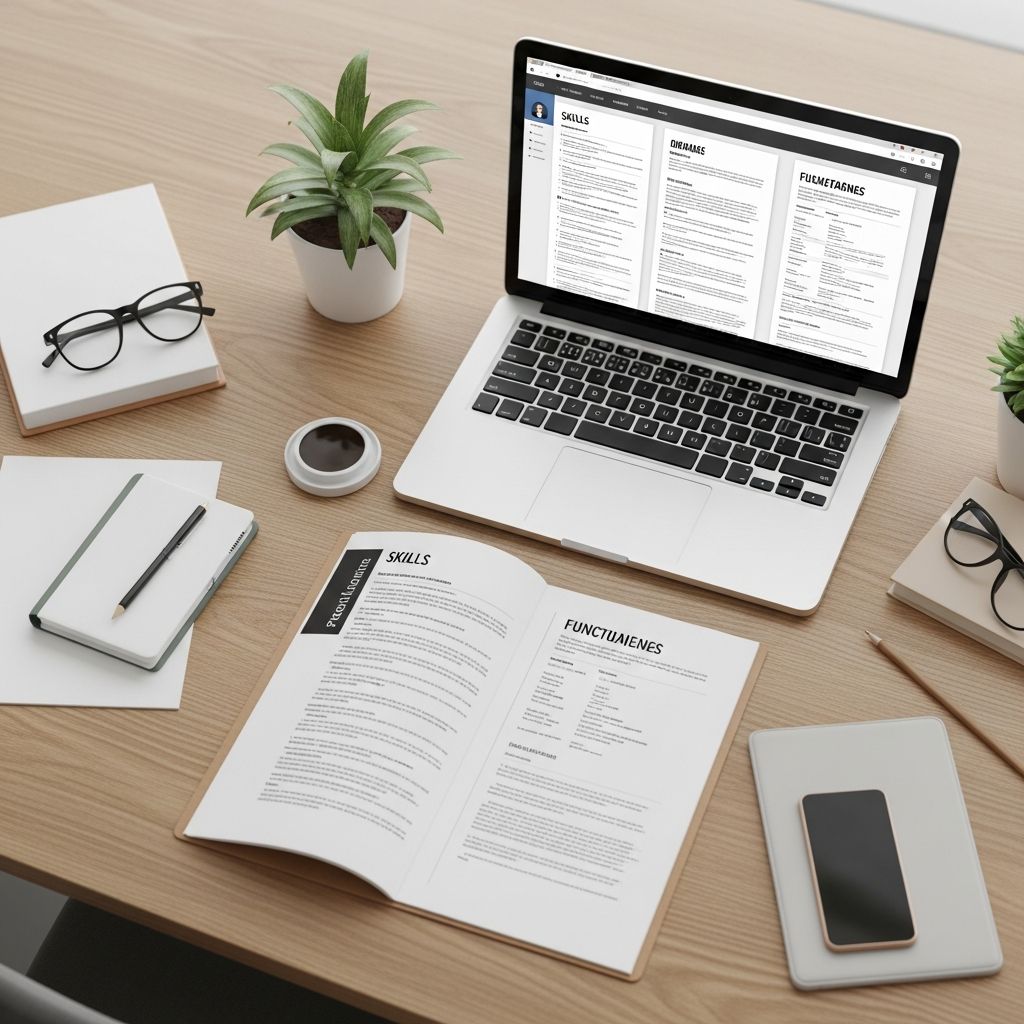
A functional resume (also called a skills-based resume) prioritizes your abilities, strengths, and achievements instead of presenting your work history in strict date order. It can be a powerful tool if your career path is unconventional, you are changing fields, or you need to de-emphasize employment gaps.
This guide explains when a functional resume makes sense, how to structure it, and what to include so that it passes both human and automated screening while showcasing your value clearly.
What Is a Functional Resume?
A functional resume is a resume format that organizes your experience under skill categories (such as “Project Leadership” or “Customer Service”) instead of listing each job with bullet points in reverse-chronological order.
While a traditional chronological resume focuses on where and when you worked, a functional resume focuses on what you can do and how your skills match the job requirements.
Key Characteristics
- Skills grouped by themes (e.g., communication, technical expertise, leadership) with supporting bullet points.
- Brief work history listed later, often without detailed duties under each role.
- Emphasis on transferable skills that can apply across different industries and roles.
- Summary or profile section near the top that aligns your top skills with the target role.
When a Functional Resume Is a Good Option
This format is not ideal for everyone. In many traditional hiring environments, a chronological or hybrid resume is still preferred. However, a functional resume can be effective in specific situations.
Situations Where It Can Help
- Career changers who need to highlight transferable skills rather than unrelated job titles.
- People with employment gaps who prefer not to draw attention to periods without formal work.
- Freelancers or project-based workers with many short-term roles that may look unstable in strict date order.
- Recent graduates or students who have strong skills from coursework, internships, or volunteer work but limited full-time experience.
- Professionals with diverse, non-linear histories (e.g., caregiving breaks, self-employment, or part-time work) who want to show a coherent skills story.
When You May Want to Avoid It
- You have a steady, relevant work history with clear progression; a chronological or hybrid format will likely be stronger.
- You work in a conservative or regulated field (e.g., traditional finance, law) where hiring managers expect chronological detail.
- The job posting or employer explicitly asks for a chronological resume.
Functional vs. Chronological vs. Hybrid: A Quick Comparison
| Resume Type | Main Focus | Best For | Potential Drawbacks |
|---|---|---|---|
| Functional | Skills grouped by category | Career changers, employment gaps, limited experience | Recruiters may suspect gaps; some ATS tools parse it poorly |
| Chronological | Jobs listed from most recent to oldest | Stable, relevant career history; clear progression | Gaps and short roles are very visible |
| Hybrid / Combination | Skills summary + chronological work section | Most professionals; balance of skills and experience | Can become repetitive if not edited carefully |
Core Sections of a Functional Resume
Although formats vary, strong functional resumes typically include the following sections, in roughly this order:
1. Contact Information
At the top, include:
- Full name
- Phone number
- Professional email
- City and state (or region) if relevant
- LinkedIn profile or portfolio link, when helpful
2. Targeted Headline and Summary
A short headline followed by a concise paragraph or bullet-style summary should:
- State your target role or field.
- Highlight 3–4 key skills that match the job description.
- Include a brief achievement or result to add credibility.
3. Skill Clusters with Achievements
This is the heart of the functional resume: 3–5 themed skill sections, each with bullet points that demonstrate how you’ve used those skills in real situations.
Examples of skill cluster headings:
- Data Analysis & Reporting
- Client Relationship Management
- Instruction & Curriculum Design
- Operations & Process Improvement
Under each heading, include bullets that are:
- Specific – describe what you did, how, and why it mattered.
- Quantified where possible – use numbers, percentages, or timeframes.
- Relevant – echo the skills and keywords from the target job posting to support ATS scanning.
4. Condensed Work History
After your skills sections, provide a brief work history. This is often a simple list including:
- Job title
- Employer
- Location (optional)
- Dates of employment (or years)
In a strictly functional resume, you usually do not repeat detailed bullet points here; that detail already appears in your skill clusters.
5. Education and Credentials
Include formal education, certifications, and relevant training, especially if they support your skills-based narrative.
- Degree(s), institution, graduation year (or “in progress”).
- Licenses and certifications (e.g., PMP, CPA, industry-specific credentials).
- Relevant coursework or continuing education that reinforces your target skills.
6. Optional Sections
Depending on your background, you may also add:
- Projects (personal, academic, or freelance).
- Volunteer experience closely related to the role.
- Awards, publications, or professional memberships.
- Languages or technical tools, when strongly relevant.
How to Write a Functional Resume Step by Step
Use this step-by-step process to build a functional resume that is both compelling and recruiter-friendly.
Step 1: Clarify Your Target Role
- Identify one specific job title or a narrow group of roles.
- Study several job postings for that title to spot repeated skills and keywords.
- List the top 8–12 skills employers mention most often.
Step 2: Inventory Your Experience
- Brainstorm everything that might demonstrate your skills:
- Previous jobs (full-time, part-time, temp, freelance).
- Academic work, research, and capstone projects.
- Volunteer roles, leadership in clubs, or community work.
- Self-directed learning, bootcamps, or certifications.
For each experience, note:
- What you did.
- Tools or methods used.
- Concrete outcomes (time saved, revenue generated, satisfaction improved, etc.).
Step 3: Group Your Skills into Themes
- Cluster related skills into 3–5 broader categories.
- Choose labels that mirror language employers use (e.g., “Customer Success” instead of a vague “People Skills”).
- Place your strongest, most relevant skill cluster first so it gets prime attention.
Step 4: Write Strong, Results-Oriented Bullets
Within each skill cluster, create 3–5 bullets. Use a simple pattern:
- Action verb + what you did + why or how it mattered.
- Incorporate numbers where possible (percentages, counts, timeframes).
- Reference tools, systems, or methods that match job requirements.
Step 5: Add Work History Without Overemphasizing Gaps
- List roles in reverse-chronological order with titles, companies, and dates.
- If you have longer gaps, you can:
- Use years only instead of month/year in some regions where this is acceptable.
- Include substantial volunteer or freelance work to show continued engagement.
- Keep this section concise, redirecting focus back to your skills above.
Step 6: Tailor for Each Application
- Adjust your summary and skill cluster order to match each job’s priorities.
- Mirror critical keywords from the job posting to improve ATS alignment, while staying truthful.
- Remove or downplay skill clusters that are not relevant to that specific role.
Advantages and Drawbacks of Functional Resumes
Advantages
- Highlights strengths first, especially when your formal job titles do not reflect your capabilities.
- Reduces focus on gaps or short stints by organizing around skills instead of time.
- Supports career pivots by showcasing transferable skills that align with a new field.
- Flexible storytelling that lets you shape a coherent narrative from varied experiences.
Drawbacks
- Some recruiters view fully functional resumes as a red flag, suspecting they hide issues such as job hopping or long gaps.
- Certain applicant tracking systems (ATS) struggle to parse non-standard layouts, which can affect automated screening.
- Hiring managers may find it harder to understand when and where you achieved specific results.
Best Practices for ATS and Recruiter Friendliness
Because a purely functional resume can sometimes confuse both software and people, use these practices to minimize risk.
- Keep standard labels such as “Work Experience” and “Education” so ATS tools recognize them.
- Use a clean layout without text boxes, images, or complex columns that may break parsing.
- Include employer names and dates in a simple list to provide essential context.
- Incorporate keywords naturally from the job posting into your summary and skill bullets.
- Consider a hybrid format if your field or target employer seems skeptical of purely functional resumes.
Common Mistakes to Avoid
- Being too vague: Listing broad skills like “communication” without concrete examples or results.
- Ignoring timelines entirely: Omitting dates and employers can undermine trust.
- Overstuffing with keywords: Keyword lists without context look artificial and unconvincing.
- Using the same resume for every job: Functional resumes need tailoring just as much as chronological ones.
- Neglecting readability: Dense blocks of text or inconsistent formatting make evaluation harder and hurt your chances.
Frequently Asked Questions (FAQs)
Is a functional resume bad for applicant tracking systems (ATS)?
Functional resumes are not inherently incompatible with ATS, but non-standard layouts and missing work-history details can cause parsing issues. To reduce risk, keep section headings conventional, list employers and dates somewhere on the page, and include relevant keywords in plain text.
Will recruiters think I am hiding something if I use a functional resume?
Some recruiters are cautious about purely functional resumes because they can obscure employment gaps or frequent moves. You can counter this by being honest about your dates, keeping your work history visible, and using your summary to briefly frame any non-linear paths in a positive, forward-looking way.
Can I use a functional resume as a recent graduate?
Yes. If you have limited professional experience but strong skills from internships, projects, or volunteering, a functional format can bring those abilities to the forefront. Make sure your bullets clearly connect academic or extracurricular work to the competencies employers need.
Is a hybrid resume better than a purely functional one?
A hybrid (or combination) resume blends a strong skills section with a chronological work history and is often more widely accepted by employers. It offers many of the benefits of a functional format while preserving the clarity that recruiters and ATS tools expect.
How long should a functional resume be?
For most professionals, aim for one page, and up to two pages only if you have extensive, highly relevant experience. Focus on the skills and accomplishments that directly support your target role; extra, unfocused detail dilutes impact.
References
- Functional Resume — Recruiteze. 2024-01-15. https://recruiteze.com/glossary/functional-resume/
- Functional Resume — Corporate Finance Institute. 2023-05-10. https://corporatefinanceinstitute.com/resources/career/functional-resume/
- What Is a Functional Resume and Is It Right for You? — Forage. 2023-08-22. https://www.theforage.com/blog/basics/functional-resume
- Functional Resume Guide: Formatting, Pros, Cons — FlexJobs. 2022-11-03. https://www.flexjobs.com/blog/post/formatting-and-using-a-functional-resume
- Functional Resume: Definition, Tips and Examples — Indeed Career Guide. 2024-02-14. https://www.indeed.com/career-advice/resumes-cover-letters/functional-resume-tips-and-examples
- Functional Resumes: What They Are and When to Use Them — TopResume. 2023-04-19. https://www.topresume.com/career-advice/functional-resume-writing-guide-examples
- Functional Resume Format: Focusing on Skills and Experience — Dummies. 2020-06-15. https://www.dummies.com/article/business-careers-money/careers/job-searches/functional-resume-format-focusing-on-skills-and-experience-196249/

- Integrated M.A. in Applied Linguistics, University of Hyderabad
- 5+ years in editorial, instructional, SEO, and research-based writing
Sneha is a relationships and lifestyle writer with a strong foundation in applied linguistics and certified training in relationship coaching. She brings over five years of writing experience to theskillvault, crafting thoughtful, research-driven content that empowers readers to build healthier relationships, boost emotional well-being, and embrace holistic living. Her writing and insights reflect the belief that beauty, happiness, and wellness…