
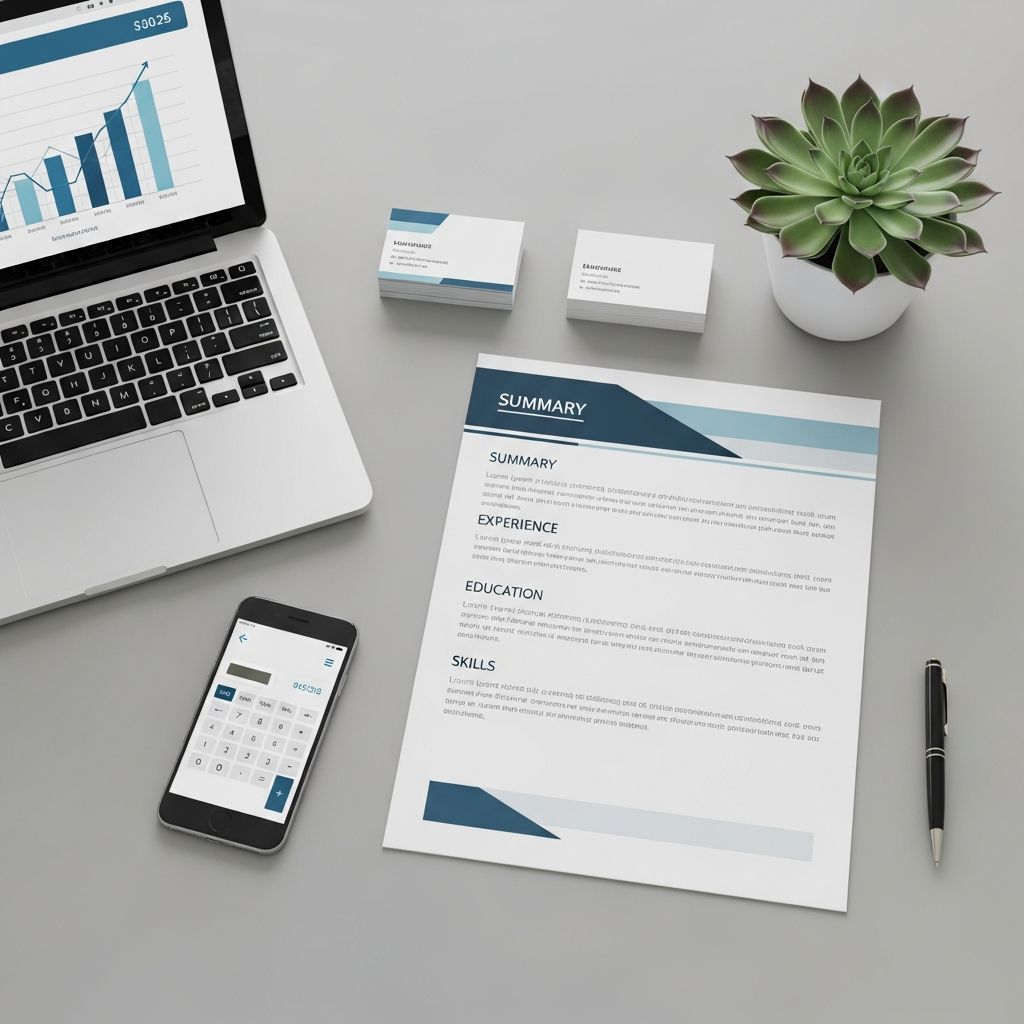
Accountants are in constant demand, but competition for the best roles is intense. A strong accountant resume must do more than list duties – it needs to demonstrate your impact on financial accuracy, compliance, and business performance. This guide walks you through how to build a resume that impresses both applicant tracking systems (ATS) and hiring managers in 2025.
1. Understand What Employers Look For in Accountants
Before you start writing, clarify what most organizations expect from accountants today. Employers value professionals who can keep compliant books, support decision-making with data, and adapt to evolving regulations and technology.
- Technical mastery of financial reporting frameworks such as GAAP or IFRS and relevant tax codes.
- Accuracy and integrity in preparing and reconciling financial records.
- Analytical skills to interpret financial data and support strategic decisions.
- Technology fluency with accounting software and spreadsheets.
- Regulatory awareness to comply with laws and standards in your jurisdiction.
Keep these expectations in mind as you decide which achievements and skills to highlight.
2. Choose the Best Resume Format for Your Stage
Your resume format should make it easy to see your most relevant strengths in seconds. In accounting, clarity and structure are crucial.
| Format | Best For | Pros | Cons |
|---|---|---|---|
| Reverse-chronological | Most accountants with steady work history | Familiar to recruiters; emphasizes growth and recent roles | Less ideal if you have career gaps or frequent moves |
| Combination (hybrid) | Mid-level and senior candidates with diverse skills | Balances skills and experience; great for tailored applications | Takes more effort to customize for each job |
| Functional | Candidates changing careers or with limited experience | Centers on skills and projects instead of job titles | Less favored by recruiters; can trigger suspicion if misused |
For most accountant roles, a reverse-chronological or combination format works best, as it shows how you have progressed in responsibility and expertise over time.
3. Start With a Focused Header and Contact Block
The top of your resume must immediately indicate who you are and how to reach you. Keep it simple, professional, and ATS-friendly.
- Name and credential: e.g., “Jordan Smith, CPA” or “Jordan Smith, Staff Accountant”.
- Phone number: Use a mobile number with voicemail set up.
- Professional email: Use a neutral address (e.g., firstname.lastname@provider.com).
- Location: City and state/region are typically enough.
- Optional links: LinkedIn profile or professional portfolio if they strengthen your candidacy.
Avoid including sensitive information such as full street address, national ID, or marital status, which are unnecessary in many countries.
4. Craft a Results-Oriented Professional Summary
A professional summary sits under your header and gives a quick snapshot of why you’re a fit. In 3–5 lines, highlight your level, core expertise, and proof that you deliver results.
Use this structure:
- Who you are: job title, years of experience, and any key certification.
- Core strengths: 3–4 skill areas relevant to the job posting.
- Evidence: 1–2 metrics that show your impact (cost savings, error reduction, efficiency gains).
For entry-level roles, you can write a brief objective emphasizing education, internships, and your motivation to grow in accounting.
5. Showcase Experience With Numbers, Not Just Duties
The experience section is where you convince employers you can handle their financial responsibilities. Instead of repeating job descriptions, focus on achievements that show how you improved accuracy, compliance, or profitability.
Under each role, include:
- Job title, employer, and dates.
- 1 line describing the scope: size of company, type of accounting, or business model.
- 3–7 bullet points beginning with strong action verbs.
Transform vague tasks into measurable accomplishments. Consider metrics such as:
- Percentage reduction in reporting errors, aged receivables, or unmatched transactions.
- Time saved in month-end or year-end closing cycles.
- Value of cost savings, recovered revenue, or tax optimization.
- Number of entities, accounts, or invoices handled per month.
Quantifying results both reflects good accounting practice and gives hiring managers confidence in your abilities.
6. Align Your Skills Section With Modern Accounting Needs
An effective skills section helps ATS recognize relevant keywords and helps recruiters see your strengths at a glance. Organize your skills into logical categories so they are easy to scan.
6.1 Core Accounting Competencies
- Financial statement preparation (income statement, balance sheet, cash flow).
- General ledger maintenance and reconciliations.
- Accounts payable and receivable management.
- Budgeting, forecasting, and variance analysis.
- Cost accounting and margin analysis.
6.2 Regulatory and Compliance Knowledge
- Knowledge of GAAP or IFRS, depending on your region.
- Internal controls and risk assessment.
- External and internal audit support.
- Tax preparation and filing for individuals or entities, as relevant.
6.3 Technology and Tools
Digital skills are increasingly important as organizations adopt automation and cloud solutions.
- Enterprise or small-business accounting software (e.g., QuickBooks, SAP, Oracle NetSuite, Xero).
- Spreadsheet proficiency, particularly advanced Excel functions.
- Familiarity with data visualization or reporting tools.
- Experience with ERP, billing, or payroll systems when relevant.
6.4 Interpersonal and Analytical Skills
- Ability to explain complex financial information to non-financial stakeholders.
- Teamwork with finance, operations, and leadership.
- Problem-solving and root-cause analysis.
- Time management and prioritization during peak reporting periods.
7. Present Education and Certifications Strategically
Education and professional credentials provide important signals of your technical foundation and commitment to standards.
7.1 Education
- List your highest degree first (e.g., Bachelor’s or Master’s in Accounting, Finance, or related field).
- Include institution name, location, and graduation year.
- For early-career candidates, you may also mention:
- Relevant coursework (e.g., advanced financial accounting, auditing, taxation).
- Honors, scholarships, or notable academic distinctions.
- Accounting or finance-related projects or research.
7.2 Professional Certifications
Accounting is a credential-driven field. Recognized qualifications demonstrate adherence to ethical and technical standards.
- CPA (Certified Public Accountant) or equivalent national license.
- CMA (Certified Management Accountant) for management accounting focus.
- ACCA, CA, or similar designations depending on your jurisdiction.
- Specialized certificates in auditing, taxation, or financial analysis.
Place key certifications near the top of your resume header or summary to ensure they are visible immediately.
8. Tailor Your Resume to the Specific Accounting Role
Accounting covers a wide range of specializations, from tax and audit to cost accounting and financial analysis. Customizing your resume for each posting signals that you understand the role’s priorities.
- Tax roles: Emphasize tax law knowledge, filing experience, and work on audits or disputes.
- Audit roles: Highlight internal controls, risk assessments, and exposure to external audit processes.
- Management accounting: Focus on budgeting, forecasting, and performance analysis that support decision-making.
- Financial accounting: Stress your accuracy in financial statement preparation and adherence to standards.
Mirror relevant language from the job description, while remaining truthful, so ATS and hiring managers see a strong alignment.
9. Make Your Resume ATS-Friendly and Easy to Read
Many organizations use applicant tracking systems to screen resumes. To avoid being filtered out, your resume should combine clean formatting with keyword-rich content.
- Use a standard, single-column layout without complex graphics or text boxes.
- Choose common headings such as “Experience,” “Education,” and “Skills.”
- Incorporate relevant keywords from the job ad (e.g., “GAAP reporting,” “budget variance analysis”).
- Save as PDF or another format specified by the employer.
- Use clear fonts and avoid images for critical information such as job titles and dates.
Readable formatting not only helps ATS but also reflects the clarity and precision expected in accounting work.
10. Optional Sections That Add Credibility
After covering the essentials, you can add selective extras that reinforce your credibility and personality, as long as they remain relevant.
- Awards and recognition: e.g., “Recognized for zero-error audits” or “Employee of the Quarter.”
- Professional memberships: Accounting or finance associations and societies.
- Languages: Important for firms dealing with international clients or reporting.
- Volunteer work: Pro bono bookkeeping or treasurer roles show practical application of skills.
- Continuing education: Workshops or courses that keep you current with standards and technology.
Prioritize items that directly strengthen your case as a trustworthy and up-to-date accountant.
11. Common Mistakes That Undermine Accountant Resumes
Even strong candidates lose out on interviews because of avoidable resume errors. Watch for these pitfalls:
- Listing tasks instead of outcomes: Replace “responsible for AP” with quantified improvements or efficiencies.
- Ignoring compliance and ethics: Accounting relies on trust; avoid anything that could raise questions about your integrity.
- Omitting technical details: Name the standards, tools, and processes you use; generalities are less persuasive.
- Using informal tone or formatting: A polished, professional document reflects positively on your judgment.
- Submitting generic resumes: Failing to tailor to the role can make you blend into the applicant pool.
Frequently Asked Questions About Accountant Resumes
Q1: How long should an accountant resume be?
Most early and mid-career accountants should keep their resume to one page. A second page is appropriate once you have extensive experience, leadership roles, or multiple relevant certifications. Focus on your most recent and impactful work, not everything you have ever done.
Q2: Do I need to include every accounting software I have used?
Include software that is relevant to the target role and reflects current market tools. Group similar tools together and avoid overwhelming the skills section. Prioritize systems and applications specifically mentioned in the job posting.
Q3: Where should I place my CPA or other key certifications?
If you hold a widely recognized credential like a CPA, place it next to your name at the top of your resume and list full details in a dedicated “Certifications” or “Licenses” section. This ensures recruiters immediately see that you meet licensing requirements.
Q4: How can students or recent graduates stand out with limited experience?
Highlight internships, course projects, case competitions, and part-time roles where you applied accounting concepts. Emphasize software proficiency, strong grades in key subjects, and any volunteer positions where you handled budgets or records.
Q5: Should I include a cover letter with my accountant resume?
A tailored cover letter is often worthwhile. Use it to explain how you improved financial processes, supported decision-makers, or navigated complex regulations. A thoughtful letter can differentiate you from candidates who only submit a generic resume.
References
- International Code of Ethics for Professional Accountants — International Ethics Standards Board for Accountants (IESBA). 2023-01-01. https://www.ethicsboard.org/publications/international-code-ethics-professional-accountants-including-international-independence-standards
- International Financial Reporting Standards (IFRS) — IFRS Foundation. 2023-01-01. https://www.ifrs.org/issued-standards/list-of-standards/
- U.S. GAAP: Generally Accepted Accounting Principles — Financial Accounting Standards Board (FASB). 2022-12-31. https://www.fasb.org/page/index
- What Does an Accountant Do? — U.S. Bureau of Labor Statistics, Occupational Outlook Handbook. 2024-04-10. https://www.bls.gov/ooh/business-and-financial/accountants-and-auditors.htm
- The Impact of Digitalization on the Accounting Profession — International Federation of Accountants (IFAC). 2021-06-15. https://www.ifac.org/knowledge-gateway/preparing-future-ready-professionals/discussion/impact-digitalization-accounting-profession

- Integrated M.A. in Applied Linguistics, University of Hyderabad
- 5+ years in editorial, instructional, SEO, and research-based writing
Sneha is a relationships and lifestyle writer with a strong foundation in applied linguistics and certified training in relationship coaching. She brings over five years of writing experience to theskillvault, crafting thoughtful, research-driven content that empowers readers to build healthier relationships, boost emotional well-being, and embrace holistic living. Her writing and insights reflect the belief that beauty, happiness, and wellness…