
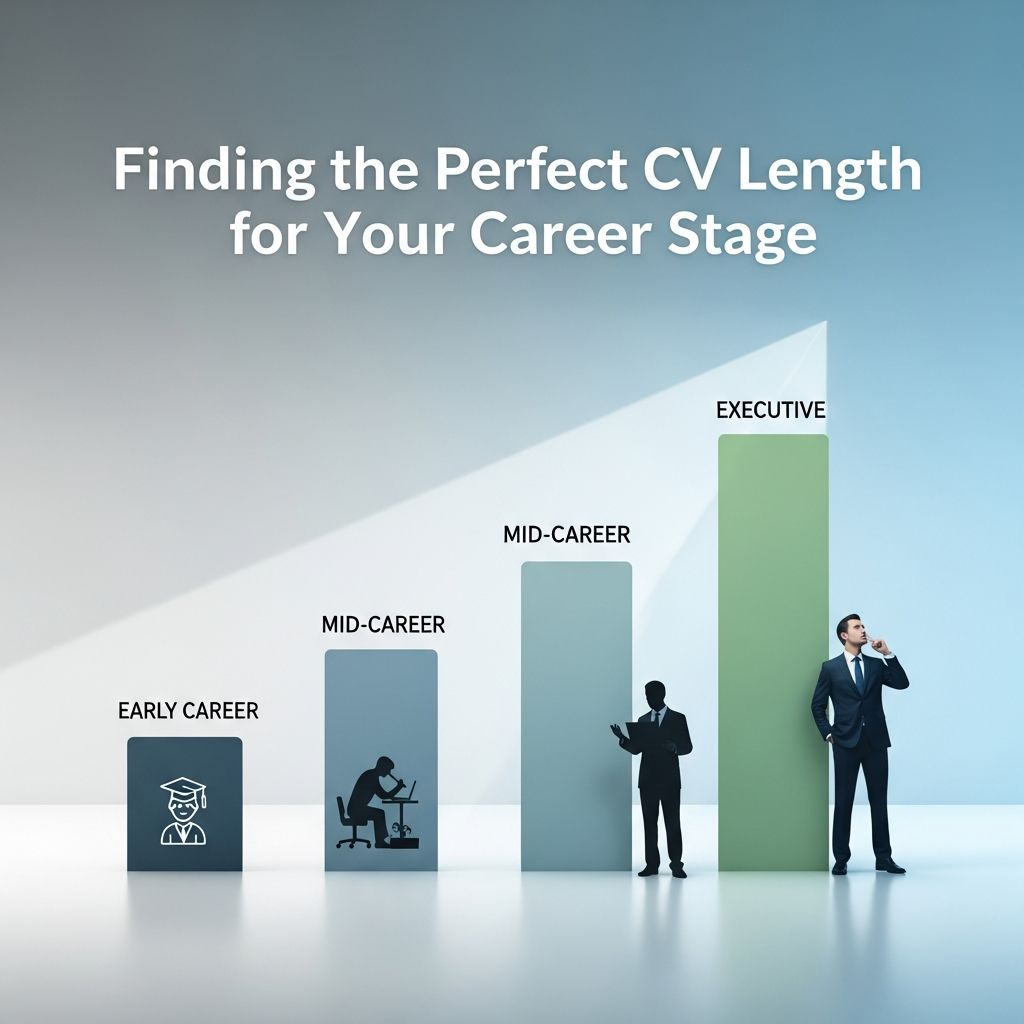
Knowing how long your CV should be is one of the most common job search questions, and for good reason. Too short and you look underqualified; too long and recruiters may never read it. This guide will help you decide on the right CV length for your profile and then structure your content to fit that target without losing impact.
CV vs. Resume: Why Length Rules Are Different
Before deciding on page count, it is essential to distinguish between a CV (curriculum vitae) and a resume, because each has different expectations.
- Resume: A concise marketing document, commonly used in the US and Canada, usually one to two pages summarizing recent, relevant experience for a specific job.
- CV: A more complete record of your professional and academic history, often used in academia, research, medicine, and in many European countries. CVs are typically longer and more detailed than resumes.
Because a CV is intended to capture your broader trajectory rather than just a short pitch, it can legitimately be several pages long, especially in academic or scientific fields.
General Guidelines: Typical CV Lengths
There is no universal rule, but most recruiters and hiring managers work with some informal benchmarks when reviewing CVs.
| Profile | Typical CV Length | Main Focus |
|---|---|---|
| Student / Recent graduate | 1 page (up to 2 if necessary) | Education, internships, projects, early experience |
| Early professional (1–5 years) | 1–2 pages | Core roles, measurable results, key skills |
| Mid-career (5–15 years) | 2–3 pages | Progression, scope of responsibility, impact |
| Senior / Executive | 3+ pages (rarely above 6 outside academia) | Leadership, strategy, major achievements |
| Academic / Research CV | As long as needed | Publications, grants, teaching, conferences |
Use these ranges as a starting point, then adapt based on your field, country, and the complexity of your background.
Choosing CV Length by Experience Level
Students and Recent Graduates
If you are still in school or have just graduated, a one-page CV is usually sufficient. Employers know you will not have a long track record yet.
- Highlight degree, coursework relevant to the role, projects, internships, and part-time work.
- Include student activities only when they show leadership, teamwork, or technical skills useful for the role.
- Use a second page only if you have substantial research, clinical experience, or multiple internships.
Early Career Professionals (1–5 Years)
Once you have a few years of full-time work, you may need one to two pages.
- Keep the most recent role as the centerpiece with concrete results.
- Trim early internships and unrelated roles to a line or two if they no longer add much value.
- Focus each bullet on an accomplishment, not just responsibility.
Mid-Career Candidates (5–15 Years)
By this stage, a two- to three-page CV is common as your responsibilities and achievements grow.
- Describe the last 10 years in more depth; older roles can be summarized.
- Group very early positions under an “Earlier Experience” or similar heading.
- Show progression: promotions, increasing budgets, team sizes, and strategic scope.
Senior, Executive, and Specialist Profiles
Executives, consultants, medical doctors, and highly specialized experts often legitimately need three or more pages to document leadership roles, board work, and specialized achievements.
- Prioritize recent, high-impact achievements on the first page.
- Consolidate minor or short-term roles into brief entries.
- Avoid repeating the same responsibilities across multiple senior positions; emphasize unique outcomes in each.
How Profession and Country Influence CV Length
Industry and geography can significantly influence what is considered a normal CV length.
Fields Where Longer CVs Are Expected
- Academia and research – It is standard to include full publication lists, grants, teaching, and conference activity, resulting in lengthy CVs.
- Medicine and healthcare – Licensing, clinical experience, procedures, and continuing medical education must often be detailed.
- Public sector / Government – Some systems require structured CVs or resumes and may impose explicit length limits; for example, the US federal hiring platform USAJOBS has introduced a two-page limit on resumes for many roles.
Regions Favouring Concise CVs
- US and Canada – The dominant document is a resume, with one page preferred for less-experienced candidates and two for experienced professionals.
- UK, Ireland, and parts of Europe – The term “CV” is used, but employers often expect two pages, with three pages acceptable in senior roles.
Always check local norms and, when possible, follow instructions in the job posting. If a two-page maximum is specified, keep your document within that limit, even if you are used to longer CVs.
Signs Your CV Is Too Short
A short CV is not automatically a problem—but if it falls well below typical length for your level, it may underrepresent your value.
- You have several years of experience but only one page with large white spaces.
- You list job titles and employers but give almost no detail about achievements.
- Recruiters ask follow-up questions about obvious aspects of your roles that could have been on the CV.
If this applies to you, consider adding:
- Quantified achievements under each role (e.g., revenue growth, cost savings, process improvements).
- Key projects, with a brief outline of your contribution and results.
- Relevant training, certifications, technical tools, or languages.
Signs Your CV Is Too Long
On the other side, a lengthy CV can hurt you when recruiters have only seconds to scan each application.
- Your CV runs far beyond the usual range for your level (e.g., five pages at entry level).
- Many bullet points repeat the same responsibilities in different roles.
- There are entire sections—such as extensive hobby lists or outdated skills—that are only loosely connected to your target job.
As a rule of thumb, recruiters typically skim each CV quickly before deciding whether to read in depth, so excess length can reduce the chance that your best achievements are noticed.
How to Shorten a CV Without Losing Impact
If you need to reduce your CV length to fit a page limit or to improve readability, focus on relevance and clarity.
- Limit bullets per role: Aim for about 3–7 bullet points for recent positions and fewer for older roles.
- Eliminate repetition: If a responsibility appears in three jobs, describe it fully under the role where you had the most impact and remove or compress it in earlier roles.
- Remove outdated content: Older, unrelated roles, obsolete software, or minor school awards can often be trimmed or removed.
- Simplify education: For experienced professionals, list degree, institution, and maybe one honor; detailed coursework is usually unnecessary.
- Keep formatting compact but readable: Use standard fonts in the 10–12 point range and reasonable margins (about 0.5–1 inch) to avoid wasting space.
How to Expand a Thin CV Credibly
If your CV feels too light, especially early in your career, you can expand content while keeping it honest and relevant.
- Develop achievement-oriented bullets: Instead of “Responsible for customer support,” write what you improved, solved, or achieved.
- Include meaningful academic work: Final-year projects, theses, or capstone work can demonstrate technical skills and initiative.
- Add relevant volunteering and extracurriculars: Only when they show skills relevant to the job (e.g., leadership, analytics, event management).
- Show continuous learning: List credible online courses, certifications, or workshops related to your field.
Formatting Choices That Influence Perceived Length
Layout decisions can make the same content feel cramped or airy. The goal is to present your information in a way that is scannable and ATS-friendly (readable by applicant tracking systems).
- Margins: Around 0.5–1 inch is common; very wide margins waste space, while extremely narrow margins can look crowded.
- Font size: Use professional fonts at 10–12 pt for body text and slightly larger for headings.
- Simple structure: A single-column layout with standard section headings is safest for ATS parsing and easy for recruiters to skim.
- Consistent spacing: Use modest line spacing and similar spacing between sections to keep the document compact but legible.
Sample CV Length Strategy by Scenario
The right length is always linked to your goal and context. Below is a simple reference to guide your decision.
| Scenario | Recommended Length | Key Action |
|---|---|---|
| New graduate applying to entry-level roles | 1 page | Summarize education and early experience; avoid long lists of unrelated activities. |
| Professional with 7 years in one industry | 2 pages | Detail recent roles and impact; compress early jobs and internships. |
| Senior manager switching companies | 2–3 pages | Prioritize strategic achievements and leadership; drop minor early roles. |
| Researcher applying for academic post | As long as needed | List publications, grants, teaching, and service; follow institutional CV guidelines. |
Frequently Asked Questions (FAQs)
Q: Is a one-page CV always better?
No. A one-page document is ideal for students and many early-career professionals, but if compressing to one page forces you to remove important evidence of your experience, a well-structured two-page CV is better.
Q: Can my CV be longer than three pages?
Yes, especially in academia, research, medicine, and some senior or specialist roles. For typical corporate positions, however, three pages is usually the upper sensible limit; anything longer should be justified by substantial, relevant content.
Q: Should I have different CV lengths for different applications?
Maintaining two versions—one concise and one more detailed—can be helpful. Use the shorter version for job boards and initial outreach, and a longer, tailored version when an employer requests more detail or for academic and research opportunities.
Q: Do recruiters really read long CVs?
Recruiters typically skim first pages quickly and then decide whether to continue. A long CV will only be read deeply if the most relevant achievements are visible early, so ensure the top half of your first page clearly matches the role.
Q: What matters more: CV length or content?
Content is always more important than strict page limits. However, the best results come from a balance: a CV long enough to demonstrate your value, but focused enough that every line earns its place and supports your target role.
References
- How Long Should a Resume Be in 2025? – Jobscan — Jobscan. 2025-01-10. https://www.jobscan.co/blog/how-long-should-a-resume-be/
- How Long Should a Resume Be? Resume Length Guide — Indeed Career Guide. 2024-06-18. https://www.indeed.com/career-advice/resumes-cover-letters/how-long-should-a-resume-be
- How Long Should a Resume Be in 2025 [For Any Profession] — Novorésumé. 2024-11-05. https://novoresume.com/career-blog/how-long-should-a-resume-be
- Optimal Resume Length in 2025: How Long Should a Resume Be? — Resume Worded. 2024-03-02. https://resumeworded.com/resume-length-key-advice
- Agency Guidance on the Two-Page Limit on Resume Length — U.S. Office of Personnel Management (OPM). 2024-09-30. https://www.opm.gov/policy-data-oversight/hiring-information/merit-hiring-plan-resources/agency-guidance-on-the-two-page-limit-on-resume-length/
- Resume Formatting for 2025: Modern Techniques — The Interview Guys. 2024-05-12. https://blog.theinterviewguys.com/resume-formatting/

- Integrated M.A. in Applied Linguistics, University of Hyderabad
- 5+ years in editorial, instructional, SEO, and research-based writing
Sneha is a relationships and lifestyle writer with a strong foundation in applied linguistics and certified training in relationship coaching. She brings over five years of writing experience to theskillvault, crafting thoughtful, research-driven content that empowers readers to build healthier relationships, boost emotional well-being, and embrace holistic living. Her writing and insights reflect the belief that beauty, happiness, and wellness…