
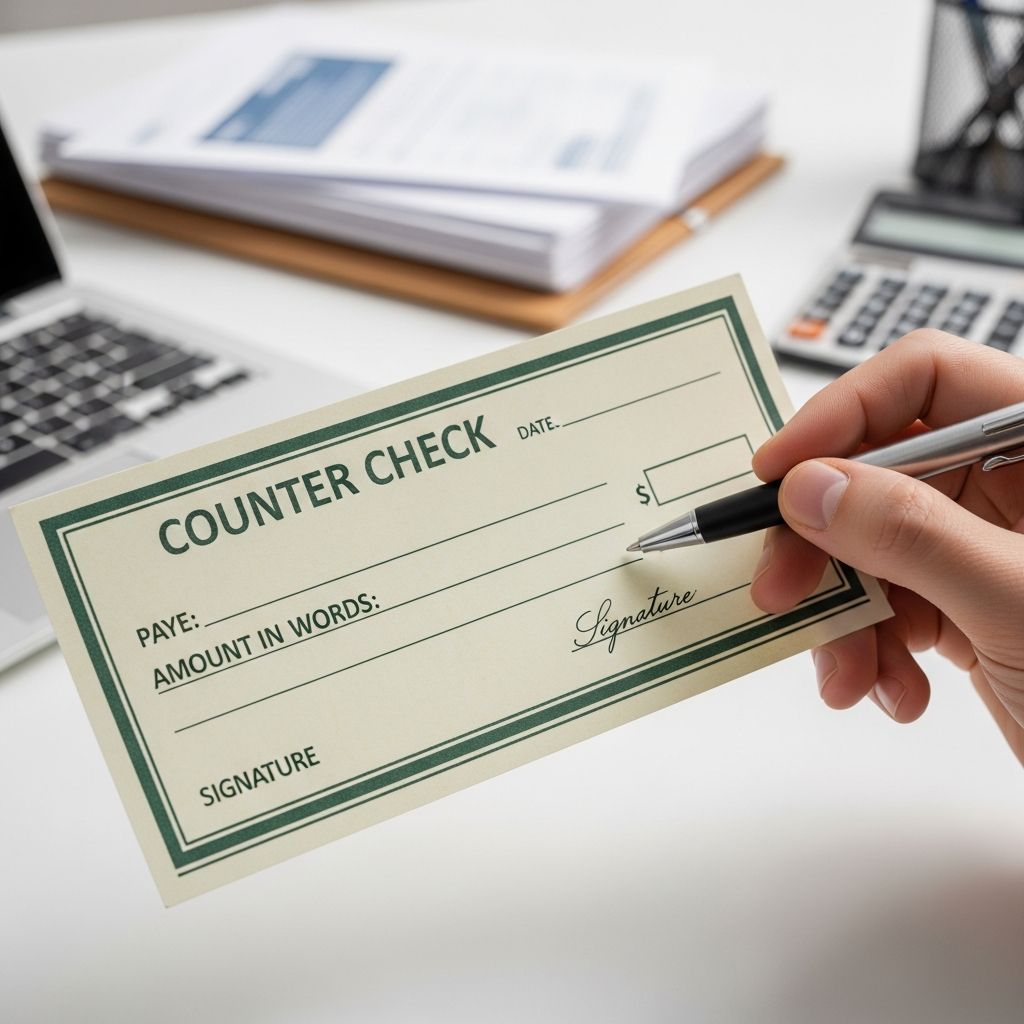
What Exactly Is a Counter Check?
A counter check is a temporary, blank check that a bank provides to a customer at a branch. Unlike a personal check from a checkbook, it doesn’t have the account holder’s name, address, or check number pre-printed. Instead, it contains only the bank’s routing number and the customer’s account number, allowing the customer to fill in the rest of the details by hand.
These checks are sometimes called blank checks, on-demand checks, or bank-issued temporary checks. They are not the same as a cashier’s check or a certified check, which are guaranteed by the bank and drawn on the bank’s own funds. A counter check is drawn from the customer’s personal account, just like a regular check, but it’s issued on the spot rather than being part of a pre-ordered checkbook.
How Counter Checks Are Different from Regular Checks
Most people are familiar with personal checks that come in a checkbook. Those checks are pre-printed with the account holder’s name, address, bank information, and a unique check number. They are ordered in advance and mailed to the customer, which can take several days.
Counter checks, on the other hand, are:
- Printed at the bank branch when requested
- Blank except for routing and account numbers
- Not personalized with the customer’s name or address
- Often available immediately, without waiting for delivery
Because they lack the usual personal details, some businesses and individuals may be more cautious about accepting them. However, they are still valid payment instruments as long as they are properly filled out and the account has sufficient funds.
How Counter Checks Compare to Cashier’s Checks
It’s important not to confuse a counter check with a cashier’s check. While both are issued by a bank, they serve different purposes and carry different levels of security.
| Feature | Counter Check | Cashier’s Check |
|---|---|---|
| Drawn from | Customer’s personal account | Bank’s own funds |
| Personalized details | No (name, address must be filled in) | Yes (payee, amount, bank details) |
| Security level | Lower (like a regular check) | Higher (bank-guaranteed) |
| Cost | Usually free or low fee | Higher fee |
| Availability | At bank branch, on demand | At bank branch, after processing |
Cashier’s checks are often required for large or formal transactions, such as real estate deposits or vehicle purchases, because they are considered more secure. Counter checks are better suited for everyday or emergency situations where a regular check isn’t available.
When You Might Need a Counter Check
Counter checks are not meant to replace a regular checkbook for routine use, but they can be very helpful in specific situations. Here are some common scenarios where a counter check might be the right choice:
Running Out of Personal Checks
If you’ve used up all the checks in your checkbook and need to make a payment before a new one arrives, a counter check allows you to continue paying bills or vendors without delay. This is especially useful if the payment is time-sensitive, such as rent or a utility bill.
Emergency or Unexpected Payments
Life doesn’t always go according to plan. If you need to make a sudden payment—like a medical bill, a repair, or a deposit for a service—and don’t have access to your checkbook, a counter check can be a quick solution. It lets you write a check immediately instead of waiting for a check order to be delivered.
Traveling Without a Checkbook
When traveling, it’s easy to forget a checkbook or leave it at home. If you need to make a payment in person and don’t have cash or a card that’s accepted, a counter check from a local branch of your bank can help. As long as the branch can verify your account, they can issue a counter check for the amount you need.
Closing a Bank Account
When closing a bank account, you may want to withdraw the remaining balance in the form of a check rather than cash. A counter check can be used to write a check to yourself for the exact amount in the account, ensuring that the account is properly closed and all funds are accounted for.
Meeting Bank or Institutional Requirements
Some banks or institutions require a check for certain transactions, such as opening a new account, making a wire transfer, or paying a processing fee. If you don’t have a personalized check available, a counter check can satisfy the requirement by providing the necessary routing and account information.
Large Purchases Requiring Check Payment
Occasionally, a seller may insist on payment by check rather than cash or electronic transfer. If you don’t have a personal checkbook, a counter check allows you to complete the purchase while still providing the bank details the seller needs to deposit or cash the check.
Avoiding Cashier’s Check Fees
Cashier’s checks are convenient but often come with a fee. For smaller or less formal transactions, a counter check can be a more cost-effective alternative. It still provides a paper trail and banking details without the higher cost of a cashier’s check.
How to Get a Counter Check from Your Bank
Obtaining a counter check is usually a simple process, but it requires a visit to a physical bank branch. Here’s how it typically works:
- Visit a branch of your bank – Counter checks are generally not available through online banking or ATMs. You’ll need to go to a local branch where your account is held.
- Provide identification – The bank will ask for a government-issued ID (like a driver’s license or passport) to verify your identity and confirm that you are the account holder.
- Request a counter check – Tell a teller or banker that you need a counter check. Some banks may ask for a reason, but this is usually just for internal records.
- Specify the amount (if needed) – While counter checks are blank, some banks may want to know the approximate amount you plan to write, especially if it’s a large sum, to ensure your account has enough funds.
- Receive the check – The bank will print or provide a blank check with your routing and account numbers. You may receive one check or a small set, depending on the bank’s policy.
It’s a good idea to call your bank in advance to confirm whether they offer counter checks, how many they provide, and if there are any fees. Policies can vary between institutions and even between branches of the same bank.
How to Fill Out a Counter Check Correctly
Since a counter check is blank, you must fill in all the necessary information by hand. Here’s what to include and how to do it:
- Date – Write the current date in the top right corner. This helps establish when the check was issued and can affect how long it remains valid.
- Payee – Clearly write the name of the person or business you are paying. Avoid abbreviations or unclear handwriting to reduce the risk of errors or fraud.
- Amount in numbers – In the box next to the dollar sign, write the amount numerically (e.g., 150.00).
- Amount in words – On the line below, write the amount in words (e.g., One hundred fifty and 00/100). This helps prevent tampering.
- Signature – Sign the check in the bottom right corner. Without a signature, the check is not valid.
- Optional: Name and address – Since the check doesn’t have your details pre-printed, you may want to write your name and address in the top left corner or in the memo line to make it easier for the recipient to identify you.
Always double-check the information before handing over the check. Mistakes in the amount, payee, or date can cause delays or rejection.
Pros and Cons of Using Counter Checks
Like any financial tool, counter checks have advantages and drawbacks. Understanding both can help you decide when they’re the right choice.
Advantages
- Immediate availability – You can get a counter check on the spot, which is useful when you need a check right away.
- No waiting for delivery – Unlike ordered checks, there’s no need to wait several days for a checkbook to arrive in the mail.
- Low or no cost – Many banks provide counter checks for free or at a very low cost, making them more affordable than cashier’s checks.
- Flexible use – They can be used for withdrawals, bill payments, purchases, and other transactions, just like regular checks.
- Useful for emergencies – They provide a backup option when you’re out of checks or away from home.
Disadvantages
- Less widely accepted – Some businesses and individuals may be hesitant to accept counter checks due to concerns about fraud or lack of personal details.
- Higher scrutiny – Recipients may treat counter checks more carefully, which could slow down processing or require additional verification.
- No check number – Without a pre-assigned check number, tracking payments can be more difficult, and it may be harder to prove which check was used for a specific transaction.
- Not ideal for formal transactions – For large or formal payments (like real estate or vehicle purchases), a cashier’s check is usually preferred.
- Bank policy limits – Some banks limit how many counter checks they issue or may charge a fee after a certain number.
Common Questions About Counter Checks
Can I deposit a counter check into my account?
Yes, you can deposit a counter check into your own account just like any other check. The bank will process it using the routing and account numbers printed on the check, and the funds will be withdrawn from the issuer’s account once the check clears.
Can a counter check bounce?
Yes, just like a regular check, a counter check can bounce if there are insufficient funds in the account when it’s presented for payment. The same fees and consequences apply, so it’s important to ensure your account has enough money to cover the check.
Do all banks offer counter checks?
Most traditional banks do offer counter checks, but policies vary. Some may only provide them to certain account types or may limit the number per visit. It’s best to check with your specific bank to understand their rules.
Can I use a counter check for online payments?
Generally, no. Online bill pay systems and payment platforms are designed to work with pre-printed checks or electronic transfers. A counter check is meant for in-person or mail-based payments, not for use in online payment portals.
Are counter checks safe to use?
Counter checks are safe as long as they are used responsibly. Always write them carefully, keep them secure, and only give them to trusted parties. Because they lack personal details, it’s a good idea to include your name and contact information when possible to reduce confusion.
Can I get a counter check if I don’t have a checkbook?
Yes, many banks will issue a counter check even if you don’t have a checkbook. As long as you have a checking account and can verify your identity, you can usually request one at a branch.
Final Thoughts: When a Counter Check Makes Sense
Counter checks are a practical tool for specific situations, not a replacement for a regular checkbook. They are most useful when you need a check immediately, are out of personal checks, or are in an emergency situation where waiting for a new checkbook isn’t an option.
They are less formal and less secure than cashier’s checks, so they’re better suited for smaller, everyday transactions rather than large or high-stakes payments. If you’re unsure whether a counter check is appropriate, it’s always a good idea to ask the recipient or your bank for guidance.
By understanding what counter checks are, how they work, and when to use them, you can make smarter, more flexible choices in your personal banking.
References
- What Is a Counter Check, and How Do You Get One? — The Muse. 2023. https://www.themuse.com/advice/what-is-a-counter-check
- Counter Check Definition — Dictionary.com. 2023. https://www.dictionary.com/browse/counter-check
- Countercheck — Merriam-Webster. 2023. https://www.merriam-webster.com/dictionary/countercheck

- Integrated M.A. in Applied Linguistics, University of Hyderabad
- 5+ years in editorial, instructional, SEO, and research-based writing
Sneha is a relationships and lifestyle writer with a strong foundation in applied linguistics and certified training in relationship coaching. She brings over five years of writing experience to theskillvault, crafting thoughtful, research-driven content that empowers readers to build healthier relationships, boost emotional well-being, and embrace holistic living. Her writing and insights reflect the belief that beauty, happiness, and wellness…