
Understanding the Strategic Value of Application Follow-Up
Submitting your application is merely the beginning of your journey toward securing an interview. After you click send, your application joins dozens or potentially hundreds of other submissions in a hiring manager’s inbox. This is where many candidates mistakenly believe their work is complete. In reality, a thoughtful and strategically timed follow-up can significantly elevate your visibility and demonstrate genuine commitment to the opportunity.
The follow-up communication serves multiple purposes beyond simply asking for a status update. It reinforces your interest in the role, provides an opportunity to highlight specific qualifications that align with the job requirements, and shows initiative and professionalism. Hiring managers and recruiters appreciate candidates who maintain professional communication throughout the hiring process, as it reflects how you might handle workplace interactions and client relationships in the future.
Many job seekers hesitate to follow up due to concerns about appearing overly aggressive or bothersome. However, when executed professionally and with appropriate timing, a follow-up message demonstrates confidence and genuine interest rather than desperation. The key is understanding the nuances of when, how, and what to communicate.
Determining the Optimal Timeline for Your Follow-Up
Timing is perhaps the most critical factor in determining whether your follow-up enhances or detracts from your candidacy. Reaching out too early may suggest you lack patience or professional judgment, while waiting too long risks having your application fade from the hiring team’s memory entirely. Industry professionals and recruitment experts have identified a strategic window for maximizing the impact of your follow-up.
The consensus among hiring professionals suggests waiting between one to two weeks before sending your initial follow-up message. This timeframe allows the hiring team adequate time to review applications without creating the impression that you’re rushing them. If you applied on a Monday, sending a follow-up on the following Monday or Tuesday would fall within this optimal range.
However, the specific timeline may vary depending on several contextual factors. For positions that were recently posted and are generating high application volume, you might lean toward the one-week mark to ensure your message arrives while your application is still fresh. Conversely, for roles posted several weeks earlier with potentially lower volume, you might wait closer to two weeks before reaching out.
If you don’t receive a response to your initial follow-up, experts recommend waiting an additional two weeks before sending a final follow-up message. This demonstrates persistent interest without crossing into territory that could be perceived as harassment. After two follow-up attempts with no response, it’s generally advisable to move your focus to other opportunities rather than continuing to reach out.
Selecting the Right Communication Channel
The medium through which you deliver your follow-up message carries its own significance. Different communication channels convey different levels of formality and respect for the recipient’s time and preferences.
Email as Your Primary Medium
Email remains the gold standard for job application follow-ups. This channel offers several advantages: it creates a documented record of your communication, allows the recipient to respond at their convenience, maintains a professional tone, and is less intrusive than direct phone contact. Email also enables you to include attachments such as your resume or portfolio if you wish to reinforce specific qualifications.
When selecting an email address, ensure it presents a professional image. Your email address should ideally contain your full name or a variation thereof rather than creative or casual handles. If your current email address doesn’t meet this standard, consider creating a professional email specifically for your job search.
LinkedIn as a Secondary Option
If the job posting specifically encouraged applications through LinkedIn or if you discovered the position via LinkedIn, using the platform’s messaging system for your follow-up is appropriate. LinkedIn messages can feel slightly less formal than email while still maintaining professionalism, and they work particularly well if you’ve already connected with the hiring manager. You can reference your LinkedIn profile and mutual connections, which adds a layer of familiarity to your communication.
Phone Calls and Other Methods
While phone calls might seem like a direct approach, they’re generally not recommended as your primary follow-up method unless the job posting explicitly invited candidates to call. Phone calls can interrupt the hiring manager’s workflow and may be perceived as presumptuous. If you do choose to call after an extended period without response (such as after two unsuccessful email follow-ups), keep the conversation brief, professional, and focused on expressing your continued interest rather than demanding information.
Crafting Your Follow-Up Message: Essential Components
A well-constructed follow-up email balances professionalism, brevity, and personality. Your message should be easily scannable, as hiring managers often review emails quickly between other responsibilities.
The Subject Line Strategy
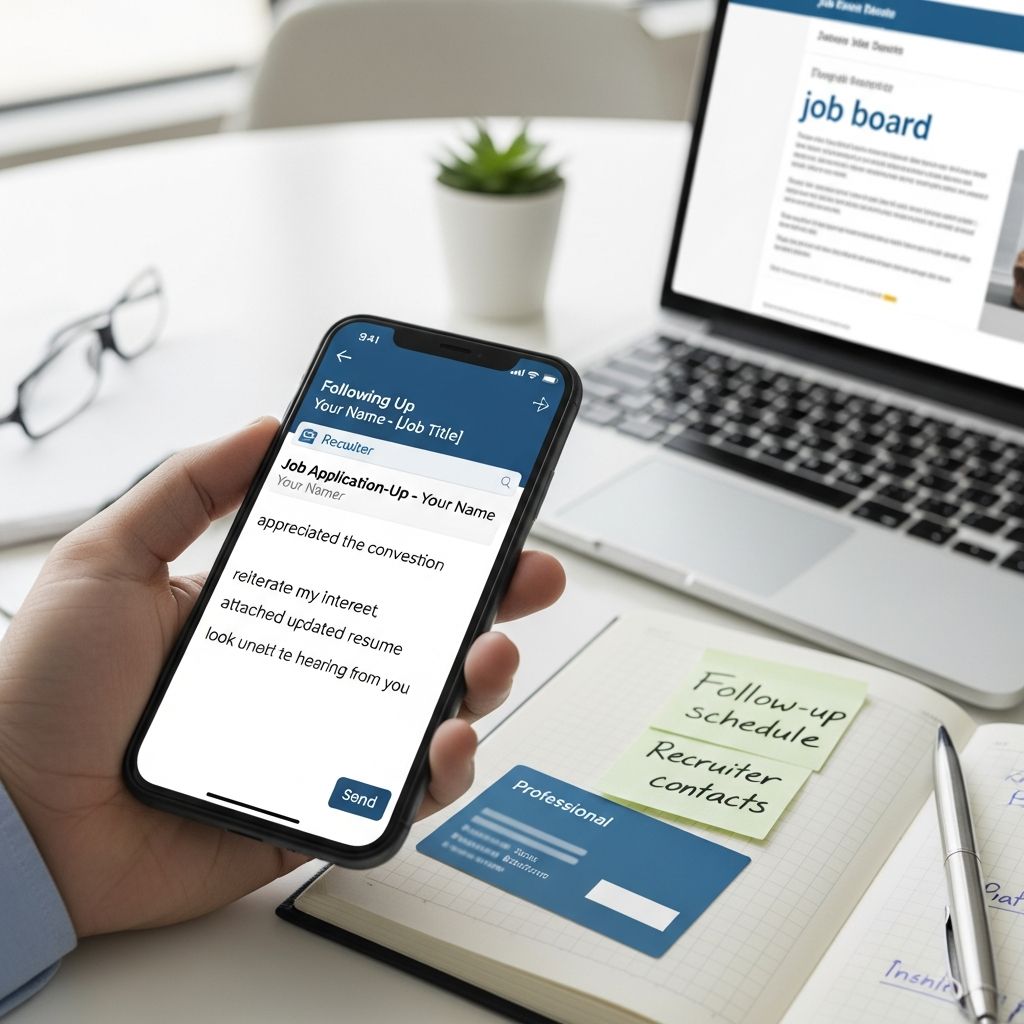
Your subject line serves as the gateway to your message. It should immediately communicate the purpose of your email without requiring the recipient to open the message. Effective subject lines often include the position title and your name, formatted as follows: “Follow-Up: [Position Title] Application – [Your Name]” or “Checking In: [Your Name] – [Position Title].” Avoid vague subject lines like “Quick Question” or generic “Hello,” which may get lost among dozens of daily emails.
A strong subject line increases the likelihood that your email will be opened and prioritized appropriately in the recipient’s inbox. It also serves a practical function by helping hiring managers quickly locate your email if they need to reference it later.
The Opening Greeting
Begin your message with a personalized greeting addressing the hiring manager by name. If you don’t have the specific hiring manager’s name, invest time in research before sending your follow-up. Check the company website, review the original job posting, search the company’s LinkedIn profile, or even call the company’s main line to ask for the appropriate contact’s name and title. This research demonstrates that you’ve invested effort in your application and view the opportunity seriously.
Use “Dear [Name]” or “Hello [Name]” depending on the formality level of the company and industry. Avoid impersonal openings like “To Whom It May Concern” or “Hello Hiring Manager,” as these suggest a lack of effort in personalizing your communication.
Identifying Your Application
Clearly remind the hiring manager who you are and which position you applied for. Many recruitment teams manage multiple openings simultaneously and receive applications from numerous candidates. Providing specific details helps them quickly locate your original application in their system. Include the position title and the date you submitted your application.
This section should be concise: “I applied for the Senior Marketing Manager position on November 25th and wanted to follow up regarding the status of my application.” This approach is direct and provides all necessary context without unnecessary elaboration.
Reaffirming Your Interest
Express genuine enthusiasm for the role and the organization. This section allows you to differentiate your follow-up from standard inquiries by demonstrating that your interest goes beyond simply getting any job. Reference specific aspects of the role, the company’s mission, recent company news, or projects that align with your professional goals.
For example: “I remain genuinely excited about the opportunity to contribute my experience in digital strategy to your marketing department. Your company’s recent expansion into international markets particularly resonates with my background in cross-cultural campaign development.” This approach shows you’ve done your research and have thoughtful reasons for your interest.
Strategic Qualification Highlights
Use your follow-up as an opportunity to briefly reinforce the most relevant aspects of your background. Select one or two qualifications that directly align with the job requirements and mention them naturally within your message. Avoid simply repeating information from your resume; instead, connect your experience to specific needs identified in the job posting.
For instance: “With five years of experience managing enterprise-level social media strategies and a track record of increasing engagement by over 40%, I’m confident I could drive meaningful results for your brand.” This approach reminds the hiring manager of your value proposition without requiring them to reread your entire resume.
The Professional Closing
End your message by thanking the recipient for their time and consideration. Offer to provide any additional information they might need, such as references, work samples, or clarification about your qualifications. Keep this section brief and professional: “Thank you for considering my application. I’m happy to provide any additional information you might require. I look forward to hearing from you.”
Include your contact information in your signature, even though it’s likely already in their system. This makes it convenient for them to reach you without having to search your original application.
Structural Best Practices for Maximum Readability
The physical formatting of your email impacts how the hiring manager receives your message. Consider these structural guidelines:
- Keep your email to three to four short paragraphs maximum
- Use white space effectively to make the email visually approachable
- Avoid long blocks of text that are difficult to scan quickly
- Use a professional font in a readable size (11 or 12 point)
- Maintain consistent formatting without excessive bolding or color
- Keep the tone professional yet personable, not robotic
When Not to Follow Up: Recognizing Red Flags
While follow-up is generally beneficial, certain situations warrant restraint. If the job posting explicitly states “no phone calls” or “applications only through our website,” respect these boundaries completely. Following such instructions demonstrates your ability to follow directions—a quality every employer values.
Additionally, if you’ve already sent two follow-up emails over an appropriate timeframe and received no response, it’s time to accept that the hiring team is not moving forward with your candidacy. Continuing to reach out at this point risks damaging your professional reputation. Instead, focus your energy on pursuing other opportunities and applying to additional positions that might be better fits.
Preparing Your Research and Contact Information
Before sending your follow-up, invest time in preparation to ensure your message is as effective as possible. Research the hiring manager’s name and role within the organization. If possible, look at their LinkedIn profile to identify any mutual connections or shared interests that might provide natural conversation points.
Verify that all your contact information is accurate and professional. Double-check that your phone number has a clear voicemail greeting, your email address is monitored regularly, and your LinkedIn profile is updated and aligned with your resume. These details matter because hiring managers may attempt to reach you at any point in the process.
Common Mistakes to Avoid in Your Follow-Up Communication
Several mistakes can undermine even a well-intentioned follow-up message. Avoid these pitfalls:
- Demanding or aggressive language that suggests entitlement
- Typos or grammatical errors that suggest carelessness
- Overly casual language or slang inappropriate for professional contexts
- Excessive length that requires significant time investment to read
- Passive-aggressive undertones expressing frustration about wait times
- Sending identical template messages to multiple companies without personalization
- Following up multiple times in quick succession
- Raising salary or benefits questions in your follow-up message
Leveraging Your Professional Network
If you have a connection within the target company, consider leveraging that relationship strategically. A warm introduction or referral from an internal employee can sometimes bypass the standard application process entirely or at least ensure your application receives priority attention. Before reaching out to an internal contact, ensure you have a legitimate professional relationship with them and haven’t simply found them on LinkedIn.
When asking for a referral, be respectful of their time and position. Provide them with clear information about the role you’re pursuing and be prepared to articulate why you’re genuinely interested. A well-placed referral carries significantly more weight than your own follow-up email and can substantially increase your chances of moving forward in the hiring process.
Sample Email Templates for Various Scenarios
Different situations call for slightly different approaches. Here are templates you can adapt to your specific circumstances:
Initial Follow-Up After One to Two Weeks
Subject: Follow-Up: [Position Title] Application – [Your Name]
Dear [Hiring Manager’s Name],
I hope this message finds you well. I applied for the [Position Title] position on [specific date] and wanted to reach out to express my continued interest in this opportunity. I’m genuinely excited about the possibility of joining [Company Name] and contributing my experience in [relevant skill area] to your team.
During my career, I’ve developed strong expertise in [specific accomplishment or skill], which I believe would be valuable for the [specific responsibility from the job posting]. I remain very interested in discussing how my background aligns with your team’s needs.
Thank you for considering my application. I’m happy to provide any additional information or clarification you might need. I look forward to hearing from you.
Best regards,
[Your Name]
[Phone Number]
[Email Address]
Secondary Follow-Up After No Response
Subject: Checking In: [Position Title] Application – [Your Name]
Dear [Hiring Manager’s Name],
I wanted to briefly follow up on my application for the [Position Title] role, which I submitted on [date]. I remain very enthusiastic about this opportunity and am confident that my background in [key skill] would enable me to make meaningful contributions to [Company Name].
If there’s any additional information I can provide to support my candidacy, please don’t hesitate to reach out. I’m available to discuss the role further at your convenience.
Thank you again for your time and consideration. I look forward to connecting with you soon.
Best regards,
[Your Name]
[Phone Number]
[Email Address]
Measuring Your Follow-Up Success
After you’ve sent your follow-up message, track your efforts and responses. Keep a spreadsheet documenting which companies you’ve applied to, when you applied, when you sent follow-ups, and whether you received responses. This organizational approach helps you avoid accidentally sending multiple follow-ups to the same company and enables you to identify patterns in which companies and positions generate responses.
If you do receive an interview invitation following your follow-up, you’ll have evidence that your persistence and professionalism paid off. Conversely, if you don’t hear back despite appropriate follow-up efforts, you can direct your attention to other opportunities without wondering whether you did enough.
Frequently Asked Questions About Job Application Follow-Ups
Q: Is it ever appropriate to follow up by phone rather than email?
A: Phone follow-up is generally less preferred than email because it interrupts the hiring manager’s workflow. However, if you’ve waited an extended period without response and the job posting didn’t prohibit phone contact, a brief, professional phone call is acceptable. Keep it short, friendly, and focused on reaffirming your interest rather than demanding information about your application status.
Q: What if I haven’t received a rejection or acceptance after my follow-ups?
A: Lack of response after two appropriately spaced follow-ups typically indicates the company is not moving forward with your candidacy, even if they haven’t explicitly stated this. Rather than continue reaching out, acknowledge this as a signal to focus your energy on other opportunities. Some companies simply don’t prioritize closing communication loops with candidates who aren’t advancing.
Q: Should I mention that I haven’t heard back in my follow-up email?
A: You can acknowledge the time that’s passed without sounding accusatory. Phrases like “I wanted to touch base” or “I wanted to follow up on” acknowledge time passage while maintaining professionalism. Avoid phrasing that sounds frustrated or entitled, such as “I haven’t heard from you yet” or “I’m still waiting to hear from you.”
Q: Is it appropriate to include my resume again in my follow-up email?
A: You can offer to resend your resume if they didn’t receive it, but typically it’s not necessary to include it proactively. Focus on reaffirming your interest and reminding them of your qualifications through your written message. If you offer to send additional materials, give them the option to request them rather than sending unsolicited attachments.
Q: What should I do if I discover new information about the company or position after applying?
A: This can actually provide excellent material for your follow-up message. If you discover the company is launching a new initiative related to your expertise or that they’ve expanded in an area matching your experience, mention this in your follow-up. It demonstrates ongoing research and engagement with the company beyond simply applying for the position.
Q: How do I follow up if I applied through an online application system?
A: Research the company’s website to identify the appropriate hiring manager or recruiter to contact. While online systems often don’t provide names, you can usually find contact information through the company’s careers page, LinkedIn, or by calling the company directly. Personalizing your follow-up with a specific name significantly increases its effectiveness compared to submitting another inquiry through an impersonal system.
Final Thoughts on Professional Follow-Up Strategy
Strategic follow-up on your job applications is not an optional nicety—it’s a critical component of modern job search success. In a competitive hiring landscape where dozens of qualified candidates may be vying for the same position, your follow-up message can be the differentiator that keeps you in contention or moves you to the next stage of the process.
Approach your follow-up with the same professionalism and attention to detail that you would bring to the actual job. View it as an extension of your application rather than a separate task, and remember that hiring managers generally appreciate candidates who demonstrate genuine interest and persistence. By following these guidelines and maintaining a respectful, professional approach throughout the process, you significantly enhance your chances of securing the interview and ultimately landing the opportunity you’re pursuing.
References
- Job Application Follow-Up: Best Practices for Success — Artech. Accessed December 2025. https://www.artech.com/blog/job-application-follow-up-best-practices-for-success/
- Best Practices for Following Up on Your Job Application — Westchester Putnam One Stop Career Center. Accessed December 2025. https://www.westchesterputnamonestop.com/resources/11-resources/217-best-practices-for-following-up-on-your-job-application
- How To Write a Follow-Up Email After a Job Application — Indeed Career Advice. Accessed December 2025. https://www.indeed.com/career-advice/finding-a-job/follow-up-email-after-application
- 12 Follow-up Email Templates for Every Work Situation — HSU Texas Career Services. December 3, 2024. https://careerservices.hsutx.edu/blog/2024/12/03/12-follow-up-email-templates-for-every-work-situation/
- Application Follow-up Email Examples — Thorens Talents. Accessed December 2025. https://www.thorenstalents.com/en/blog/application-follow-up-email-examples
- The Best Ways to Follow Up After Submitting a Job Application — Cardinal Staffing. July 22, 2025. https://www.cardinalstaffing.com/2025/07/22/the-best-ways-to-follow-up-after-submitting-a-job-application/
- Best Practices for Following Up on Job Applications — EarnBetter. Accessed December 2025. https://earnbetter.com/blog/follow-up-on-job-application/

Medha Deb is an editor with a master's degree in Applied Linguistics from the University of Hyderabad. She believes that her qualification has helped her develop a deep understanding of language and its application in various contexts. Medha specializes in the areas of beauty, health, sports, and wellness and is committed to ensuring that the content on the website is…