
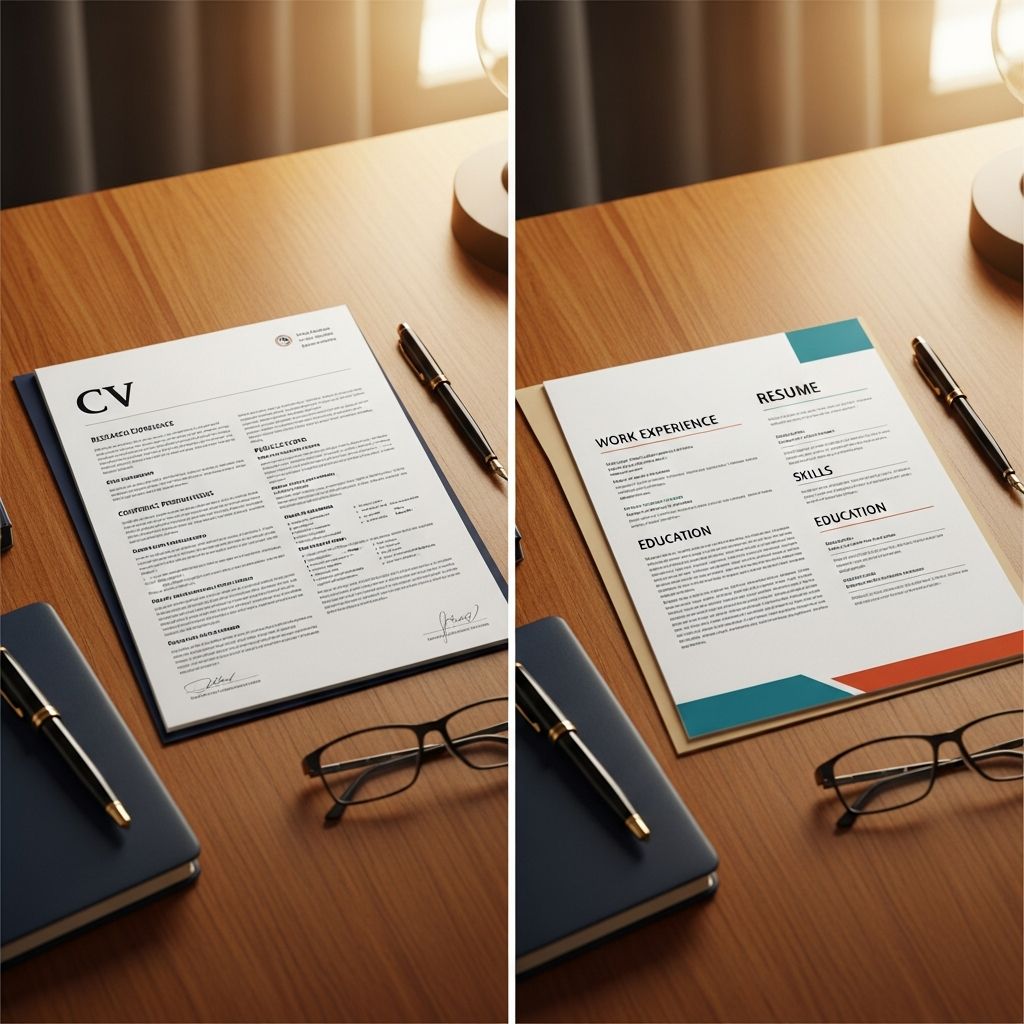
Understanding Your Career Documentation Options
When you embark on a job search or pursue further education, one of the first decisions you’ll face is determining which document to submit with your application. Two primary options exist: a curriculum vitae (CV) and a resume. While many professionals use these terms interchangeably, they serve distinct purposes and audiences. Understanding the nuances between these documents is essential for presenting yourself effectively to potential employers or academic institutions.
The choice between a CV and a resume depends largely on your target industry, geographic location, and the specific position you’re pursuing. In the United States, resumes dominate the non-academic job market, while CVs are the standard in academia, research, and many international settings. Knowing which document to prepare can significantly impact your chances of advancing in the hiring process.
Defining the Curriculum Vitae
A curriculum vitae, derived from Latin meaning “course of life,” is a comprehensive document that provides a detailed account of your educational background, professional experiences, research contributions, and accomplishments. Unlike a resume, a CV is designed to tell the complete story of your academic and professional journey.
The primary purpose of a CV is to demonstrate your expertise and credentials to institutions and organizations that prioritize academic achievement and research contributions. A well-crafted CV showcases not only your positions held but also the impact you’ve made in your field through publications, presentations, awards, and scholarly activities.
CVs vary significantly in length depending on your career stage and field. Early-career professionals might have a CV spanning two to three pages, while experienced academics and researchers could have CVs extending to ten or more pages. This flexibility allows CVs to accommodate the breadth of accomplishments accumulated over a long career.
What Is a Resume and How Does It Differ?
A resume is a concise, typically one or two-page document that highlights your most relevant work experience, education, and skills as they pertain to a specific job opening. The term “resume” comes from French and literally translates to “summary,” which accurately describes its condensed nature.
Where a CV aims for comprehensiveness, a resume emphasizes relevance and conciseness. Rather than listing every position you’ve ever held, a resume focuses on experiences that directly connect to the role you’re applying for. This targeted approach helps hiring managers quickly assess whether your background aligns with their needs.
Resumes are designed with readability in mind. Employers typically spend only a few minutes reviewing each resume, so successful documents use clear formatting, strategic white space, and action-oriented language to make key information stand out immediately.
Key Differences at a Glance
| Aspect | Curriculum Vitae (CV) | Resume |
|---|---|---|
| Length | 2-10+ pages (or longer for established professionals) | 1-2 pages |
| Primary Use | Academic, research, and scientific positions | Most non-academic jobs across industries |
| Content Focus | Complete academic and professional history | Most relevant experience and skills |
| Geographic Use | Standard in UK, Europe, and academia worldwide | Standard in North America for most positions |
| Detail Level | Highly detailed with multiple sections | Condensed and targeted information |
| Publications | Detailed listing of all publications | Minimal or none unless highly relevant |
| Awards and Honors | Comprehensive list of recognitions | Only most significant or relevant awards |
When to Submit a Curriculum Vitae
You should prepare and submit a CV in several specific situations. Graduate school applications almost universally require a CV to evaluate your academic background and research potential. Fellowships, scholarships, and grant applications typically demand CVs to demonstrate your qualifications and contribution to your field.
Academic positions at universities and colleges require CVs, as do many research-focused roles in government laboratories, think tanks, and research institutions. Medical and scientific careers often necessitate CVs to highlight clinical experience, publications, and research contributions. Positions in international organizations and outside the United States frequently require CVs as the standard career documentation.
Additionally, if you’re applying for leadership positions in non-profit organizations, certain government roles, or positions where your full professional history and credentials are particularly relevant, a CV may be more appropriate than a resume.
When to Submit a Resume
Resumes are the appropriate choice for most job applications in the private sector within North America. Marketing, finance, technology, human resources, and business development positions typically require resumes. Positions in non-academic corporate environments, startups, and small businesses are generally pursued using resumes rather than CVs.
If you’re applying for internships, entry-level positions, or roles in creative industries, a resume is the standard document. When an employer doesn’t specify which document to submit and you’re applying for a non-academic position in the United States, default to a resume. Always check the job posting carefully, as some employers specifically request one format over the other.
Essential Components of a Strong Curriculum Vitae
An effective CV begins with clear contact information including your full name, email address, phone number, and optionally your professional website or LinkedIn profile. Include your current location or institution.
The education section should list all degrees earned in reverse chronological order, including the degree type, major, institution name, and graduation date. For academic CVs, include your GPA if it was strong, relevant coursework, research focus areas, and dissertation or thesis title.
Professional experience or research positions form a substantial section of most CVs. Describe your roles, responsibilities, and accomplishments at each position, emphasizing contributions to research, teaching, mentoring, or scholarly work. Include dates of employment and institution names.
Publications represent a critical section for academic CVs. List all peer-reviewed articles, books, book chapters, and other scholarly publications in a standardized format. Research experience and projects should detail significant investigations you’ve conducted, including funding amounts if applicable.
Teaching experience deserves its own section if substantial. Include courses taught, student numbers, and any innovations in pedagogical approach. Presentations at conferences and seminars should be listed, typically in reverse chronological order.
Include sections for honors and awards, professional memberships and affiliations, grants and funding received, and any specialized certifications or training. Many CVs conclude with a statement of research interests or areas of expertise.
Building an Impactful Resume
Your resume should open with a professional summary or objective statement that provides an “elevator pitch” of your qualifications and career goals. This section should immediately communicate the value you bring and how your background aligns with the position.
The work experience section forms the core of most resumes. List positions in reverse chronological order, including company name, job title, employment dates, and location. Rather than simply describing duties, use action verbs and quantifiable results to demonstrate impact. For example, instead of “Responsible for sales development,” write “Increased quarterly sales by 28% through development of three new client accounts and implementation of targeted marketing strategy.”
Your education section should include your degree(s), institution(s), graduation date, and major. Including your GPA is optional and recommended only if it’s 3.5 or higher. List relevant coursework or certifications only if you’re early in your career or if they’re particularly relevant to the target position.
A skills section highlights competencies most relevant to the job you’re seeking. Include both technical skills (software proficiencies, programming languages) and soft skills (leadership, communication, project management). Limit this section to approximately nine skills, prioritizing those mentioned in the job description.
Consider including a certifications and licenses section if you hold professional credentials. Additional sections might include volunteer experience, professional affiliations, published work, or speaking engagements, but only if these significantly strengthen your candidacy for the specific role.
Formatting and Design Considerations
CVs should maintain a professional appearance while allowing readers to easily navigate multiple pages. Use consistent formatting with clear section headings. A readable font at 10-12 point size ensures legibility. Employ generous margins and white space to prevent the document from appearing cluttered. Consider using a simple design element such as a horizontal line under your name or between sections to add visual interest without appearing unprofessional.
Resumes demand even greater attention to formatting since hiring managers may scan them in seconds. Use a clean, modern layout with strategic use of bold text and bullet points to highlight important information. Maintain consistent spacing and formatting throughout. Avoid excessive graphics, colored text, or unusual fonts that might distract from your content or fail to display properly when submitted electronically.
Both documents should be saved as PDF files to preserve formatting across different operating systems and devices. Use a professional filename such as “FirstName_LastName_CV.pdf” rather than generic names like “resume.pdf.”
Content Strategy and Customization
Tailoring your CV or resume for each application significantly increases your chances of success. Review the job description and identify key qualifications, responsibilities, and desired skills. Reorganize sections or emphasize different experiences based on what the employer prioritizes.
Use language from the job posting when describing your experience. If the posting emphasizes “project management,” highlight instances where you successfully managed projects. If they mention “cross-functional collaboration,” emphasize experiences working across departments or with diverse teams.
For CVs, you might adjust the emphasis of different sections depending on whether you’re applying to a teaching-focused position versus a research-focused role. For resumes, you might expand the description of certain positions while condensing others based on their relevance to the current application.
Common Pitfalls to Avoid
When preparing your CV, resist the urge to include every single accomplishment. Be selective and focus on achievements most relevant to the position or institution you’re approaching. Avoid using overly technical jargon that might be understood only within your specific sub-field, as reviewers may not possess deep expertise in your exact area.
For resumes, don’t include unnecessary personal information such as age, marital status, religious affiliation, or photographs unless specifically requested. Avoid generic objectives like “seeking a challenging position where I can utilize my skills,” which fails to demonstrate knowledge of the specific role or company.
Never exaggerate or misrepresent your accomplishments in either document. Employers verify information, and dishonesty can disqualify you immediately or result in termination if discovered after hire. Proofread carefully for spelling and grammatical errors, which can create negative impressions about your attention to detail.
Digital and Alternative Formats
While PDF documents remain the standard, some organizations request resumes in other formats such as Microsoft Word. Always follow application instructions carefully. Some online application systems may require you to input information directly rather than uploading a document, so be prepared to reformat your information.
Many professionals now maintain digital portfolios or personal websites that complement their CVs or resumes. These platforms can showcase publications, research projects, work samples, or creative portfolio items. Include a link to your online presence if it strengthens your candidacy for the position.
Frequently Asked Questions
Q: Can I use the same CV or resume for every job application?
A: While you can use a master document as a template, customizing each application significantly improves your chances. Tailor content, emphasis, and language to match the specific position and organization. Generic applications are less competitive than personalized ones.
Q: How far back in my work history should I go?
A: For resumes, typically include the last 10-15 years of relevant experience. For CVs, include all professional positions and academic experiences. If you have a very long career, you might summarize very early positions while providing detail for recent roles.
Q: Should I include a photo on my CV or resume?
A: In the United States, photos are generally not recommended unless applying to modeling, acting, or similar positions where appearance is relevant. In some European countries and certain academic fields, small professional headshots are more commonly included. Follow local conventions and the employer’s guidelines.
Q: How should I handle employment gaps?
A: Employment gaps don’t need to be explicitly explained in the document itself, but be prepared to discuss them in interviews. You might briefly note significant gaps by including only years rather than months for positions, or you could mention brief explanations for major gaps such as “Sabbatical for professional development” or “Career transition period.”
Q: What’s the best way to present ongoing education or professional development?
A: List completed certifications and degrees prominently. For in-progress education, indicate expected completion dates. Include relevant workshops, conferences, or professional development courses that enhance your qualifications for the target position.
Q: How can I make my CV or resume stand out?
A: Use specific, quantifiable achievements rather than vague descriptions. Include relevant keywords from the job posting. Demonstrate impact and results. Choose a clean, professional design. Ensure error-free writing. Tailor content for each application rather than using a generic template.
References
- Curriculum Vitae: Definition, What to Include, and How to Format — Corporate Finance Institute. 2024. https://corporatefinanceinstitute.com/resources/career/curriculum-vitae/
- CV (Curriculum Vitae) – UC Davis Career Center — University of California, Davis. 2024. https://careercenter.ucdavis.edu/resumes-and-materials/cv-curriculum-vitae
- Definition of genre A curriculum vitae — Duke University, The Graduate School. https://twp.duke.edu/
- CV vs. Resume: Key Differences (Plus How To Write a CV) — Indeed Career Guide. 2024. https://www.indeed.com/career-advice/resumes-cover-letters/what-is-a-cv
- Curriculum Vitae (CV) — College of Liberal Arts, University of Minnesota. 2024. https://cla.umn.edu/undergraduate-students/career-services/getting-job-or-internship/curriculum-vitae-cv
- Difference Between Curriculum Vitae and Resume — Southern New Hampshire University. 2024. https://www.snhu.edu/about-us/newsroom/career/difference-between-curriculum-vitae-and-resume
- Curriculum vitae — Merriam-Webster Dictionary. 2024. https://www.merriam-webster.com/dictionary/curriculum%20vitae

Medha Deb is an editor with a master's degree in Applied Linguistics from the University of Hyderabad. She believes that her qualification has helped her develop a deep understanding of language and its application in various contexts. Medha specializes in the areas of beauty, health, sports, and wellness and is committed to ensuring that the content on the website is…