
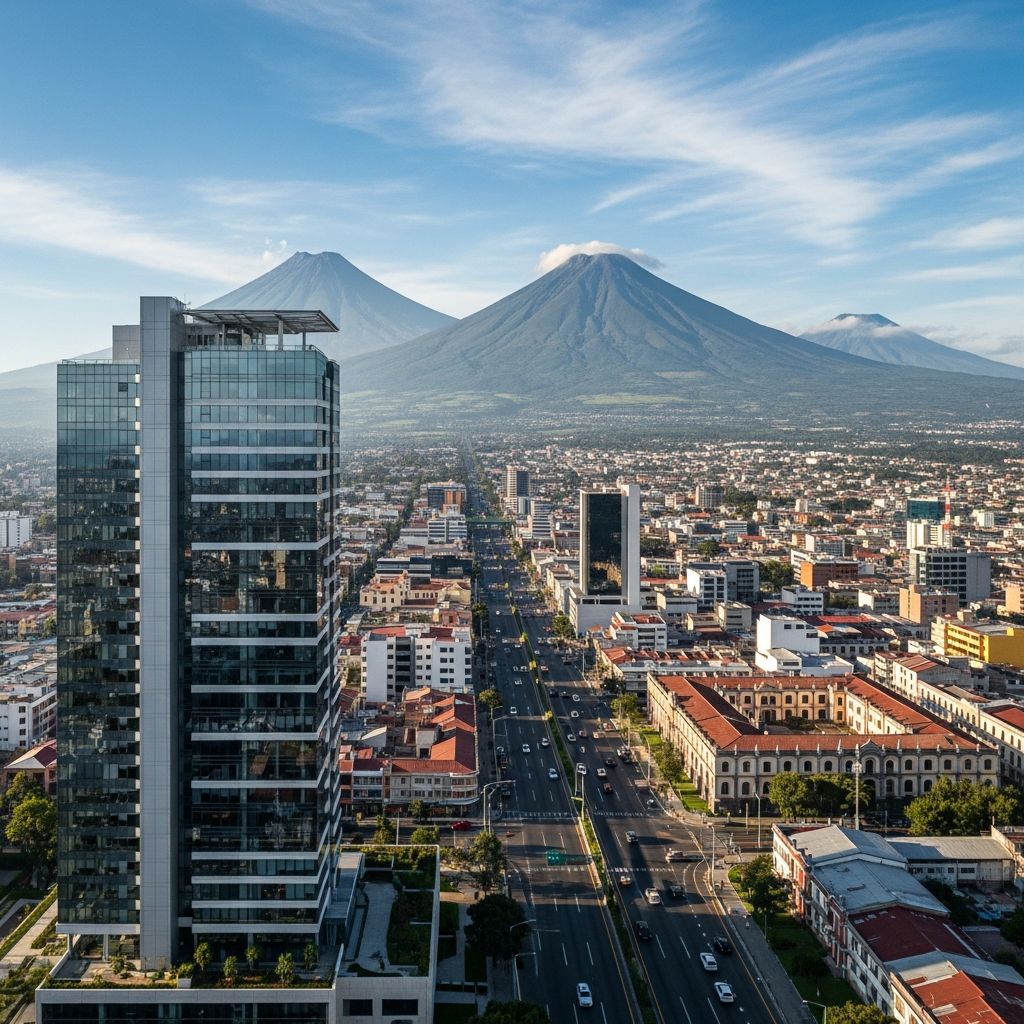
Guatemala City has grown into one of Central America’s most dynamic business centers, combining a large domestic market with strategic access to North and South America. For companies exploring expansion or nearshoring, and for professionals considering relocation, understanding how this urban hub works is essential.
Why Guatemala City Matters in the Regional Economy
As the capital and largest city of Guatemala, Guatemala City concentrates the country’s political, financial, and corporate power. It also sits at the heart of the largest economy in Central America by population, offering a sizable internal market and access to regional trade routes.
- Gateway economy: Central location with routes toward Mexico, the United States, Central America, and the Caribbean.
- Macroeconomic resilience: International organizations highlight stable growth, low public debt, and strong external buffers.
- Policy focus on investment: Recent reforms and promotion efforts target infrastructure, competition, and improved governance for investors.
These fundamentals position Guatemala City as a logical base for regional operations, particularly for export-oriented and service businesses.
Economic Landscape: Growth, Stability, and Reform
Macroeconomic conditions strongly influence business decisions. Recent assessments by international institutions give Guatemala a relatively favorable profile, while also emphasizing the need for structural change.
| Indicator | Recent Trend / Assessment | Why It Matters for Business |
|---|---|---|
| Real GDP growth | Growth around 3.5–4% projected in coming years, supported by private consumption and manufacturing. | Suggests steady demand and a relatively predictable environment for investment. |
| Public debt | Among the lowest public debt levels in Latin America. | Lower risk of fiscal stress, supporting macro stability and investor confidence. |
| Credit rating | Recent upgrade reflecting macro stability and prudent fiscal policy. | Signals improved country risk, helpful for capital access and financing costs. |
| Poverty & informality | Poverty above 50% and labor informality around 70%. | Highlights long-term social challenges and a dual economy of formal and informal sectors. |
For companies, the key takeaway is a combination of macroeconomic strength and micro-level complexity: solid growth and stability coexist with structural issues such as inequality, governance gaps, and limited infrastructure, all of which shape daily operations.
Guatemala City’s Strategic Advantages for Investors
Despite challenges, Guatemala City offers several concrete advantages that attract foreign direct investment and regional headquarters.
1. Strategic Location and Market Access
- Central American hub: Located on major overland corridors connecting Mexico and the rest of Central America, facilitating logistics and distribution.
- Trade agreements: The country benefits from agreements such as CAFTA-DR with the United States and free trade links with regional partners, making Guatemala City a convenient export platform.
- Nearshoring potential: Proximity to the U.S. time zones and markets continues to make Guatemala attractive for supply chain relocation and service outsourcing.
2. Competitive Labor Force
- Young demographics: A relatively young population feeds a growing labor pool for both manufacturing and services.
- Cost advantages: Wages and operating costs are generally lower than in North America, and often competitive with other Latin American capitals.
- Bilingual talent: Many professionals in Guatemala City speak both Spanish and English, a key asset for BPO, shared services, and multinational teams.
3. Expanding Service and Industrial Base
- Diversified economy: While agriculture remains important, manufacturing and especially services account for a large share of GDP.
- Industrial parks and free zones: Facilities around Guatemala City support light manufacturing, logistics, and assembly operations, often linking to export markets.
- Growing tech and BPO ecosystem: Increased internet penetration and a skilled urban workforce underpin expanding outsourcing and digital service industries.
Key Sectors with High Potential in Guatemala City
Guatemala City is not just an administrative capital; it is also the primary platform for many of the country’s fastest-growing sectors.
Manufacturing and Light Industry
Guatemala has developed a strong manufacturing base, particularly in garments and textiles, with Guatemala City acting as a management, design, and logistics center.
- Competitive labor and access to free trade zones support export-oriented plants.
- Industrial parks near the capital connect factories to ports and overland routes.
- Companies often base headquarters, finance, and compliance teams in the city while operating plants in surrounding departments.
Business Process Outsourcing and Shared Services
BPO, customer support centers, and back-office operations are expanding rapidly, attracted by language skills and time zone alignment.
- Guatemala City concentrates call centers, IT support teams, and finance hubs for regional clients.
- Service providers leverage stable telecommunications and growing broadband coverage.
- Companies targeting North American markets benefit from cultural proximity and similar working hours.
Financial and Corporate Services
Most national banks, insurers, law firms, and consulting companies maintain headquarters in Guatemala City, making it the primary location for corporate services.
- Access to experienced legal and accounting professionals helps foreign firms navigate registration, tax, and regulatory issues.
- Financial institutions offer local-currency and foreign-currency products tailored to trade and investment.
- Professional networks facilitate partnerships, joint ventures, and local representation.
Renewable Energy and Infrastructure
While many energy projects are outside the capital, Guatemala City plays a central role in project finance, policymaking, and operations management.
- The country possesses significant hydro, solar, geothermal, and wind potential, supported by national policies to expand renewable generation.
- Energy firms and infrastructure developers typically base management and administrative teams in the city.
- Improved infrastructure, including transport and digital connectivity, remains a policy priority.
Business Environment: Opportunities and Obstacles
Beyond sectors and headlines, investors need to understand the practical realities of operating in Guatemala City.
Regulatory and Institutional Climate
The national government has launched initiatives to improve the investment climate, but regulatory complexity and governance issues persist.
- Pro-investment policy direction: Authorities are promoting new laws and reforms linked to competition, infrastructure, financial inclusion, and anti-corruption.
- Administrative procedures: Company registration and licensing require interaction with multiple agencies, typically based in or accessible from Guatemala City.
- Rule of law challenges: International reports emphasize the importance of strengthening governance, transparency, and judicial independence to sustain investor confidence.
Informality and Social Gaps
High poverty and informality influence labor markets and urban development.
- Informal employment: With a large portion of the workforce outside formal systems, companies must carefully manage recruitment, compliance, and social contributions.
- Talent segmentation: While skilled professionals are available in the capital, competition for experienced managers and technical experts can be intense.
- Corporate responsibility: Social investments and inclusive hiring are increasingly important for long-term legitimacy and community relations.
Corruption and Governance Risks
Domestic and international observers continue to flag corruption as a key risk for businesses operating in the country.
- Companies may encounter issues in public procurement, permitting, and interactions with certain authorities.
- Adherence to robust compliance frameworks and international anti-bribery standards is strongly recommended.
- Working with reputable local partners and advisors in Guatemala City can help navigate these risks.
Living and Working in Guatemala City
For organizations sending staff or hiring international experts, quality of life is a pivotal factor. Guatemala City offers a mix of modern amenities and urban challenges.
Urban Districts and Daily Life
- Business districts: Many corporate offices are concentrated in central and southern zones of the city, where modern buildings, coworking spaces, and hotels cluster.
- Residential options: Expatriate and professional communities gravitate toward areas with better security, services, and international schools.
- Culture and leisure: Museums, restaurants, shopping centers, and cultural venues provide a rich urban life, complemented by proximity to historic sites and natural attractions elsewhere in Guatemala.
Cost of Living and Talent Attraction
Compared with many North American and European cities, Guatemala City generally offers lower living costs, though imported goods and high-end housing can be expensive.
- Housing: Rents vary widely by neighborhood, with modern apartments and gated communities priced above local averages.
- Services: Private healthcare, international education, and transportation add to total compensation considerations for expat staff.
- Talent strategies: Many firms blend local hires with a small number of relocated managers, using Guatemala City’s large talent pool for most roles.
Sustainability and Corporate Responsibility in the Capital
Guatemalan companies increasingly view sustainability not only as compliance but as a strategic lever for competitiveness and reputation.
- Environmental initiatives: Businesses are integrating energy efficiency, waste management, and resource optimization into operations, especially in urban facilities.
- Social impact: Programs focused on education, community development, and inclusive employment help address deep-rooted social challenges.
- Governance improvements: Adoption of better reporting practices and ESG frameworks can build trust with international investors and partners.
Guatemala City, as the corporate nerve center, is where many of these sustainability commitments are designed, monitored, and communicated.
Practical Tips for Entering the Guatemala City Market
Translating opportunity into successful operations requires careful preparation. The following guidelines can help companies and professionals plan a smoother entry.
For Companies and Investors
- Conduct in-depth due diligence: Understand sector-specific regulations, licensing requirements, and any local participation rules.
- Leverage local expertise: Partner with established legal, tax, and human resources advisors based in Guatemala City to navigate registration and compliance.
- Plan for governance risks: Implement strong internal controls, third-party vetting, and clear anti-corruption policies.
- Balance centralization and decentralization: Use Guatemala City for decision-making, finance, and coordination while assessing whether production or logistics sites should be elsewhere in the country.
- Engage with business networks: Chambers of commerce, industry associations, and binational organizations can provide insights, contacts, and advocacy channels.
For Professionals and Job Seekers
- Develop language skills: Fluency in Spanish is a major advantage; English is valuable in multinational environments and BPO roles.
- Target growing sectors: Explore opportunities in manufacturing management, finance, IT, renewables, and shared services headquartered in the city.
- Understand local work culture: Relationship building and personal trust are important; in-person interactions and networks often shape career paths.
- Assess lifestyle priorities: Consider commute times, security factors, schooling, and access to services when choosing where to live and work.
Frequently Asked Questions About Doing Business in Guatemala City
Q: Is Guatemala City a safe place to set up a regional office?
A: Security conditions in Guatemala City vary by neighborhood. Many companies operate successfully in business districts with private security and risk management measures in place. It is advisable to work with local experts to assess locations, implement security protocols, and provide staff guidance.
Q: How difficult is it for foreign investors to enter the Guatemalan market?
A: Foreign investment is generally allowed in most sectors, and authorities are promoting reforms to improve the business environment. However, administrative procedures, legal complexity, and governance challenges mean that investors should expect a learning curve and rely on experienced local advisors.
Q: What types of companies are best suited for Guatemala City?
A: Firms that benefit from proximity to the U.S. market, need bilingual service teams, or require a Central American coordination hub are particularly well positioned. This includes BPO providers, regional headquarters, financial services, logistics coordinators, and manufacturers using the capital as an administrative base.
Q: Are there government incentives for investment?
A: Guatemala offers various incentives through free trade zones, special regimes, and sector-specific policies, particularly for export-oriented manufacturing and services. Eligibility and benefits depend on project characteristics, so detailed legal review is essential.
Q: How can companies address sustainability expectations in Guatemala City?
A: Many Guatemalan firms now integrate environmental and social strategies into their core business models. New entrants can align with this trend by setting clear ESG goals, partnering with local NGOs or community groups, and reporting transparently on progress.
References
- Guatemala: 2025 Article IV Consultation—Press Release; Staff Report — International Monetary Fund. 2025-01-01. https://www.imf.org/-/media/files/publications/cr/2025/english/1gtmea2025001-source-pdf.pdf
- 2025 Investment Climate Statements: Guatemala — U.S. Department of State. 2025-09-01. https://www.state.gov/reports/2025-investment-climate-statements/guatemala
- Guatemala, firmly on track to lead the region in attracting investment — Invest Guatemala. 2025-07-15. https://investguatemala.com/2025/07/15/guatemala-firmly-on-track-to-lead-the-region-in-attracting-investment/
- Latin American Economic Outlook 2025: Guatemala Country Note — Organisation for Economic Co-operation and Development (OECD). 2025-10-01. https://www.oecd.org/en/publications/latin-american-economic-outlook-2025_80e48de5-en/full-report/guatemala_ba6b0e34.html
- Doing Business in Guatemala in 2025 – Market Entry, Company Formation and Opportunities — Biz Latin Hub. 2025-03-01. https://www.bizlatinhub.com/tips-for-doing-business-in-guatemala/
- Doing Business in Guatemala in 2025 [Expert Guide] — Remote People. 2025-02-01. https://remotepeople.com/countries/guatemala/doing-business-in-guatemala/
- Guatemalan Companies and Sustainability as a Business Strategy — Guatemala Portal. 2024-11-01. https://www.guatemalaportal.com/guatemalan-companies-and-sustainability-as-a-business-strategy-2/

Medha Deb is an editor with a master's degree in Applied Linguistics from the University of Hyderabad. She believes that her qualification has helped her develop a deep understanding of language and its application in various contexts. Medha specializes in the areas of beauty, health, sports, and wellness and is committed to ensuring that the content on the website is…