
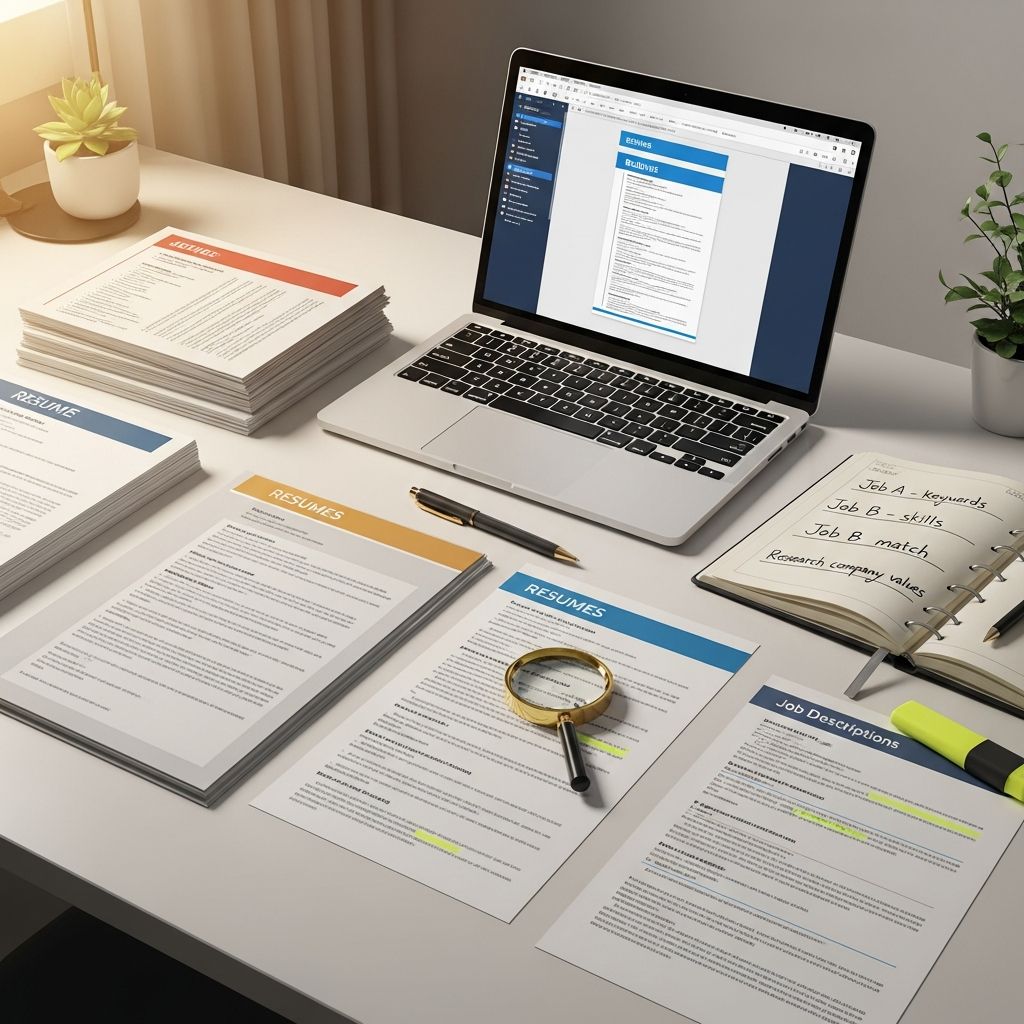
Sending the same generic resume to dozens of openings rarely works anymore. Recruiters expect to see clear alignment between your background and the specific role, and most employers use software to screen applications before a person ever looks at them. To get noticed, you need a resume that is deliberately tailored to each job.
This guide walks you through an efficient, repeatable process for customizing your resume without rewriting it from scratch every time.
Why Tailoring Your Resume Matters More Than Ever
Most mid- to large-sized employers use Applicant Tracking Systems (ATS) to filter resumes by keywords and minimum requirements before a recruiter reviews them. If your resume does not reflect the language of the job description, it may never make it to a human reader.
- ATS filters prioritize resumes that match required skills, job titles, and qualifications.
- Recruiters scan quickly and look for obvious evidence that you fit the role within seconds.
- Hiring has become skills-focused, so employers pay close attention to specific tools, technologies, and measurable results rather than only job titles.
Tailoring does not mean inventing experience you do not have. It means deciding what to emphasize, what to trim, and how to describe your work so the match is unmistakable.
The Core Idea: Align, Do Not Imitate
Effective tailoring is about alignment, not copying. You are answering a simple question for the employer: “Based on what you’ve already done, how prepared are you to do this specific job?”
To do this honestly and effectively:
- Mirror the employer’s priorities in your layout and section order.
- Use the same terminology when it genuinely applies to your experience (for example, “stakeholder management” instead of “managing partners”).
- Highlight the most relevant accomplishments and minimize less-related details.
Step 1: Decode the Job Description
Start by treating the job posting as a checklist of what your resume must demonstrate.
Identify the Employer’s Top Priorities
Print or copy the job description and mark up the most important elements:
- Role goals: What will this person be accountable for in the first 6–12 months?
- Must-have skills and tools: Any requirements that appear under “required,” “must have,” or are repeated.
- Preferred skills: Nice-to-have items that could set you apart.
- Soft skills and behaviors: Phrases like “collaborative,” “detail-oriented,” “data-driven,” or “customer-focused.”
Next, group similar items into a short list of themes. For example, a marketing role might emphasize “campaign management,” “analytics,” and “cross-functional collaboration.” These themes will drive how you tailor your resume.
Step 2: Build a Simple Targeting Map
Before editing your resume, map the role to your background. Create a quick reference chart like the one below to connect what they want to what you have.
| Job Requirement | Your Matching Experience | Keywords to Include |
|---|---|---|
| Manage cross-functional projects | Led 4 product launches with marketing, sales, and engineering | project management, cross-functional, launch |
| Use data to inform decisions | Built monthly performance dashboard and reported KPIs | data-driven, analytics, KPIs, dashboard |
| Experience with CRM software | Owned Salesforce updates and contact segmentation | Salesforce, CRM, segmentation |
This targeting map keeps you focused while you edit and helps ensure the right keywords appear naturally throughout your resume for both ATS and human readers.
Step 3: Reorder Sections to Match the Role
The structure of your resume should reflect what matters most for this particular job. Recruiters skim top-to-bottom, so your first few inches of content are critical.
- If experience is the main focus: Put your professional experience section right after your contact information and summary.
- If the posting emphasizes skills or tools: Move a concise skills section near the top so important keywords are immediately visible.
- If you are a recent graduate or career changer: Consider a prominent “Relevant Projects” or “Relevant Coursework” section above older or less related roles.
You are not changing your history; you are changing what the reader sees first.
Step 4: Tailor Your Professional Summary
Your summary (or professional profile) is the fastest way to signal fit. In three to five lines, it should connect your background directly to this specific role.
To tailor your summary:
- Use the target job title or a close variant when accurate.
- Mention 2–3 of the top themes from your targeting map (for example, “data-driven operations,” “client management,” “team leadership”).
- Include 1–2 quantified achievements that relate to the employer’s goals (for example, “reduced processing time by 30%”).
A tailored summary helps both ATS and recruiters quickly understand why your resume deserves a closer look.
Step 5: Rewrite Bullet Points for Relevance and Impact
Most tailoring work happens inside your experience section. Rather than rewriting your entire history, refine your bullet points so each one supports at least one theme from the job description.
Prioritize the Right Stories
For each role on your resume, ask:
- Which responsibilities and results are directly related to this job?
- What can I quantify (time savings, revenue impact, volume, accuracy, satisfaction)?
- Where can I naturally include the keywords from my targeting map?
Move your most relevant and impressive bullets to the top of each job entry. Recruiters may only read the first two or three.
Use an Action + Impact Formula
To keep your tailored bullets clear and compelling, use a simple pattern:
- Action verb + what you did + how you did it (tools, skills) + result
For example:
- “Developed weekly performance dashboards in Excel and Tableau to track KPIs, improving reporting speed by 25%.”
- “Coordinated a cross-functional team of 8 to launch a new feature on time, increasing adoption by 18% in the first quarter.”
This structure makes it easy for employers to see both your responsibilities and your impact.
Step 6: Optimize Your Skills Section for ATS and Humans
A dedicated skills section helps recruiters and ATS quickly confirm you meet the technical and core competency requirements.
To tailor it effectively:
- Match the employer’s language: Use the same phrasing for tools, technologies, and certifications they list when it accurately reflects your abilities.
- Group skills logically: For example, “Technical Skills,” “Analytics,” or “Languages,” depending on what the role emphasizes.
- Prioritize relevance over length: Focus on skills you are confident using and that clearly support this specific job.
Whenever possible, reinforce important skills within your bullet points so they are not isolated in a single list.
Step 7: Decide What to De-Emphasize or Remove
Tailoring is also about what you leave out. If a detail does not help you look like a strong candidate for this job, consider trimming or compressing it.
- Condense older, less relevant roles into shorter entries with fewer bullets.
- Remove tasks that are unrelated to the target role, especially if they distract from more important achievements.
- Shorten or remove sections (like unrelated hobbies) that push critical content onto a second page unnecessarily.
The goal is a focused, concise document that makes it easy to see why you fit this specific role.
Step 8: Format for Readability and Quick Scanning
Beyond content, formatting plays a major role in how your tailored resume is received. Career services and employer guides consistently recommend clean, simple layouts that emphasize clarity over design flourishes.
- Use a clear, professional font and consistent heading styles.
- Keep bullet points short enough to skim quickly, especially if viewed on a screen.
- Align dates and locations in a consistent format so ATS can interpret them correctly.
- Avoid images, unusual graphics, or complex columns that can confuse parsing software.
Good formatting supports your tailoring work by guiding the reader’s eye to the most important information first.
Step 9: Create Reusable Building Blocks
To avoid starting from zero with every new application, create a small library of resume components you can mix and match.
- Core resume: A master version that includes all of your experience and a wide set of bullets.
- Role-specific bullets: Alternative bullet versions emphasizing different strengths (for example, one set focused on leadership, another on technical depth).
- Multiple summaries: Short summaries targeted to 2–3 types of roles you commonly pursue.
When a new posting appears, you can quickly assemble a tailored version using these building blocks instead of writing everything from scratch.
Step 10: Cross-Check Against the Job Posting
Before sending your application, do one final pass with the job description next to your resume.
Ask yourself:
- Can a recruiter match you to the role within 10–15 seconds of scanning the top half of your resume?
- Do all of the must-have requirements appear somewhere in your summary, skills, or bullets?
- Have you included the most important keywords in natural, context-rich ways?
- Does your resume feel honest and consistent with your actual experience?
If the answer is yes, your resume is effectively tailored and ready to submit.
Frequently Asked Questions (FAQs)
Q: Do I really need a different resume for every single job?
You do not need to rebuild your resume from scratch, but you should make targeted adjustments for each role. Small changes to your summary, section order, skills list, and key bullet points can significantly increase your chances of passing ATS filters and impressing recruiters.
Q: How long should a tailored resume be?
Most early- and mid-career professionals should aim for one page, especially when tailoring for a specific role. If you have extensive relevant experience, two pages can be appropriate, but only if every section supports your fit for the job.
Q: Can I use creative designs or graphics if I’m in a design field?
You can maintain a visually distinctive portfolio or design-focused version of your resume for direct human review, but it is still wise to keep an ATS-friendly version without complex graphics or unusual layouts for online applications.
Q: How do I tailor my resume if I’m changing careers?
Focus on transferable skills (like communication, project coordination, analysis) and relevant projects or coursework. Move an appropriately titled section such as “Relevant Projects” or “Related Experience” above older roles that are less aligned, and use your summary to connect your past work to the new field.
Q: What if I do not have all the skills listed in the posting?
Very few candidates meet 100% of the listed criteria. Emphasize the skills and experiences you do have that are closest to the employer’s needs, show evidence of learning new tools quickly, and highlight any recent upskilling or training you have completed.
References
- Resume Formatting for 2025: 9 Modern Techniques That Will Get You Hired — The Interview Guys. 2024-06-10. https://blog.theinterviewguys.com/resume-formatting/
- 12 Resume Best Practices from a Career Advisor: How to Make Your Resume Stand Out in 2025 — UC San Diego Division of Extended Studies. 2024-01-05. https://extendedstudies.ucsd.edu/news-events/extended-studies-blog/12-resume-best-practices-from-a-career-advisor-how-to-make-your-resume-stand-out-in-2025
- Creating the Best Resume Format in 2025 — Jobscan. 2024-08-20. https://www.jobscan.co/blog/best-resume-format/
- Create a Strong Resume — Harvard University, Mignone Center for Career Success. 2023-09-01. https://careerservices.fas.harvard.edu/resources/create-a-strong-resume/
- 16 Top Resume Tips to Help You Land a Job in 2026 — Coursera Career Academy. 2024-11-12. https://www.coursera.org/articles/resume-tips

Medha Deb is an editor with a master's degree in Applied Linguistics from the University of Hyderabad. She believes that her qualification has helped her develop a deep understanding of language and its application in various contexts. Medha specializes in the areas of beauty, health, sports, and wellness and is committed to ensuring that the content on the website is…