
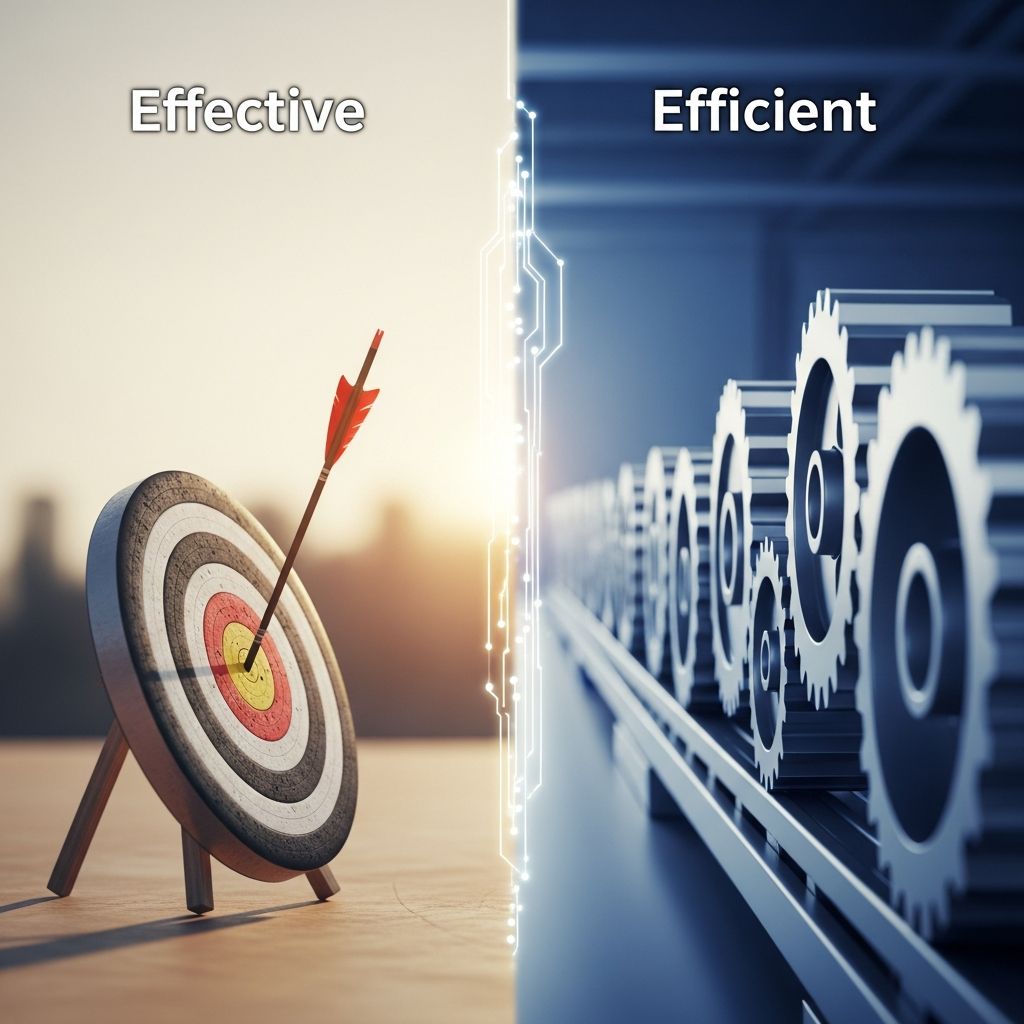
In modern workplaces, you often hear people praised for being “efficient” or “highly effective.” These words sound similar, but they describe different ways of working. Understanding how they differ—and how to combine them—is one of the most powerful shifts you can make in your career.
This guide explains what it really means to be effective and efficient, how each one influences your performance, and specific strategies you can use to grow in both dimensions without burning out.
What Does It Mean to Be Effective?
Being effective means you consistently achieve meaningful results. The focus is not on how quickly you work, but on whether your work creates the impact that matters.
Researchers and management thinkers often describe effectiveness as the degree to which goals are met or desired outcomes are achieved, regardless of the resources used to get there.
Key traits of effective professionals
- Clear priorities: They understand what matters most for their role, team, and organization.
- Outcome focus: They judge success by impact, not activity or busyness.
- Strategic thinking: They question whether a task contributes to larger goals before committing to it.
- Follow-through: They finish the work that moves the needle, even when it is complex or time-consuming.
Examples of effectiveness in action
- A salesperson who closes fewer deals overall but wins the right clients that drive long-term revenue.
- A project manager who postpones a low-value feature to focus on a release that solves customers’ biggest pain point.
- A team lead who spends extra time aligning stakeholders upfront to avoid a costly pivot later.
In each case, the person may not be the fastest worker, but their decisions and actions move important goals forward.
What Does It Mean to Be Efficient?
Being efficient means you use time, effort, and resources wisely while completing tasks. In business settings, efficiency is often framed as getting more output from the same or fewer inputs, such as time or budget.
Key traits of efficient professionals
- Process awareness: They know the steps involved in their work and continuously refine them.
- Speed with accuracy: They complete recurring tasks quickly with minimal errors.
- Resource mindfulness: They avoid unnecessary meetings, rework, and duplicated efforts.
- Tool usage: They rely on templates, checklists, and automation where appropriate.
Examples of efficiency in action
- An analyst who builds a reusable report template that cuts weekly reporting time in half.
- A customer support agent who resolves more tickets per hour without sacrificing service quality.
- A marketer who schedules a month of content in one focused session instead of handling posts ad hoc every day.
Here, the spotlight is on how work is done: fewer steps, less waste, and consistent speed.
Effectiveness vs. Efficiency: How They Differ
You can think of effectiveness and efficiency as answering two different questions:
- Effectiveness: “Are we working on the right things?”
- Efficiency: “Are we doing those things in the best possible way?”
| Aspect | Effectiveness | Efficiency |
|---|---|---|
| Primary focus | Results and goal achievement | Process, speed, and resource use |
| Core question | “Did we achieve the right outcome?” | “Did we deliver with minimal waste?” |
| Measurement | Impact, quality, relevance | Time, cost, effort, throughput |
| Time horizon | Often long-term success | Often short-term productivity |
| Risk when overemphasized | Great outcomes at unsustainable cost | Fast output that may miss real needs |
Why confusing the two can hurt your performance
Many professionals fall into one of two traps:
- Highly efficient but ineffective: You power through emails, tasks, and meetings quickly, but your work does not meaningfully advance your objectives.
- Highly effective but inefficient: You produce great results, but your approach is so time-consuming or exhausting that it is hard to sustain.
Research on organizational performance frequently emphasizes that both dimensions are necessary. For example, management studies note that efficiency strengthens cost and productivity, while effectiveness is tied more closely to strategic goals and customer satisfaction.
Why Both Matter for Your Career
Organizations increasingly expect employees to be both result-oriented and resource-conscious. Large surveys of employers routinely highlight problem-solving, prioritization, and time management among the top skills for career advancement.
Benefits of being effective
- Greater visibility: When you work on the right problems, decision-makers notice.
- Stronger reputation: You become known as someone who can be trusted with important initiatives.
- Better alignment with strategy: Your day-to-day tasks support broader organizational goals, which can position you for leadership roles.
Benefits of being efficient
- Higher throughput: You can handle more work without sacrificing quality.
- Lower stress: When your systems are organized, you avoid constant last-minute scrambles.
- More time for high-value work: Efficient handling of routine tasks frees time for creative or strategic projects.
How to Become More Effective at Work
Improving effectiveness starts with choosing the right targets. You cannot be effective if you aim at the wrong goals.
1. Align your work with clear goals
Goal-setting frameworks such as SMART goals or objectives and key results (OKRs) can help you connect everyday tasks with broader outcomes.
- Clarify how your role contributes to team or company objectives.
- Translate large goals into a small number of measurable outcomes.
- Review your goals weekly and adjust tasks that no longer fit.
2. Ruthlessly prioritize
Effectiveness requires saying “no” or “not now” to lower-value work.
- Identify your top 1–3 priorities for the day instead of a long to-do list.
- Use simple filters such as impact vs. effort when choosing which tasks to tackle first.
- Ask your manager for clarification when priorities conflict.
3. Measure impact, not just output
Track metrics that reflect real outcomes, not just activity.
- Instead of counting the number of emails sent, track issues resolved or decisions made.
- For projects, assess whether the final result solved the original problem.
- Collect feedback from stakeholders to understand how your work is perceived.
How to Become More Efficient Without Burning Out
Once you are confident you are working on the right things, efficiency helps you handle them in a sustainable way.
1. Streamline your workflows
Complex or cluttered processes slow you down and increase the chance of errors.
- Document recurring tasks step by step; remove steps that add little value.
- Batch similar tasks—such as email responses or report updates—to reduce context switching.
- Use templates for documents, messages, and reports you produce regularly.
2. Use tools and automation thoughtfully
Digital tools can increase efficiency when used with intention.
- Leverage calendar blocks to protect time for focused work.
- Use task managers or project software to track deadlines and dependencies.
- Automate repetitive actions where possible, such as file naming or simple data transfers.
3. Protect your energy and attention
Efficiency is not only about time; it also depends on mental and emotional energy. Occupational health research shows that breaks, recovery time, and workload management are crucial for sustainable performance and lower burnout risk.
- Work in focused intervals with short breaks in between.
- Limit unnecessary meetings and politely decline when your presence is not essential.
- Set realistic deadlines and flag overload early instead of silently absorbing it.
Combining Effectiveness and Efficiency Day to Day
In practice, you do not choose between being effective or efficient; you adjust the balance depending on the situation.
When to prioritize effectiveness
- At the beginning of a new project or initiative.
- When goals, requirements, or success measures are unclear.
- When decisions have long-term strategic consequences.
In these contexts, spend more time clarifying the right direction before trying to optimize the process.
When to emphasize efficiency
- For recurring tasks that have stable, well-understood steps.
- When deadlines are tight but the goal is already clear.
- During execution phases where changes are minimal and predictable.
Here, refining workflows and removing waste will deliver the biggest gains.
A simple three-step check for any task
Before starting a piece of work, ask yourself:
- Why am I doing this? (Clarify effectiveness.)
- What outcome will define success? (Specify the result.)
- How can I get there with the fewest steps and least rework? (Plan for efficiency.)
This brief reflection helps ensure that you are not just working quickly, but working quickly on the right things.
Practical Examples from Common Work Situations
Email and communication
- More effective: Writing messages that clearly state decisions, next steps, and responsibilities so threads do not drag on for days.
- More efficient: Checking email at set times instead of constantly, and using templates for frequent responses.
Meetings
- More effective: Only holding meetings when they are necessary to make decisions, share critical information, or resolve conflicts.
- More efficient: Circulating an agenda, starting on time, and ending once the objectives are achieved.
Projects and deliverables
- More effective: Spending time upfront to define the problem, stakeholders, and success criteria.
- More efficient: Using project plans, timelines, and standard templates to avoid last-minute chaos.
Frequently Asked Questions (FAQs)
Q: Is it better to be effective or efficient?
Neither on its own is enough. Effectiveness ensures you work on the right goals; efficiency ensures you reach them without wasting resources. High performers usually develop effectiveness first—understanding what matters—then increase efficiency to deliver those results faster and more sustainably.
Q: How do I know if I am focusing too much on efficiency?
Warning signs include feeling constantly busy but unsure what you accomplished, optimizing low-value tasks while strategic work lags, and measuring your day mostly in terms of speed or volume. If you recognize these patterns, step back and reconnect your efforts to key objectives and outcomes.
Q: Can a team or company be efficient but ineffective?
Yes. Organizations sometimes design very lean processes that deliver outputs quickly, but those outputs do not solve customer problems or advance strategic goals. Studies in operations and strategy frequently highlight that overemphasis on cost and speed can harm innovation and long-term competitiveness.
Q: How can managers help employees be both effective and efficient?
Managers play a central role by clarifying priorities, connecting individual tasks to broader goals, and regularly reviewing workloads and processes. Research on high-performance workplaces points to clear expectations, supportive supervision, and opportunities to improve skills and systems as key drivers of both effectiveness and efficiency.
Q: What should I do first if I want to improve tomorrow?
Choose one important outcome you want to influence this week—such as moving a project forward or resolving a recurring issue. Identify the single most impactful action you can take for that outcome, and block time in your calendar to work on it without distraction. This simple move improves effectiveness; after repeating it for a few weeks, you can gradually refine how you execute those blocks to improve efficiency.
References
- Locke, Edwin A. and Latham, Gary P. Building a Practically Useful Theory of Goal Setting and Task Motivation — American Psychologist. 2002-09-01. https://doi.org/10.1037/0003-066X.57.9.705
- Business Efficiency vs. Effectiveness: The Difference — Oracle NetSuite. 2022-08-23. https://www.netsuite.com/portal/resource/articles/financial-management/business-efficiency-vs-effectiveness.shtml
- Efficiency vs. Effectiveness in the Workplace: Why Your Team Needs Both — Melp. 2023-05-15. https://www.melp.us/blog/efficiency-vs-effectiveness-in-the-workplace-why-your-team-needs-both/
- The Future of Jobs Report 2023 — World Economic Forum. 2023-04-30. https://www.weforum.org/reports/the-future-of-jobs-report-2023/
- Goal Setting to Improve Performance — U.S. Office of Personnel Management. 2020-01-15. https://www.opm.gov/policy-data-oversight/performance-management/reference-materials/publications/goal-setting.pdf
- Workplace Stress and Health in a Changing World of Work — National Institute for Occupational Safety and Health (NIOSH), CDC. 2023-02-10. https://www.cdc.gov/niosh/topics/workstress/default.html

Medha Deb is an editor with a master's degree in Applied Linguistics from the University of Hyderabad. She believes that her qualification has helped her develop a deep understanding of language and its application in various contexts. Medha specializes in the areas of beauty, health, sports, and wellness and is committed to ensuring that the content on the website is…