
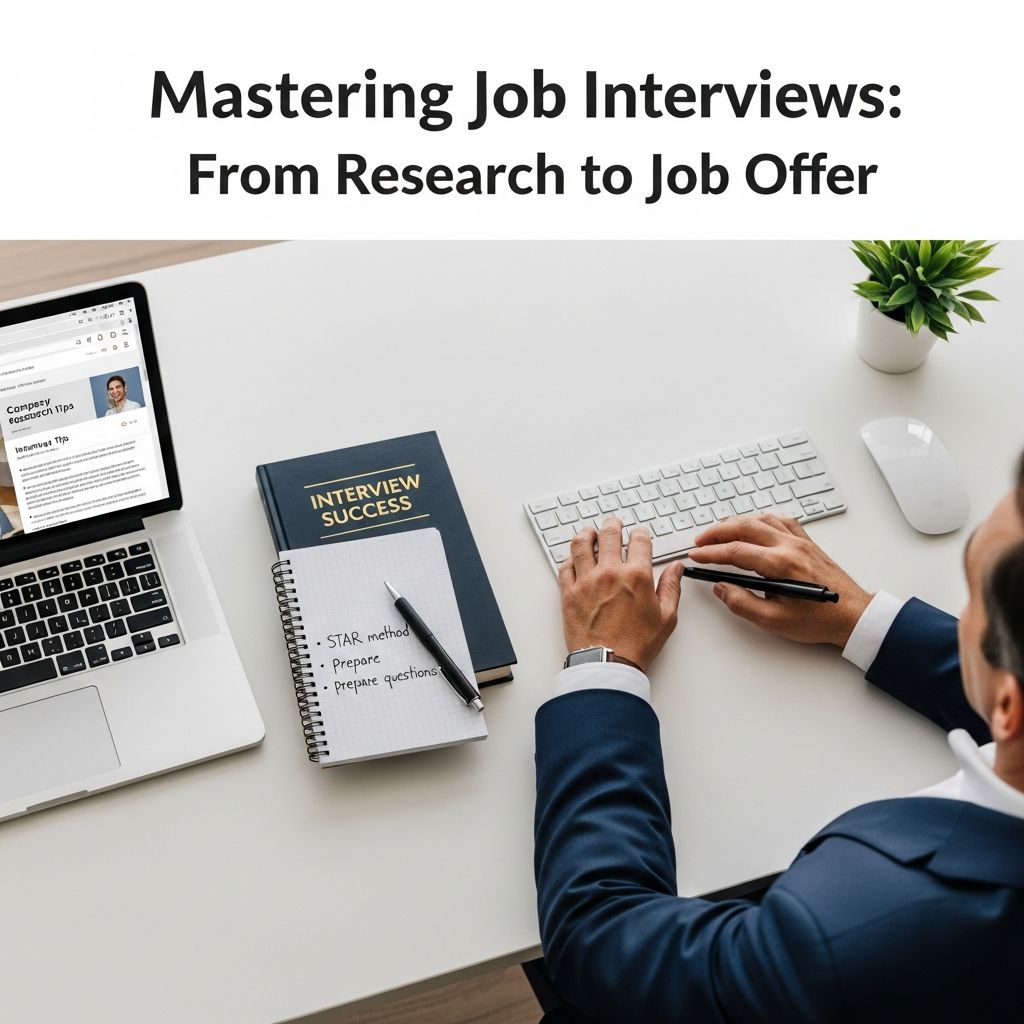
Interviewing is a skill you can learn and practice. With the right preparation, you can walk into any conversation with employers knowing what to say, how to say it, and how to decide whether the role is right for you.
Understanding What Interviews Are Really About
Most candidates see interviews as one-sided evaluations, but they are actually structured conversations with clear goals for both sides.
| Perspective | Main Goals |
|---|---|
| You (the candidate) |
|
| Interviewer (employer) |
|
Seeing the interview as a mutual evaluation makes it easier to prepare focused examples, ask sharp questions, and decide confidently if you want the job.
Step 1: Decode the Job Description
Your preparation should start with the job description. Treat it like a roadmap for what you need to show in the interview.
Identify what the employer really cares about
- Highlight repeated skills (e.g., communication, project management, data analysis).
- Underline key responsibilities that appear early or are described in detail.
- Note required vs. preferred qualifications and prepare to address both.
For each major requirement, write one or two real examples from your past experience that demonstrate you can do that task or use that skill.
Translate your experience into interview talking points
For every important bullet in the job posting, answer these questions in writing:
- When have I done something similar?
- What challenge did I face?
- What specific actions did I take?
- What measurable or visible results did I achieve?
This work feeds directly into strong answers for behavioral and situational interview questions.
Step 2: Research the Employer Strategically
Employers expect you to know more than just the company name. Thoughtful research helps you tailor your answers and ask questions that show genuine interest.
What to research before the interview
- Mission and values: Understand why the organization exists and how it describes its culture.
- Products or services: Know the main offerings and who the customers or users are.
- Recent news: Look for new launches, partnerships, or challenges they are facing.
- The role’s place in the organization: How your position supports larger goals.
Use the information you find to frame your answers: connect your achievements to the company’s priorities and language.
How research improves your answers
With solid research, you can:
- Explain clearly why you want to work there, not just why you need a job.
- Show you understand the team’s challenges and how you can help.
- Avoid generic statements and instead use specific, credible details.
Step 3: Build Your Core Narrative
Nearly every interview starts with some version of “Tell me about yourself.” Having a concise, compelling answer sets the tone for the rest of the conversation.
Craft a 60–90 second professional summary
Structure your answer around three elements:
- Present: Your current role or situation and what you focus on professionally.
- Past: A brief mention of relevant experience or education that led you here.
- Future: What you are looking for now and how it connects to this opportunity.
Keep it professional, focused on your work story, not your personal biography.
Prepare three “anchor stories”
Anchor stories are versatile examples you can reuse for many questions. Choose examples that show:
- Leadership or initiative
- Problem solving and analytical skills
- Teamwork and communication
Write each story in bullet form so you can recall it under pressure.
Step 4: Use the STAR Method for Behavioral Questions
Behavioral questions (“Tell me about a time when…”) are designed to predict future performance by looking at real past behavior. Many universities and career centers recommend the STAR (or similar) method to structure these answers clearly.
What is the STAR method?
- S – Situation: Brief context or background.
- T – Task: What you needed to achieve or the problem to solve.
- A – Action: The specific steps you took.
- R – Result: The outcome, ideally with measurable impact.
Research from career services organizations shows that structured responses like STAR or SAR (Situation–Action–Result) help interviewers evaluate your skills more accurately and fairly.
Example STAR outline (template)
You can use this simple outline when practicing:
- Situation: “In my previous role at [Organization], we faced [challenge]…”
- Task: “My responsibility was to…”
- Action: “I decided to…, I coordinated…, I analyzed…”
- Result: “As a result, we achieved…, which led to…”
Practice speaking these stories out loud until you can deliver them smoothly in 1–2 minutes.
Step 5: Practice Key Interview Questions
You cannot predict every question, but there are categories you can reliably prepare for.
Common types of questions
- Introductory: “Tell me about yourself,” “Walk me through your resume.”
- Motivation: “Why this role?”, “Why our organization?”
- Strengths and growth: “What are your strengths?”, “Share a development area and what you are doing about it.”
- Behavioral: “Tell me about a time you handled conflict on a team.”
- Role-specific or technical: Questions that test job knowledge or practical skills.
How to practice effectively
- Record yourself answering 4–6 common questions and review your tone, clarity, and length.
- Time your answers; most should be around 60–120 seconds.
- Ask a friend, mentor, or career counselor to run a mock interview and offer feedback.
- Use online tools where available (some platforms provide video practice and feedback on pace and clarity).
Step 6: Plan Your Logistics and Professional Image
Even strong answers cannot fully compensate for poor punctuality, disorganized materials, or unprofessional conduct. Basic logistics influence first impressions.
Before the interview day
- Confirm the time, format (virtual or in-person), and names of interviewers if possible.
- Test your technology for video interviews (internet connection, camera, microphone).
- Prepare copies of your resume, a list of references, and a notebook and pen for in-person meetings.
On the day of the interview
- Arrive early: Aim for 10–15 minutes early in person, or log in 5–10 minutes early for virtual sessions.
- Dress appropriately: Choose clean, professional clothing that fits the organization’s culture.
- Demonstrate professionalism: Make eye contact, offer a firm handshake where appropriate, and use polite, clear language.
Step 7: Manage Nerves and Communicate Confidently
Feeling nervous is normal. Research on performance under pressure suggests that preparation and mental rehearsal can reduce anxiety and improve outcomes.
Techniques to manage interview anxiety
- Prepare for your biggest fears: Identify questions that worry you most and practice them repeatedly.
- Visualize success: Spend a few minutes imagining yourself answering calmly and connecting well with the interviewer.
- Use a “blank-out plan”: If you lose your train of thought, pause, take a breath, and say, “Let me think about the best example for that,” then continue.
- Control the basics: Sleep adequately, hydrate, and leave enough time to arrive without rushing.
Verbal and non-verbal communication tips
- Speak at a measured pace; avoid rushing even if you feel nervous.
- Sit upright and face the interviewer or camera directly.
- Listen carefully, and do not interrupt; it is fine to pause briefly before answering.
- If you do not understand a question, ask for clarification rather than guessing.
Step 8: Ask Insightful Questions
The questions you ask convey curiosity, preparation, and judgment. Universities and career centers emphasize that strong questions help both sides assess fit more accurately.
Categories of strong questions
- Role clarity: “What would success look like in this role in the first six months?”
- Team and culture: “How does the team typically collaborate and share feedback?”
- Growth and development: “How do you support professional development and career progression?”
- Evaluation and next steps: “How do you typically measure performance in this position?”
Avoid questions you could easily answer by reading the website, or questions focused only on salary and benefits in the first conversation unless the employer raises them.
Step 9: Close Strong and Follow Up Professionally
The way you end an interview can reinforce your interest and professionalism.
How to close the conversation
- Thank the interviewer sincerely for their time.
- Reiterate your interest in the role and one or two specific reasons it appeals to you.
- Ask about the next steps and expected timeline if they have not been mentioned.
Writing a concise follow-up email
Within 24 hours, send a brief message that:
- Thanks the interviewer again for the conversation.
- Mentions something specific you discussed to personalize the note.
- Restates your enthusiasm and how you can contribute.
Many employer and government resources highlight follow-up as a key professional courtesy that also helps you stand out from other candidates.
Quick Interview Preparation Checklist
- Reviewed the job description and highlighted core skills and responsibilities.
- Researched the organization’s mission, products, and recent news.
- Prepared a 60–90 second professional summary.
- Developed at least three STAR stories that show key skills.
- Practiced answers to common and role-specific questions.
- Planned logistics: route, technology, clothing, and materials.
- Prepared 3–5 thoughtful questions to ask the interviewer.
- Planned a template for a follow-up email.
Frequently Asked Questions (FAQs)
Q: How far in advance should I start preparing for an interview?
Ideally, start focused preparation as soon as the interview is scheduled. For most roles, 2–3 days of structured practice (1–2 hours per day) is enough to review the job description, research the employer, refine your stories, and rehearse key questions.
Q: What if I do not have direct experience in the same role or industry?
Use academic projects, volunteer work, internships, and part-time jobs to show transferable skills such as communication, teamwork, problem solving, and reliability. Many university career centers explicitly encourage drawing from a wide range of experiences in behavioral interviews.
Q: How long should my answers be?
Most answers should be about one to two minutes. Shorter answers can seem incomplete, while very long ones may lose focus. Using a structure like STAR helps you stay concise while still providing enough detail for the interviewer to evaluate your experience.
Q: Is it acceptable to bring notes to an interview?
Bringing a small notebook with prepared questions and space for notes is common and often encouraged, especially for in-person interviews. Avoid reading from a script; glance occasionally if needed but keep your main focus on the conversation.
Q: What should I do if I realize I answered a question poorly?
If there is still time later in the interview, you can say, “I’d like to add one brief point to an earlier question,” and then clarify your answer. Focus on what you learned from the situation and how you would handle it now, which shows growth and self-awareness.
References
- How To Prepare for an Interview in 11 Steps — Indeed Editorial Team. 2024-01-05. https://www.indeed.com/career-advice/interviewing/how-to-prepare-for-an-interview
- Preparing for the Successful Job Interview — Texas State University Career Services. 2023-08-10. https://www.careerservices.txst.edu/students-alumni/resources-services/career-guides/job-interview-guide.html
- Interview Questions and How to Prepare — UC Davis Internship and Career Center. 2023-09-18. https://careercenter.ucdavis.edu/interviews-and-offers/questions-and-prep
- Preparing for an Interview — Shawnee State University Career Services. 2022-11-02. https://www.shawnee.edu/career-services/resumes-cover-letters-interviewing/preparing-interview
- Interview Tips — U.S. Department of Labor. 2022-06-15. https://www.dol.gov/general/jobs/interview-tips
- The STAR Method for Behavioral Interviews — Massachusetts Institute of Technology Career Advising & Professional Development. 2023-04-20. https://capd.mit.edu/resources/the-star-method-for-behavioral-interviews/
- Stand Out in a Job Interview (Video) — Harvard Business Review / Amy Gallo. 2022-03-08. https://www.youtube.com/watch?v=ZU9x1vFx5lI

- Integrated M.A. in Applied Linguistics, University of Hyderabad
- 5+ years in editorial, instructional, SEO, and research-based writing
Sneha is a relationships and lifestyle writer with a strong foundation in applied linguistics and certified training in relationship coaching. She brings over five years of writing experience to theskillvault, crafting thoughtful, research-driven content that empowers readers to build healthier relationships, boost emotional well-being, and embrace holistic living. Her writing and insights reflect the belief that beauty, happiness, and wellness…