
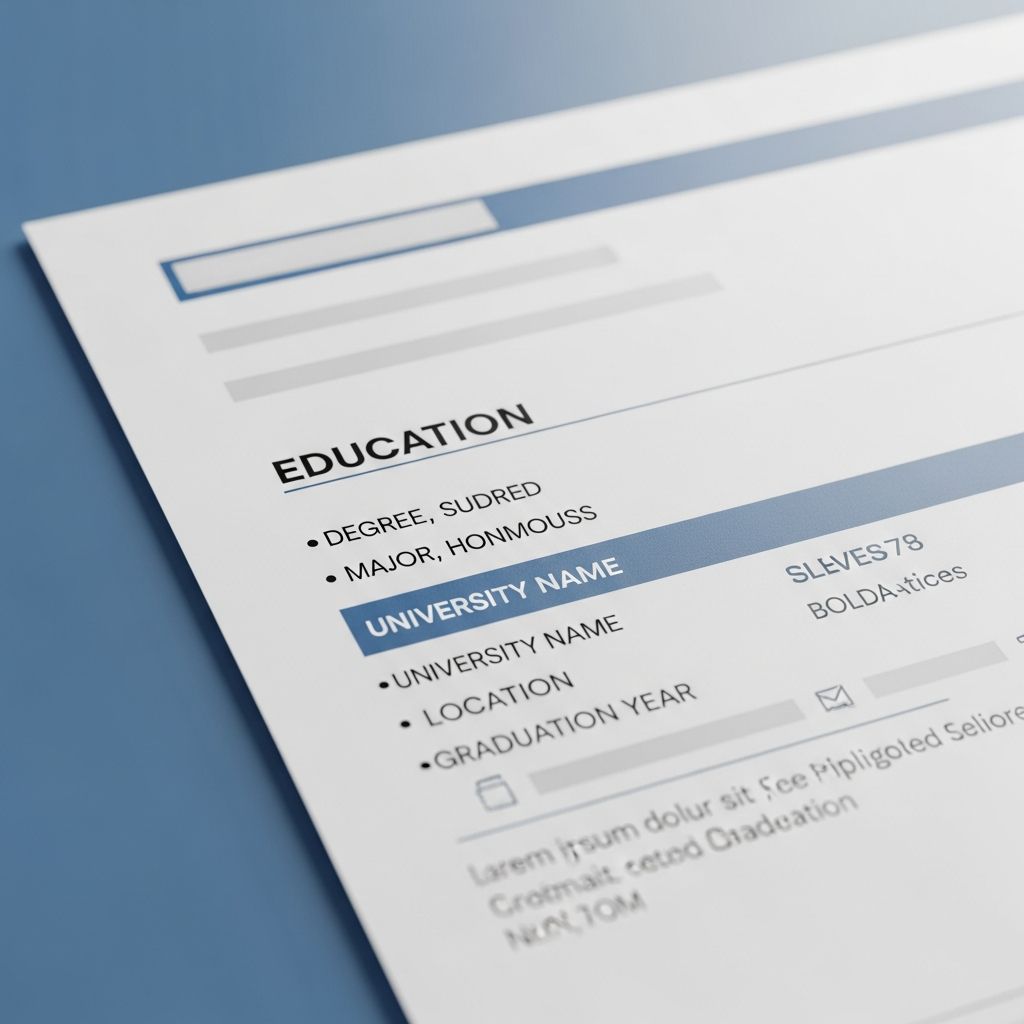
Presenting Your Academic Background for Maximum Impact
When crafting a resume, many job seekers focus almost entirely on work experience, assuming that education is secondary. But for many roles—especially early in a career, in regulated fields, or in highly technical industries—your academic background is a critical credential. The education section is not just a formality; it’s a strategic opportunity to demonstrate qualifications, credibility, and alignment with the job.
Done well, this section reinforces that you meet the basic requirements and can handle the intellectual demands of the role. Done poorly, it can look cluttered, confusing, or even raise questions about your attention to detail. This guide walks through how to structure, prioritize, and present your education so it strengthens your candidacy rather than distracting from it.
Deciding What Belongs in the Education Section
The education section should be concise but informative. It’s not a transcript, nor is it a biography of your academic life. Instead, it’s a targeted summary of the degrees, institutions, and related achievements that matter most for the position you’re pursuing.
Core Information to Include
For most candidates, the following elements form the foundation of the education section:
- Institution name: Use the official name of the school or university.
- Location: City and state (or country, if applying internationally).
- Degree earned: Be specific (e.g., Bachelor of Science, Master of Business Administration).
- Field of study: Major, and optionally minor or concentration.
- Dates: Graduation year, or expected graduation date if still in progress.
When to Add More Detail
Beyond the basics, consider including additional information only when it adds value for the role. Relevant additions might include:
- Honors and distinctions: Latin honors (e.g., cum laude), dean’s list, scholarships, or academic awards.
- Relevant coursework: A short list of key courses, especially if you’re early in your career or applying for a highly technical role.
- Thesis or capstone projects: Brief mention of significant academic work, particularly if it demonstrates skills directly applicable to the job.
- Study abroad or exchange programs: If they contributed to language skills, cultural competence, or international experience relevant to the role.
Structuring the Section for Clarity
Consistency and readability are key. Hiring managers and applicant tracking systems (ATS) scan resumes quickly, so a well-organized education section makes it easy to verify qualifications at a glance.
Use a Clear, Standard Heading
Label this section simply as Education. While creative titles like “Academic Journey” or “Learning Path” might feel expressive, they can confuse ATS parsers and make it harder for recruiters to locate the information they need. A straightforward heading ensures your credentials are found and understood immediately.
Order Entries Chronologically (Reverse)
List your degrees in reverse chronological order, starting with the most recent or highest level of education. This format aligns with how most resumes are structured and reflects the natural progression of your academic and professional development.
Formatting Each Entry
Each educational entry should follow a consistent format. A typical structure looks like this:
- Degree Name, Field of Study
- Institution Name, City, State
- Graduation Year (or Expected Graduation)
For example:
- Bachelor of Arts in Psychology
- State University, Anytown, CA
- 2023
If you’re still completing a degree, clearly indicate that:
- Master of Science in Data Science
- Metropolitan Institute of Technology, Cityville, NY
- Expected May 2025
Where to Place Education on Your Resume
The placement of the education section depends on your career stage and the nature of the role. The goal is to highlight the most relevant qualifications first.
Recent Graduates and Entry-Level Candidates
If you’ve recently completed your degree and have limited professional experience, education should appear near the top of your resume—typically after your contact information and professional summary, but before work experience. This signals that your academic background is a primary qualification for the role.
Mid-Career and Experienced Professionals
Once you have several years of relevant work experience, your professional history becomes the main selling point. In this case, place the education section after your work experience. Keep it concise: institution, degree, field, and graduation year are usually sufficient unless the job posting emphasizes specific academic credentials.
When Education Should Be Prominent
Even for experienced candidates, there are situations where education deserves a more prominent position:
- The job requires a specific degree or certification (e.g., engineering, healthcare, law).
- You’ve recently earned a relevant advanced degree or completed a significant credential.
- The employer uses an ATS that screens for educational keywords early in the process.
In these cases, placing education higher on the page—perhaps just below the summary—can help ensure your resume passes initial screening and reaches a human reviewer.
Handling Special Situations
Not every candidate’s academic history fits a neat template. Here’s how to handle common edge cases without undermining your credibility.
Incomplete or Non-Traditional Education
If you attended college but did not graduate, you can still include the experience, but be honest and strategic:
- Do not claim a degree you did not earn.
- You can list the institution, dates attended, and field of study, with a note like “Coursework completed in [Field]” or “Completed [X] credits toward a [Degree].”
- Focus on relevant skills and knowledge gained, especially if they’re directly applicable to the role.
For non-traditional paths (e.g., community college, online programs, bootcamps), present them clearly and professionally. Many employers value practical, skills-based training, especially when it’s directly related to the job.
Multiple Degrees and Certifications
If you have several degrees, list them all in the education section, ordered by relevance and recency. For certifications that are closely tied to your academic or professional training, you have two options:
- Include them in the education section if they are academic or university-issued credentials.
- Create a separate Certifications or Professional Development section if they are industry-specific (e.g., PMP, AWS, CPA, CFA).
The key is consistency: group similar types of credentials together and make it easy for the reader to see which qualifications you hold.
International Education
If you studied outside your home country, provide enough context so that employers can understand the level and nature of your degree:
- Use the official name of the institution and country.
- Clarify the degree type in terms familiar to the local market (e.g., “Bachelor’s equivalent” or “Master’s level degree”).
- Consider adding a brief note if the degree structure differs significantly (e.g., “Integrated Master’s in Engineering, equivalent to a U.S. Bachelor’s + Master’s”).
This helps avoid confusion and ensures your qualifications are evaluated fairly.
What to Leave Out
Just as important as what you include is what you omit. A cluttered education section can dilute your message and distract from stronger qualifications.
High School for Most Candidates
Once you have a college degree, high school information is generally unnecessary. It takes up space that could be used for more relevant experience or skills. The only exceptions are:
- Recent high school graduates applying for entry-level roles.
- Roles where high school completion is a specific requirement (e.g., some apprenticeships or training programs).
Irrelevant or Outdated Details
Avoid including:
- High school GPA (unless you’re a very recent graduate and it’s exceptional).
- Every course you’ve ever taken.
- Generic or outdated software or tools unless they’re specifically requested.
- Personal information like age, marital status, or unrelated hobbies.
Every line on your resume should serve a purpose. If a detail doesn’t help the employer understand your qualifications for this specific role, it’s better left out.
Aligning Education with the Job Description
The most effective resumes are tailored to the specific job. This means adjusting the education section to reflect what the employer values.
Use Keywords from the Posting
Many companies use applicant tracking systems that scan for keywords related to required degrees, fields of study, and certifications. To increase your chances of passing this initial screen:
- Use the exact degree title and field of study mentioned in the job description when possible.
- Include relevant coursework or projects only if they match the skills or knowledge the employer is seeking.
- Highlight honors or distinctions that demonstrate excellence in areas relevant to the role.
Emphasize Relevance, Not Just Completeness
It’s tempting to list everything you’ve ever studied, but a targeted approach is more effective. Ask yourself:
- Does this degree or course directly support the requirements of the job?
- Does it demonstrate a skill or knowledge area that the employer has identified as important?
- Would omitting it weaken my case for being qualified?
If the answer is no, it’s usually safe to keep that detail off the resume or move it to a separate document (like a full academic transcript) that you can provide if requested.
Common Mistakes to Avoid
Even small errors in the education section can create a negative impression. Here are some frequent pitfalls and how to sidestep them.
Inconsistent Formatting
Switching between different date formats, capitalization styles, or levels of detail makes the section look unprofessional. Choose one style and apply it consistently across all entries.
Overloading with Irrelevant Information
Listing every class, club, or minor detail from your academic career can overwhelm the reader. Focus on what’s most relevant to the job and keep the rest concise.
Exaggerating or Misrepresenting Credentials
Claiming a degree you didn’t earn, inflating your GPA, or misrepresenting the nature of a program can have serious consequences, including rescinded offers or termination. Always be truthful and precise in how you describe your education.
Ignoring ATS Requirements
Many resumes are read by software before they ever reach a human. To ensure your education section is parsed correctly:
- Use standard section headings like “Education.”
- Use simple, clean formatting without tables, text boxes, or unusual fonts.
- Spell out degree types and fields of study clearly (avoid abbreviations unless they’re widely recognized).
Education in Context: A Strategic Component
Your education section should never exist in isolation. It works best when it complements and reinforces the rest of your resume.
Connecting Education to Experience
In your work experience or summary, reference skills or knowledge gained through your studies. For example:
- “Applied statistical modeling techniques learned in graduate coursework to improve forecasting accuracy by 15%.”
- “Leveraged project management principles from MBA program to lead cross-functional teams and deliver projects on time and under budget.”
This shows that your education wasn’t just theoretical—it has practical, measurable impact.
Using Education to Support Career Transitions
If you’re changing fields, your education can be a powerful bridge. Highlight degrees, courses, or projects that demonstrate relevant knowledge and skills, even if your work history is in a different area. This helps employers see that you’re not just interested in the new field—you’re prepared for it.
FAQs: Education on Your Resume
Should I include my GPA?
Include your GPA only if it’s strong (typically 3.5 or higher on a 4.0 scale) and you’re early in your career. For experienced professionals, GPA is usually less relevant and can be omitted unless specifically requested.
Where should I list certifications?
Industry-specific certifications (e.g., PMP, CPA, AWS) are best listed in a separate Certifications or Professional Development section. Academic or university-issued credentials can go in the education section.
What if I didn’t graduate?
You can still list the institution, dates attended, and field of study, but be honest. Use phrases like “Completed coursework toward a Bachelor’s in [Field]” or “Attended [University] from [Year] to [Year].” Focus on the skills and knowledge gained.
Should I list high school?
Generally, no, once you have a college degree. High school is only necessary for recent graduates or roles where it’s a specific requirement.
How detailed should coursework be?
Only list coursework if it’s directly relevant to the job and you lack extensive work experience. Keep it to a short, focused list (3–5 key courses) rather than a long catalog of every class.
Can I include online degrees or bootcamps?
Yes, especially if they’re from reputable providers and relevant to the role. Present them clearly and professionally, just like any other degree or program.
Final Checklist for Your Education Section
Before finalizing your resume, review your education section against this checklist:
- Is the section clearly labeled as “Education”?
- Are entries listed in reverse chronological order?
- Does each entry include institution, location, degree, field, and graduation year (or expected date)?
- Are honors, relevant coursework, or projects included only when they add value?
- Is the formatting consistent and ATS-friendly?
- Have I removed irrelevant or outdated details (e.g., high school for experienced candidates)?
- Is all information accurate and honestly represented?
- Does the section align with keywords and requirements in the job description?
By treating your education section as a strategic, rather than perfunctory, part of your resume, you can ensure it supports your overall narrative and strengthens your case for being the right candidate for the job.
References
- Resume Writing Guide — Harvard University Mignone Center for Career Success. Accessed 2025. https://careerservices.fas.harvard.edu/resources/create-a-strong-resume/
- Resume Resources — University of Michigan Career Center. Accessed 2025. https://careercenter.umich.edu/article/resume-resources
- How to List Education on a Resume — Indeed Career Advice. Accessed 2025. https://www.indeed.com/career-advice/resumes-cover-letters/how-to-list-education-on-a-resume

- Integrated M.A. in Applied Linguistics, University of Hyderabad
- 5+ years in editorial, instructional, SEO, and research-based writing
Sneha is a relationships and lifestyle writer with a strong foundation in applied linguistics and certified training in relationship coaching. She brings over five years of writing experience to theskillvault, crafting thoughtful, research-driven content that empowers readers to build healthier relationships, boost emotional well-being, and embrace holistic living. Her writing and insights reflect the belief that beauty, happiness, and wellness…