
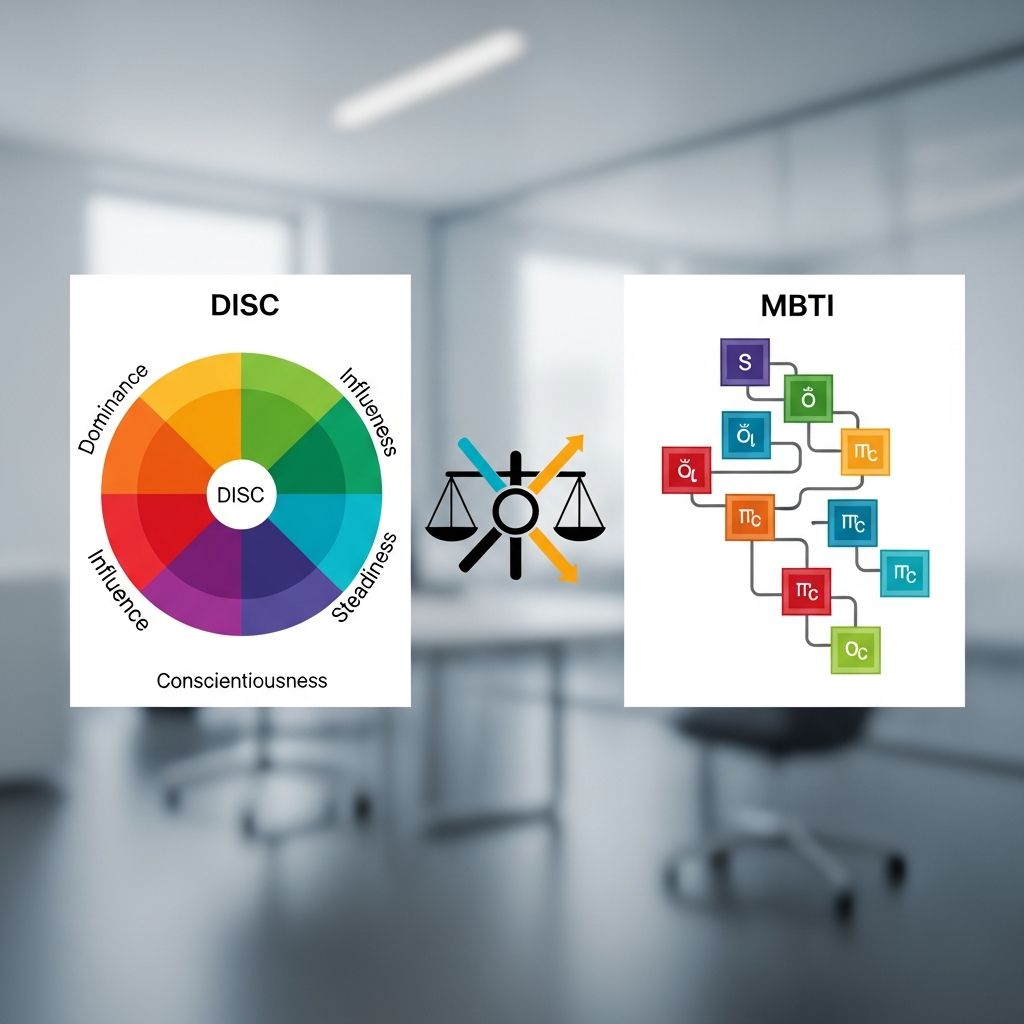
Understanding Personality Tools in the Modern Workplace
Leaders and HR professionals today have access to a wide range of tools designed to improve team dynamics, communication, and leadership effectiveness. Among the most widely used are the DISC assessment and the Myers-Briggs Type Indicator (MBTI). Both are popular in corporate training, coaching, and team-building programs, but they serve different purposes and are built on different foundations.
Choosing between DISC and MBTI isn’t about finding which one is ‘better’ in absolute terms, but rather which one better aligns with your organization’s immediate goals, culture, and development priorities. This article explores the core differences between these two frameworks, their strengths and limitations, and how to decide which one—or whether a combination—makes the most sense for your team.
What DISC Actually Measures
The DISC model is a behavioral assessment that categorizes people into four primary styles based on how they tend to behave in work and social environments. These styles are:
- D (Dominance) – Direct, results-oriented, and focused on control and outcomes.
- I (Influence) – Outgoing, enthusiastic, and relationship-focused.
- S (Steadiness) – Calm, patient, and team-oriented, valuing stability and consistency.
- C (Conscientiousness) – Analytical, detail-oriented, and focused on accuracy and process.
DISC is designed to describe observable behavior: how someone communicates, makes decisions, responds to pressure, and interacts with others. It’s less concerned with why someone behaves a certain way and more focused on what that behavior looks like in practice.
Because of this, DISC is often described as a ‘here and now’ tool. It helps people understand how they are likely to act in meetings, under deadlines, or in conflict situations, and how others might be acting as well. This makes it highly practical for improving day-to-day interactions.
What MBTI Is Designed to Reveal
The Myers-Briggs Type Indicator, in contrast, is a psychological preference inventory. It’s based on Carl Jung’s theory of psychological types and categorizes individuals into 16 personality types using four dichotomies:
- Extraversion (E) vs. Introversion (I) – Where you direct your energy.
- Sensing (S) vs. Intuition (N) – How you take in information.
- Thinking (T) vs. Feeling (F) – How you make decisions.
- Judging (J) vs. Perceiving (P) – How you organize your outer life.
MBTI aims to uncover deeper patterns in how people perceive the world, process information, and make choices. It’s more about internal preferences than outward behavior. For example, an introverted person might still be highly effective in social or leadership roles, but they may prefer to recharge alone and process ideas internally before speaking.
Because MBTI focuses on underlying preferences, it’s often used in contexts like career counseling, personal development, and long-term leadership growth. It helps individuals understand their natural strengths, potential blind spots, and how they might best contribute to an organization over time.
Comparing the Core Focus of Each Framework
At a fundamental level, the key difference between DISC and MBTI comes down to what each is trying to explain:
- DISC answers: How do people tend to behave in work and social situations?
- MBTI answers: What are people’s natural psychological preferences, and how do those shape their experience of the world?
This distinction has important implications for how each tool is used in organizations. DISC is more immediately applicable to communication, teamwork, and conflict resolution because it describes behavior that can be observed and adapted. MBTI is more useful for self-awareness, career planning, and understanding long-term development paths.
Practical Applications in the Workplace
Both tools can be valuable, but they tend to shine in different areas of organizational development.
Where DISC Excels
DISC is particularly strong in:
- Improving communication styles between team members and managers.
- Helping sales and customer service teams adapt their approach to different client types.
- Reducing conflict by helping people understand behavioral differences rather than taking them personally.
- Supporting leadership development by clarifying how different styles can lead effectively in different contexts.
- Onboarding and team integration, where a simple, shared language about behavior can speed up collaboration.
Because DISC uses only four broad styles, it’s relatively easy to learn and apply. Teams can quickly grasp the basics and start using the framework in meetings, feedback conversations, and project planning.
Where MBTI Adds Value
MBTI is especially useful for:
- Personal and professional development coaching.
- Helping individuals understand their strengths, stress triggers, and growth areas.
- Supporting career pathing and role alignment based on natural preferences.
- Building empathy and psychological safety by helping people appreciate different ways of thinking and working.
- Long-term leadership development, where understanding one’s own and others’ cognitive styles is critical.
MBTI tends to be more complex and requires more time and guidance to interpret effectively. It’s less about quick fixes and more about deeper, sustained growth.
Scientific Validity and Reliability Considerations
When selecting any assessment tool, it’s important to consider its psychometric properties—how reliable and valid it is as a measure.
DISC assessments, particularly modern, research-backed versions, generally show good internal consistency and test-retest reliability. They are designed to be practical and user-friendly, which sometimes means simplifying complex human behavior into a manageable model. This can be a strength for application but a limitation if used to make high-stakes decisions like hiring or promotion.
MBTI has been widely used for decades and has a large body of research behind it, but it also faces criticism from some psychologists. Concerns include:
- Lower test-retest reliability for some individuals, meaning people may get different results when retaking the assessment.
- Binary categorization (e.g., E vs. I) that may not fully capture the spectrum of human personality.
- Limited predictive power for job performance compared to more rigorously validated tools like the Big Five personality model.
Neither DISC nor MBTI should be treated as definitive, scientific measures of personality. Instead, they are best used as conversation starters and development tools, not as the sole basis for personnel decisions.
When to Choose DISC for Your Organization
DISC is often the better choice when your organization needs:
- Fast, practical improvements in communication and teamwork.
- A simple, shared language that can be rolled out across large teams or multiple locations.
- Immediate applications in customer-facing roles, sales, and service.
- Conflict resolution and collaboration support in cross-functional or matrixed teams.
- Leadership training that focuses on adaptive communication and situational leadership.
DISC is particularly well-suited for organizations in fast-paced, results-driven environments where quick behavioral adjustments can have a direct impact on performance.
When MBTI Might Be the Right Fit
MBTI is more appropriate when your goals include:
- Deepening self-awareness and personal insight among employees.
- Supporting long-term career development and leadership pipelines.
- Building a culture of psychological safety and mutual understanding.
- Helping teams appreciate different thinking and decision-making styles.
- Coaching and mentoring programs that focus on individual growth over time.
MBTI works well in organizations that value reflection, personal development, and a more nuanced understanding of how people think and work. It’s often used in professional services, education, and mission-driven organizations where long-term cultural fit and personal alignment are important.
Can You Use Both? A Balanced Approach
Many organizations find that using both DISC and MBTI in complementary ways can be highly effective. For example:
- Use DISC as the primary tool for team communication, conflict resolution, and day-to-day collaboration.
- Use MBTI in leadership development programs, coaching, and career planning to deepen self-understanding.
- Introduce DISC first to build a common behavioral language, then layer in MBTI for more advanced development.
The key is to be intentional about how each tool is used. DISC can help people understand how they and others behave, while MBTI can help them understand why they might prefer certain ways of working or communicating.
Common Pitfalls to Avoid
Regardless of which tool you choose, there are several common mistakes to watch out for:
- Using assessments for hiring or promotion decisions. Neither DISC nor MBTI is designed or validated for selection purposes. Relying on them for hiring can lead to biased or legally questionable decisions.
- Labeling or stereotyping people. It’s easy to fall into the trap of saying, ‘Oh, you’re a D, so you’re aggressive,’ or ‘You’re an INFP, so you can’t handle conflict.’ These labels can limit growth and create self-fulfilling prophecies.
- Overemphasizing type over context. Behavior is influenced by situation, role, and environment. A person’s DISC style or MBTI type is just one part of a much larger picture.
- Not providing follow-up support. Simply giving people their results without coaching, discussion, or application exercises often leads to short-lived impact.
To avoid these pitfalls, treat both tools as developmental resources, not as definitive labels or decision-making criteria.
How to Decide Which Tool Is Right for Your Team
Here are some practical questions to help guide your decision:
- Are we looking for quick, practical improvements in communication and teamwork? → DISC may be the better starting point.
- Are we focused on long-term leadership development and personal growth? → MBTI could be more appropriate.
- Do we need a simple, scalable tool for large teams or multiple locations? → DISC is often easier to roll out widely.
- Do we want to build deep self-awareness and psychological insight? → MBTI offers more depth in this area.
- Are we willing to invest in training and coaching to ensure proper use? → Both tools require skilled facilitation to be effective.
There’s no one-size-fits-all answer. The best choice depends on your organization’s culture, goals, and the specific challenges you’re trying to address.
Integrating Personality Insights into Development Programs
Once you’ve selected a tool (or tools), the real value comes from how you integrate it into your development ecosystem. Consider:
- Using the assessment as part of onboarding to help new hires understand team dynamics.
- Incorporating it into leadership training to improve communication, feedback, and delegation.
- Facilitating team workshops where members share their styles and discuss how to work together more effectively.
- Linking insights to performance conversations, not as a label, but as a way to understand preferences and adaptability.
- Revisiting the tool periodically to reflect on growth and changing roles.
The goal is not to ‘type’ people, but to create a shared understanding that supports better collaboration, communication, and development.
Frequently Asked Questions
Is DISC more accurate than MBTI?
Accuracy depends on what you’re measuring. DISC is often seen as more directly applicable to observable behavior in the workplace, while MBTI provides deeper insight into psychological preferences. Neither is a perfect predictor of behavior or performance, but both can be useful when used appropriately.
Can DISC and MBTI be used together?
Yes, many organizations use them together. DISC can help teams understand how people behave, while MBTI can help individuals understand why they might prefer certain ways of working. When used thoughtfully, they can complement each other well.
Should we use these tools for hiring?
No. Neither DISC nor MBTI is designed or validated for hiring decisions. Using them for selection can lead to bias, legal risk, and poor hiring outcomes. They are best used for development, not selection.
How often should teams retake these assessments?
There’s no fixed rule, but many organizations revisit DISC every 1–2 years, especially after major role changes or team restructures. MBTI is often treated as more stable, but it can still be useful to revisit in the context of coaching or leadership development.
Do people’s types or styles change over time?
MBTI types are generally considered stable, though people can develop skills outside their preferences. DISC styles can shift more noticeably based on role, environment, and stress. Both tools should be seen as snapshots of current tendencies, not fixed identities.
References
- Myers-Briggs Type Indicator Manual — The Myers & Briggs Foundation. 2020. https://www.myersbriggs.org/my-mbti-personality-type/mbti-basics/
- Everything DiSC Research & Validation — Wiley. 2023. https://www.wiley.com/en-us/Everything+DiSC%AE+Research+%26+Validation-pdp-100000000000000
- Personality Testing in the Workplace — Society for Industrial and Organizational Psychology (SIOP). 2022. https://www.siop.org/

Medha Deb is an editor with a master's degree in Applied Linguistics from the University of Hyderabad. She believes that her qualification has helped her develop a deep understanding of language and its application in various contexts. Medha specializes in the areas of beauty, health, sports, and wellness and is committed to ensuring that the content on the website is…