
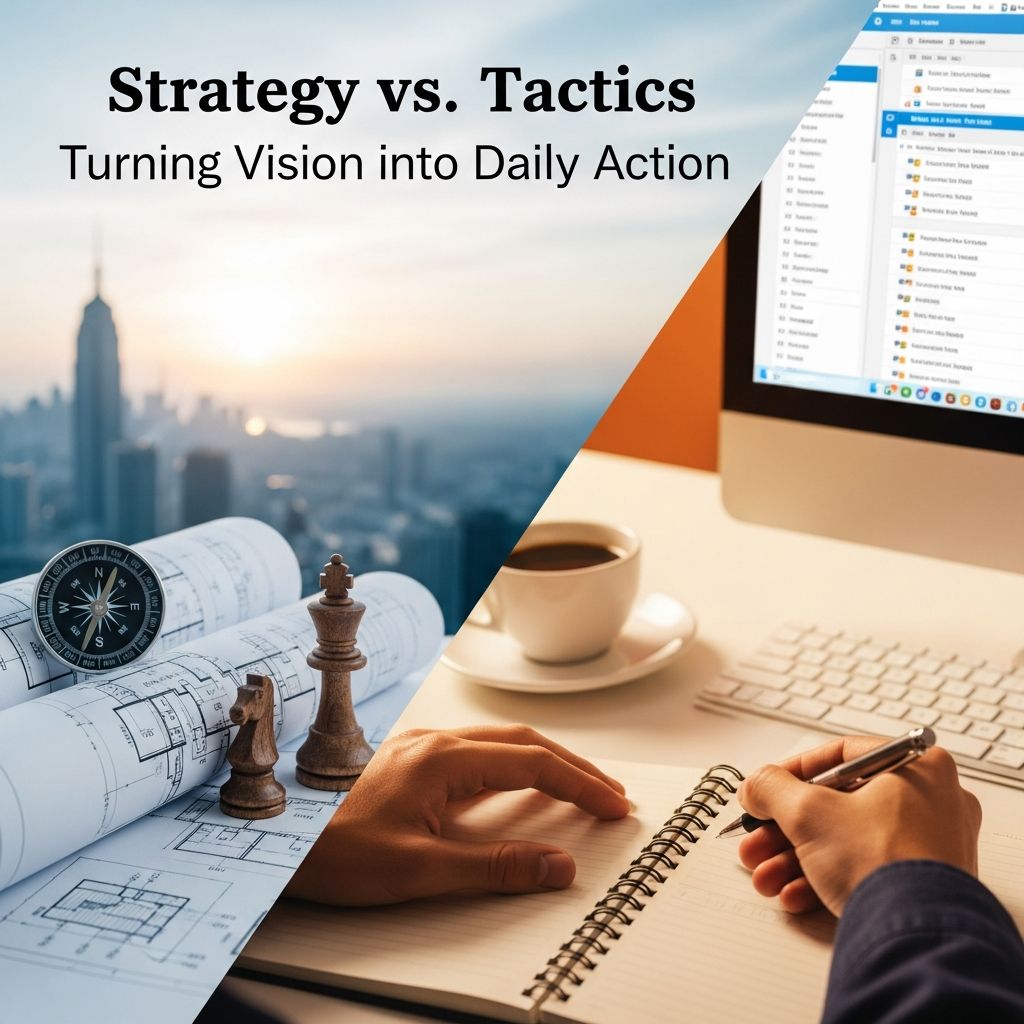
Organizations rarely fail because they lack ideas. They fail because they cannot translate those ideas into consistent, coordinated action. Understanding the difference between strategy and tactics is the starting point for closing this gap between intention and execution.
This article explains what strategy and tactics are, how they differ, and how to connect them so that every action your teams take moves you closer to your long-term goals.
What Do We Really Mean by Strategy and Tactics?
Although the words are often used interchangeably, strategy and tactics describe two distinct levels of decision-making in organizations, projects, and even personal careers.
What is Strategy?
Strategy is the long-term, organization-wide plan that explains where you are going and why it matters. It sets direction, defines the advantage you want to build, and clarifies how you will compete or create value over time.
- Time horizon: multi-year, long-term focus.
- Scope: broad, affecting the whole organization and its stakeholders.
- Purpose: guide major choices about markets, offerings, investments, and capabilities.
Good strategy is not just ambition; it is a coherent set of choices that position your organization for sustainable performance.
What are Tactics?
Tactics are the concrete actions, initiatives, and methods you use in the short term to carry out your strategy.
- Time horizon: weeks, months, and sometimes single quarters.
- Scope: focused on specific teams, projects, or campaigns.
- Purpose: turn strategic intent into measurable activity and results.
Tactics answer the question: “What exactly will we do next to move closer to our strategic goal?”
Strategy vs. Tactics at a Glance
| Dimension | Strategy | Tactics |
|---|---|---|
| Core question | Why and what we aim to achieve | How we will achieve it day to day |
| Time frame | Long-term (often 3–5+ years) | Short-term (weeks to 12 months) |
| Scope | Whole organization or business unit | Specific teams, functions, or projects |
| Level of detail | High-level, principle-based direction | Detailed steps and actions |
| Owners | Senior leaders and strategic planners | Managers, project leads, and operational teams |
| Measurement | Strategic KPIs and long-term outcomes | Operational metrics and activity-based KPIs |
Why Mixing Up Strategy and Tactics Causes Problems
When leaders blur the line between strategy and tactics, common patterns emerge:
- Endless activity with little progress: Teams launch many initiatives, but results do not accumulate toward a clear destination.
- Short-term wins, long-term drift: You may hit quarterly targets while slowly losing relevance or competitive position.
- Confused priorities: Without clear strategy, every new idea can appear equally important, creating overload and burnout.
- Weak alignment: Functions and regions optimize locally but pull in different directions, diluting impact.
Clear separation and connection between strategy and tactics help organizations make trade-offs, allocate resources wisely, and avoid “busy work” that does not advance the mission.
How Strategy, Goals, and Tactics Work Together
To make strategy usable, leaders typically translate it into a cascade of goals and initiatives.
From Vision to Daily Work
- Vision: A compelling picture of the future you want to create.
- Strategy: The set of choices about where to play and how to win in order to realize that vision.
- Strategic goals: Mid-term outcomes that signal progress toward the strategy (for example, market share, profitability, customer loyalty).
- Tactics: Specific initiatives—campaigns, projects, process changes—that push those strategic goals forward.
When this chain is visible and coherent, employees can see how their daily tasks relate to the broader mission, which in turn supports engagement and performance.
Characteristics of Effective Strategy
Research and practice suggest that strong strategies share several traits.
- Focused: They prioritize a few decisive areas rather than attempting to excel at everything.
- Coherent: Choices about products, customers, and capabilities reinforce one another.
- Differentiated: They create a distinct value proposition that competitors cannot easily copy.
- Actionable: They are expressed in terms that can be translated into concrete objectives and measures.
Characteristics of Strong Tactics
On the tactical level, quality is judged differently.
- Alignment: Each tactic clearly supports at least one strategic goal.
- SMART design: Tactics are specific, measurable, achievable, relevant, and time-bound.
- Resource-aware: They fit the available people, budget, and time.
- Adaptable: Tactics can be adjusted quickly when data or conditions change.
- Repeatable: If they work, they can be standardized and scaled.
Examples: Seeing Strategy and Tactics in Different Contexts
To make the distinction concrete, it helps to look at a few simplified scenarios in business and leadership contexts.
Customer Experience
- Strategic intent: Become the most trusted provider in the industry by delivering consistently excellent customer experiences.
- Possible strategic goals:
- Improve net promoter score (NPS) by 20% over three years.
- Increase customer retention rate by 10 percentage points.
- Sample tactics:
- Launch a training program for frontline staff on service recovery skills.
- Introduce a same-day response standard for all customer inquiries.
- Deploy a feedback tool to collect customer sentiment after every interaction.
Digital Transformation
- Strategic intent: Shift from a product-centric to a data-driven service model.
- Possible strategic goals:
- Generate 30% of revenue from digital services within five years.
- Build advanced analytics capability across all major business lines.
- Sample tactics:
- Implement a cloud-based data platform over the next 12 months.
- Run quarterly training sprints in data literacy for managers.
- Launch pilot projects that use predictive models to improve forecasting.
People and Culture
- Strategic intent: Build a culture of continuous learning and innovation to support long-term competitiveness.
- Possible strategic goals:
- Increase internal mobility and cross-functional moves by 25%.
- Raise employee engagement scores on “learning and growth” by 15%.
- Sample tactics:
- Introduce an internal coaching and mentoring program.
- Allocate a fixed percentage of work time to experimentation and learning.
- Launch an internal innovation challenge with seed funding for winning ideas.
Aligning Strategy and Tactics: A Practical Approach for Leaders
Leaders play a central role in ensuring that strategy does not stay on slides while tactics do not become disconnected from the bigger picture.
1. Make Strategic Choices Explicit
Begin by clearly articulating your strategic choices in accessible language:
- Which customers and markets will you prioritize?
- What value will you offer that is distinct and meaningful?
- Which capabilities will you invest in most heavily?
Documenting these choices helps teams evaluate whether proposed tactics genuinely support the intended direction.
2. Translate Strategy into a Small Set of Measurable Goals
Use a limited number of organization-wide goals to connect strategy to action.
- Define 3–7 strategic goals for the next 2–3 years.
- Attach outcome metrics (such as revenue mix, retention, or market share) rather than only activity metrics.
- Communicate why these goals were chosen and how progress will be reviewed.
3. Empower Teams to Design Their Own Tactics
Once strategic goals are clear, local teams are often best positioned to design tactics that fit their context.
- Invite departments to propose tactics that explicitly map to strategic goals.
- Encourage experimentation within agreed boundaries.
- Review tactics periodically to ensure continued alignment.
4. Track Both Strategic and Tactical Metrics
Monitoring only activity-based metrics (emails sent, calls made, hours trained) can create an illusion of progress. Tracking both strategic and tactical measures ensures you remain focused on outcomes.
- Strategic metrics: long-term trends such as profitability, market share, customer lifetime value, and culture indicators.
- Tactical metrics: campaign performance, operational efficiency, and milestones for individual projects.
5. Create Feedback Loops Between Levels
Strategy is not static. Market conditions, technologies, and stakeholder expectations evolve, and tactics generate new learning.
- Use insights from tactical execution to refine strategic choices.
- Update tactics when data show they are not moving the right strategic metrics.
- Hold regular review meetings that explicitly connect day-to-day performance to long-term direction.
Common Pitfalls to Avoid
Organizations that struggle with strategy and tactics often fall into predictable traps.
- Confusing plans with strategy: Long lists of projects and budgets are not a substitute for a clear theory of how you will win.
- Overloading teams with initiatives: Too many tactics dilute focus and reduce the chance that any of them will be executed well.
- Chasing trends: Adopting new tools or practices without asking how they support strategy wastes resources and attention.
- Ignoring capability gaps: Ambitious strategy with no plan to build the necessary skills, systems, or culture is unlikely to succeed.
- One-way communication: Announcing strategy without engaging teams in designing tactics reduces ownership and learning.
Frequently Asked Questions (FAQs)
Q: Can tactics ever shape or change strategy?
Yes. While strategy should guide tactics, data from tactical experiments can reveal new opportunities or constraints. When patterns emerge—such as a tactic working exceptionally well in an unexpected segment—leaders may revisit and adjust the overall strategy accordingly.
Q: Is a goal a strategy or a tactic?
A goal on its own is neither. Goals are milestones that connect strategy to tactics. Strategy explains why a goal matters and how it fits the bigger picture; tactics describe what you will do to reach that goal.
Q: Who should be responsible for strategy and tactics?
Senior leaders are typically accountable for defining strategy and organization-wide goals, while middle managers and teams design and execute tactics within that framework. However, front-line insights are valuable in shaping both levels.
Q: How often should strategy change compared with tactics?
Tactics may change frequently—monthly or even weekly—as teams respond to new information. Strategy is more stable and usually evolves over years, but it should still be reviewed regularly as markets and technologies shift.
Q: How do we know if our tactics are aligned with strategy?
Every major initiative should be traceable to a specific strategic goal. A simple test is to ask: “If we stopped this activity, would it materially affect progress toward our long-term objectives?” If the answer is no, the tactic may be poorly aligned.
References
- The Essential Guide to Strategy vs. Tactics — Smartsheet. 2023-05-12. https://www.smartsheet.com/content/strategy-vs-tactics
- Strategy vs. Tactics: Differences, Examples & How to Track Both — ClearPoint Strategy. 2023-03-21. https://www.clearpointstrategy.com/blog/strategy-vs-tactics
- Strategy vs Tactics in 2025: Definitions & Differences — Quantive. 2025-01-10. https://quantive.com/resources/articles/strategy-vs-tactics
- Strategy vs Tactics: the key differences explained — Nulab. 2024-02-05. https://nulab.com/learn/strategy-and-planning/strategy-vs-tactics/
- Strategy vs. Tactics: What is the Difference and Why it Matters — Blue Ocean Strategy. 2022-09-08. https://www.blueoceanstrategy.com/blog/strategy-vs-tactics/
- From vision to implementation: Breaking down strategy vs. tactics — Tability. 2024-06-18. https://www.tability.io/odt/articles/from-vision-to-implementation-breaking-down-strategy-vs-tactics
- Strategy vs Tactics: Difference, Examples & Definition — Worksection. 2023-11-03. https://worksection.com/en/blog/strategy-vs-tactics.html

Medha Deb is an editor with a master's degree in Applied Linguistics from the University of Hyderabad. She believes that her qualification has helped her develop a deep understanding of language and its application in various contexts. Medha specializes in the areas of beauty, health, sports, and wellness and is committed to ensuring that the content on the website is…