
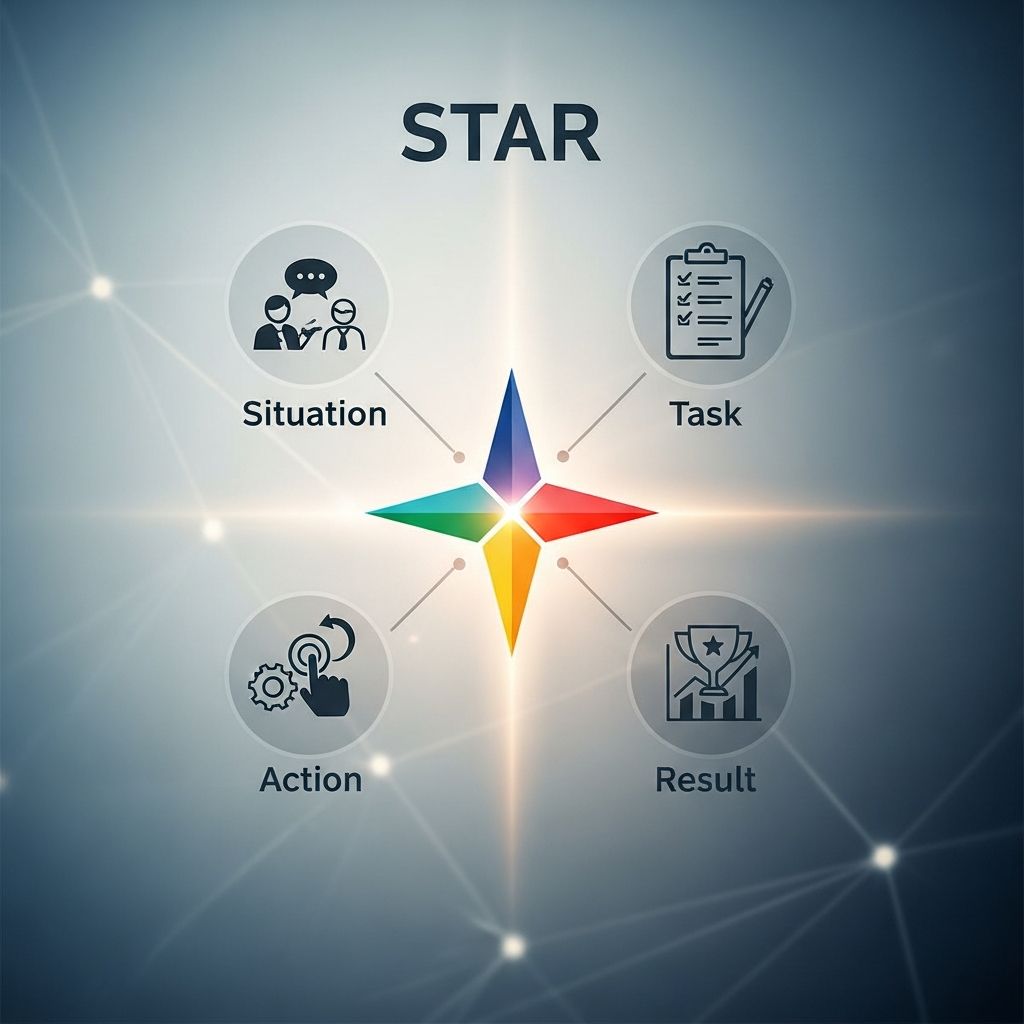
Behavioral interviews are designed to uncover how you behave in real situations by asking you to describe what you have done in the past. The STAR method is a simple, structured way to turn those past experiences into clear, compelling stories that demonstrate your skills and potential to employers.
This guide explains what STAR is, why employers use it, and how you can apply it to different roles and interview formats so you can speak confidently about your achievements.
What the STAR Method Really Means
The STAR method is an acronym that breaks a story into four logical parts: Situation, Task, Action, Result. It is most commonly used in interviews but is also useful in applications, performance reviews, and coaching conversations.
| Letter | Element | Purpose | Typical Content |
|---|---|---|---|
| S | Situation | Provide context so the listener understands the background. | Where you were, who was involved, what was happening. |
| T | Task | Clarify what you needed to achieve or what problem you faced. | Your responsibility, goal, or challenge. |
| A | Action | Show what you personally did and how you approached it. | Steps taken, decisions made, tools or skills you used. |
| R | Result | Demonstrate the outcome and impact of your actions. | Quantified results, feedback received, lessons learned. |
Career services at universities and national careers services widely recommend this method because it helps candidates answer behavioral questions in a focused and structured way.
Why Employers Value STAR-Based Answers
Behavioral interviewing is based on idea that past behavior is one of the best predictors of future performance. Instead of relying on hypothetical answers (what you would do), employers listen for real examples of what you have done.
Well-structured STAR answers help hiring managers to:
- See how you approach problems, collaborate, and make decisions in practical situations.
- Assess your skills against the job description, such as leadership, teamwork, or conflict management.
- Compare candidates more fairly because each person responds to similar types of questions using the same structure.
- Identify red flags, like taking credit for others’ work or avoiding accountability.
This method is used across industries and levels, from internships to executive roles, and is particularly common in structured interview processes used by larger organizations.
Recognizing Behavioral Interview Questions
You can use STAR whenever an interviewer asks for a specific example from your past. Behavioral questions usually start with prompts such as:
- “Tell me about a time when…”
- “Give me an example of…”
- “Describe a situation where…”
- “Can you talk about a time you had to…”
Common competency areas explored through these questions include:
- Working in a team or handling conflict.
- Leading others or influencing decisions.
- Managing deadlines, pressure, or competing priorities.
- Solving complex or ambiguous problems.
- Adapting to change or learning from mistakes.
Building a STAR Story Step by Step
To make the STAR method practical, it helps to think of each part as a short paragraph in a mini-story.
1. Situation: Set the Scene Briefly
The situation should be short but clear. The goal is to give just enough information so that the interviewer can follow the rest of your story.
- Include when and where it happened (role, organization, course, or activity).
- Mention who else was involved only if it is relevant.
- Focus on the part of the situation that connects directly to the question.
Avoid spending most of your time here; guidance from university career offices suggests that the situation should be a relatively small portion of your answer compared with the actions you took.
2. Task: Clarify the Goal or Challenge
The task section explains what you had to accomplish or what problem needed to be solved.
- State your objective or key responsibility.
- Highlight any constraints (time pressure, limited resources, conflicting priorities).
- Show why the task mattered to your team or organization.
If there were several goals, focus on the one that best connects to the competency in the question (for example, leadership, organization, or initiative).
3. Action: Show What You Personally Did
This is the core of your STAR story. Research-based guidance from career centers recommends spending the majority of your answer describing your actions, not just the group’s activities.
- Use first person (“I”) to emphasize your individual contribution, even if you worked as part of a team.
- Walk the interviewer through the key steps you took.
- Highlight the skills you used, such as analysis, communication, negotiation, or technical expertise.
- Mention tools or methods only if they help show relevant skills for the role.
The interviewer should come away with a clear sense of how you think and how you behave under pressure.
4. Result: Demonstrate Impact and Learning
The result closes the loop and shows why your story matters. Employers are interested in measurable outcomes wherever possible, as well as what you learned from the experience.
- Explain the final outcome: what changed, improved, or was delivered.
- Include numbers if you can (for example, time saved, percentage improvement, cost reduction, customer satisfaction scores).
- Mention recognition, such as positive feedback, awards, or follow-up responsibilities.
- End with what you learned or how you have applied that learning since.
Even when the result was mixed or not entirely successful, you can still present a strong answer by emphasizing reflection and improvement.
Preparing Your STAR Stories in Advance
Preparing several STAR stories before an interview helps you answer a wide range of questions calmly and confidently. Career guidance from national careers services and universities recommends a structured preparation process.
Identify Key Skills for the Role
Start with the job description and highlight repeated skills, responsibilities, and verbs.
- Look for words related to collaboration, leadership, analysis, or customer focus.
- Note any technical skills or tools that are central to the role.
- Consider the organization’s values; many behavioral questions assess cultural fit.
Select 4–6 Versatile Experiences
Choose experiences that demonstrate several skills at once so you can adapt them to different questions.
- Include a mix of work, academic, and volunteer or extracurricular examples, especially early in your career.
- Pick situations where you played an active role and can describe your actions in detail.
- Avoid stories that center on confidential or highly sensitive information.
Outline Each Story Using Bullet Points
Instead of writing a script, outline each STAR story with short prompts.
- One or two bullets for the situation and task.
- Three to five bullets for your actions.
- One or two bullets for results and lessons learned.
University career centers caution that memorized scripts can sound unnatural and make it harder to adapt your answer to follow-up questions.
Practice Out Loud
Run through your stories verbally so they feel natural and fit within a reasonable time limit (often 1–2 minutes per answer in structured interviews).
- Record yourself and listen for clarity, speed, and overuse of jargon.
- Ask a friend, mentor, or coach to play the role of interviewer and ask follow-up questions.
- Refine your answers to keep them focused on what the interviewer needs to know.
Adapting STAR to Different Interview Formats
The STAR method is flexible and can be applied to many kinds of selection processes, including remote interviews and written applications.
Phone and Video Interviews
- Keep notes with brief STAR bullet points in front of you; use them as prompts rather than full scripts.
- Pause briefly before answering to choose the most relevant story.
- Speak slightly more slowly to ensure your story is easy to follow without visual cues.
Panel or Structured Interviews
- Assume your answers may be scored against predefined criteria; be explicit about your role and results.
- Maintain eye contact with all panel members while telling your story.
- Invite follow-up questions by ending with what you learned or how you would approach similar situations in the future.
Application Forms and Written Statements
- Use short paragraphs mirroring the STAR structure (without necessarily labelling each part).
- Be concise; most application forms have strict word limits.
- Prioritize clear outcomes and evidence of impact, supported by numbers where possible.
Common Mistakes When Using the STAR Method
Even strong candidates can weaken their answers by misusing the STAR framework. Typical pitfalls include:
- Spending too long on the Situation: Detailed backstory often adds little value and leaves less time to explain your actions.
- Describing what the team did instead of what you did: Interviewers need to understand your specific contribution and skills.
- Skipping the Result: Without clear outcomes, it is hard for employers to judge the effectiveness of your actions.
- Choosing irrelevant examples: Stories that do not relate to the question or role make it hard for interviewers to see your fit.
- Sounding overly rehearsed: Memorized answers can seem robotic and make it difficult to respond naturally to follow-up questions.
Enhancing STAR Answers with Reflection
Many career experts recommend adding a short reflection at the end of your STAR response, especially for senior roles.
- Summarize what the experience taught you.
- Explain how it changed your approach or behaviour.
- Connect the lesson to the job you are applying for.
This reflective element can help interviewers see that you learn from experience and can adapt to new challenges, a quality that research consistently links to career success and effective leadership.
Quick Checklist: A Strong STAR Answer
Use this checklist just before an interview or assessment to confirm you are ready:
- You can describe at least four STAR stories that cover teamwork, leadership, problem-solving, and handling pressure.
- Each story includes a clear situation, task, action, and result.
- Your actions are specific, detailed, and focused on what you did.
- Your results include some form of measurable outcome or feedback.
- You can deliver each story in about 1–2 minutes without sounding memorized.
Frequently Asked Questions (FAQs)
Q: Can I use the same STAR story for different questions?
Yes, you can reuse strong examples if you emphasize different aspects of the story. For instance, one project might demonstrate both teamwork and problem-solving; you can adjust which details you highlight depending on the question.
Q: What if I do not have much work experience?
You can draw on academic projects, volunteering, extracurricular activities, or part-time jobs. National careers services specifically encourage candidates to use examples from a variety of contexts as long as they clearly demonstrate the required skills.
Q: How detailed should my answers be?
Aim for enough detail that the interviewer could picture the situation and understand your reasoning, without getting lost in minor facts. Career guidance from universities suggests giving most of the detail in the action section and keeping the situation and task relatively brief.
Q: Is it acceptable to talk about a time things went wrong?
Yes, as long as you take responsibility for your part, explain what you did to address the issue, and emphasize what you learned. Interviewers often appreciate honest reflection and evidence that you can recover from setbacks.
Q: How many STAR stories should I prepare?
Preparing four to six well-thought-out stories is enough for many interviews. You can then adapt these core examples to cover a wide range of competencies, rather than trying to memorize a new example for every possible question.
References
- The STAR method — National Careers Service. 2021-11-26. https://nationalcareers.service.gov.uk/careers-advice/interview-advice/the-star-method
- How To Use the STAR Interview Response Technique — Indeed Career Guide. 2022-08-15. https://www.indeed.com/career-advice/interviewing/how-to-use-the-star-interview-response-technique
- Using the STAR Method for Your Next Behavioral Interview — MIT Career Advising & Professional Development. 2023-02-10. https://capd.mit.edu/resources/the-star-method-for-behavioral-interviews/
- Behavioral Interviewing: How to use the STAR Method — CoachHub. 2023-04-06. https://www.coachhub.com/blog/star-method
- STAR method: Interview questions you can ace with this technique — The Muse. 2022-05-04. https://www.themuse.com/advice/star-interview-method

- Integrated M.A. in Applied Linguistics, University of Hyderabad
- 5+ years in editorial, instructional, SEO, and research-based writing
Sneha is a relationships and lifestyle writer with a strong foundation in applied linguistics and certified training in relationship coaching. She brings over five years of writing experience to theskillvault, crafting thoughtful, research-driven content that empowers readers to build healthier relationships, boost emotional well-being, and embrace holistic living. Her writing and insights reflect the belief that beauty, happiness, and wellness…