
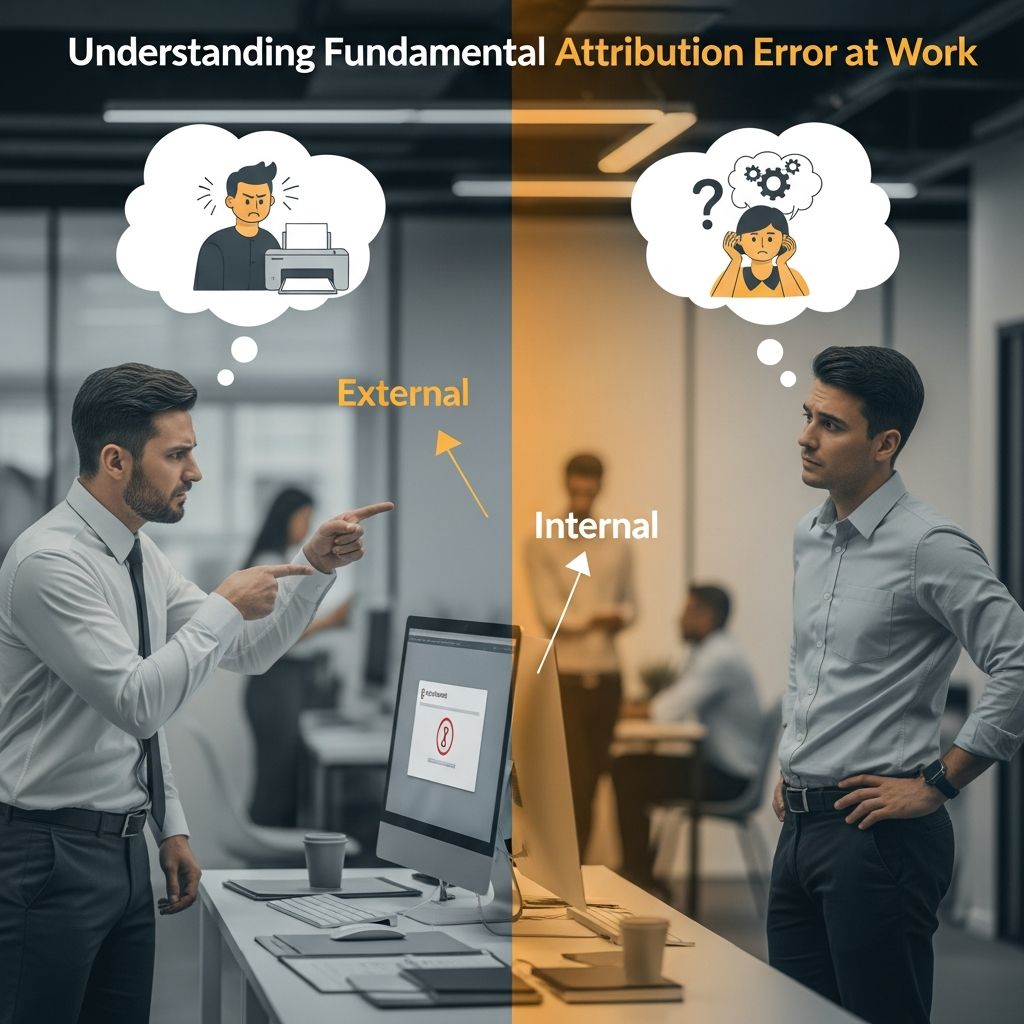
Every day at work, people explain each other’s behavior. Someone misses a deadline, challenges an idea in a meeting, or forgets to respond to an email. In a split second, we decide why it happened. Was it carelessness, disrespect, pressure from another project, or something else entirely? The answers we give to those questions are guided by a powerful cognitive bias known as the fundamental attribution error.
This thinking shortcut influences how leaders evaluate performance, how teammates interpret conflict, and how cultures of trust or blame are created. Understanding it is essential for anyone who manages people, leads change, or cares about building a fair and psychologically safe workplace.
What Is the Fundamental Attribution Error?
In social psychology, the fundamental attribution error (FAE) is the tendency to overemphasize personal traits and underemphasize situational factors when explaining other people’s behavior.
- We assume behavior reflects what a person is like (e.g., “irresponsible,” “lazy,” “difficult”).
- We give too little weight to the context they are acting in (e.g., workload, unclear expectations, systemic issues).
Researchers often describe this as a form of attribution bias: a systematic error in how we assign causes to events and actions.
Dispositional vs. Situational Explanations
| Type of explanation | What it focuses on | Typical workplace example |
|---|---|---|
| Dispositional (internal) | Personality, character, attitudes, or abilities | “She missed the deadline because she’s disorganized.” |
| Situational (external) | Environment, constraints, resources, social pressures | “She missed the deadline because the scope changed and resources were cut.” |
The fundamental attribution error shows up when we jump to dispositional explanations for others and overlook plausible situational causes, especially in ambiguous situations.
Why This Bias Matters for Leaders
In leadership and people management, the cost of misreading behavior is high. The fundamental attribution error can:
- Distort performance evaluations by confusing one-off situational failures with stable character flaws.
- Undermine psychological safety when people expect to be judged harshly rather than understood.
- Fuel conflict as colleagues attribute negative intent instead of exploring constraints.
- Reinforce inequity, because stereotypes can shape which dispositional labels are applied to whom.
Research in organizational behavior shows that biased attributions affect promotion decisions, feedback quality, and how much support employees receive when they struggle. Leaders who recognize this bias can respond in ways that are both more accurate and more humane.
Where the Fundamental Attribution Error Came From
The concept has deep roots in social psychology. Early theorists such as Fritz Heider explored how people act as “naïve psychologists,” constantly explaining behavior around them. In the late 1960s and 1970s, classic experiments by Edward Jones, Victor Harris, and later Lee Ross demonstrated a consistent pattern: observers inferred stable attitudes and traits even when they knew behavior was heavily constrained by the situation.
For example, in one famous study, participants read essays that were either in favor of or against a political figure. Even when they were told the author had been assigned the position and had no choice, participants still tended to believe the essay reflected the writer’s real opinion. This strong pull toward dispositional explanations led Ross to label the phenomenon “fundamental” to how we think about others.
Why Our Brains Default to Disposition
Several psychological processes make the fundamental attribution error likely, particularly in fast-moving workplaces.
1. What We See Feels Like the Whole Story
Other people’s behavior is immediately visible; the context around them is not. Psychologists call this perceptual salience: we focus on what stands out in front of us.
- We see a colleague interrupt and label them “rude”.
- We don’t see that they were told to keep the meeting within a strict timebox.
Because the person is more salient than the situation, we treat their behavior as a reflection of who they are.
2. Mental Shortcuts Save Energy
Forming a quick dispositional judgment is cognitively cheap. Adjusting that judgment to incorporate situational information requires effort and attention.
- Under time pressure, we rely more on automatic interpretations.
- When mentally overloaded, we are less likely to update our first impression to reflect new context.
This helps explain why attribution errors are more common when leaders are busy, stressed, or multitasking.
3. A Double Standard for Ourselves vs. Others
Studies consistently show an asymmetry in how we explain behavior:
- For our own negative outcomes, we highlight situational causes (“I was under-resourced”).
- For others’ negative outcomes, we emphasize disposition (“They’re not committed”).
This “actor–observer” pattern supports self-protection and ego, but it can be damaging in leadership decisions.
4. Cultural Emphasis on Individual Responsibility
In many individualistic cultures, there is a strong norm of personal accountability and self-determination. Research indicates that in such contexts, people are particularly prone to attribute outcomes to individual traits rather than structural or contextual factors.
In multicultural teams, this can create misunderstandings: behavior that one person sees as a character issue may, to someone from a different cultural background, look more like a function of role expectations or group norms.
How Fundamental Attribution Error Shows Up at Work
Although the bias is often discussed in abstract terms, its impact in organizations is very concrete. Here are common domains where it quietly shapes decisions and relationships.
Performance and Potential Assessments
When leaders review performance, they may attribute patterns to character instead of conditions:
- Frequent overtime is labeled as “lack of time management,” ignoring understaffing.
- Quiet participation in meetings is read as “no leadership potential,” not cultural norms or limited psychological safety.
Over time, these misattributions can skew talent pipelines and succession planning, as some people are seen as “naturally high performers” and others as inherently “average” or “risky.”
Feedback and Coaching Conversations
When managers default to dispositional explanations, feedback often sounds like criticism of identity rather than support for behavior change:
- “You’re just not proactive” instead of “Let’s look at what’s blocking you from taking initiative.”
- “You’re too emotional” instead of “The way you express concerns in meetings affects how others hear your ideas.”
Coaching research emphasizes that effective development focuses on specific behaviors and the situations in which they occur, not on fixed traits. Attribution-aware leaders frame feedback around context, choices, and skills that can be learned.
Conflict, Trust, and Team Dynamics
In conflicts, the fundamental attribution error amplifies negative stories about others:
- We infer bad intent (“They’re trying to undermine me”) instead of exploring constraints.
- We assume stable traits (“They’re impossible to work with”) rather than situational triggers.
Teams that habitually explain friction through personality labels often see trust erode. In contrast, groups that routinely consider context are better at problem-solving and preserving relationships.
Inclusion, Bias, and Stereotypes
Attribution patterns don’t exist in a vacuum; they intersect with social stereotypes and structural inequalities. Research in ethics and behavioral science shows that people often judge others’ missteps more harshly than their own and rationalize their own behavior with situational excuses.
At work, this can mean:
- Members of underrepresented groups have their mistakes attributed to lack of ability.
- Similar mistakes by dominant-group members are seen as circumstantial or temporary.
Over time, these uneven attributions contribute to gaps in opportunity, promotion, and perceived competence.
Practical Strategies to Reduce Fundamental Attribution Error
The goal is not to eliminate internal explanations altogether—traits and choices do matter—but to rebalance our thinking so that context receives appropriate weight. Below are evidence-informed practices leaders and teams can adopt.
1. Slow Down and Ask Context Questions
Before drawing conclusions about someone’s behavior, deliberately pause and ask:
- “What else could explain this behavior besides their personality?”
- “What pressures, incentives, or constraints might they be facing?”
- “If I were in their position, how might I be acting?”
This simple cognitive check disrupts automatic dispositional judgments and makes room for more situational explanations.
2. Gather Data, Not Stories
Replace quick labels with specific observations:
- Track patterns across time and situations: Is the behavior consistent or context-dependent?
- Seek multiple perspectives: How do other stakeholders interpret the same behavior?
- Clarify expectations and constraints: Was success realistically possible under the conditions?
In performance reviews, documenting objective behaviors and circumstances improves fairness and reduces reliance on impressionistic judgments.
3. Use “Both/And” Language in Feedback
Balanced attributions recognize that behavior often arises from an interaction between person and situation. In conversations, this sounds like:
- “You have a strong preference for autonomy, and the current process is highly structured, which can create friction.”
- “Your direct communication style is valuable, and in high-stress meetings it can feel abrupt to others.”
“Both/and” framing helps people see their impact without collapsing identity into a single trait.
4. Design Systems That Make the Situation Visible
Organizations can make it easier for leaders to see context by:
- Capturing workload and resource data alongside performance metrics.
- Documenting changes in scope, timelines, or priorities in project histories.
- Standardizing criteria for evaluations to reduce reliance on “gut feel” impressions.
When situational information is systematically surfaced, it naturally tempers extreme dispositional judgments.
5. Encourage Attribution-Aware Team Norms
Teams can explicitly adopt norms such as:
- “Assume positive intent, investigate constraints.”
- “Describe behavior before assigning motives.”
- “Ask before you conclude: ‘What was going on for you when that happened?’”
These practices build a shared language for challenging quick character assumptions and opening up conversations about context.
6. Develop Leaders’ Self-Awareness Through Coaching
Executive and leadership coaching often focuses on expanding leaders’ awareness of their own thinking patterns and default interpretations. By reflecting on their attributions, leaders can:
- Notice when they are labeling people rather than behaviors.
- Explore how their own history, values, and stress levels color their judgments.
- Practice alternative interpretations and more constructive responses.
Research on leadership development highlights that such reflective practices improve decision quality and interpersonal effectiveness.
From Blame to Curiosity: A Mindset Shift
At its core, working skillfully with the fundamental attribution error is about moving from a blame mindset to a curiosity mindset:
- Blame asks “Who is at fault?” and leaps to labels.
- Curiosity asks “What’s driving this behavior?” and looks for interacting causes.
For leaders, this shift changes everything:
- Performance issues become opportunities to redesign roles, clarify priorities, or build skills.
- Conflicts become signals about misaligned expectations or unspoken needs.
- Mistakes become data for improving both systems and individual capabilities.
By intentionally balancing dispositional and situational explanations, leaders create workplaces where people are held accountable and set up for success.
Frequently Asked Questions (FAQs)
What is the difference between fundamental attribution error and simple judgment?
Fundamental attribution error is not just making any judgment; it is a systematic tendency to explain others’ behavior primarily through traits while downplaying context. Everyday judgments that give substantial weight to situations are not examples of this error.
Is the fundamental attribution error always wrong?
No. Sometimes behavior does accurately reflect stable traits. The error lies in treating dispositional explanations as the default, especially when relevant situational factors are present but ignored.
Do people commit this bias equally across cultures?
Cross-cultural research suggests that the tendency is stronger in more individualistic cultures, where personal responsibility and autonomy are heavily emphasized, and somewhat weaker in collectivistic cultures that highlight context and relationships.
How can I notice myself making this error in real time?
Signals include using global labels (“always,” “never”), making strong inferences about character from one event, and feeling certain about your interpretation without having asked the person what was happening for them. When you notice these cues, pause and generate at least two plausible situational explanations.
Can teams be trained to reduce fundamental attribution error?
Yes. Training that combines basic education about cognitive biases with practical tools—such as structured reflection questions, feedback scripts, and case-based discussions—can reduce attribution errors and improve interpersonal accuracy in organizations.
References
- Fundamental Attribution Error Theory in Psychology — Simply Psychology. 2023-08-28. https://www.simplypsychology.org/fundamental-attribution.html
- Fundamental Attribution Error — Harvard Business School Online, Business Insights Blog. 2022-06-15. https://online.hbs.edu/blog/post/the-fundamental-attribution-error
- Fundamental Attribution Error (Social Psychology) — EBSCO Research Starters. 2016-01-01. https://www.ebsco.com/research-starters/psychology/fundamental-attribution-error-social-psychology
- Fundamental Attribution Error — Ethics Unwrapped, McCombs School of Business, The University of Texas at Austin. 2018-09-01. https://ethicsunwrapped.utexas.edu/glossary/fundamental-attribution-error
- Fundamental Attribution Error — The Decision Lab. 2021-05-10. https://thedecisionlab.com/biases/fundamental-attribution-error

Medha Deb is an editor with a master's degree in Applied Linguistics from the University of Hyderabad. She believes that her qualification has helped her develop a deep understanding of language and its application in various contexts. Medha specializes in the areas of beauty, health, sports, and wellness and is committed to ensuring that the content on the website is…