
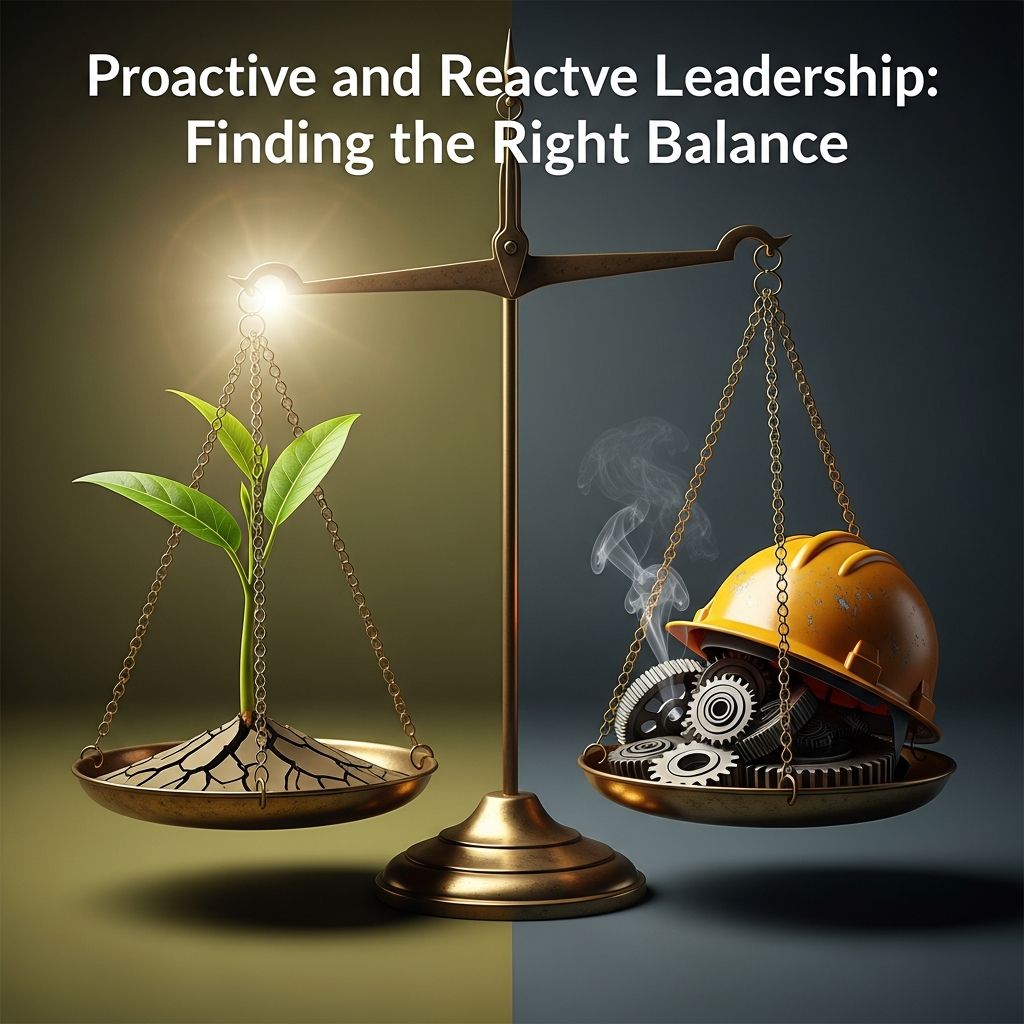
Every leader moves along a spectrum between being proactive and reactive. One style looks ahead to anticipate change; the other responds quickly when events take an unexpected turn. The most effective leaders do not choose one over the other: they learn to blend both approaches strategically to guide teams through uncertainty, complexity, and growth.
Understanding Proactive vs Reactive Leadership
At its core, the difference between proactive and reactive leadership comes down to time orientation and decision patterns.
- Proactive leadership focuses on the future, setting direction, scanning for emerging risks and opportunities, and acting early to shape outcomes before pressures escalate.
- Reactive leadership focuses on the present, responding to events, resolving immediate problems, and making quick decisions under time and information constraints.
Both are legitimate and necessary. Organizations need proactive leaders to create strategy and prevent avoidable crises, and reactive leaders to navigate shocks such as market disruptions, system failures, or public emergencies.
Core Characteristics of Proactive and Reactive Leaders
| Dimension | Proactive Leadership | Reactive Leadership |
|---|---|---|
| Primary focus | Future risks, trends, and opportunities | Current problems and urgent needs |
| Typical time horizon | Months to years; long-term outcomes | Minutes to weeks; immediate impact |
| Decision style | Deliberate, data-informed, scenario-based | Fast, intuitive, situational |
| Risk posture | Identifies and mitigates risks in advance | Contains and manages risks once they materialize |
| Team experience | Predictable direction and clear priorities | High tempo, frequent shifts, intense pressure |
| Innovation impact | Encourages experimentation and learning | May prioritize quick fixes over long-term improvement |
The Strengths of Proactive Leadership
Proactive leadership is often associated with vision, prevention, and sustainable growth. Research in strategic management consistently links proactive behavior with competitive advantage in dynamic environments, especially when leaders actively scan their environment and build adaptive capabilities.
Key advantages of proactive leadership
- Strategic clarity: Proactive leaders articulate a clear direction and connect daily work to long-term goals, which supports alignment across teams.
- Early risk mitigation: By identifying threats before they escalate, proactive leaders reduce the frequency and severity of crises, supporting resilience.
- Support for innovation: Future-oriented leaders are more likely to create psychological safety, allocate time for experimentation, and reward learning, which in turn supports innovation.
- Better resource planning: Anticipating demand, skills gaps, or capacity constraints enables more intentional investment in people, systems, and processes.
- Lower chronic stress: When teams are not perpetually firefighting, they experience less ongoing time pressure and uncertainty, conditions associated with burnout.
Risks and pitfalls of overemphasizing proactivity
Being highly proactive is not automatically positive. If overused or applied without feedback, it can create blind spots:
- Analysis paralysis: Excessive planning and modeling can delay action when real-time experimentation would generate better information.
- Detachment from reality: Leaders focused on distant horizons may underestimate immediate constraints or fail to respond quickly to new data.
- Rigid plans: Overcommitment to a strategy can reduce flexibility when technology, regulation, or customer expectations change unexpectedly.
The Strengths of Reactive Leadership
Reactive leadership comes to the forefront in emergencies and fast-moving situations. Crisis management research and public administration studies recognize the importance of rapid, coordinated decisions when time is limited and stakes are high.
Key advantages of reactive leadership
- Speed under pressure: Reactive leaders act decisively when information is incomplete and delays would worsen harm.
- High adaptability: Comfort with uncertainty allows teams to pivot quickly when plans fail or context shifts suddenly.
- Resource efficiency in the short term: Rather than investing heavily to cover many hypothetical scenarios, reactive leaders direct resources to issues that have clearly materialized.
- Strong crisis capability: Teams used to responding to disruption develop robust troubleshooting and improvisation skills, valuable when contingencies break down.
Risks and pitfalls of overemphasizing reactivity
Constant reactivity can erode performance, culture, and health when it becomes the default mode of operating:
- Firefighting culture: Teams may focus on short-term fixes rather than addressing underlying causes, leading to recurring problems.
- Strategic drift: Responding mainly to external pressures can pull the organization away from its mission and long-term objectives.
- Employee burnout: Persistent time pressure and unpredictability are associated with higher stress, emotional exhaustion, and turnover.
- Underinvestment in prevention: When leaders only respond after issues arise, they can postpone investments in training, technology, and process improvement that would reduce future risk.
When to Lead Proactively and When to React
Neither style is inherently superior. The question is: under what conditions should each dominate? Effective leaders adjust their stance based on context, risk, and time sensitivity.
Situations that call for proactive leadership
- Stable or moderately predictable environments where data allows for robust forecasting and planning.
- Strategic initiatives such as market expansion, digital transformation, or new product development.
- Capability building, including leadership development, culture change, and long-term workforce planning.
- Regulatory or technological shifts that can be anticipated in advance, even if exact timing is unclear.
Situations that call for reactive leadership
- Acute crises such as security breaches, system outages, or safety incidents, where delay could magnify harm.
- Sudden market shocks, including major customer losses, disruptive competitor moves, or supply chain failures.
- Unexpected political or environmental events that disrupt operations and require immediate response.
Blending Proactive and Reactive: A Practical Leadership Model
Rather than viewing proactivity and reactivity as opposites, it is more helpful to see them as complementary modes. High-performing leaders deliberately design how much time and energy they spend in each mode.
A simple three-layer view of leadership focus
- Foundation: Prevent and prepare
Routine time dedicated to planning, risk assessment, training, and process improvement to reduce avoidable surprises. - Middle layer: Monitor and adapt
Continuous scanning of operations, markets, and stakeholders to identify weak signals and adjust before issues escalate. - Top layer: Respond and recover
Clear protocols and skills for rapid, coordinated response when crises still occur, followed by learning reviews to feed back into prevention.
Practical steps to build a balanced leadership style
- Set explicit time ratios: Protect regular time blocks for strategic thinking and improvement work so they are not swallowed by urgent tasks.
- Create decision rules: Define thresholds for when to escalate into crisis mode versus when to slow down for deliberate analysis.
- Design routines for learning: After major incidents or projects, run structured debriefs to identify root causes and system changes.
- Distribute authority: Empower teams with clear decision rights so that both proactive ideas and reactive responses do not bottleneck at the top.
Developing Proactive and Reactive Capabilities in Leaders
Leadership development programs increasingly emphasize adaptability: the capacity to shift across different modes of thinking and acting as context changes. Leaders can cultivate both proactive and reactive skills through deliberate practice.
Building proactive capabilities
- Strategic thinking: Practice scenario planning, trend analysis, and systems thinking to understand long-term implications of decisions.
- Data-informed planning: Use performance metrics, market research, and stakeholder feedback to design realistic roadmaps.
- Risk management: Develop structured risk registers, mitigation plans, and early warning indicators.
- Coaching skills: Support others to think ahead, take initiative, and own outcomes, which multiplies proactive behavior across the organization.
Strengthening reactive capabilities
- Rapid decision-making: Train with simulations or scenario-based exercises where information is incomplete and time-limited.
- Crisis communication: Learn to provide clear, concise, and honest updates to teams and stakeholders during high-stress events.
- Prioritization under pressure: Practice triaging issues, distinguishing between what is urgent and what is critical.
- Emotional regulation: Use evidence-based stress management techniques to remain composed and credible during disruption.
Impact on Culture, Engagement, and Wellbeing
Leadership style shapes not just performance but also how people feel at work. Research on job stress and organizational climate shows that constant reactivity, high demands, and low control are associated with burnout and health risks, whereas participation in decisions and predictability support wellbeing.
- Predominantly proactive environments tend to offer more clarity, autonomy, and opportunities for learning, which can strengthen commitment and intrinsic motivation.
- Predominantly reactive environments may foster camaraderie under pressure but can also lead to chronic fatigue and reduced engagement if not counterbalanced.
Balancing both modes allows organizations to be resilient: stable enough to provide psychological safety, but flexible enough to navigate shocks without losing their sense of purpose.
Frequently Asked Questions (FAQs)
Q1: Is proactive leadership always better than reactive leadership?
No. Proactive leadership is essential for long-term success and prevention, but reactive leadership is critical in crises and fast-changing situations. The most effective leaders know when to slow down to plan and when to move quickly to contain emerging risks.
Q2: Can a leader be both proactive and reactive at the same time?
Yes. Leaders can design their schedule and decision processes so that most of their time supports proactive initiatives, while maintaining clear protocols for rapid response. The same leader can shift between modes depending on the urgency and importance of the situation.
Q3: How can organizations encourage more proactive behavior in teams?
Organizations can set longer-term goals, reward preventive actions, allocate time for improvement projects, and provide training in strategic thinking and risk management. Giving employees influence over how work is done also supports proactive problem solving.
Q4: What are signs that a team is stuck in reactive mode?
Warning signs include constant firefighting, frequent interruptions, recurring problems, limited time for reflection or planning, and high levels of stress or turnover. In such cases, leaders may need to redesign workloads and invest in root-cause analysis.
Q5: How does coaching support a shift toward proactive leadership?
Coaching helps leaders develop self-awareness, clarify long-term priorities, and build the skills needed for strategic thinking, delegation, and communication. This, in turn, makes it easier to spend less time reacting and more time shaping the future.
References
- How to Balance a Proactive And Reactive Leadership Approach — TSSG. 2024-02-01. https://www.tssg.ca/balancing-proactive-and-reactive-leadership/
- Proactive vs. reactive: what’s the best management style? — Calm. 2023-06-15. https://www.calm.com/blog/proactive-vs-reactive
- Proactive vs Reactive Leadership: The Ultimate Guide — Midwest Teachers Institute. 2024-01-10. https://www.midwestteachersinstitute.org/proactive-vs-reactive-leadership/
- Reactive, Responsive, & Proactive Leadership — PolGovPro Blog. 2024-07-24. https://polgovpro.blog/2024/07/24/reactive-responsive-proactive-leadership/
- Proactive vs. Reactive Management — EZRA Coaching. 2022-11-03. https://www.helloezra.com/resources/insights/proactive-vs-reactive-management

- Integrated M.A. in Applied Linguistics, University of Hyderabad
- 5+ years in editorial, instructional, SEO, and research-based writing
Sneha is a relationships and lifestyle writer with a strong foundation in applied linguistics and certified training in relationship coaching. She brings over five years of writing experience to theskillvault, crafting thoughtful, research-driven content that empowers readers to build healthier relationships, boost emotional well-being, and embrace holistic living. Her writing and insights reflect the belief that beauty, happiness, and wellness…