
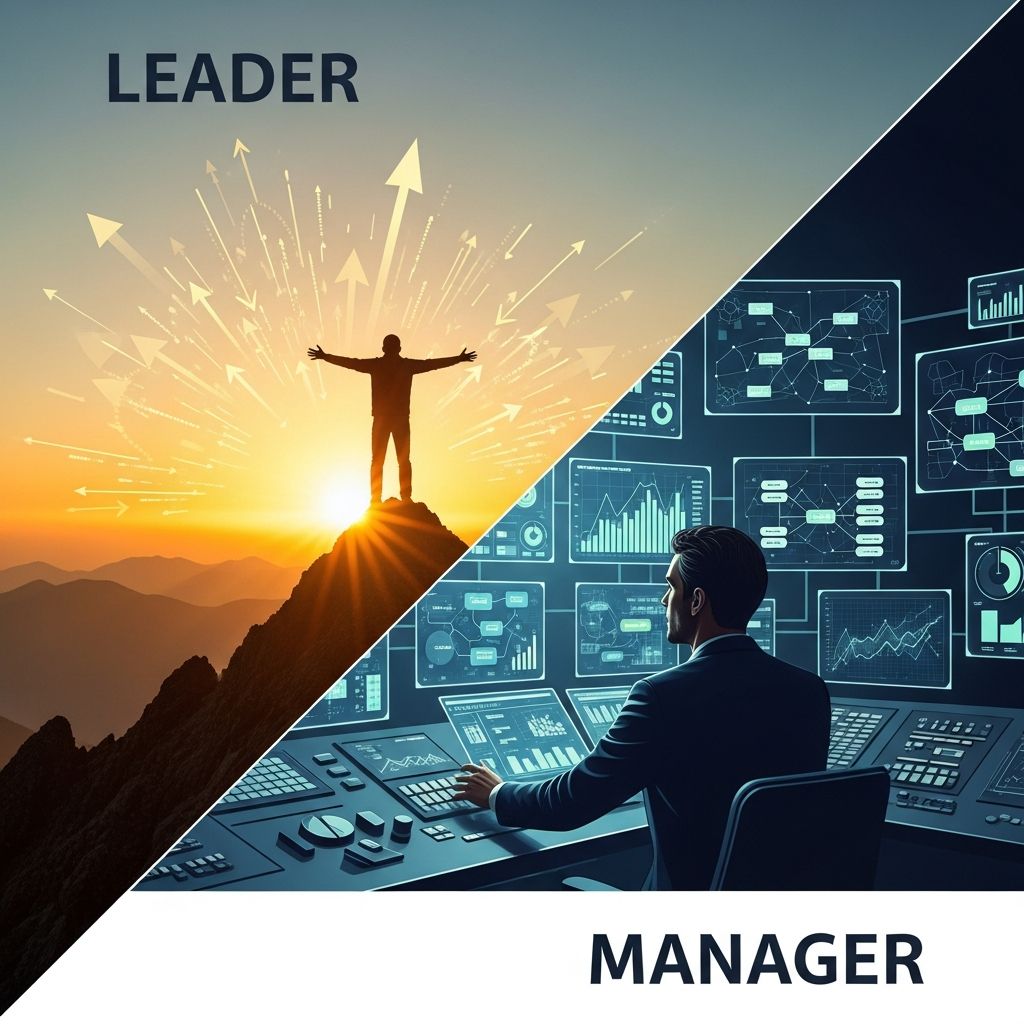
Organizations frequently ask whether they need more leaders or more managers. In reality, sustainable success depends on both—often in the very same person. Understanding where leadership and management overlap, and where they clearly diverge, helps you decide which capabilities you rely on most today and which you need to build for the future.
Why the Leader vs Manager Debate Still Matters
Leadership and management are sometimes used as if they mean the same thing, but research and practice show they play different roles in performance and change.
- Leadership is primarily about vision, influence and cultural direction.
- Management is primarily about execution, coordination and consistency.
- Organizations that neglect either one struggle—too much leadership can create chaos, while too much management can freeze innovation.
Instead of asking “leader or manager?”, a more useful question is: When does my team need leadership, when does it need management, and how can I flex between the two?
Core Mindsets: How Leaders and Managers Think
The clearest distinction between leaders and managers starts with their mental focus. Each role looks at the same organization through a different lens.
| Dimension | Leader Mindset | Manager Mindset |
|---|---|---|
| Time horizon | Future-oriented: focuses on where the organization needs to go next. | Present-oriented: focuses on what must be delivered now and soon. |
| Primary concern | People, purpose, and direction. | Tasks, processes, and resources. |
| Approach to risk | Challenges the status quo and looks for new possibilities. | Reduces uncertainty and protects continuity. |
| View of power | Influence and trust: earns followership regardless of title. | Formal authority: relies on role and responsibilities in the hierarchy. |
| Key question | “Why are we doing this and what should change?” | “How do we make this work reliably and on time?” |
Both mindsets are valuable. A leader without any management perspective can push for change that never lands, while a manager without leadership perspective can maintain systems that no longer serve the organization well.
What Leaders Do Versus What Managers Do
Day-to-day activities further highlight the practical difference between leading and managing.
Typical Responsibilities of Leaders
People who operate from a leadership stance tend to:
- Craft and communicate a compelling vision for the future and connect it to daily work so it feels concrete, not abstract.
- Shape organizational culture by modeling values, behaviors and norms that support long-term goals.
- Align stakeholders by building coalitions across departments and levels, not just within a single team.
- Challenge assumptions and encourage experimentation, even when it disrupts comfortable routines.
- Inspire and empower people to take ownership instead of waiting for instructions.
Typical Responsibilities of Managers
People who operate primarily from a management stance usually:
- Translate strategy into plans by turning broad goals into clear tasks, timelines and accountability.
- Organize people and resources so the right skills, tools and budgets are in place to meet objectives.
- Monitor performance through metrics, check-ins and reports to keep work on track.
- Standardize and improve processes so work is consistent, efficient and repeatable.
- Resolve operational issues such as bottlenecks, conflicts or resource constraints quickly.
In small or fast-growing organizations, these responsibilities are often blended in the same role. Research on startups and lean organizations notes that leaders there frequently take on hands-on management to execute their vision.
Key Skills: Where Leadership and Management Diverge and Overlap
Leadership and management draw on some shared capabilities—communication, decision-making, and problem-solving—but they apply them differently.
Essential Leadership Skills
- Visioning and strategic thinking: seeing patterns, threats and opportunities beyond the immediate quarter.
- Influence without authority: mobilizing people who do not report to you by building credibility and trust.
- Emotional intelligence: recognizing and managing one’s own emotions as well as others’ to build psychological safety and engagement.
- Change leadership: communicating the case for change, addressing resistance and sustaining momentum over time.
Essential Management Skills
- Planning and prioritization: sequencing work, allocating resources and balancing competing demands.
- Process design: structuring workflows and controls so performance is measurable and repeatable.
- Performance management: setting expectations, giving feedback and linking results to consequences.
- Risk and issue management: identifying operational risks early and taking corrective action promptly.
Skills Both Leaders and Managers Need
Regardless of role or title, some capabilities are now considered non-negotiable for anyone responsible for others:
- Clear communication in multiple directions—upwards, sideways and downwards—using both data and narrative.
- Coaching and development to help people grow skills and confidence, not only complete tasks.
- Ethical judgment in how power, information and rewards are used within the team or organization.
How Organizational Context Shapes the Balance
The ideal mix of leadership and management is not fixed; it depends heavily on your environment.
When Leadership Dominates
Leadership capabilities tend to be most critical when:
- The organization faces rapid market change or disruption and must rethink strategy.
- New products, services or business models are being launched and uncertainty is high.
- The culture needs to shift—for example, becoming more customer-centric, inclusive or innovative.
When Management Dominates
Management capabilities come to the foreground when:
- Operations must be stable, safe and compliant, such as in regulated industries.
- The organization is scaling quickly and needs standardized processes to maintain quality.
- Resources are tight and efficiency is essential to meet obligations and targets.
Large vs Small Organizations
- In large, hierarchical organizations, formal leaders are often located at the top (e.g., C-suite), while managers sit between executives and front-line employees, coordinating execution.
- In smaller or flatter organizations, individuals frequently wear both hats at once, setting direction and managing delivery simultaneously.
Self-Assessment: Do You Lead, Manage, or Blend Both?
You can roughly gauge your default style by reflecting on how you naturally respond in typical work situations. Consider how often you:
- Start conversations with “why” and “where we’re going” versus “what needs doing today.”
- Invest time in relationships and development versus mainly tracking tasks and deadlines.
- Challenge existing processes versus strengthening and enforcing them.
- Look beyond your team to how work fits the bigger picture versus focusing solely on your unit’s KPIs.
If you recognize yourself strongly in one column—vision, influence and change on one side; planning, control and execution on the other—you may lean more toward leadership or management. The goal is not to abandon your strengths, but to intentionally build the complementary side.
Bridging the Gap: Becoming a Leader–Manager
Research and executive education programs increasingly emphasize that the most effective professionals are those who can integrate leadership and management rather than treating them as mutually exclusive.
For Strong Managers Wanting to Lead More
If you already excel at planning, coordination and delivery, try:
- Spending more time on external scanning: study customers, competitors and broader trends, not just internal metrics.
- Practicing storytelling: link projects to a bigger purpose so people see more than a task list.
- Delegating operational details where possible to create space for strategic thinking and relationship building.
- Inviting challenge and ideas: ask your team how work could be reimagined, not just improved.
For Natural Leaders Wanting to Manage Better
If you gravitate to big ideas and motivation but struggle with structure, consider:
- Learning basic project management tools to translate vision into timelines, risks and milestones.
- Clarifying expectations so people know what success looks like, not only why it matters.
- Measuring outcomes through a small set of meaningful indicators that track progress without overwhelming the team.
- Building routines (check-ins, reviews, retrospectives) that support your culture rather than stifle it.
Practical Micro-Shifts to Use Tomorrow
You do not need a new job title to lead more or manage better. Small behavioral shifts can quickly change how others experience you.
- In your next team meeting, spend the first five minutes reconnecting work to the broader vision before diving into updates.
- When delegating, specify not only the task and deadline but the decision rights: what the person can decide alone and when to escalate.
- In one-on-one conversations, balance performance feedback with coaching questions about long-term growth.
- When a problem emerges, treat it both as an execution issue (what broke) and a learning opportunity (what it reveals about your systems or assumptions).
Frequently Asked Questions (FAQs)
Is every manager automatically a leader?
No. A manager is a formal role responsible for plans, resources and performance; leadership is about behaviors that inspire and influence others, regardless of title. Some managers act as strong leaders; others primarily administer and coordinate.
Can someone be a leader without managing people?
Yes. Individuals can lead by shaping ideas, setting examples and influencing decisions even without direct reports. Research on informal leadership shows that people often emerge as leaders within teams because of their actions and credibility, not their position.
Which is more important: leadership or management?
Neither is universally more important. In stable environments with complex operations, strong management can matter more. In periods of disruption or transformation, leadership becomes critical. Healthy organizations deliberately cultivate both.
How can organizations develop both leaders and managers?
Effective organizations invest in learning that builds strategic thinking, influence and change skills alongside planning, project management and performance management. They also design roles and career paths that allow people to practice both sets of capabilities early, not only after promotion.
What mistakes happen when companies confuse the two?
Common problems include promoting technical experts into people management without leadership development, rewarding only short-term operational results while ignoring culture, or celebrating visionary ideas without committing to disciplined execution. The result is often disengagement, missed opportunities or failed change initiatives.
References
- Management vs. Leadership: Similarities and Differences — Wilson College Online. 2023-02-06. https://online.wilson.edu/resources/management-vs-leadership/
- Managers Versus Leaders: The Debate Continues — University of Wisconsin–Green Bay Small Business Development Center. 2017-07-01. https://www.uwgb.edu/sbdc/articles/managers-vs-leaders/
- What Is the Difference Between a Leader and a Manager? — National Society of Leadership and Success. 2022-03-15. https://www.nsls.org/blog/what-is-the-difference-between-a-leader-and-a-manager
- Leadership vs. Management: What’s the Difference? — Harvard Business School Online. 2020-12-03. https://online.hbs.edu/blog/post/leadership-vs-management
- Leadership vs. Management: What’s the Real Difference? — Seattle University Albers School of Business and Economics. 2023-05-10. https://www.seattleu.edu/business/online/albers/blog/leadership-vs-management
- 4 Ways Leaders and Managers Differ — University of Washington Professional & Continuing Education. 2019-10-01. https://www.pce.uw.edu/news-features/articles/4-ways-leaders-and-managers-differ

- Integrated M.A. in Applied Linguistics, University of Hyderabad
- 5+ years in editorial, instructional, SEO, and research-based writing
Sneha is a relationships and lifestyle writer with a strong foundation in applied linguistics and certified training in relationship coaching. She brings over five years of writing experience to theskillvault, crafting thoughtful, research-driven content that empowers readers to build healthier relationships, boost emotional well-being, and embrace holistic living. Her writing and insights reflect the belief that beauty, happiness, and wellness…