
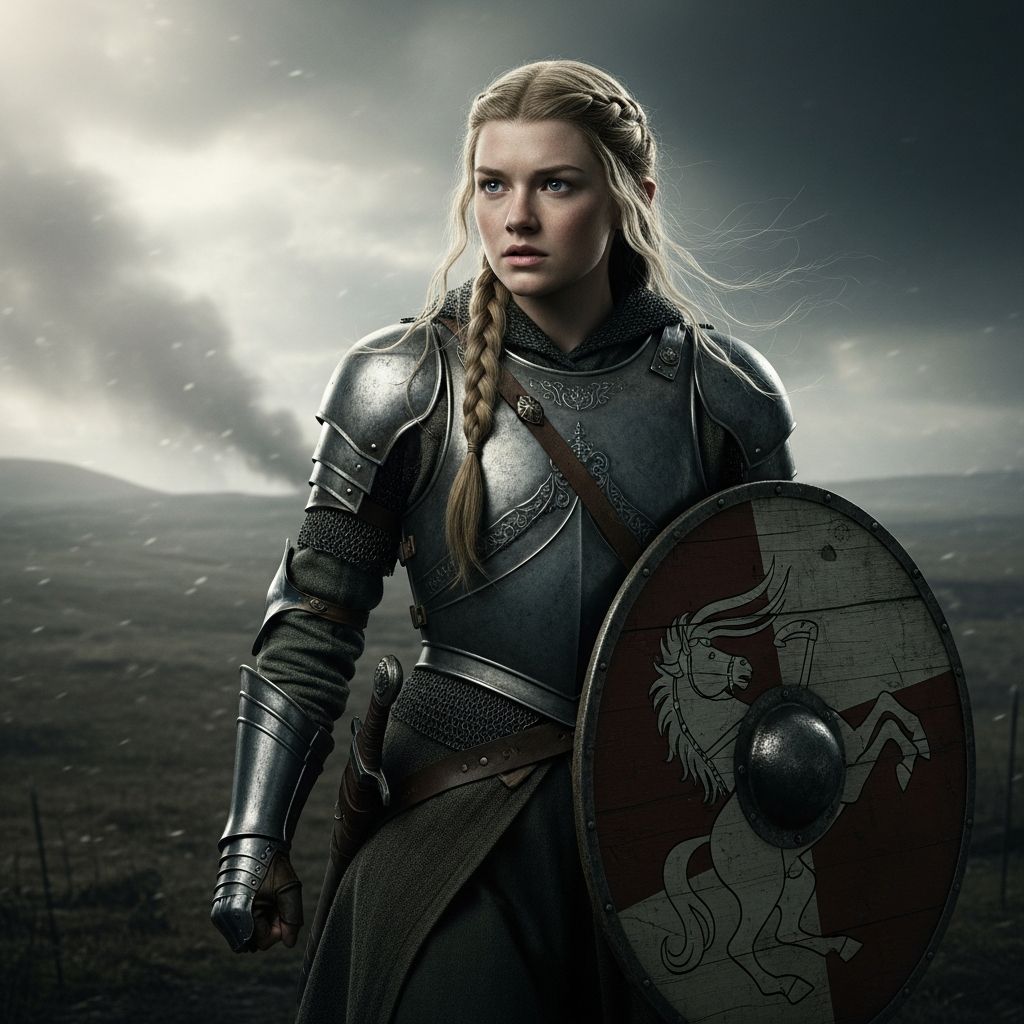
The Unseen War Within: Éowyn’s Inner Conflict
In the sweeping tapestry of Middle-earth, few characters carry the weight of personal struggle as profoundly as Éowyn of Rohan. While the War of the Ring unfolds across vast battlefields and ancient kingdoms, Éowyn wages a quieter, more intimate war—one fought not with sword and shield alone, but with identity, longing, and the ache of being unseen. Her story is not simply that of a woman who disguises herself as a warrior; it is the story of a soul trapped between duty and desire, between the role she is expected to play and the person she knows herself to be.
From the moment we meet her in Meduseld, the golden hall of Edoras, Éowyn is already defined by absence. Her father is gone, her mother long dead, and her uncle, King Théoden, is slowly being consumed by the shadow of Saruman’s influence. In this environment, Éowyn is given a role: the noblewoman who tends the hearth, who waits, who serves. She is praised for her beauty and grace, but these are not the qualities she values most. What she craves is action, purpose, the chance to stand where the men stand and fight where the men fight.
This tension is not merely about gender roles; it is about agency. Éowyn is not asking to be treated as a man, but to be allowed to act as a person with will, courage, and skill. When she declares, “I am of the House of Eorl and not a serving-woman,” she is not rejecting her femininity, but rejecting the idea that her value is limited to domestic service. Her frustration is not with men, but with a system that refuses to see her full self.
Defiance as a Form of Truth
Éowyn’s decision to ride to war disguised as Dernhelm is often framed as an act of rebellion, and rightly so. But it is more than that: it is an act of self-assertion. In a world where women are expected to remain behind, she chooses to step forward. In a culture that equates honor with male martial prowess, she claims that honor for herself. Her disguise is not deception for its own sake; it is the only way the world will allow her to be seen as a warrior.
Her defiance is not reckless. She is not a novice; she has trained, she has skill, and she has the courage to face what others fear. When she rides into the Pelennor Fields, she is not seeking glory for its own sake, but meaning. She is not fleeing from her duties in Edoras; she is fleeing from a life that offers her no real duty at all. To be left behind while the men ride to war is, in her eyes, to be erased.
Her famous confrontation with the Witch-king of Angmar is the culmination of this inner journey. When she removes her helmet and reveals herself as a woman, she is not just defeating an enemy; she is reclaiming her identity. “But no living man am I!” is not only a tactical surprise; it is a declaration that the world’s categories—man, woman, warrior, healer—are not absolute. She is both woman and warrior, and in that moment, she transcends the limitations others have placed on her.
The Cost of Courage: Trauma and the Shadow of Despair
Victory on the battlefield does not erase the wounds within. After the fall of the Witch-king, Éowyn is gravely injured, not only in body but in spirit. Tolkien makes it clear that she was pitted against a foe beyond the strength of her mind or body, and that only by being “sterner than steel” could she endure the shock. This is not just a description of physical danger; it is a recognition of psychological trauma.
Éowyn’s courage is born of despair as much as of hope. She rides to war not only to fight evil, but to escape a life that feels like slow death. When she says she does not fear pain or death, she is not merely being brave; she is expressing a deep weariness with a world that offers her no place of true belonging. Her desire for death in battle is not suicidal in the modern clinical sense, but it is a cry of a soul that sees no future worth living for.
Her injury in Minas Tirith is thus symbolic as well as literal. The Shadow that has haunted her—both the external darkness of Mordor and the internal darkness of isolation and unfulfilled longing—has left its mark. Healing her body is only the first step; healing her heart is the greater task.
From Shieldmaiden to Healer: A Quiet Revolution
One of the most powerful moments in Éowyn’s arc comes not in battle, but in the quiet aftermath. Standing in Minas Anor, the Tower of the Sun, she declares that the Shadow has departed and that she will be a shieldmaiden no longer. She will not vie with the great Riders, nor take joy only in the songs of slaying. Instead, she will be a healer, and she will love all things that grow.
This transformation is not a rejection of her past, but a deepening of it. She does not say she was wrong to fight; she says she is ready for something different. The warrior and the healer are not opposites; they are two expressions of the same courage. Where once she fought to be seen, now she chooses to serve in a way that allows others to be seen, to be cared for, to live.
Her choice to become a healer is not a retreat into traditional femininity, but a redefinition of strength. In a culture that values martial prowess above all, choosing to nurture life rather than take it is a radical act. It is a recognition that true power is not only in the ability to destroy, but in the ability to restore.
Love, Longing, and the Redefinition of Devotion
Éowyn’s feelings for Aragorn are often misunderstood. They are not merely romantic infatuation, but a complex mix of admiration, idealization, and the search for a father figure, a king, a savior. Aragorn represents everything she has been denied: purpose, honor, the ability to act decisively in the world. In loving him, she is also loving the life she wishes she could live.
When Aragorn gently tells her that he cannot return her love in the way she hopes, it is not a rejection of her worth, but a recognition of her need to find her own path. Her eventual love for Faramir is not a consolation prize; it is the fruit of her own growth. Faramir, like her, is a wounded warrior, a man who has faced the Shadow and survived. Their bond is not based on fantasy or idealization, but on shared experience, mutual respect, and the quiet understanding of those who have walked through darkness.
In choosing Faramir, Éowyn is not abandoning her independence; she is integrating it into a new kind of relationship. She does not become his shadow; she becomes his equal, his partner in healing and rebuilding. Their love is not a fairy-tale ending, but a hard-won peace, earned through suffering and self-discovery.
Éowyn’s Legacy: A Model of Integrated Strength
Éowyn’s journey offers a powerful model of what it means to be strong in a complex world. She is not strong because she denies her emotions, but because she faces them. She is not strong because she rejects vulnerability, but because she moves through it. Her strength is not in never needing help, but in being willing to accept it when it is offered.
In literature and in life, female characters are often forced into narrow archetypes: the nurturing mother, the cold warrior, the tragic lover. Éowyn refuses to be confined to any single box. She is warrior and healer, noblewoman and common soldier, lover and independent woman. Her story shows that strength is not a single trait, but a spectrum of choices made in the face of limitation and loss.
Her legacy is not just in the defeat of the Witch-king, but in the quiet revolution she embodies: the idea that true courage includes the willingness to change, to heal, and to love in new ways.
Éowyn in the Broader World of Middle-earth
Within the larger narrative of The Lord of the Rings, Éowyn stands out not only for her actions, but for her thematic significance. While characters like Aragorn, Gandalf, and Frodo represent different aspects of leadership, wisdom, and sacrifice, Éowyn represents the struggle for self-definition in a world that resists change.
Her story parallels that of other characters who are constrained by their roles: Faramir, who must live in the shadow of his brother; Sam, who must rise from servant to hero; and even Aragorn, who must claim a kingship he has long denied. But Éowyn’s struggle is unique in that it is shaped by gender, by the expectations placed on her as a woman in a patriarchal society.
Yet Tolkien does not present her as an isolated exception. Her courage inspires others; her defiance opens doors that were previously closed. In her, we see the possibility of a world where roles are not fixed, where people are valued not for what they are supposed to be, but for who they truly are.
Key Themes in Éowyn’s Journey
- Agency and Identity: Éowyn’s central struggle is for the right to define herself, not be defined by others.
- Defiance and Duty: She challenges traditional roles not out of rebellion for its own sake, but out of a deep sense of duty to her people and her own values.
- Trauma and Healing: Her journey includes both physical and emotional wounds, and her ultimate strength lies in her ability to heal and grow.
- Love and Self-Discovery: Her relationships are not just romantic, but mirrors of her inner development and changing understanding of herself.
- Transformation of Strength: She moves from a model of strength as combat to a model of strength as care, showing that power can be expressed in many forms.
Éowyn’s Journey in Context: A Comparative Table
| Stage | Internal State | External Role | Key Moment |
|---|---|---|---|
| Edoras | Trapped, despairing, longing for purpose | Noblewoman, caretaker, constrained by gender roles | “I can ride and wield blade, and I do not fear either pain or death.” |
| Pelennor Fields | Defiant, courageous, driven by a mix of hope and despair | Shieldmaiden Dernhelm, warrior in disguise | “But no living man am I! You look upon a woman.” |
| Minas Tirith (after battle) | Wounded, disillusioned, beginning to question her path | Injured warrior, patient, beginning to heal | “I will be a shieldmaiden no longer.” |
| Minas Anor (after healing) | Peaceful, self-aware, embracing a new purpose | Healer, partner to Faramir, builder of a new life | “I will be a healer, and love all things that grow.” |
Frequently Asked Questions
Why does Éowyn disguise herself as a man to go to war?
Éowyn disguises herself because the culture of Rohan does not allow women to fight in open battle. By taking the name Dernhelm and hiding her identity, she creates a space where her skills and courage can be recognized, even if only temporarily. It is less about becoming a man and more about being allowed to act as a warrior.
Does Éowyn’s love for Aragorn make her weak?
No. Her feelings for Aragorn are complex and rooted in admiration, idealization, and a desire for a life of purpose. Her eventual ability to let go of that love and open herself to Faramir is a sign of strength and growth, not weakness.
Is Éowyn’s decision to stop being a warrior a step backward?
Not at all. Her choice to become a healer is a transformation, not a retreat. It reflects her growth from seeking validation through combat to finding fulfillment in nurturing life. It is a different expression of the same courage.
How does Éowyn compare to other female characters in Tolkien’s work?
Éowyn is one of the most fully developed female characters in The Lord of the Rings. Unlike Galadriel or Arwen, who are powerful but often distant, Éowyn is deeply human, with flaws, desires, and a clear arc of change. Her journey is more grounded in personal struggle and emotional realism.
What does Éowyn’s story teach us about strength and identity?
Éowyn’s story teaches that strength is not a single trait, but a journey. It includes defiance, courage, vulnerability, healing, and the willingness to change. True strength lies in knowing oneself, claiming one’s agency, and choosing a path that aligns with one’s deepest values.
References
- The Return of the King — J.R.R. Tolkien. George Allen & Unwin, 1955.
- The Two Towers — J.R.R. Tolkien. George Allen & Unwin, 1954.
- The Lord of the Rings: A Reader’s Companion — Wayne G. Hammond and Christina Scull. HarperCollins, 2005.

Medha Deb is an editor with a master's degree in Applied Linguistics from the University of Hyderabad. She believes that her qualification has helped her develop a deep understanding of language and its application in various contexts. Medha specializes in the areas of beauty, health, sports, and wellness and is committed to ensuring that the content on the website is…