
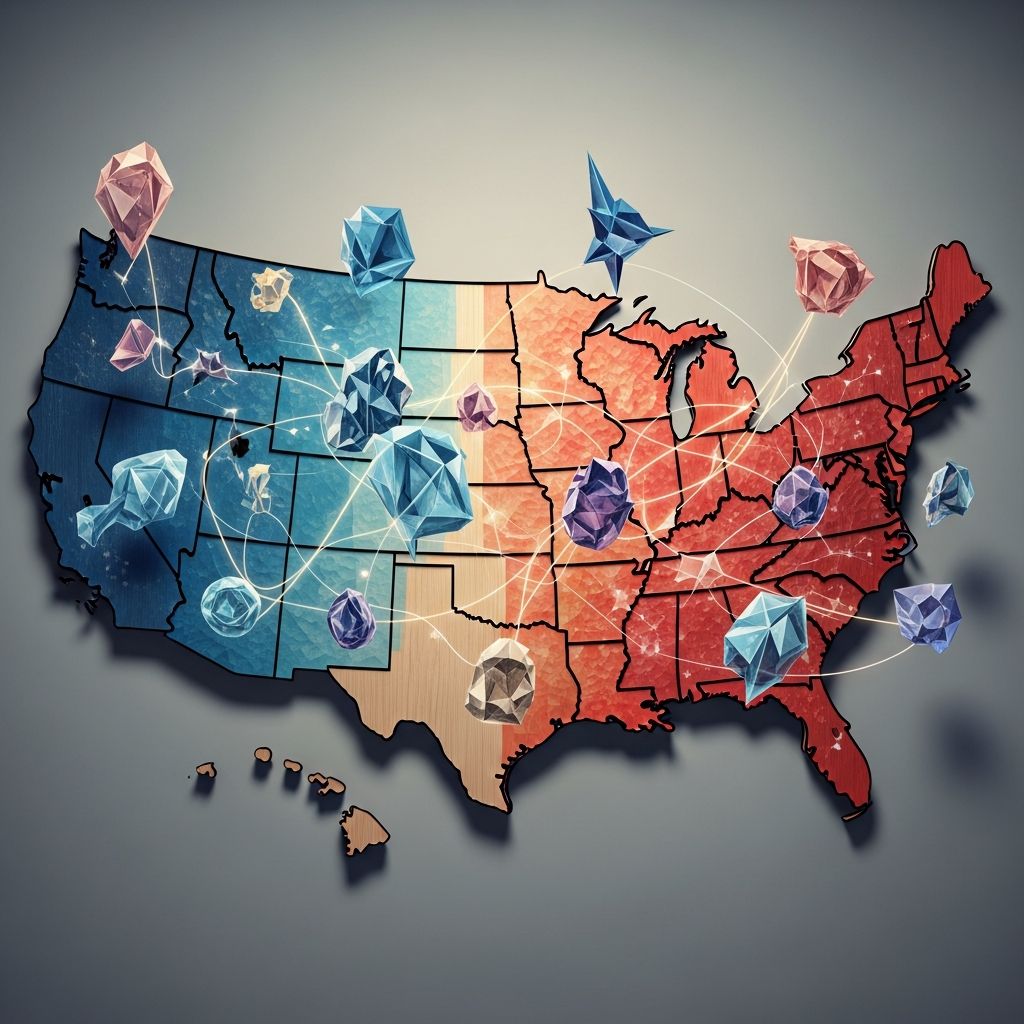
Americans often talk about politics as if everything comes down to facts, values, or interests. Yet behind the issues and slogans, people bring something quieter but powerful into the voting booth: their underlying personality. Research in political psychology suggests that long-term patterns of thinking, feeling, and behaving help steer citizens toward different parties, priorities, and political styles.
This article explores how broad personality tendencies interact with the major U.S. political parties. It does not claim that personality determines party identity, but that it helps explain why some people find one party's message intuitively comfortable while others gravitate elsewhere.
Why Personality Matters in Politics
Personality traits are relatively stable dispositions—like being more cautious or adventurous—that shape how people see the world, handle risk, and relate to others. Modern research often organizes these traits into the well-known Big Five framework: openness to experience, conscientiousness, extraversion, agreeableness, and neuroticism.
Studies consistently find links between these traits and political attitudes:
- People higher in openness to experience tend to support social change and liberal positions.
- People higher in conscientiousness are more likely to favor order, tradition, and conservative parties.
- Differences in agreeableness and extraversion also relate to preferences for cooperation, conflict, and civic engagement.
At the same time, personality and ideology remain distinct: most of the variation in each is unique, and personality does not simply cause political beliefs. Instead, personality seems to nudge people toward certain ideological "homes" and styles of political engagement that feel psychologically congruent.
Two Major Parties, Many Psychological Niches
The United States is frequently described as a two-party system, yet each party is more like a loose coalition of psychological niches. Within both Democrats and Republicans, people vary in how strongly they identify with the party, how open they are to compromise, and what issues matter most.
Still, some broad patterns emerge when you combine research on traits, values, and self-descriptions:
- Conservative Republicans are more likely to describe themselves as respectful of authority and traditional, and they are less likely than liberal Democrats to emphasize being open-minded as a core identity.
- Liberal Democrats are more likely to describe themselves as open-minded and accepting of different lifestyles, often expressing greater comfort with social change.
Those self-descriptions mirror longstanding findings: conservatism correlates with preferences for order, stability, and predictability, while liberalism correlates with curiosity, tolerance of ambiguity, and openness to new experiences.
Core Trait Patterns Behind Party Pull
To understand the "emotional texture" of each party, it is helpful to look at how common personality dimensions align with broad ideological tendencies.
Openness to Experience: Curiosity vs. Familiarity
Openness to experience involves enjoying novelty, abstract ideas, art, and unconventional perspectives. People high in openness are often intellectually curious and comfortable with ambiguity.
Research consistently links higher openness to:
- More liberal social attitudes
- Support for diversity and multiculturalism
- Greater willingness to question tradition and authority
In the U.S. context, this often translates into a stronger pull toward liberal wings of the Democratic Party, which emphasize experimentation, inclusion, and social change.
Conscientiousness: Order, Duty, and Structure
Conscientiousness reflects organization, self-discipline, and preference for clear rules and stable routines. Highly conscientious people tend to value reliability and long-term planning.
Studies find that higher conscientiousness predicts:
- More socially and economically conservative views
- Greater emphasis on law, order, and personal responsibility
- Comfort with hierarchy and established norms
These traits align with messages commonly emphasized by the Republican Party, especially around tradition, security, and respect for authority.
Extraversion and the Social Side of Politics
Extraversion involves sociability, energy, and enjoyment of being around others. Political researchers have found that extraversion is associated with greater participation in political activities such as attending rallies or contacting officials.
Extraverts can be found across the spectrum, but they may differ in style:
- More liberal extraverts might gravitate toward activist networks, protests, and public advocacy.
- More conservative extraverts might focus on community groups, religious organizations, or local party structures.
In both major parties, highly extraverted members are often the ones knocking on doors, running for office, or organizing events.
Agreeableness: Cooperation vs. Confrontation
Agreeableness reflects empathy, cooperation, and concern for others' well-being. More agreeable individuals often favor compromise and social harmony.
In U.S. politics, higher agreeableness is often associated with:
- Support for welfare policies and social safety nets
- More prosocial views about government's role in helping vulnerable groups
These tendencies fit somewhat more easily with left-of-center economic views, though agreeable conservatives may emphasize charity, community, and moral duty from a different ideological frame.
How Personality Shapes Party Experience
Personality does not only affect which party someone chooses; it also influences what they notice, celebrate, or find frustrating within their chosen party.
| Trait emphasis | Party attraction (tendency, not rule) | Typical satisfactions | Potential frustrations |
|---|---|---|---|
| High openness | Progressive Democrats | Innovation, diversity, policy experimentation | Slow change, compromise with status quo |
| High conscientiousness | Conservative Republicans | Clear rules, emphasis on order and tradition | Perceived inconsistency or pragmatism over principle |
| High agreeableness | Varies; often center-left economics | Cooperative problem-solving, focus on human impact | Partisan conflict, harsh rhetoric |
| High extraversion | Active across both parties | Community, events, campaigns, leadership roles | Bureaucratic delays, behind-the-scenes complexity |
This table sketches broad tendencies. Any individual can diverge from the pattern, but the patterns help explain why the same party can feel energizing to some and alienating to others.
Psychological Comfort Zones in U.S. Parties
Beyond trait scores, parties offer different "psychological comfort zones"—that is, environments that feel emotionally congruent. Political psychologists note that people often seek ideological worlds that affirm their deeper motivations and needs for certainty, security, or self-expression.
Seeking Certainty and Structure
Some people are especially bothered by ambiguity and rapid change. Studies have linked conservative orientations to higher needs for order, closure, and stability, as well as greater sensitivity to threat or loss.
For such individuals, political messages emphasizing:
- Strong borders and security
- Respect for authority and tradition
- Clear moral standards
often feel reassuring. These themes are more associated with the Republican Party, which can serve as a psychological anchor for citizens who value predictability.
Seeking Change and Exploration
Other citizens are energized by novelty and experimentation. They may see social change as an opportunity rather than a threat and feel at ease with complexity and mixed outcomes.
They are often drawn to political messages that emphasize:
- Reform and innovation
- Inclusion of marginalized groups
- Flexibility in traditions and norms
Those themes tend to be more visible in the Democratic Party, especially among its more progressive factions.
Intra-Party Diversity: Different Types Under the Same Banner
Even within a single party, personality diversity can be striking. Consider a few stylized psychological profiles that may coexist inside each party's tent.
Inside the Democratic Coalition
- The visionary idealist
High in openness and often more introverted, this type cares deeply about big-picture reforms and is willing to accept short-term disruption for long-term change. - The pragmatic organizer
Moderate in openness and high in conscientiousness and agreeableness, this type prefers realistic steps, coalition-building, and incremental policy gains. - The activist communicator
Higher in extraversion, this type thrives on campaigning, public speaking, and mobilizing others.
Inside the Republican Coalition
- The principled traditionalist
High in conscientiousness and respect for authority, this type values stability, inherited institutions, and clear moral boundaries. - The free-market individualist
Often high in self-reliance and sometimes lower in agreeableness regarding economic issues, this type stresses autonomy, competition, and limited government. - The community guardian
Strong local ties and moderate agreeableness characterize this type, who focuses on protecting family, neighborhood, and cultural continuity.
These are broad sketches, not strict categories, but they show how people with different psychological strengths can still share a party label while prioritizing different goals and strategies.
Beyond Partisanship: Personality and Political Engagement
Personality does more than shape party preference; it also influences how people engage with politics.
- High extraversion predicts greater likelihood of joining campaigns, volunteering, or running for office.
- High conscientiousness is associated with voting reliability and consistent political participation.
- High openness can fuel interest in complex policy debates, alternative media, and new political movements.
Research on local politicians suggests that elected officials often have above-average levels of cognitive skills and certain noncognitive traits—such as extraversion and conscientiousness—that help them navigate demanding roles and public scrutiny.
Limitations and Misconceptions
It is tempting to use personality frameworks to put people in boxes, but such simplifications are misleading and can be harmful in a polarized environment.
- No trait "belongs" to any party. Liberals can be highly conscientious; conservatives can be highly open. Context, upbringing, and life experiences matter.
- Personality is not destiny. Even when traits correlate with ideology, the majority of variation remains unexplained, and individuals can and do change their political views over time.
- Values, identity, and information also powerfully shape political choices, sometimes overriding trait tendencies.
Understanding personality–politics links is most useful not for prediction, but for empathy: it highlights that political opponents may literally experience the same social changes as more threatening or more hopeful based on deeper psychological preferences.
Frequently Asked Questions (FAQs)
Q: Does my personality type decide whether I am a Democrat or a Republican?
A: No. Personality can influence what kinds of messages or policy priorities feel intuitively appealing, but party identification also depends on family background, social networks, media habits, and concrete life experiences. Research suggests personality and ideology are related yet distinct, and most of the variance in political attitudes is not explained by traits alone.
Q: Can two people with very similar personalities end up in different parties?
A: Yes. Even individuals who share similar trait profiles can diverge politically because of religion, regional culture, education, race, income, or simply which issues they consider most important. Traits nudge people toward certain preferences, but they do not dictate a single political outcome.
Q: Are conservatives less open-minded and liberals less conscientious by definition?
A: No. On average, studies find that conservatives score somewhat higher in conscientiousness and lower in openness than liberals, but these are statistical trends, not rules that apply to every person. There are many conscientious liberals and many intellectually curious conservatives.
Q: Do political parties deliberately target personality traits?
A: Parties and campaigns increasingly use data and psychological insights to tailor messages, but much of the alignment between traits and parties has developed historically. Parties evolved to represent coalitions of interests and values; over time, those coalitions attracted citizens whose personalities made those values feel particularly comfortable.
Q: Can understanding personality reduce political polarization?
A: It cannot solve structural conflicts, but it can soften personal hostility. Recognizing that political opponents may be driven by different needs for security, change, or belonging—not simply ignorance or bad faith—can make dialogue more respectful and productive.
References
- The Relationship between Personality Traits and Political Ideologies — Verhulst, B., Hatemi, P. K., & Martin, N. G. 2012-10-25. https://www.ncbi.nlm.nih.gov/pmc/articles/PMC3809096/
- The Big Five Personality Traits in the Political Arena — Gerber, A. S., Huber, G. A., Doherty, D., & Dowling, C. M. Annual Review of Political Science, 2011. https://www.annualreviews.org/doi/10.1146/annurev-polisci-051010-111659
- Politics is personal — Azar, B. American Psychological Association Monitor, 2019-11. https://www.apa.org/monitor/2019/11/cover-politics
- Big Five Personality Traits and Political Orientation — Crivello, J. Cleveland State University, 2019. https://engagedscholarship.csuohio.edu/tdr/vol5/iss1/2/
- From “traditional” to “open-minded”: How Americans describe themselves — Pew Research Center, 2024-08-29. https://www.pewresearch.org/short-reads/2024/08/29/from-traditional-to-open-minded-how-americans-describe-themselves/
- Personality Traits and Cognitive Ability in Political Selection — Dal Bó, E., Finan, F., Folke, O., Persson, T., & Rickne, J. Journal of the European Economic Association, 2025. https://academic.oup.com/jeea/article/23/5/1908/8029910

- Integrated M.A. in Applied Linguistics, University of Hyderabad
- 5+ years in editorial, instructional, SEO, and research-based writing
Sneha is a relationships and lifestyle writer with a strong foundation in applied linguistics and certified training in relationship coaching. She brings over five years of writing experience to theskillvault, crafting thoughtful, research-driven content that empowers readers to build healthier relationships, boost emotional well-being, and embrace holistic living. Her writing and insights reflect the belief that beauty, happiness, and wellness…