
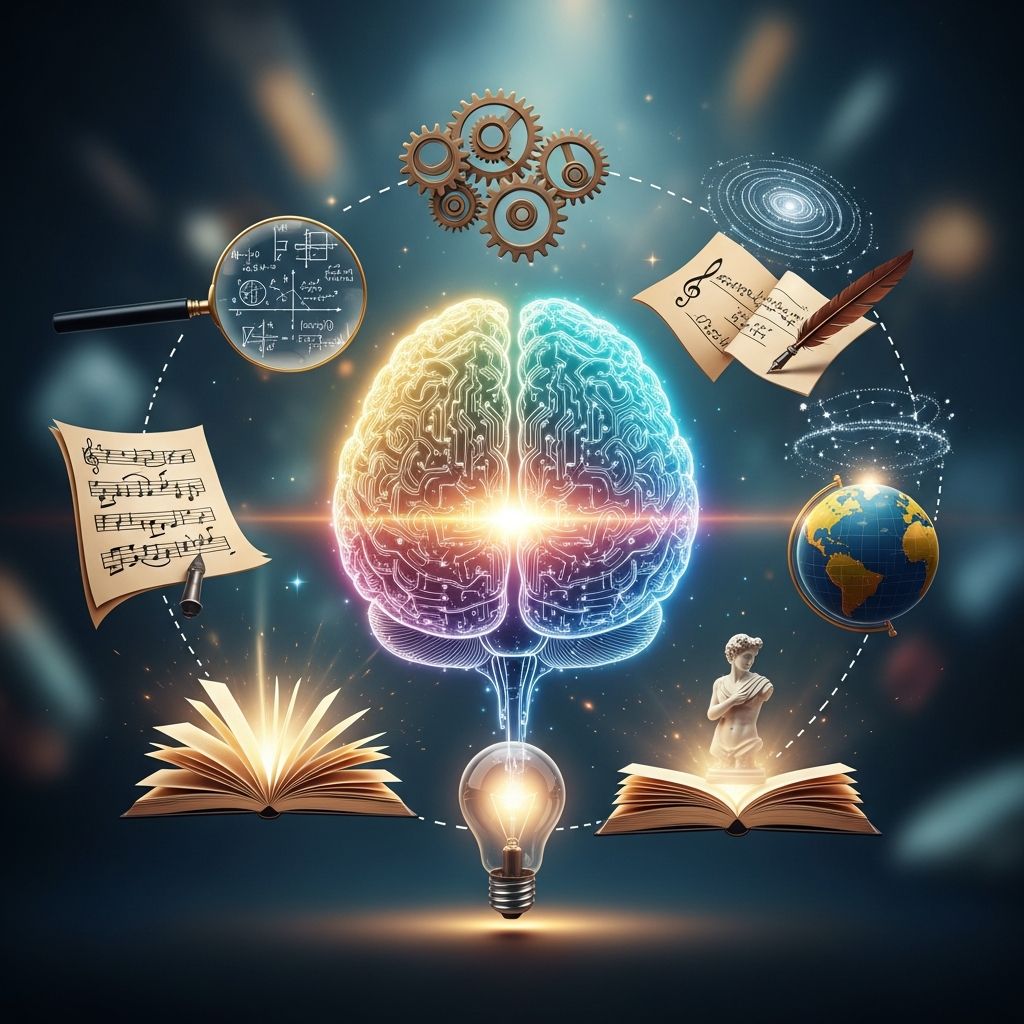
Beyond Intelligence: Redefining What Genius Really Means
When we think of genius, our minds often conjure images of isolated brilliance—a solitary figure hunched over calculations or lost in creative reverie. Yet the reality of genius is far more nuanced and multifaceted than popular culture suggests. True genius extends well beyond raw intellectual capacity or academic achievement; it encompasses a distinctive constellation of behavioral patterns, cognitive preferences, and personality characteristics that work in concert to produce exceptional achievement and innovation.
Genius is not simply a measure of IQ or cognitive ability, though intelligence certainly plays a role. Instead, it represents a unique combination of psychological traits that enables individuals to perceive the world differently, approach challenges unconventionally, and persist in pursuit of ambitious visions despite significant obstacles. Understanding what genius actually looks like requires moving beyond stereotypes and examining the real-world behaviors and characteristics that distinguish genuinely exceptional minds.
The Architectural Foundation of Exceptional Thinking
At the core of genius lies a fundamentally different approach to processing information and engaging with problems. Brilliant minds are characterized by their capacity to think in multiple dimensions simultaneously, holding complex abstract concepts while synthesizing connections that others might overlook. This is not merely about thinking faster; it is about thinking differently—approaching challenges from unconventional angles that reveal previously invisible solutions.
One of the most striking features of genius-level thinking is the ability to reject conventional wisdom and question established norms. Where most people accept information at face value, accepting the explanations and frameworks provided by their predecessors, genuinely exceptional minds feel compelled to examine these assumptions critically. They ask probing questions that others might consider unnecessary or even presumptuous, driven by an intrinsic need to understand not just what something is, but why it is that way and whether it could be otherwise.
This characteristic thinking pattern often manifests as abstract reasoning—the capacity to work with ideas, theories, and concepts that exist beyond concrete, immediately observable reality. Rather than being confined to practical applications and immediate utility, brilliant minds gravitate toward exploring theoretical frameworks, creating models, and testing the boundaries of established knowledge systems. This allows them to make novel connections and conceive of possibilities that more conventional thinkers might never consider.
The Role of Relentless Curiosity
Perhaps no trait is more universally associated with genius than an consuming, almost insatiable curiosity. True geniuses possess what can only be described as an unquenchable thirst for knowledge—not knowledge for its own sake necessarily, but knowledge as a means of understanding and solving problems that captivate their imagination.
This curiosity manifests differently than ordinary interest. While most people develop passing interests in various subjects, the genius-level mind approaches learning with an urgency and intensity that borders on obsession. These individuals pursue knowledge in domains that fascinate them with a fervor that may seem unreasonable to outside observers. They remain perpetually restless, constantly seeking answers, probing deeper into subjects, and pursuing novel ideas with almost compulsive dedication.
Interestingly, this curiosity is not limited to any particular domain. Brilliant minds can emerge in any field—from the sciences and mathematics to music, art, writing, and beyond. What unites them across these diverse domains is this underlying drive to understand, to question, and to push beyond existing boundaries of knowledge. As the legendary physicist Albert Einstein famously noted, “I have no special talents; I am only passionately curious.”
Singular Focus and Immersive Engagement
Perhaps one of the most defining and often misunderstood characteristics of genius is the capacity for extraordinary focus—what modern psychology sometimes calls hyperfocus. This is not the ordinary concentration that allows someone to study for an exam or complete a work assignment. Rather, it represents a profound, almost all-consuming immersion in a task or problem that captures the genius’s attention.
When a brilliant mind becomes absorbed in a pursuit aligned with their passions and capabilities, they can achieve states of complete engagement that conventional minds rarely experience. They become so fully absorbed in their work that external concerns—hunger, fatigue, social obligations, even basic self-care—recede into insignificance. This ability to enter what psychologists call “flow”—a state of complete timelessness and oneness with the work at hand—represents a powerful advantage in achieving creative breakthroughs and technical mastery.
This intense focus is often accompanied by an apparent disregard for efficiency in other areas. A genius might be extraordinarily productive in their domain of passion while simultaneously appearing disorganized, forgetful, or scattered in routine matters. They often prioritize depth over breadth, choosing to dig deeper into subjects that fascinate them rather than maintaining broad but shallow knowledge across multiple domains.
The Courage to Challenge and Risk
Genius inevitably requires a willingness to take intellectual and creative risks—to propose ideas that others might dismiss, to pursue directions that conventional wisdom suggests are unlikely to succeed, to challenge the status quo when doing so invites criticism and rejection. Brilliant minds are rarely motivated primarily by a desire for approval or social validation. Instead, they are driven by their internal convictions about what is possible and what is worth pursuing.
This manifests as a kind of intellectual courage—the ability to maintain belief in a vision or direction even when others doubt, criticize, or actively oppose the effort. Geniuses are willing to embrace failure as a learning opportunity rather than as a definitive judgment on their worthiness or capability. They understand that the path to genuine innovation and breakthrough involves attempting things that might not work, and they treat failures as information rather than defeats.
This risk-taking is not reckless; rather, it is grounded in a deep confidence in one’s ability to solve problems and overcome obstacles. Genius-level individuals possess what might be called visionary belief—a conviction that if they can imagine something, they possess within themselves the capability and determination to make it real, regardless of how long it might take or what obstacles might arise.
Memory as a Foundation for Connection-Making
An often-overlooked but genuinely significant characteristic of genius is an exceptional capacity to store, organize, and retrieve large amounts of information. This is not mere memorization in the conventional sense—the rote repetition of facts. Rather, it represents a sophisticated capacity to maintain vast networks of knowledge while making meaningful connections between disparate pieces of information.
This powerful recall capacity enables brilliant minds to draw upon deep reservoirs of existing knowledge when approaching new problems, allowing them to recognize patterns, apply insights from one domain to another, and build upon the cumulative work of those who came before. The more information a genius accumulates, the more neural connections they develop, enabling increasingly sophisticated synthesis and creative combination of ideas.
Interestingly, this exceptional memory in their primary domain of expertise sometimes contrasts sharply with ordinary or even below-average memory for routine matters unrelated to their passions. A genius might forget a social appointment or fail to remember mundane details but can instantly recall obscure scientific findings or historical details relevant to their work.
Mental Stillness and Creative Spaciousness
Contrary to the popular image of the frantically working genius, many of the world’s most brilliant minds have emphasized the importance of what might be called creative emptiness—deliberate periods of disengagement from active work. Figures ranging from Mozart to Leonardo da Vinci recognized that genuine creative breakthroughs often emerge from periods of apparent inactivity, when the mind is allowed to wander freely without the constraint of purposeful work.
This contemplative dimension of genius suggests that brilliant minds benefit from—and indeed seem to require—time to process, integrate, and allow unconscious mental processes to work on problems. During these periods of relative mental stillness, creative insights often emerge, and new connections form between previously disparate ideas. This stands in interesting contrast to the intense hyperfocus that brilliant minds also display, suggesting that genius involves a rhythm between periods of immersive engagement and periods of spacious reflection.
Psychological Characteristics: Autonomy and Endurance
Beyond the cognitive and behavioral dimensions, genuinely brilliant individuals share certain psychological characteristics that enable their exceptional achievements. Autonomy—the capacity to work independently, to trust one’s own judgment, and to express divergent or novel perspectives without requiring external validation—is particularly important. Geniuses often work on problems that others don’t recognize as problems, pursuing questions that conventional wisdom might dismiss as unimportant or unresolvable.
Equally crucial is endurance—a capacity for sustained effort over extended periods. The path from initial insight to realized achievement typically involves lengthy periods of persistent work, encountering and overcoming obstacles, and maintaining commitment even when progress seems stalled. This capacity to persist through challenges, to maintain focus despite setbacks, and to follow through on ambitious visions distinguishes genius-level achievement from fleeting brilliance.
Adaptability in Unfamiliar Territory
While genius often involves deep specialization and singular focus, it equally requires considerable cognitive flexibility. Brilliant minds can adjust their approach when circumstances change, learn rapidly in unfamiliar domains, and modify their thinking in response to new information or unexpected obstacles. This mental flexibility allows them to navigate unpredictable situations and complex environments while maintaining progress toward their goals.
This adaptability reflects a broader intellectual openness—a willingness to revise thinking, abandon approaches that aren’t working, and explore alternative pathways. While geniuses hold strong convictions about their visions and goals, they remain pragmatic about the methods and approaches required to achieve them, adjusting tactics while maintaining strategic commitment to larger objectives.
Intensity, Passion, and Extraordinary Commitment
Finally, genius seems invariably accompanied by a kind of psychological intensity—a passionate commitment to achievement and excellence that goes beyond what most people experience. Brilliant minds often set extraordinarily high expectations for themselves and, sometimes, for those around them. They channel dynamic energy into shaping their futures and pursuing their goals with uncompromising dedication.
This passion frequently manifests as impatience with inefficiency or mediocrity—in themselves and sometimes in others. A genius might appear frustrated or dismissive when encountering approaches that seem unnecessarily cumbersome or solutions that fail to meet their standards of excellence. This intensity is often accompanied by a strong work ethic and willingness to invest whatever effort their pursuits demand, rarely making excuses for setbacks and instead viewing obstacles as challenges to overcome rather than reasons to abandon effort.
The Multiple Faces of Brilliance
It’s important to recognize that genius is not monolithic. Brilliant individuals manifest their exceptional abilities across diverse domains—some through mathematical-logical thinking, others through linguistic ability, artistic expression, musical talent, interpersonal leadership, intrapersonal insight, kinesthetic mastery, or naturalistic observation. The underlying characteristics—curiosity, focus, risk-taking, memory, adaptability, and passionate commitment—remain relatively consistent, but they express themselves distinctly depending on the individual’s domain of excellence.
Frequently Asked Questions
Q: Are all geniuses introverted?
A: No. While some geniuses are quiet introverts who focus intensely on internal mental processes, others are extroverted and thrive on collaboration and social engagement. Introversion and extroversion represent different personality orientations, not measures of intellectual capability or genius-level achievement.
Q: Can genius be developed, or is it purely innate?
A: Genius likely involves both inherited capacities and developed skills. While individuals may be born with particular aptitudes or cognitive strengths, the behaviors and characteristics of genius—curiosity, focus, persistence, creative thinking—can be cultivated and strengthened through deliberate practice and environmental support.
Q: Do geniuses typically excel in school?
A: Not necessarily. Traditional educational systems sometimes constrain rather than nurture genius, as they emphasize conformity, established knowledge, and standardized approaches. Many brilliant individuals find formal schooling restrictive or misaligned with their learning styles and passions, and their genius may not become evident until they pursue independent research or creative work.
Q: Is genius the same as high intelligence?
A: While high intelligence is often a component of genius, they are not identical. Genius involves intelligence combined with creativity, focus, passion, and the capacity to produce exceptional work in a particular domain. Someone can be highly intelligent without displaying the distinctive characteristics and achievements associated with genius.
Q: Can someone be a genius in multiple domains?
A: Yes, though it is relatively uncommon. Some individuals display genius-level achievement across multiple fields—for example, Leonardo da Vinci excelled in art, science, engineering, and anatomy. However, the demands of achieving mastery and making significant contributions typically require such concentrated effort that most geniuses focus primarily on a single domain.
References
- How to Spot a Genius – The 10 Behaviours Geniuses Display — The HR Director. https://www.thehrdirector.com/business-news/people-science/spot-genius-10-behaviours-geniuses-display/
- Common Characteristics of a True Genius — Connor Gillivan. https://connorgillivan.com/common-characteristics-of-a-true-genius/
- What are the Characteristics of a Genius? — Oxbridge Home Learning. https://oxbridgehomelearning.uk/blog/characteristics-of-a-genius/
- Genius: Definition, Characteristics & Examples — Britannica. https://www.britannica.com/science/genius-psychology
- The Common Character Trait of Geniuses — Big Think. https://www.youtube.com/watch?v=Ym6whrAw8wU

Medha Deb is an editor with a master's degree in Applied Linguistics from the University of Hyderabad. She believes that her qualification has helped her develop a deep understanding of language and its application in various contexts. Medha specializes in the areas of beauty, health, sports, and wellness and is committed to ensuring that the content on the website is…