
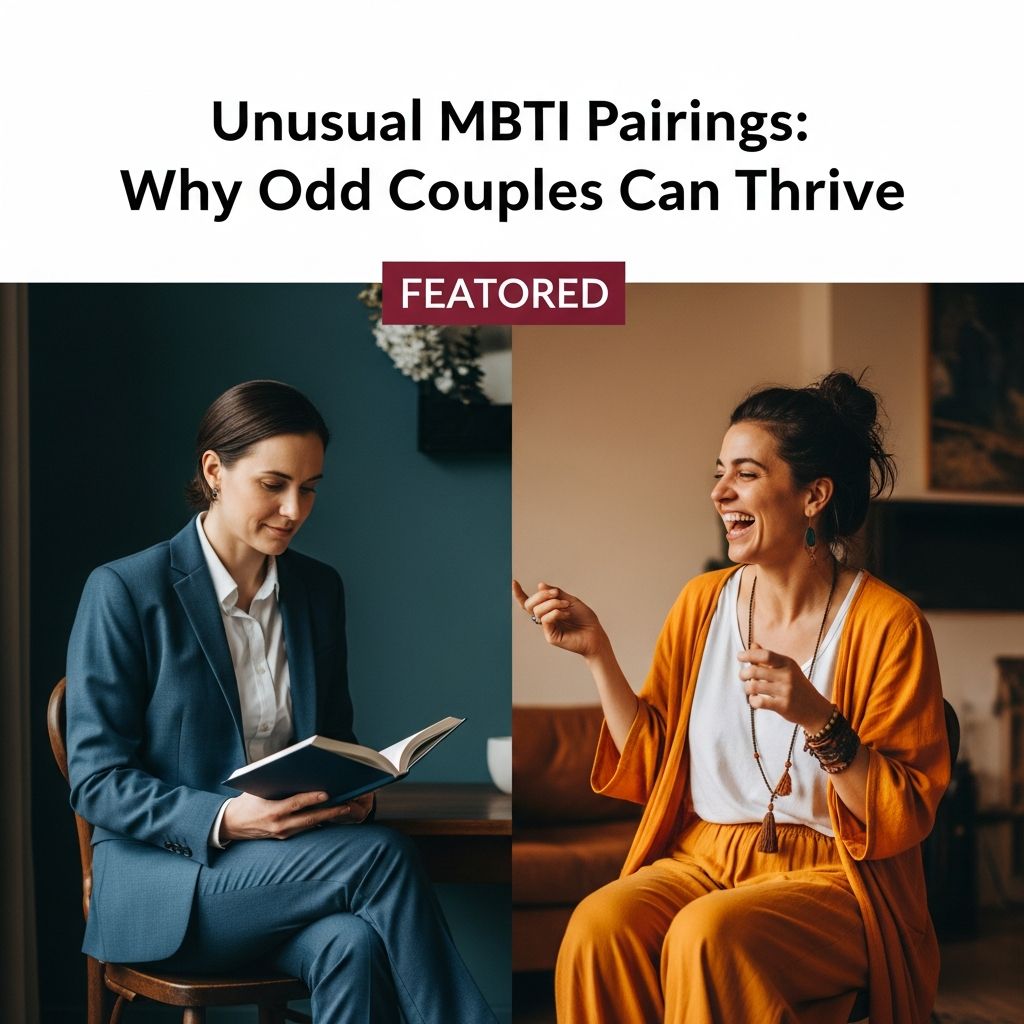
When people first learn about the 16 personality types, it is tempting to ask a single question: “Which type is my perfect match?” Personality theory is often used as a shortcut to judge romantic compatibility, but research and clinical practice show a more complex picture. Some of the most rewarding partnerships are the ones that look “mismatched” on paper yet work beautifully in real life.
This article explores how seemingly strange Myers–Briggs (MBTI-style) combinations can succeed, what patterns make them challenging, and what strategies help two very different people create a healthy relationship.
Personality Compatibility: Beyond “Perfect Matches”
Personality type frameworks like the MBTI describe preferences for energy (introversion/extraversion), information (sensing/intuition), decisions (thinking/feeling), and structure (judging/perceiving). They can clarify how two partners:
- Focus attention and recharge (socially or alone)
- Notice details or big-picture patterns
- Prioritize logic or harmony in decisions
- Prefer planning or spontaneity in daily life
However, experts emphasize that these tools cannot reliably predict relationship success by themselves. Relationship quality is more strongly linked to skills like communication, conflict management, and shared values than to any particular type match.
Why “Odd” Personality Pairings Are So Fascinating
Unusual type pairings grab attention because they break the common belief that partners must be similar to get along. Research on personality and romantic satisfaction suggests that:
- People with more similar traits often report somewhat higher satisfaction, but the effect is modest.
- Couples can still be very satisfied when they differ substantially, as long as they handle differences constructively.
- Opposites can provide balance, covering one another’s blind spots and encouraging growth.
The “weird” pairings in this article illustrate those balancing effects—how one partner’s strength can complement the other’s vulnerability and vice versa.
Core Dimensions That Shape Unusual Couples
When you look at unconventional pairings, four type differences appear again and again:
| Dimension | Contrast in the Couple | Potential Tension | Potential Benefit |
|---|---|---|---|
| Extraversion vs. Introversion | One craves stimulation, the other prefers quiet. | Social schedules, energy drains, alone-time conflicts. | Balanced social life; one draws the other out or slows them down. |
| Sensing vs. Intuition | One focuses on facts, the other on ideas. | Arguments over what is “realistic” versus “inspiring.” | Grounded vision: imagination paired with practicality. |
| Thinking vs. Feeling | One values logic first, the other values people first. | Perceived coldness vs. oversensitivity in conflicts. | Decisions that consider both fairness and empathy. |
| Judging vs. Perceiving | One plans, the other improvises. | Clashes over order, deadlines, and routines. | Flexible structure: enough planning without rigidity. |
Five Kinds of “Weird” MBTI Couples That Can Work
Below are five broad patterns of unusual pairings. They are not limited to specific four-letter codes; instead they describe contrasting preferences that often feel odd at first glance but can become powerful when understood.
1. The Social Meteor and the Quiet Galaxy (E–I Opposites)
In these pairings, one partner is strongly extraverted (energized by people and activity) while the other is strongly introverted (recharged by solitude and reflection). This can apply to many specific type matches, for example ENFP–INFJ, ESTP–ISTJ, or ESFJ–INTP.
Typical friction points:
- Disagreements about how many social events to attend
- One partner feeling drained, the other feeling bored
- Misunderstandings (“Why don’t you want to come? Don’t you care about my friends?”)
Hidden strengths:
- The extravert opens doors to new people, experiences, and opportunities.
- The introvert creates space for deep conversation and emotional processing.
- Together, they can design a rhythm of engagement and retreat that is healthier than either extreme.
How they can make it work:
- Plan a mix of shared outings and planned alone-time so solitude is not misread as rejection.
- Agree in advance on “must-attend” events and which gatherings can be optional.
- Use the introvert’s listening skills and the extravert’s social ease to support one another in stressful situations (family gatherings, work events, etc.).
2. The Dream Architect and the Detail Guardian (N–S Opposites)
Here, an intuitive type (fascinated by patterns, theories, and possibilities) pairs with a sensing type (grounded in concrete facts, present realities, and practical steps). Studies on personality compatibility suggest that sharing this preference often feels comfortable, which makes N–S mixes feel especially “odd” at first.
Typical friction points:
- The intuitive partner feels stifled by “nitpicking details” and routine.
- The sensing partner feels frustrated by “impractical ideas” and constant change.
- Arguments over whether a plan is “realistic” or “too cautious.”
Hidden strengths:
- The intuitive partner provides long-term vision and creative problem-solving.
- The sensing partner ensures stability, reliability, and concrete follow-through.
- Together, they can design plans that are both imaginative and executable.
How they can make it work:
- Translate visions into clear timelines, budgets, and milestones with both partners’ input.
- Honor the intuitive partner’s need for future-focused discussions, while preserving routines that help the sensing partner feel secure.
- Use the intuitive partner’s ability to reframe setbacks and the sensing partner’s memory for what has worked before when facing problems.
3. The Analyst and the Empath (T–F Opposites)
Thinking–Feeling differences are especially visible when couples disagree. Thinkers tend to prioritize objective logic, while Feelers are more attuned to personal values and emotional impact. Relationship research indicates that couples who both lean toward feeling may find it easier to prioritize the relationship, but mixed T–F couples can create an invaluable balance between justice and compassion.
Typical friction points:
- The Feeling partner experiences the Thinker’s feedback as harsh or uncaring.
- The Thinking partner sees the Feeler as “too emotional” or “irrational.”
- Disagreements over parenting, boundaries, or fairness versus mercy.
Hidden strengths:
- The Thinking partner can advocate for clear standards, boundaries, and problem analysis.
- The Feeling partner can protect the emotional climate and maintain connection during conflict.
- Together, they can make decisions that respect both principles and people.
How they can make it work:
- Agree that both perspectives are needed: “Is this fair?” and “How will this feel?”
- Practice conflict rituals where the Thinking partner states care and intent, and the Feeling partner names specific needs rather than vague hurt.
- Use the Thinking partner’s structure to create plans for difficult talks and the Feeling partner’s attunement to notice when either person is approaching overwhelm.
4. The Planner and the Improviser (J–P Opposites)
Judging types tend to like schedules, closure, and clear decisions, while Perceiving types prefer flexibility, options, and keeping things open. Experts in couples counseling frequently see this dynamic because it strongly affects daily habits and lifestyle.
Typical friction points:
- Arguments about punctuality, cleanliness, and “wasted time.”
- The Judging partner feels solely responsible for planning and organizing.
- The Perceiving partner feels controlled or criticized.
Hidden strengths:
- The Judging partner offers reliability, accountability, and long-range structure.
- The Perceiving partner brings adaptability, creativity, and ease with uncertainty.
- Together, they can respond to crises with both order and flexibility, which relationship therapists describe as a hallmark of resilient couples.
How they can make it work:
- Divide responsibilities by strength: one might handle calendar and bills; the other handles last-minute logistics and on-the-fly problem solving.
- Set “non-negotiables” (for example, meeting financial deadlines) and “flex spaces” (for example, weekend plans).
- Practice appreciation: the Planner actively praises spontaneity that leads to joy; the Improviser acknowledges the relief of having plans in place.
5. The Logic Engine and the Idealist Heart (Unusual Full-Type Pairings)
Some relationships seem unusual because the complete type codes look radically different. Imagine, for instance, a very structured, fact-focused Thinker with a highly imaginative, value-driven Feeler. On a compatibility chart, they might fall in a “low match” zone, yet in real life they can form deep, lasting bonds when they approach each other with curiosity instead of judgment.
Typical friction points:
- The idealistic partner sees the other as pessimistic or rigid.
- The pragmatic partner worries that the other is unrealistic or overly idealistic.
- Conflicts over long-term life choices: careers, finances, activism, or community roles.
Hidden strengths:
- The logical partner can turn lofty dreams into concrete strategies.
- The idealist can connect daily actions to a bigger sense of purpose and meaning.
- Together, they can pursue projects that are both value-driven and sustainably managed.
How they can make it work:
- Hold regular “vision talks” where the idealist shares hopes and the logical partner responds with realistic pathways rather than criticism.
- Jointly decide where in life to prioritize meaning (for example, volunteering, parenting) and where to prioritize efficiency (for example, financial planning).
- Deliberately expose each other to their preferred worlds: one brings the other to debates and strategy sessions; the other invites them into artistic, spiritual, or humanitarian spaces.
What Research Says About Personality and Relationship Success
Although popular charts and online quizzes often declare certain type pairs as “ideal” or “incompatible,” research is more cautious:
- Most studies find that overall relationship skills (communication, conflict resolution, commitment) predict satisfaction better than personality similarity alone.
- Some evidence suggests that shared preferences in certain areas, such as values and emotional style, may slightly boost satisfaction but do not determine outcomes.
- Counselors warn that using type labels as fate can become a self-fulfilling prophecy, discouraging couples from learning the very skills that would help them succeed.
In short: unusual MBTI pairings are not doomed. They simply require clarity about differences and a shared willingness to grow.
Practical Strategies for Making “Weird” Pairings Work
No matter which unusual combination you are in, several principles apply across the board:
- Name the pattern, not the person. Say “Our types differ about planning” rather than “You are irresponsible” or “You are controlling.”
- Trade zones of leadership. Let each partner lead in areas where their type naturally excels: one with structure, the other with flexibility; one with emotional repair, the other with strategic decisions.
- Create shared rituals. Regular check-ins, weekly planning sessions, or date nights can buffer the stress of differences and have been linked to better relationship outcomes in couples therapy research.
- Stay type-informed but person-focused. Use MBTI descriptions as conversation starters, not as verdicts.
Frequently Asked Questions (FAQs)
Q: Can MBTI type predict if a relationship will fail?
A: No. Personality type describes preferences, not destiny. Studies and clinical observations show that couples of many different type combinations can have satisfying relationships when they build strong communication, mutual respect, and effective conflict skills.
Q: Are similar personality types always better matches?
A: Similar partners may find it easier to understand each other’s habits and priorities, but they can also reinforce blind spots and avoid growth. Mixed or “odd” pairings can add balance and resilience when partners learn to value each other’s differences.
Q: Is it risky to date someone with the “opposite” type?
A: Opposite-type pairings can feel intense and confusing at first, but they are not inherently riskier if both people are willing to communicate openly and compromise. Challenges usually come from unexamined expectations, not the four letters themselves.
Q: Should couples use MBTI tests when deciding to marry?
A: Personality tools can support premarital conversations about expectations, communication, and lifestyle preferences, but experts advise against using any single test as a go/no-go decision tool. They are best seen as a map of tendencies, not a compatibility guarantee.
Q: How can we talk about our personality differences without blaming each other?
A: Use neutral language about preferences (for example, “I recharge alone” versus “You are antisocial”), ask curious questions, and focus on joint problem solving. Many couples find it helpful to read short descriptions of each other’s types and highlight parts that feel accurate as a starting point for discussion.
References
- Personality Type Compatibility in Relationships — Growing Self Counseling & Coaching. 2022-04-15. https://www.growingself.com/personality-type-compatibility-in-relationships/
- Personality Type Compatibility: What the Myers-Briggs Test Says — PsychCentral. 2022-10-07. https://psychcentral.com/health/personality-type-compatibility
- Personality Type Interactions & Compatibility — Truity / True You Journal. 2021-06-10. https://www.truity.com/blog/page/personality-type-interactions-compatibility
- Compatibility — MyPersonality. 2020-09-01. https://mypersonality.net/compatibility
- Which Personality Type Is Your Ideal Partner? — 16Personalities. 2018-05-03. https://www.16personalities.com/articles/which-personality-type-is-your-ideal-partner
- Relationships & Enneagram Type Combinations — The Enneagram Institute. 2013-01-01. https://www.enneagraminstitute.com/the-enneagram-type-combinations/
- Simplified Myers-Briggs Type Compatibility Chart — Dreams Around The World. 2017-01-01. https://www.dreamsaroundtheworld.com/wp-content/uploads/2017/01/Myers_Briggs_Type_Compatibility_Chart.pdf

- Integrated M.A. in Applied Linguistics, University of Hyderabad
- 5+ years in editorial, instructional, SEO, and research-based writing
Sneha is a relationships and lifestyle writer with a strong foundation in applied linguistics and certified training in relationship coaching. She brings over five years of writing experience to theskillvault, crafting thoughtful, research-driven content that empowers readers to build healthier relationships, boost emotional well-being, and embrace holistic living. Her writing and insights reflect the belief that beauty, happiness, and wellness…