
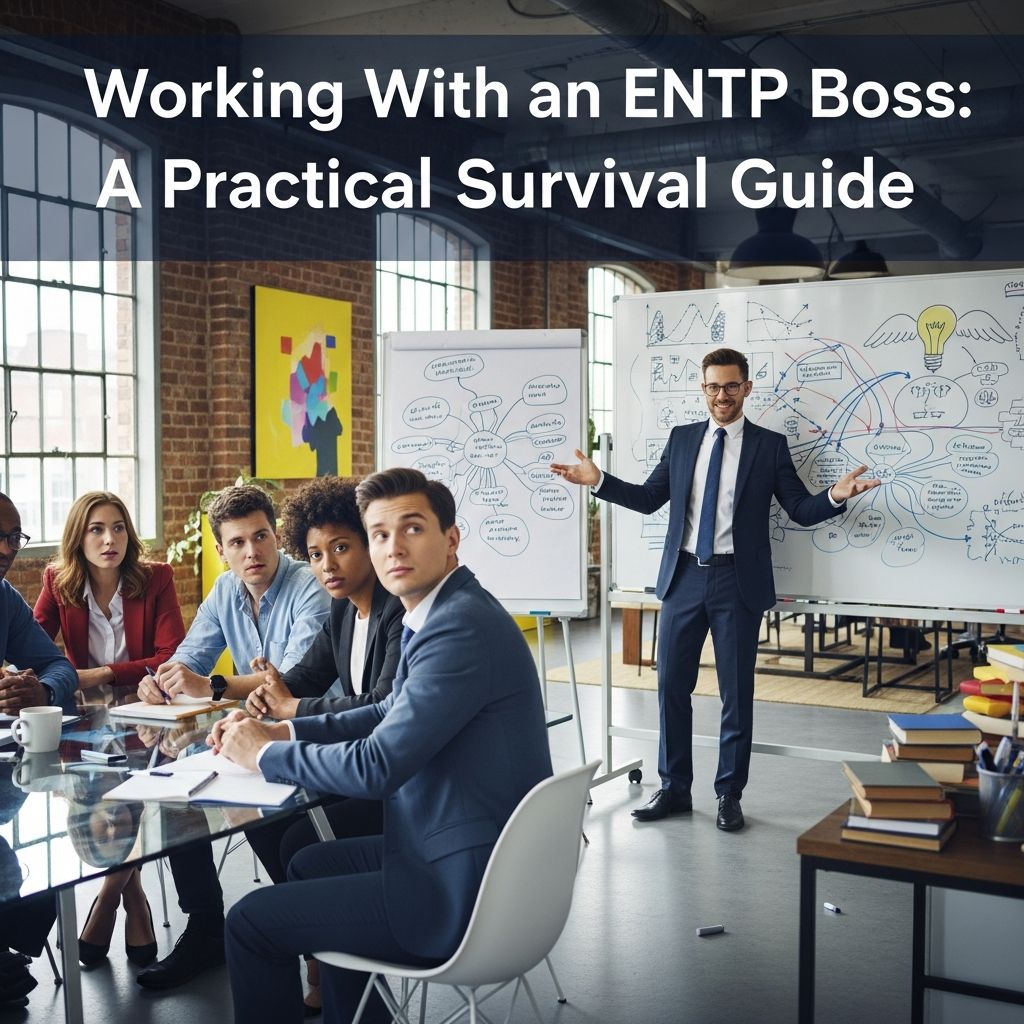
Few managers are as energizing, frustrating, and unexpectedly inspiring as an ENTP boss. When you understand how their personality works, you can turn daily chaos into a powerful environment for learning, autonomy, and rapid growth.
Who Is the ENTP Boss, Really?
In the Myers–Briggs Type Indicator (MBTI) framework, ENTP stands for Extraverted, Intuitive, Thinking, Prospecting. ENTPs are often called the Debater or Visionary type. They are known for quickly generating ideas, seeing multiple angles of a problem, and challenging assumptions around them.
Research on personality and leadership consistently shows that traits like openness to experience, extraversion, and cognitive flexibility are linked to more innovative leadership and greater adaptability in changing environments. ENTP bosses tend to embody these qualities strongly, which can be both a gift and a challenge for their teams.
| ENTP Trait | How It Shows Up in a Boss | Impact on You |
|---|---|---|
| Extraverted | Talks through ideas out loud, thrives in meetings and debates | May feel like plans change mid-sentence |
| Intuitive | Focus on big-picture concepts, future possibilities | Details and logistics may be left to you |
| Thinking | Makes decisions logically, values competence over harmony | Feedback can sound blunt or impersonal |
| Prospecting | Prefers flexibility, last-minute changes, experimentation | Plans can shift quickly, priorities often rearranged |
What Makes ENTP Leadership So Unusual?
ENTPs are often more comfortable in leadership than in tightly scripted management roles. They enjoy exploring strategies, experimenting with approaches, and then handing off execution to others. This creates a leadership style that feels like a mix of start-up founder, debate club captain, and mad scientist.
Core Strengths of an ENTP Boss
- Relentless idea generation – They constantly see alternative paths, new products, or unconventional solutions others miss.
- Comfort with uncertainty – They are at ease in shifting markets, new technologies, or rapidly changing priorities, which is valuable in complex organizations.Empirical work on personality and leadership suggests that such adaptability supports effectiveness in dynamic contexts.
- Meritocratic mindset – ENTPs respect sharp thinking and results more than rank or politics. Strong performers and original thinkers often rise quickly under them.
- Low micromanagement – They prefer to delegate and give people room to experiment instead of watching every step.
- Strategic pattern-spotting – They connect trends, patterns, and weak signals, often spotting opportunities or risks early.
Common Pain Points for Their Teams
- Unclear instructions – They often share a vision but skip over specific steps, assuming people will fill in the gaps.
- Frequent pivots – ENTP bosses may radically change direction after new information, which can disrupt schedules and stress more structured teammates.
- Combative communication – They may use debate to test ideas. People who prefer harmony can experience this as personal attack rather than intellectual sparring.
- Inconsistent follow-through – They love starting things more than finishing them, which can leave initiatives half-built unless someone else drives execution.
- Emotional blind spots – ENTPs may prioritize logic over feelings and overlook the emotional impact of criticism or sudden changes.
Understanding the ENTP Decision-Making Process
To work effectively with an ENTP boss, it helps to understand what is happening in their head when they make decisions:
- Explore options first – They mentally generate multiple scenarios, often by talking them out during meetings.
- Stress-test ideas with debate – They challenge, poke holes, and encourage pushback to see which idea survives.
- Lock in late – They resist closing options too early, even near deadlines, because new information might still appear.
- Adjust on the fly – Once in motion, they adjust strategy based on what they learn rather than rigidly following the original plan.
This style aligns with research on leaders in uncertain environments, where iterative experimentation and rapid learning can outperform rigid planning when conditions are volatile.
How to Thrive Under an ENTP Boss
Instead of fighting their nature, you can build a partnership that leverages both your strengths. The key is not to become an imitation ENTP, but to complement them.
1. Turn Vague Vision into Concrete Action
ENTP bosses are usually relieved when someone turns their abstract ideas into a workable plan.
- After a discussion, send a brief written summary: key goal, milestones, owners, deadlines.
- Ask clarifying questions such as: “What does success look like in three months?” or “Which metric matters most here?”
- Offer 2–3 implementation options and ask them to choose, instead of presenting a blank page.
2. Don’t Fear the Debate – Prepare for It
ENTPs often see argument as a sport and a tool for better thinking, not a sign of hostility.
- Come to meetings with data, examples, or quick prototypes rather than vague opinions.
- Separate ideas from identity: critique the proposal, not the person, and assume they’re doing the same.
- Use phrases like “Here’s a risk I’m worried about” or “Let me test that assumption” to stay in problem-solving mode.
3. Build Trust Through Competence and Candor
ENTP bosses tend to reward people who demonstrate independent thinking, resourcefulness, and honesty.
- Be direct about constraints, risks, and mistakes instead of hiding them.
- Offer improvements when you raise problems. They enjoy people who bring solutions, not just complaints.
- Ask for autonomy once you’ve proven reliability; they’re often happy to give you a wide lane if you deliver.
4. Manage the Chaos Without Resentment
Because ENTP leaders change course frequently, you can reduce stress by building in flexibility.
- Create buffer time in your schedule for last-minute adjustments.
- Track changing priorities in a simple list and confirm: “Here’s how I’m ranking these three projects. Is that right?”
- Document decisions and share them in writing, so when things shift you can recalibrate together.
5. Protect Emotional Boundaries
Personality research shows that “Thinking” types are more likely to evaluate situations through logic than emotion, which can be misread as insensitivity. Your ENTP boss may not realize when their style is draining people.
- Name the impact on work: “When priorities change weekly, it’s hard to deliver on time. Can we lock this sprint for two weeks?”
- Use “I” statements if their debate style feels overwhelming: “I process better with a bit more space between ideas.”
- Seek allies or a mentor who can help you translate their communication style and advocate for realistic workloads.
Adapting to ENTP Leadership Based on Your Own Style
Your experience will vary depending on your own personality preferences. While MBTI is not a clinical tool and should not be used for hiring decisions, research indicates that personality differences can meaningfully affect how people interpret each other’s behavior at work.
If You Prefer Structure (e.g., Judging Types)
- Ask for clear deadlines and checkpoints instead of open-ended goals.
- Offer to be the stabilizer who codifies processes once an experiment works.
- Share what you need: “It helps me to have the plan frozen by Friday so I can schedule my week.”
If You’re More Sensitive to Conflict (e.g., Feeling Types)
- Mentally reframe debates as idea testing instead of personal criticism.
- After a heated discussion, ask: “Are we good personally? I want to make sure that was about the work, not us.”
- Suggest alternative formats: written feedback, one-on-one check-ins, or shorter meetings if large-group debates feel intense.
If You’re Also Idea-Driven (e.g., Other Intuitive Types)
- Bring your own bold proposals—ENTPs often respect those who can keep up intellectually.
- Offer to co-design experiments or pilots; they may happily make you a collaborator, not just an implementer.
- Balance them by owning follow-through on one or two high-value projects rather than chasing every new idea.
Practical Communication Templates
Small changes in how you phrase things can dramatically improve conversations with an ENTP boss.
When You Need Clarity
- “To make sure I’m aligned, here are the three outcomes I’m targeting. Would you change anything?”
- “If I can only do one of these this week, which is most important?”
When You Disagree
- “Can I test that idea from another angle? Here’s what I’m seeing.”
- “I like the direction. My concern is X. How can we design around that risk?”
When Things Keep Changing
- “We’ve updated the plan three times this month. For the team’s sanity, can we freeze this version until the end of the sprint?”
- “Here’s the cost of switching now (time, budget). Are you comfortable with that trade-off?”
When the Relationship Becomes Unsustainable
Not every pairing of personalities is a long-term fit. If you have tried to adapt and still find yourself constantly exhausted or demoralized, it may be time to reassess. Occupational health research suggests that prolonged mismatch between job demands and personal resources increases burnout risk and turnover intentions.
- Notice ongoing signs of strain: insomnia, dread before work, chronic frustration, or feeling undermined.
- Consider whether the issue is style (which can be negotiated) or values (which rarely change).
- Seek a confidential conversation with HR, a mentor, or a coach if you need help evaluating options.
Frequently Asked Questions (FAQs)
Q: Why does my ENTP boss keep changing their mind?
ENTP leaders like to keep options open and integrate new information as it appears. They see frequent adjustments as rational optimization rather than inconsistency, especially in uncertain or fast-moving environments.
Q: How can I persuade an ENTP boss to support my idea?
Frame your idea as an experiment, show how it improves efficiency or opens new opportunities, and anticipate objections with data or examples. Engage them in debate and be willing to refine your proposal in real time.
Q: Do ENTP bosses care about people or only ideas?
They often feel strongly about people but communicate through logic and problem-solving. Because they focus on ideas, they may unintentionally overlook emotional cues. Clear, respectful feedback about impact can help them adjust.
Q: I’m overwhelmed by the pace. What can I do?
Ask to narrow your focus to the highest-impact projects, clarify what can be postponed, and suggest stable time blocks for deep work. Many ENTP bosses will accept constraints when they see how it protects quality and results.
Q: Are ENTP bosses good for my career?
They can be, especially if you want rapid exposure to new problems and autonomy. ENTP leaders often give ambitious employees big challenges early. However, you may need to actively ask for recognition, clearer paths, and support around workload boundaries.
References
- Zaccaro, S. J. & Klimoski, R. J. (Eds.), The Nature of Organizational Leadership — Jossey-Bass. 2001-01-01. https://psycnet.apa.org/record/2001-18398-000
- Myers, I. B., McCaulley, M. H., Quenk, N. L., & Hammer, A. L., MBTI Manual: A Guide to the Development and Use of the Myers-Briggs Type Indicator — The Myers-Briggs Company. 1998-01-01. https://eu.themyersbriggs.com/en/tools/MBTI
- Leiter, M. P. & Maslach, C., “Areas of Worklife: A Structured Approach to Organizational Predictors of Job Burnout” — Research in Occupational Stress and Well Being, Vol. 3. 2004-01-01. https://doi.org/10.1016/S1479-3555(03)03003-8
- 16Personalities, “ENTPs at Work” — NERIS Analytics Limited. 2023-01-01. https://www.16personalities.com/entps-at-work
- American Psychological Association, “Personality” Topic Page — American Psychological Association. 2020-01-01. https://www.apa.org/topics/personality

- Integrated M.A. in Applied Linguistics, University of Hyderabad
- 5+ years in editorial, instructional, SEO, and research-based writing
Sneha is a relationships and lifestyle writer with a strong foundation in applied linguistics and certified training in relationship coaching. She brings over five years of writing experience to theskillvault, crafting thoughtful, research-driven content that empowers readers to build healthier relationships, boost emotional well-being, and embrace holistic living. Her writing and insights reflect the belief that beauty, happiness, and wellness…