
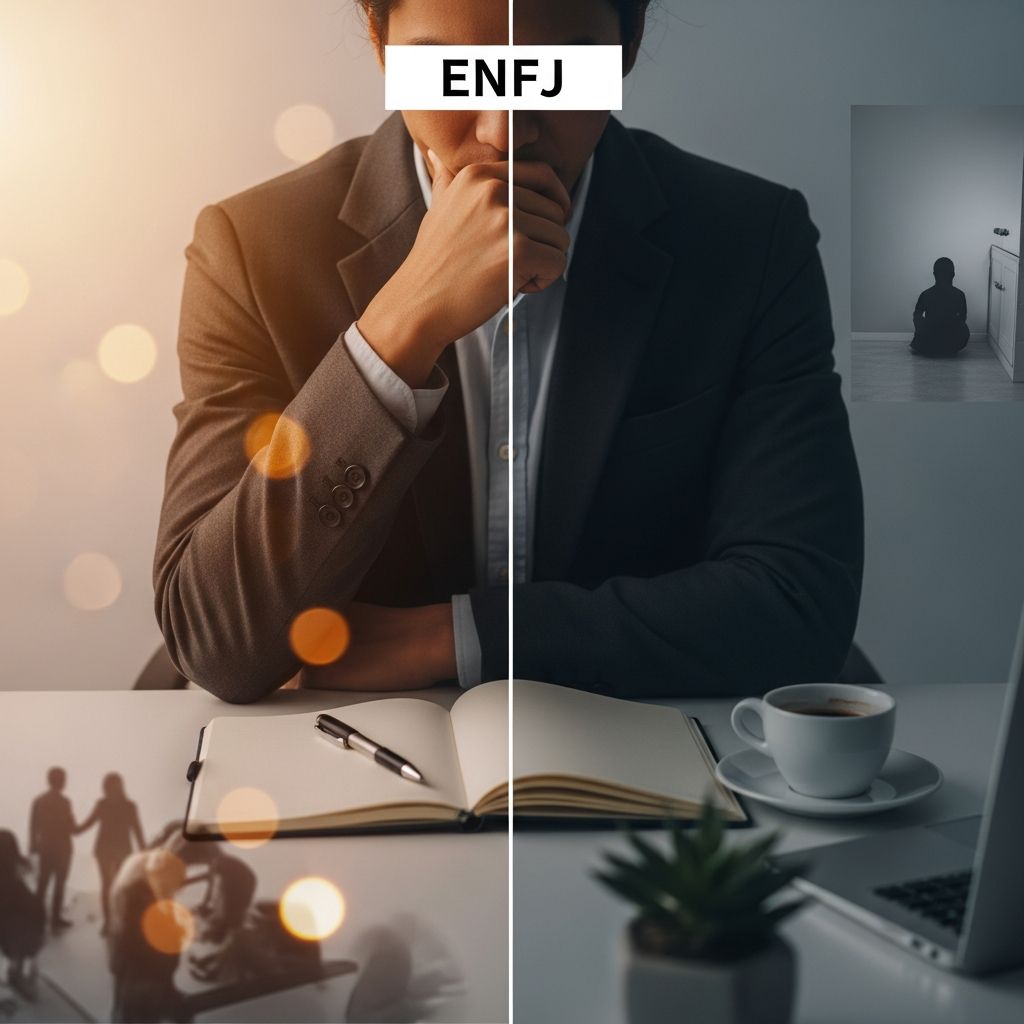
The ENFJ personality type, often called the Protagonist, combines warmth, insight, and a strong drive to improve the lives of others. They are known for their optimism, social intelligence, and deep concern for people, but these same qualities can become sources of stress, burnout, and conflict when overused or unmanaged.
This guide explores the key strengths and weaknesses of ENFJs, how they show up in daily life, and practical ways to build healthier balance in relationships, work, and personal growth.
Who ENFJs Are at Their Core
ENFJs are defined in the Myers–Briggs framework as Extraverted, Intuitive, Feeling, and Judging. In more practical terms, they tend to:
- Focus on people and relationships more than tasks or things.
- See patterns and possibilities rather than just current facts.
- Make decisions by values and emotional impact, not just logic.
- Prefer structure and plans over spontaneity and last-minute changes.
Researchers have found that types high in extraversion and agreeableness are more likely to engage in helping behaviors and community involvement, patterns that align closely with typical ENFJ traits.
Signature Strengths of ENFJs
ENFJs often stand out because of a blend of interpersonal and motivational strengths. These qualities can make them admired leaders, loyal friends, and trusted confidants.
1. Deep Emotional Awareness and Empathy
ENFJs are highly attuned to emotional undercurrents. They pick up small shifts in tone, body language, and atmosphere and quickly grasp how others are feeling. Research on empathy suggests that people who score higher on measures of emotional understanding are more likely to provide effective social support and maintain satisfying relationships.
- They sense when someone feels left out or uncomfortable.
- They often anticipate needs before others ask for help.
- They adjust their words and behavior to put people at ease.
This emotional radar is a powerful strength in counseling, teaching, customer-facing roles, and leadership.
2. Natural Gift for Encouraging and Motivating Others
Many ENFJs seem to be motivators by instinct. They see potential in people and genuinely believe others can grow and improve.
- They give specific, heartfelt encouragement.
- They help people build confidence and envision better futures.
- They often become informal coaches, mentors, or morale boosters.
Because they believe in others so strongly, ENFJs often inspire people to take brave steps they might not have taken alone.
3. Strong Sense of Responsibility and Reliability
ENFJs often feel personally responsible for the wellbeing of their group—family, team, community, or cause. This can translate into impressive reliability.
- They show up when they say they will.
- They follow through on commitments, even when it is inconvenient.
- They organize events, coordinate people, and keep projects moving.
Studies of conscientiousness, a trait related to reliability and planning, link it to better job performance and long-term goal achievement. ENFJs frequently display these behaviors when their efforts serve people or values they care about.
4. Visionary, Big-Picture Thinking
Despite their people-focus, ENFJs are not only about day-to-day social life. Their intuitive side pushes them to think about meaning, direction, and the future.
- They imagine what a better system, workplace, or community could look like.
- They connect personal stories to broader social issues.
- They enjoy conversations about purpose, values, and long-term impact.
This makes them well-suited to roles where they can combine people skills with strategic thinking, such as education leadership, nonprofit work, human resources, or change management.
5. Charisma and Social Intelligence
ENFJs often project warmth, enthusiasm, and confidence. Combined with empathy, this can be very compelling.
- They are skilled at reading a room and adapting their approach.
- They bring energy to group discussions and know how to include quieter voices.
- They can communicate complex or sensitive topics in ways that feel approachable.
Social intelligence research emphasizes skills like perspective-taking, impression management, and social awareness, all areas where ENFJs typically excel.
Common ENFJ Weaknesses and Blind Spots
Every strength has a shadow side. For ENFJs, their gifts for empathy, encouragement, and responsibility can become sources of stress or conflict when they are not balanced with boundaries, self-awareness, and realistic expectations.
1. Overextending Themselves for Others
Because ENFJs care deeply about people, they can struggle to say no. They may absorb too many responsibilities, both emotional and practical.
- Taking on extra work to protect the team from stress.
- Constantly checking in on friends or family members in crisis.
- Feeling guilty when they prioritize their own needs.
Chronic overextension is linked to emotional exhaustion and burnout, particularly in helping and caregiving roles. Without clear boundaries, ENFJs may end up depleted and resentful, even though their intentions are generous.
2. Idealism that Collides with Reality
ENFJs often hold high standards for integrity, fairness, and cooperation. When real-world systems or individuals fall short, they can feel deeply disappointed or disillusioned.
- Expecting organizations to live up to stated values and feeling betrayed when they do not.
- Assuming others share their commitment to fairness and collaboration.
- Struggling to accept moral gray areas or imperfect compromises.
Idealism can fuel meaningful change, but if ENFJs do not allow room for human limitations, they may oscillate between intense enthusiasm and frustration.
3. Tendency to Become Overly Directive or \”Knowing What’s Best\”
Because they care about people’s growth and have clear ideas about what improvement looks like, ENFJs can slip into a subtly controlling stance.
- Giving advice that sounds more like instructions.
- Pushing others to change at a pace they are not ready for.
- Assuming that their perspective on values or growth is the correct one.
Others may experience this as pressure, moralizing, or even condescension, even when the ENFJ’s intentions are compassionate. Learning to ask more questions and invite collaboration can soften this pattern.
4. Difficulty Separating Their Emotions from Others’ Emotions
ENFJs often function as emotional sponges. They may absorb the anxieties, frustrations, or sadness of people around them until it becomes hard to tell where their own feelings end and others’ begin.
- Feeling drained after social interactions, even ones that seemed positive.
- Having trouble relaxing when people they care about are upset.
- Trying to “fix” emotions around them to feel okay themselves.
Research on emotional contagion shows that people can “catch” the moods of those around them, especially if they are high in empathy. ENFJs are particularly vulnerable to this and may need deliberate practices—like alone time, journaling, or mindfulness—to reset.
5. Overlooking Their Own Needs and Individual Identity
In focusing so much on harmony and support, ENFJs may neglect self-exploration.
- Defining themselves primarily by their roles (friend, partner, leader, parent).
- Making major decisions based mainly on others’ preferences.
- Feeling lost or empty during life transitions when roles change.
Over the long term, failing to develop a clear personal identity and independent perspective can lead to role strain and diminished wellbeing.
How ENFJ Traits Play Out in Daily Life
The table below summarizes how ENFJ strengths and weaknesses may manifest in different areas of life.
| Life Area | Typical ENFJ Strengths | Common ENFJ Challenges |
|---|---|---|
| Friendships | Warm, attentive, reliable, and encouraging friends who remember details and celebrate others’ successes. | May feel hurt if loyalty is not returned; can become overinvolved in others’ personal problems. |
| Romantic Relationships | Expressive, supportive partners who invest heavily in emotional closeness and growth. | Might ignore their own needs, avoid conflict, or idealize partners and feel crushed by disappointment. |
| Work & Career | Skilled team builders and communicators; naturally suited for roles involving teaching, mentoring, or coordination. | Risk of burnout from people-heavy roles; struggle delegating; may take criticism personally. |
| Family Life | Create a warm, inclusive atmosphere; often the emotional anchor and organizer of family events. | Can feel solely responsible for everyone’s happiness; may have difficulty setting limits with relatives. |
| Personal Growth | Motivated to improve, reflect, and align life with their values. | May focus more on others’ development than their own; can judge themselves harshly when they fall short of ideals. |
Growth Strategies for ENFJs
Understanding strengths and weaknesses is only useful if it leads to change. The following practices can help ENFJs preserve what is best about their personality while protecting their health and relationships.
1. Practice Boundaries as a Form of Care
Saying no is difficult for many ENFJs, but boundaries are essential for sustainable generosity.
- Set a limit on how many extra commitments you take on per week.
- Schedule regular time in your calendar that is protected for rest or solitary hobbies.
- Use language like, “I care about this, and I also need to protect my energy,” instead of apologizing excessively.
Workplace research emphasizes that boundary-setting protects against chronic stress and helps maintain long-term engagement.
2. Balance Idealism with Realistic Expectations
ENFJs do not need to abandon their ideals; they may only need to refine how they hold them.
- Differentiate between core values that are non-negotiable and preferences that can flex.
- Expect that change—personal or social—usually happens gradually, not overnight.
- Look for small, concrete wins instead of all-or-nothing success.
This mindset can reduce frustration while still honoring the ENFJ drive to improve things.
3. Develop Comfort with Healthy Conflict
Avoiding disagreement may preserve short-term harmony but undermine long-term trust. ENFJs can benefit from learning respectful, direct communication.
- Use “I” statements to express needs and limits without blame.
- Remember that disagreement does not equal rejection.
- View conflict as a chance to clarify expectations and deepen understanding.
Evidence-based communication programs show that constructive conflict skills support relationship satisfaction and reduce stress.
4. Invest in Self-Reflection and Independent Thinking
While ENFJs are highly attuned to others, they grow when they turn some of that attention inward.
- Keep a journal focused on your own opinions, desires, and long-term goals.
- Periodically ask, “What do I want, independent of others’ expectations?”
- Explore activities or learning purely because they interest you, not because they help someone else.
This strengthens a more stable sense of self that does not disappear when roles or relationships change.
5. Protect Emotional Energy
Because ENFJs are sensitive to emotional climates, deliberate recovery is essential.
- Limit time in chronically negative environments when possible.
- Use practices like mindfulness, deep breathing, or quiet walks to reset after intense social days.
- Talk with trusted people who can listen without immediately turning to you for support.
These small habits can prevent emotional overload and help ENFJs stay grounded.
Frequently Asked Questions About ENFJ Strengths and Weaknesses
Q: Are ENFJs always extroverted and social?
Many ENFJs enjoy people and gain energy from social interaction, but they also need regular time alone to process emotions and ideas. An ENFJ may appear outgoing in groups and yet feel drained afterward if they do not have quiet time to recover.
Q: What careers fit ENFJ strengths best?
ENFJs often thrive in roles that combine people focus with purpose, such as teaching, counseling, coaching, human resources, organizational development, or leadership in mission-driven organizations. Their strengths in communication, empathy, and coordination are especially valuable in these fields.
Q: How can ENFJs avoid burnout?
The most important steps are setting clear boundaries, sharing responsibility instead of carrying everything alone, and scheduling non-negotiable rest. Learning to tolerate others’ temporary discomfort—without rushing in to fix everything—also reduces constant emotional strain.
Q: Do ENFJ weaknesses mean they are \”too emotional\”?
ENFJs do tend to experience emotions vividly, but this is not a flaw in itself. Their emotional sensitivity is a major source of their empathy and insight. Difficulties usually arise not from feeling too much, but from lacking boundaries, self-care, or outlets for processing what they feel.
Q: Can ENFJs become more logical and objective?
Yes. While their natural preference is to decide by values and impact on people, ENFJs can consciously strengthen skills like critical thinking, data analysis, and evidence-based decision-making. Over time, this can help them integrate heart and head instead of seeing them as opposites.
References
- Carlo, G., et al. \”The interplay of personality and prosocial/antisocial behavior in adolescence.\” — Journal of Personality. 2014-02-01. https://doi.org/10.1111/jopy.12052
- Hatfield, E., Cacioppo, J. T., & Rapson, R. L. \”Emotional contagion.\” — Current Directions in Psychological Science. 1993-06-01. https://doi.org/10.1111/1467-8721.ep10770953
- Barrick, M. R., & Mount, M. K. \”The Big Five personality dimensions and job performance: A meta-analysis.\” — Personnel Psychology. 1991-12-01. https://doi.org/10.1111/j.1744-6570.1991.tb00688.x
- Thorndike, E. L. \”Intelligence and its uses.\” — Harper’s Magazine. 1920-01-01. https://babel.hathitrust.org/cgi/pt?id=hvd.32044092711315
- Maslach, C., Schaufeli, W. B., & Leiter, M. P. \”Job burnout.\” — Annual Review of Psychology. 2001-02-01. https://doi.org/10.1146/annurev.psych.52.1.397
- Markman, H. J., et al. \”Preventing marital distress through communication and conflict management training: A 4- and 5-year follow-up.\” — Journal of Consulting and Clinical Psychology. 1993-02-01. https://doi.org/10.1037/0022-006X.61.1.70

Medha Deb is an editor with a master's degree in Applied Linguistics from the University of Hyderabad. She believes that her qualification has helped her develop a deep understanding of language and its application in various contexts. Medha specializes in the areas of beauty, health, sports, and wellness and is committed to ensuring that the content on the website is…