
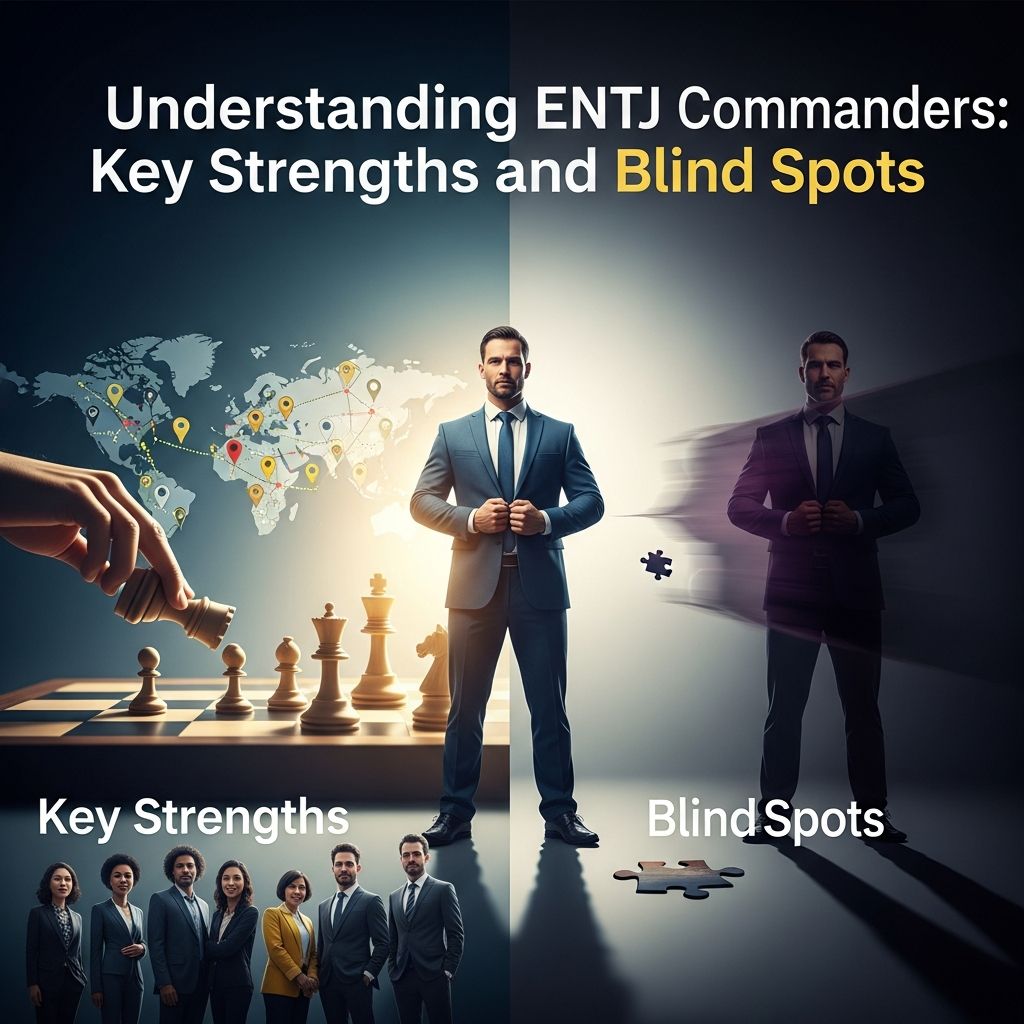
ENTJ Commanders: Power, Precision, and Their Hidden Costs
Among the 16 Myers-Briggs personality types, the ENTJ (Extraverted, Intuitive, Thinking, Judging) often stands out as the archetypal strategist and leader. Research on ENTJ preferences consistently highlights their capacity for long-term planning, logical analysis, and decisive action, which makes them highly visible in leadership roles across organizations and communities.
Yet the same traits that set ENTJs apart can create blind spots: emotional distance, inflexibility, and an intense focus on results over relationships. Understanding this duality helps ENTJs develop more sustainable influence and helps others collaborate with them more effectively.
The ENTJ Blueprint: What the Four Letters Really Mean
ENTJ is an acronym describing four core preference pairs in the Myers-Briggs Type Indicator (MBTI) model, which is widely used in organizational and counseling contexts, although it is considered a preference tool rather than a measure of ability.
| Letter | Preference | Everyday Expression |
|---|---|---|
| E | Extraversion | Draws energy from interaction, discussion, and external engagement. |
| N | Intuition | Focuses on patterns, concepts, and future possibilities rather than concrete details. |
| T | Thinking | Makes decisions through logic, fairness, and objective criteria, not personal sentiment. |
| J | Judging | Prefers structure, planning, and clear decisions instead of open-ended approaches. |
This combination often produces a style sometimes described as a “decisive strategist” – a person who sees the big picture, organizes people and systems, and moves forcefully toward defined goals.
Core Strengths of ENTJ Personalities
ENTJs bring a powerful set of strengths that can transform teams, organizations, and entire systems when used thoughtfully.
1. Visionary and Strategic Thinking
ENTJs are naturally inclined to think in terms of long-term outcomes rather than short-term fixes. They quickly identify patterns, underlying structures, and leverage points in complex situations, allowing them to design bold strategies that others may not see.
- Comfortable dealing with abstract ideas and large-scale systems.
- Enjoy mapping out multi-year plans and ambitious objectives.
- Often anticipate obstacles and design contingencies in advance.
In leadership research, strategic thinking is consistently associated with effective decision-making and organizational performance, particularly in volatile environments.
2. Decisive, Action-Oriented Leadership
Once an ENTJ has analyzed a situation, they move quickly from idea to implementation. They dislike stagnation and are willing to make tough calls when others hesitate.
- Comfortable taking responsibility for complex decisions.
- Reduce ambiguity by setting clear direction and priorities.
- Often thrive in high-pressure scenarios that require fast action.
Studies of leadership behavior consistently highlight decisiveness as a factor that can enhance followers’ confidence and clarity when combined with competence and communication.
3. Efficiency and Systems Optimization
ENTJs frequently see inefficiencies that others have learned to tolerate. They are driven to streamline processes, clarify roles, and restructure organizations for better performance.
- Challenge outdated procedures and redundant steps.
- Seek measurable improvements in speed, cost, or quality.
- Prefer data-driven approaches to redesign workflows.
This orientation aligns with principles in organizational psychology that link clear structures and efficient systems to better outcomes and lower resource waste.
4. Confidence and Persuasive Communication
ENTJs commonly present their ideas with clarity and conviction. Even without formal authority, they are often treated as unofficial leaders because they articulate a direction and rally people around it.
- Comfortable speaking in front of groups or senior stakeholders.
- Use logical arguments and compelling narratives to gain buy-in.
- Often inspire others through their ambition and energy.
Personality research notes that extraverted, assertive communicators are more likely to be perceived as leaders and to be selected for leadership positions, especially in Western workplaces.
5. Resilience and Goal Persistence
Many ENTJs show remarkable stamina in pursuing complex goals. They typically respond to setbacks with renewed effort rather than withdrawal.
- View obstacles as challenges to be solved, not reasons to stop.
- Maintain focus through long projects or difficult change efforts.
- Often hold themselves and others to high standards of performance.
This trait can be a stabilizing force in environments where frequent change or uncertainty might otherwise demotivate teams.
Key Weaknesses and Growth Edges for ENTJ Types
The flip side of ENTJ strengths is a set of predictable blind spots. Recognizing these patterns allows ENTJs to adapt their style without sacrificing effectiveness.
1. Tendency Toward Dominance and Control
Because ENTJs are confident in their reasoning, they may assume their perspective is the most efficient or rational one. This can lead to overly directive behavior that sidelines others’ ideas.
- May push their agenda without fully considering alternative approaches.
- Can interrupt, talk over, or dismiss quieter team members.
- Risk fostering dependency, where others wait to be told what to do.
Over time, this style can suppress innovation and reduce psychological safety, which research shows is critical for effective teams and open communication.
2. Impatience with Different Work Styles
ENTJs think and decide quickly. When colleagues need more time to reflect or process information, ENTJs may interpret this as inefficiency or lack of commitment.
- Struggle with people who communicate indirectly or need extensive reassurance.
- May rush discussions, skipping over important details or risks.
- Can unintentionally pressure others into premature decisions.
This impatience can be especially problematic in multicultural or multidisciplinary settings, where diverse communication and thinking styles are necessary for good outcomes.
3. Emotional Blind Spots and Limited Empathy
With a strong preference for logical analysis, ENTJs often underuse emotional information. They may see feelings as obstacles to be managed rather than as data about people’s needs and reactions.
- May appear cold or detached in emotionally charged situations.
- Risk minimizing the impact of decisions on morale and relationships.
- Can struggle to express vulnerability or ask for support.
Research in social and emotional competencies suggests that leaders who neglect emotional cues often face higher conflict levels and lower engagement, even when their strategies are objectively sound.
4. Perception of Arrogance or Intolerance
ENTJs tend to respect competence, directness, and clear thinking. When others operate from different values – such as harmony, tradition, or emotional support – ENTJs may privately devalue those priorities.
- Can come across as blunt, judgmental, or dismissive.
- May underestimate contributions that are less visible or less quantifiable.
- Risk alienating sensitive or collaborative team members.
This reputation for arrogance often reflects an unmoderated preference for rational efficiency over other human needs, not an intentional desire to belittle people.
5. Overwork and Difficulty Delegating
Because ENTJs are driven and standards-focused, they can slip into doing too much themselves, especially if they doubt others’ competence.
- Take on excessive responsibility, leading to stress or burnout.
- Micromanage projects rather than trusting capable colleagues.
- May ignore early signs of fatigue or mental strain.
Organizational research has linked this pattern of overcommitment and control to higher stress and lower well-being for leaders, as well as reduced autonomy for team members.
Balancing the ENTJ Profile: Practical Growth Strategies
ENTJs do not need to abandon their natural directness or strategic focus to grow. Instead, they can refine how and when they use these strengths.
1. Practicing Strategic Listening
Listening does not slow down progress when done intentionally; it often improves the quality of decisions.
- Begin key meetings with a round of brief input before proposing a solution.
- Ask at least one clarifying question before challenging an idea.
- Summarize what you heard to confirm understanding before deciding.
This approach protects ENTJs’ need for efficiency while reducing misunderstandings and increasing buy-in.
2. Using Emotional Data as Another Information Stream
Rather than viewing emotions as irrational, ENTJs can treat them as additional signals about engagement, motivation, and risk.
- Notice patterns: when do people become quiet, defensive, or energized?
- Check impact by asking, “How is this decision landing for you?”
- Practice naming your own states: “I’m frustrated with the delay, but open to options.”
Developing even moderate emotional awareness has been linked in research to improved leadership effectiveness and relationship quality.
3. Building Flexibility into Rigid Plans
ENTJs excel at designing structured plans. The growth edge is to consciously create room for adaptation.
- In large projects, define “non-negotiables” and “flexible elements.”
- Schedule review points to reassess assumptions and adjust tactics.
- Invite subject-matter experts to challenge your plan at key milestones.
This keeps the strategic direction intact while allowing new information and ideas to refine the path.
4. Delegating for Development, Not Just Efficiency
Instead of delegating only routine tasks, ENTJs can assign high-value responsibilities that grow others’ capabilities.
- Clarify outcomes and boundaries, then step back from the “how.”
- Offer scheduled check-ins instead of constant oversight.
- Frame mistakes as learning opportunities, not as proof you should have done it yourself.
This approach aligns with evidence that autonomy and challenge are key drivers of motivation and performance.
Working and Living with an ENTJ
Understanding ENTJ tendencies helps colleagues, partners, and friends interpret their behavior more accurately and communicate more effectively.
How to Collaborate Successfully with ENTJs
- Be direct and concise: ENTJs appreciate clear points supported by logic and relevant data.
- Show preparedness: Arrive with facts, options, and a proposed recommendation.
- Challenge respectfully: They often enjoy debate, as long as it stays focused on ideas rather than personal criticism.
- Clarify expectations: Ask for priorities, deadlines, and decision criteria upfront.
- Give honest feedback: ENTJs may not notice when their style is too sharp; concrete examples help.
Supporting ENTJs in Personal Relationships
- Recognize that their drive for improvement often includes the relationship itself – their criticism may be an awkward form of care.
- Ask for emotional presence explicitly: “I need you to listen without fixing this right now.”
- Encourage breaks from work and remind them that rest supports long-term performance.
- Express appreciation when they soften their style or show vulnerability; this reinforces growth.
Frequently Asked Questions (FAQs)
Q: Are ENTJs always suited for leadership roles?
A: ENTJs often gravitate toward leadership because of their strategic mindset and confidence, but effective leadership also depends on emotional skills, ethics, experience, and context. Some ENTJs prefer expert or entrepreneurial roles without large people-management responsibilities.
Q: Why do ENTJs seem insensitive or harsh at times?
A: Their preference for logical clarity and efficiency can overshadow their awareness of feelings. ENTJs may not intend to hurt anyone; they simply prioritize directness and outcomes unless they deliberately practice empathy and tact.
Q: Can ENTJs be emotionally supportive partners or friends?
A: Yes. While emotional expression may not come naturally, many ENTJs learn to be reliable, protective, and constructive supporters when they understand that emotional presence is a crucial form of loyalty and care.
Q: How common is the ENTJ personality type?
A: ENTJs are generally considered one of the less common MBTI types, often reported at under a few percent of the population, which may contribute to their sense of being different from those around them.
Q: Is MBTI, including ENTJ descriptions, scientifically proven?
A: The MBTI is widely used in career development and organizational training, but it has mixed support in academic psychology. It is best understood as a framework for discussing preferences and communication styles, not as a diagnostic tool or a strict predictor of behavior.
References
- ENTJ Personality Type: Commander — Simply Psychology. 2023-04-10. https://www.simplypsychology.org/entj-personality.html
- Strengths & Weaknesses | ENTJ Personality (Commander) — 16Personalities. 2022-06-01. https://www.16personalities.com/entj-strengths-and-weaknesses
- 10 Characteristics of the Commander Personality Type (ENTJ) — Calm. 2022-11-15. https://www.calm.com/blog/entj
- ENTJ Personality Type: The Decisive Strategist — MBTIonline (The Myers-Briggs Company). 2021-09-01. https://www.mbtionline.com/en-US/MBTI-Types/ENTJ
- ENTJ: MBTI Personality Profile — The Myers-Briggs Company (EU site). 2020-05-12. https://eu.themyersbriggs.com/en/tools/MBTI/MBTI-personality-Types/ENTJ

- Integrated M.A. in Applied Linguistics, University of Hyderabad
- 5+ years in editorial, instructional, SEO, and research-based writing
Sneha is a relationships and lifestyle writer with a strong foundation in applied linguistics and certified training in relationship coaching. She brings over five years of writing experience to theskillvault, crafting thoughtful, research-driven content that empowers readers to build healthier relationships, boost emotional well-being, and embrace holistic living. Her writing and insights reflect the belief that beauty, happiness, and wellness…