
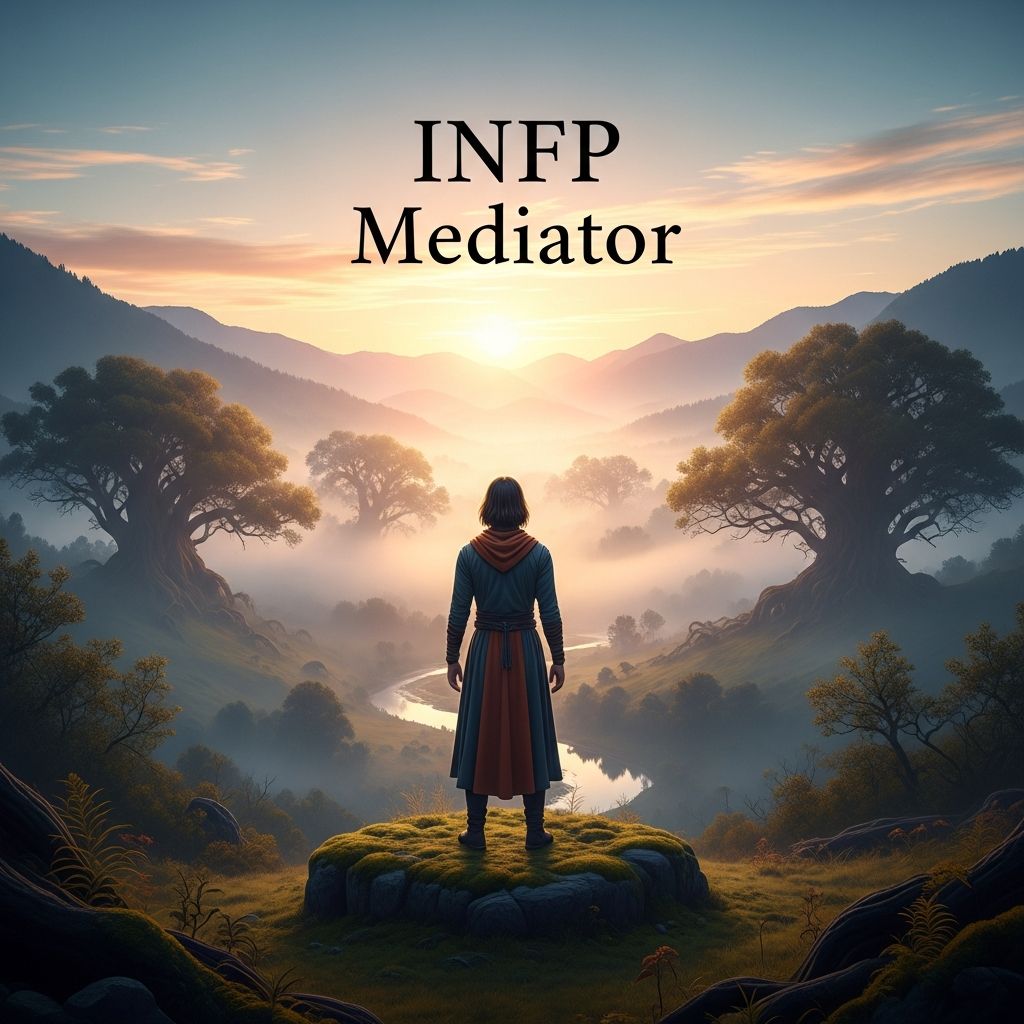
The INFP personality type, often called the Mediator, is known for deep empathy, rich imagination, and an unwavering commitment to inner values. Rather than chasing status or recognition, INFPs are usually driven by meaning, authenticity, and the desire to live in alignment with what feels morally right to them.
This guide explores the INFP inner world, typical strengths and struggles, relationship patterns, and practical ways INFPs can build a life that honors both their ideals and their wellbeing.
Core Blueprint of the INFP Type
INFP comes from the Myers–Briggs Type Indicator (MBTI), a model inspired by the work of Carl Jung and developed by Isabel Briggs Myers and Katharine Briggs. It describes preferences in how people gain energy, process information, make decisions, and approach structure.
What INFP Stands For
- Introverted (I) – Energy is restored through solitude or time with a few trusted people, not large, stimulating groups.
- Intuitive (N) – Focus is on meanings, patterns, and future possibilities rather than concrete details.
- Feeling (F) – Decisions are guided primarily by personal values and the emotional impact on people.
- Perceiving (P) – Prefers flexibility, options, and open-ended exploration over rigid plans and fixed schedules.
Signature INFP Qualities
Across research and practitioner descriptions, INFPs are often characterized as:
- Quiet but deeply thoughtful
- Highly empathetic and tuned in to emotional nuance
- Imaginative, idealistic, and drawn to creative expression
- Guided by internal values more than external rules
- Flexible, adaptable, and open to new perspectives
The Inner World of an INFP
Many INFPs describe feeling like they live with one foot in reality and one foot in an inner universe of ideas, possibilities, and stories. Their internal landscape is often vivid and emotionally rich.
Values as an Inner Compass
INFPs typically organize their lives around a personal moral code. This code may not match social norms, but it feels non-negotiable to them.
- They question whether choices are authentic, not just practical.
- They are often uncomfortable doing anything that feels manipulative or unfair.
- They can sacrifice conventional success if it conflicts with their sense of integrity.
Emotional Depth and Sensitivity
INFPs often feel emotions intensely – both their own and others’. This sensitivity fuels compassion, but also makes them vulnerable to emotional overload.
- They may absorb the mood of a room without realizing it.
- Harsh criticism can feel deeply personal and hard to shake.
- They often need time alone to process feelings and regain equilibrium.
Imagination and Daydreaming
Many INFPs report extensive daydreaming as children and adults – creating inner stories, exploring “what if” scenarios, and envisioning better futures.
- They frequently think in metaphors, symbols, or narratives.
- They may sketch, write, or make music to give shape to internal impressions.
- Routine environments can feel draining if there is little room for creativity.
Strengths and Vulnerabilities of INFPs
Like every personality type, INFPs bring distinct strengths and predictable challenges. Recognizing both sides can help INFPs grow with more self-compassion.
| Key Area | Typical INFP Strength | Common Vulnerability |
|---|---|---|
| Empathy | Deep understanding of others’ emotions | Emotional exhaustion, difficulty setting boundaries |
| Values | Strong ethical sense, integrity, authenticity | Idealism can lead to disappointment or cynicism |
| Creativity | Original ideas, imaginative problem-solving | Struggles with follow-through and finishing tasks |
| Relationships | Loyal, supportive, emotionally present | Conflict avoidance, difficulty expressing needs |
| Work Style | Independent, reflective, values-driven | Procrastination, difficulty with rigid structures |
Major INFP Strengths
- Empathetic connection – INFPs often sense unspoken feelings and create a safe, nonjudgmental space for others to share.
- Creative vision – They naturally generate original approaches and enjoy exploring unconventional ideas.
- Open-minded curiosity – INFPs usually respect different viewpoints and seek to understand rather than to judge.
- Passionate commitment – When they truly care, they can be persistent and dedicated, especially in causes that align with their ethics.
- Ability to see potential – They often notice hidden strengths in people or systems and imagine what could be improved.
Common INFP Struggles
- Overthinking and rumination – INFPs may replay conversations, worry about having hurt others, or second-guess choices.
- Conflict avoidance – They may stay silent to keep peace, then feel resentful or misunderstood.
- Difficulty with criticism – Negative feedback can feel like a rejection of their whole self, making learning harder.
- Procrastination and decision paralysis – Wanting the “perfect” choice can delay action; they may leave options open too long.
- Weak boundaries – Their desire to help can lead to emotional fatigue, burnout, and self-neglect.
INFPs in Relationships
In friendship and romance, INFPs usually seek depth over breadth. They prefer a few genuine, emotionally close relationships rather than many casual connections.
What INFPs Offer Loved Ones
- Attentive listening and validation of feelings
- Loyalty once trust is established; they rarely take important relationships lightly
- Encouragement of authenticity – they often help others feel safe being themselves
- Thoughtful gestures, creative gifts, or heartfelt messages
- Support for personal growth – they genuinely want the people they care about to grow into their best selves
Typical Relationship Challenges
- Idealized expectations – INFPs may hold romantic or friendship ideals that no human can fully match.
- Indirect communication – They sometimes hint rather than state needs clearly, hoping to be understood intuitively.
- Withdrawal under stress – When hurt, they may retreat into their inner world rather than discuss issues openly.
- Difficulty letting go – Past relationships and perceived failures can be hard to emotionally release.
Supporting an INFP Partner or Friend
People who love INFPs can strengthen the relationship by:
- Offering honest but gentle feedback, focused on behavior rather than character
- Respecting their need for quiet time without taking it personally
- Encouraging them to voice needs directly instead of guessing
- Engaging in meaningful conversations about values, dreams, and ideas
- Showing appreciation for their emotional labor and invisible efforts
INFPs at Work and in Careers
INFPs tend to thrive in environments that allow autonomy, creativity, and alignment with their personal values. Roles that feel purely transactional or focused entirely on profit often leave them disengaged.
Preferred Work Environments
- Quiet spaces with minimal constant interruption
- Flexible schedules and some control over how tasks are done
- Leaders who value authenticity, respect, and fairness
- Opportunities to contribute to well-being, learning, or social good
- Colleagues who appreciate depth and individuality
Commonly Fulfilling Career Paths
While INFPs can succeed in many fields, they often feel drawn to work that involves creativity, personal meaning, or service to others.
- Counseling and mental health – such as therapist, counselor, or coach
- Writing and communication – author, editor, content creator, journalist
- Education – teacher, tutor, educational consultant
- Creative arts – visual arts, design, music, filmmaking, game writing
- Nonprofit and advocacy – roles in social justice, environmental protection, or humanitarian work
Workplace Growth Areas
- Developing time management systems that support follow-through
- Practicing assertive communication to express boundaries and ideas
- Learning to separate self-worth from performance, so feedback is less overwhelming
- Breaking large, idealistic visions into small, concrete steps
- Collaborating with more structured colleagues who can complement their flexibility
Emotional Health and Personal Growth for INFPs
Because INFPs are so emotionally attuned, maintaining psychological wellbeing is crucial. Approaches that honor both their sensitivity and their autonomy tend to be most effective.
Self-Care Habits That Help INFPs Thrive
- Regular solitude to process experiences, journal, or engage in creative hobbies
- Boundaries around emotional labor, especially in helping professions or caregiving roles
- Mindfulness or grounding practices to stay connected to the present instead of getting lost in worries
- Physical routines (walks, yoga, stretching) to counterbalance time spent in their heads
- Compassionate self-talk that challenges harsh internal criticism
Useful Therapeutic and Growth Approaches
Mental health professionals note that talk therapies can be particularly helpful for reflective, introspective types like INFPs, especially when they struggle with mood issues or overwhelm.
- Person-centered or humanistic therapy that emphasizes empathy and unconditional positive regard can align well with INFP values.
- Cognitive-behavioral techniques may help them question all-or-nothing thinking or unrealistic self-expectations.
- Creative therapies (art, music, narrative work) can give structure to their inner imagery and emotions.
- Values-clarification exercises can help them choose realistic, actionable priorities instead of vague ideals.
Practical Tips: Everyday Life Strategies for INFPs
Small, concrete changes can help INFPs turn their idealism into sustainable action.
Managing Energy and Overwhelm
- Schedule “recharge blocks” in the week where no social or work commitments are allowed.
- Limit exposure to distressing news or media when feeling emotionally raw.
- Use simple routines (bedtime, meals, planning time) to reduce decision fatigue.
- Learn to say “let me think about it” before agreeing to requests.
Turning Ideas into Completed Projects
- Break projects into very small tasks and celebrate each completed step.
- Pair up with an accountability partner to gently check progress.
- Set “good enough” criteria to prevent perfectionism from blocking finishing.
- Use visual tools (boards, sticky notes, digital lists) to make invisible goals tangible.
Healthy Communication Patterns
- Practice stating needs with “I” statements (e.g., “I feel overwhelmed and need some quiet time”).
- Prepare for tough conversations by writing out key points first.
- Ask clarifying questions instead of assuming others’ intentions.
- Remember that gentle disagreement is not the same as rejection.
Frequently Asked Questions About INFPs
Q: Are INFPs always shy or socially anxious?
Not necessarily. INFPs are introverted, which means they tend to recharge alone, but many enjoy deep conversations and meaningful gatherings. Social anxiety is a separate issue; some INFPs are socially confident in the right contexts, especially with people they trust.
Q: Do INFPs change careers often?
INFPs may explore several paths over a lifetime because they value meaning and alignment with their ideals. When a role feels empty or unethical, they may eventually seek work that resonates more with their values and interests, even if that means changing directions.
Q: Why do INFPs sometimes seem distant?
They often retreat inward to process emotions or recharge after social interaction. This distance is usually not a sign of dislike; it is how they maintain balance. Checking in with them calmly and giving space when requested usually strengthens trust.
Q: Can INFPs be good leaders?
Yes. While they may dislike authoritarian leadership, INFPs can be effective values-based leaders who inspire others through vision, fairness, and empathy. They tend to excel in roles where they can guide, mentor, or advocate rather than command.
Q: Is personality type fixed for life?
Personality traits show some stability over time, but research indicates they can shift with age, context, and deliberate effort. MBTI preferences describe tendencies, not rigid boxes. INFPs can develop skills that are not naturally preferred, such as structured planning or assertive communication.
References
- Understanding the INFP Personality Type — BetterUp. 2023-06-15. https://www.betterup.com/blog/infp-personality-type
- 8 Key Traits of INFP Personalities: The Mediator Explained — ReachLink. 2023-09-08. https://reachlink.com/advice/personality/8-key-traits-of-infp-personalities-the-mediator-explained/
- 7 Tell-Tale Characteristics of an INFP — Introvert, Dear. 2022-04-10. https://introvertdear.com/news/how-to-recognize-infp-personality-type/
- 10 Characteristics of the Mediator Personality Type (INFP) — Calm. 2023-10-05. https://www.calm.com/blog/infp
- INFP Personality (Mediator) — 16Personalities. 2021-05-01. https://www.16personalities.com/infp-personality
- INFP Strengths & Weaknesses — 16Personalities. 2021-05-01. https://www.16personalities.com/infp-strengths-and-weaknesses

- Integrated M.A. in Applied Linguistics, University of Hyderabad
- 5+ years in editorial, instructional, SEO, and research-based writing
Sneha is a relationships and lifestyle writer with a strong foundation in applied linguistics and certified training in relationship coaching. She brings over five years of writing experience to theskillvault, crafting thoughtful, research-driven content that empowers readers to build healthier relationships, boost emotional well-being, and embrace holistic living. Her writing and insights reflect the belief that beauty, happiness, and wellness…