
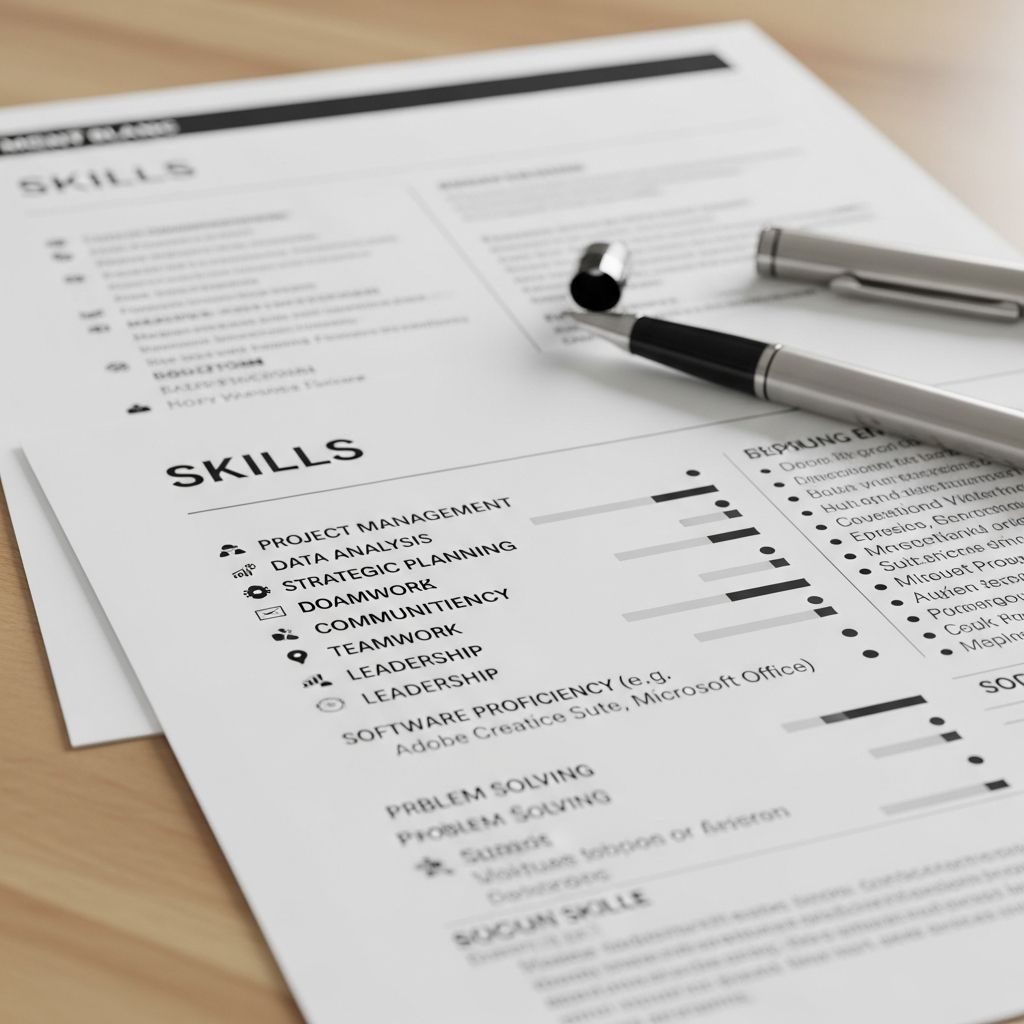
A skills-first resume shifts the spotlight from your employment timeline to your core competencies, making it an invaluable tool for job seekers whose career paths don’t follow a straight line. This format organizes your professional profile around key abilities, achievements, and qualifications, allowing recruiters to quickly grasp your value without getting bogged down in dates or job titles.
Understanding the Skills-First Resume Format
Unlike traditional chronological resumes that list jobs from most recent to oldest, a skills-first approach groups experiences under thematic skill categories. This structure proves particularly effective when your work history includes irregularities, such as extended breaks, frequent short-term roles, or transitions between unrelated industries. By leading with what you can do, you immediately address the employer’s needs and demonstrate relevance.
The core philosophy is simple: employers hire for results and capabilities, not calendars. This format empowers you to curate your narrative, drawing from diverse sources like education, volunteering, freelance projects, and professional training to build a compelling case.
Who Benefits Most from This Approach?
Not every job seeker needs a skills-first resume, but certain profiles find it transformative. Here’s a breakdown of ideal candidates:
- Recent Graduates: With minimal professional experience, emphasize academic projects, internships, extracurriculars, and transferable skills like research, teamwork, and analysis.
- Career Changers: Highlight overlapping competencies from prior fields, such as leadership from retail applying to management roles or data analysis from finance suiting marketing positions.
- Employment Gap Navigators: Whether due to parenting, travel, health, or relocation, downplay timelines while showcasing maintained or newly acquired skills.
- Gig Economy Veterans: Freelancers, contractors, and temp workers consolidate fragmented experiences into cohesive skill clusters, proving expertise across projects.
- Seasoned Professionals Re-entering: Older workers or those returning after sabbaticals focus on current relevance, mitigating age bias by prioritizing up-to-date abilities.
This format suits about 20-30% of job seekers, particularly in dynamic markets where adaptability trumps tenure.
Key Advantages of Leading with Skills
Adopting a skills-first structure offers distinct edges over conventional formats. Consider these benefits:
- Immediate Impact: Recruiters spend an average of 7-10 seconds scanning resumes; front-loading top skills captures attention instantly.
- Flexibility in Storytelling: Tailor content per application by reordering skill groups to match job descriptions.
- Gap Minimization: Employment voids fade into the background as focus stays on capabilities.
- Achievement Amplification: Quantifiable accomplishments anchor each skill, providing proof over promises.
- Brevity and Clarity: Often one page, this format respects busy hiring managers’ time.
| Scenario | Chronological Resume Challenge | Skills-First Solution |
|---|---|---|
| Career Gap (2 years) | Obvious blank space raises questions | Skills section fills page with value |
| Frequent Job Changes | Perceived instability | Projects grouped by theme |
| Industry Switch | Irrelevant past roles dominate | Transferable skills lead |
| Entry-Level Applicant | Thin work history | Education and projects elevated |
Potential Drawbacks and How to Counter Them
While powerful, skills-first resumes aren’t flawless. Applicant Tracking Systems (ATS) may struggle with non-standard layouts, and some recruiters view them suspiciously as hiding history. Counter this by:
- Incorporating job titles and employers subtly in a brief ‘Professional Summary’ section.
- Using standard headings like ‘Skills’ and ‘Experience’ for ATS compatibility.
- Pairing with a strong LinkedIn profile for full context.
Reserve this format for human-reviewed applications or industries valuing skills over pedigree, like creative fields or startups.
Step-by-Step Guide to Building Your Skills-First Resume
Craft a standout document with this proven blueprint:
- Contact Information: Name, phone, email, LinkedIn, location (no full address for privacy).
- Professional Summary: 3-5 sentences profiling your value proposition, top skills, and career focus. Example: ‘Dynamic project coordinator with 5+ years in agile environments, excelling in cross-functional team leadership and deadline management. Proven in tech and nonprofit sectors.’
- Core Skills Inventory: 6-12 bullet points blending hard (e.g., Python, SEO) and soft skills (e.g., negotiation, adaptability). Prioritize job ad matches.
- Skills Deep Dive: 3-5 categories with 3-5 bullets each, quantifying impacts. E.g., Leadership: Directed 15-person team to 20% efficiency gain.
- Work Snapshot: Minimal list: Company, Title, Dates (year only), 1-2 key bullets if relevant.
- Education & Certifications: Degrees, relevant coursework, online certs (e.g., Google Analytics, CPR).
- Additional Sections: Volunteer work, publications, languages as space allows.
Design tips: Clean fonts (Arial/Calibri 10-12pt), ample white space, consistent formatting, PDF export.
Real-World Examples Tailored to Scenarios
Example 1: Recent Grad Seeking Marketing Role
- Summary: Ambitious BComm graduate skilled in digital marketing, content creation, and analytics.
- Skills: SEO, Google Ads, Adobe Suite, Social Media Strategy.
- Digital Marketing: Grew campus club Instagram by 300% via targeted campaigns.
- Work: Retail Associate, XYZ Store (2024-2025).
Example 2: Career Changer from Teaching to HR
- Skills: Conflict Resolution, Training Design, Performance Coaching.
- People Management: Mentored 50+ students, improving grades by 15% average.
These samples demonstrate customization power.
Frequently Asked Questions (FAQs)
Is a skills-first resume suitable for all industries?
No, it’s best for creative, tech, or non-corporate roles. Corporate or ATS-heavy fields prefer chronological.
How do I make it ATS-friendly?
Use standard section names, keywords from the job post, and avoid tables/graphics in parsing areas.
Should I include dates at all?
Yes, minimally under a compact work history to build trust without dominating.
Can freelancers use this effectively?
Absolutely—group projects by skill to show depth across clients.
How long should it be?
One page ideal; experienced candidates may extend to two.
Pro Tips for Maximum Impact
– Analyze 3-5 job postings; mirror their language.
– Quantify everything: percentages, dollars, numbers.
– Get feedback from peers or tools like Jobscan.
– Update quarterly to reflect new wins.
– Always customize—no generic versions.
Mastering the skills-first resume positions you as a capability powerhouse, turning potential weaknesses into strengths. Implement these strategies to elevate your job search.
References
- Functional Resume Format: Who Should Use It & Why — LiveCareer. 2023-10-15. https://www.livecareer.com/resume/formats/functional
- Advantages of a Functional Résumé and CV — CareerCubicle. 2022-05-20. http://careercubicle.com/blog/advantages-of-a-functional-resume-and-cv/
- Functional Resume — Recruiteze. 2024-01-12. https://recruiteze.com/glossary/functional-resume/
- Functional Resume — Corporate Finance Institute. 2023-08-05. https://corporatefinanceinstitute.com/resources/career/functional-resume/
- What Is a Functional Resume and Is It Right for You? — Forage. 2024-03-18. https://www.theforage.com/blog/basics/functional-resume

Medha Deb is an editor with a master's degree in Applied Linguistics from the University of Hyderabad. She believes that her qualification has helped her develop a deep understanding of language and its application in various contexts. Medha specializes in the areas of beauty, health, sports, and wellness and is committed to ensuring that the content on the website is…