
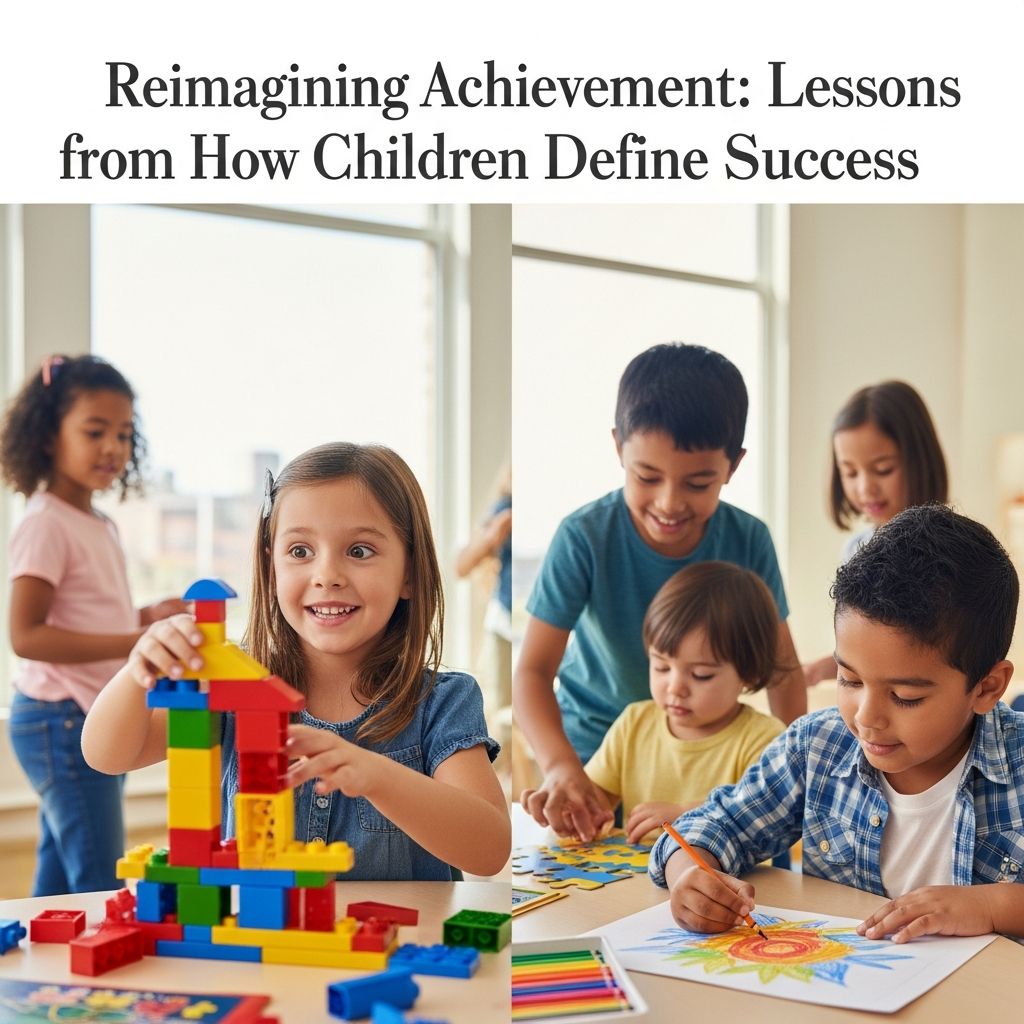
Understanding Success Through a Child’s Eyes
Adults often complicate success by attaching it to tangible outcomes—promotions, possessions, accolades, and external validation. Yet children possess a fundamentally different understanding of what it means to achieve and excel. Their perspective strips away the noise and reveals truths about success that, once learned, can transform how we approach our own goals and aspirations. Success, in a child’s view, represents the process of becoming better rather than achieving a specific destination. This distinction creates a foundation for sustained motivation, genuine fulfillment, and the resilience necessary to navigate life’s inevitable challenges.
When we observe children engaged in activities they enjoy—whether building blocks, learning to ride a bicycle, or mastering a new game—we notice something remarkable: they remain fundamentally committed to the experience itself rather than obsessing over the final result. They celebrate small victories, learn from missteps, and maintain enthusiasm regardless of setbacks. This approach contains profound wisdom that modern achievement culture desperately needs.
The Power of Intrinsic Motivation and Personal Ownership
Children naturally gravitate toward activities driven by internal passion rather than external pressure. When a child decides to learn something because they genuinely want to understand it, their engagement reaches entirely different levels compared to when adults impose goals upon them. This intrinsic motivation—the desire to pursue something for its own sake—serves as the most powerful driver of sustained effort and genuine success.
Adults frequently fall into the trap of pursuing achievements that others value rather than those that truly matter to them. A promotion that looks impressive on paper but brings no joy, a hobby pursued to impress friends rather than for personal satisfaction, or a career path inherited from family expectations all represent achievements disconnected from authentic motivation. Children teach us that ownership matters profoundly. When you decide what success means for you personally, when the goals emerge from your own desires and values, the entire achievement process transforms.
This lesson suggests that adults would benefit from pausing to ask themselves: Am I pursuing this goal because I genuinely want it, or because I believe I should want it? The difference between these two motivations determines whether achievement will feel like growth or like burden.
Embracing Mistakes as Essential Learning Opportunities
A toddler learning to walk does not interpret repeated falls as evidence of failure. Instead, each tumble provides valuable information about balance, strength, and technique. Children instinctively understand that mistakes represent the most direct pathway to improvement. They gather data from errors, adjust their approach, and try again without the debilitating shame that often paralyzes adults.
Modern achievement culture frequently sends the opposite message. Schools penalize mistakes with poor grades. Workplaces fear errors due to quality control concerns. Social media highlights only the polished final product, hiding the numerous attempts and adjustments that preceded it. The result is that many adults develop an irrational fear of failure that prevents them from attempting anything challenging or unfamiliar.
Children demonstrate a healthier framework. As the poet Nikki Giovanni noted, “Mistakes are a fact of life. It is the response to the mistakes that counts.” When children approach mistakes as information rather than indictment, they remain willing to take the risks necessary for genuine growth. They understand that mistakes indicate they are pushing beyond their current abilities, testing new approaches, and expanding their capabilities.
Consider the implications: If adults could reframe mistakes the way children naturally do, how many new skills would we develop? How many creative projects would we complete? How many challenges would we tackle that currently seem too risky?
Maintaining Curiosity and Wonder as Lifelong Practices
Children possess an almost insatiable curiosity about the world around them. They ask endless questions, investigate everything within reach, and find genuine fascination in phenomena that adults barely notice. This curiosity is not a personality trait limited to certain individuals—it represents a fundamental developmental characteristic that children actively practice and reinforce through exploration and play.
Somewhere between childhood and adulthood, many people lose this active curiosity. Routines settle in. Familiar patterns become comfortable. The world stops seeming surprising and fresh. Yet this loss of curiosity carries enormous costs. Research consistently demonstrates that curious individuals experience greater life satisfaction, continue learning more effectively, and maintain higher levels of engagement across all domains of life.
Children teach through example that curiosity is not something you either have or lack—it is a practice that requires active maintenance. When children explore, they play with possibilities, imagine different outcomes, and experiment without excessive planning or worry about perfection. They try things simply to see what happens. This approach to exploration generates both joy and accelerated learning.
Adults can resurrect this capacity by deliberately introducing exploration into their daily lives. Ask questions about topics you normally take for granted. Investigate skills that interest you without worrying about becoming an expert. Approach familiar situations from new angles. This practice of curiosity mirrors how children naturally engage with the world.
Building Resilience Through Perspective and Support
The path toward any meaningful achievement includes obstacles, setbacks, and moments of discouragement. Children face these challenges too, yet many possess remarkable resilience—the ability to bounce back from difficulties and maintain effort toward their goals. Resilience does not emerge from avoiding challenges; it develops through experiencing adversity and learning that you can navigate it.
Children naturally build resilience when adults help them maintain perspective during difficulties. A failed test is not a referendum on intelligence; it is information about which concepts require additional study. A rejection from a sports team is not evidence of incompetence; it is feedback about areas for improvement. A conflict with a friend does not mean you are unlovable; it is a normal part of relationships that can be resolved.
When facing adversity, children benefit from approaches that include:
- Contextualizing setbacks rather than catastrophizing them—understanding that a temporary difficulty is not the end of everything
- Attempting problem-solving independently before rushing to rescue them—building confidence in their own capacity to address challenges
- Identifying positive elements alongside obstacles—recognizing what went well and what they learned
- Breaking large problems into smaller, manageable steps—creating a pathway forward from difficulty
- Hearing about adults’ own challenges and recovery—understanding that difficulty is universal and survivable
These same approaches support adult resilience. When you encounter setbacks, the perspective you adopt determines whether you grow or stagnate. Children model the perspective that treats difficulties as information rather than indictment, as invitations to learn rather than proof of inadequacy.
Redefining Success Beyond External Metrics
Children understand success intuitively through how they feel rather than through measurable metrics. When a child successfully completes a challenging task, their face radiates genuine joy. When they master a new skill, pride and excitement are evident. This emotional quality of authentic achievement—the internal sense of growth and capability—represents the true measure of success that most adults overlook.
The achievement culture prevalent in many societies emphasizes external metrics: test scores, salary brackets, social media followers, trophy collections. These metrics can motivate effort temporarily, but they create fragile foundations for sustained achievement because they depend on external validation and comparison with others. By contrast, the internal sense of growth and capability that children naturally experience creates enduring motivation and satisfaction.
Success, as children intuitively understand it, means becoming the best possible version of yourself at any given moment. This definition contains several important elements. First, it acknowledges that “best” is personal and relative rather than absolute. Second, it emphasizes process over outcome, effort over results. Third, it recognizes that growth is continuous rather than arriving at a final destination. Fourth, it focuses on your own trajectory rather than comparison with others.
When adults adopt this perspective, they experience greater satisfaction from their achievements. Improvement matters more than perfection. Effort is celebrated rather than only results. Growth in areas that matter personally brings genuine fulfillment rather than external praise.
Cultivating Confidence Through Experience and Support
Confidence in children develops not from praise but from genuine experiences of competence and growth. When children complete challenging tasks through their own effort, when they overcome obstacles they previously thought impossible, when adults acknowledge their progress and improvement, their confidence naturally strengthens.
This process requires balance. Too much failure without success leads to discouragement and avoidance of challenge. Yet equally important, repeated success only builds confidence when the child understands they achieved it through their own effort rather than luck or others’ assistance. The confidence that children develop through completing genuine challenges provides foundation for pursuing even larger goals.
Adults can mirror this process in their own lives by deliberately selecting goals that stretch their current capabilities without exceeding them entirely. By completing these challenging-but-achievable goals through sustained effort, you create genuine experiences of growth. Over time, these experiences accumulate into authentic confidence—not the brittle kind based on others’ validation, but the sturdy kind rooted in actual capability and proven resilience.
Embracing Play and Creativity in Achievement
Children instinctively understand that play is not frivolous; it is how learning happens most effectively. Through play, children experiment with ideas, test possibilities, make mistakes in safe environments, and develop creativity and problem-solving capacity. Yet adults often abandon play entirely, treating achievement as serious business divorced from enjoyment.
This separation diminishes achievement in multiple ways. When work becomes purely obligatory, motivation decreases. When you remove the element of play and experimentation, creativity declines. When achievement becomes grim rather than joyful, sustainability suffers. Children demonstrate that the most effective learning combines challenge with enjoyment, effort with playfulness, serious goals with light-hearted exploration.
Reintroducing play into your approach to achievement does not mean taking things less seriously. Rather, it means maintaining the experimental, exploratory mindset that children naturally bring to challenges. It means being willing to try unconventional approaches, to experiment with different methods, to laugh at mistakes while learning from them, and to find genuine enjoyment in the process of growth.
The Foundation: Self-Esteem and Feeling Valued
Beneath all of these lessons about achievement lies a crucial foundation: children’s ability to maintain motivation, resilience, and positive emotional responses to challenges depends fundamentally on feeling loved, secure, and competent. When children believe they are valued for who they are rather than what they accomplish, when they feel secure in relationships and environments, when they experience competence through successfully completing age-appropriate challenges, they approach achievement with fundamentally different psychology.
Adults too benefit from this foundation. Self-worth disconnected from achievement creates psychological space to pursue challenging goals without the fear that failure will render you worthless. Security in important relationships provides buffer against setbacks and encouragement during difficulties. Experiences of competence build confidence for pursuing larger challenges.
This suggests that sustainable, fulfilling achievement grows from a foundation of self-acceptance and security rather than from willpower, discipline, or external pressure alone.
Frequently Asked Questions
Q: Can adults successfully adopt a child’s perspective on success?
A: Yes, adults can consciously adopt these perspectives through deliberate practice. While children naturally maintain these views, adults can reinstate them through reflection, adjusting goal-setting approaches, and intentionally celebrating progress rather than only outcomes.
Q: How do I maintain intrinsic motivation when external pressures demand results?
A: Separate your identity from specific outcomes. Focus on the aspects of work or projects that genuinely interest you. Break large externally-imposed goals into smaller milestones where you can identify personally meaningful dimensions.
Q: What should I do when I experience significant setbacks?
A: Apply the framework children use: gather information from the setback, adjust your approach based on what you learned, maintain perspective by recognizing it is temporary rather than permanent, and continue effort toward your goals with revised strategy.
Q: How can I help my own children develop these healthy views of success?
A: Model curiosity and healthy responses to mistakes in your own life. Praise effort and improvement rather than innate ability. Allow them to experience appropriate challenges and help them learn from setbacks rather than protecting them from all difficulty.
References
- Children’s Emotional Reactions to Achievement — Dr. Jim Taylor. Accessed 2026-01-18. https://www.drjimtaylor.com/4.0/childrens-emotional-reactions-to-achievement/
- 11 Life Lessons for Kids to Foster Growth — Slumberkins. Accessed 2026-01-18. https://slumberkins.com/blogs/slumberkins-blog/life-lessons-for-kids
- A Kid’s Guide to Success – In School, Sports, and Life — Dr. Steve Silvestro. Accessed 2026-01-18. https://www.drstevesilvestro.com/kids-guide-to-success-in-school-sports-life
- 6 Important Life Lessons We Can Learn From Children — Brainz Magazine. Accessed 2026-01-18. https://www.brainzmagazine.com/post/6-important-life-lessons-we-can-learn-from-children

Medha Deb is an editor with a master's degree in Applied Linguistics from the University of Hyderabad. She believes that her qualification has helped her develop a deep understanding of language and its application in various contexts. Medha specializes in the areas of beauty, health, sports, and wellness and is committed to ensuring that the content on the website is…