
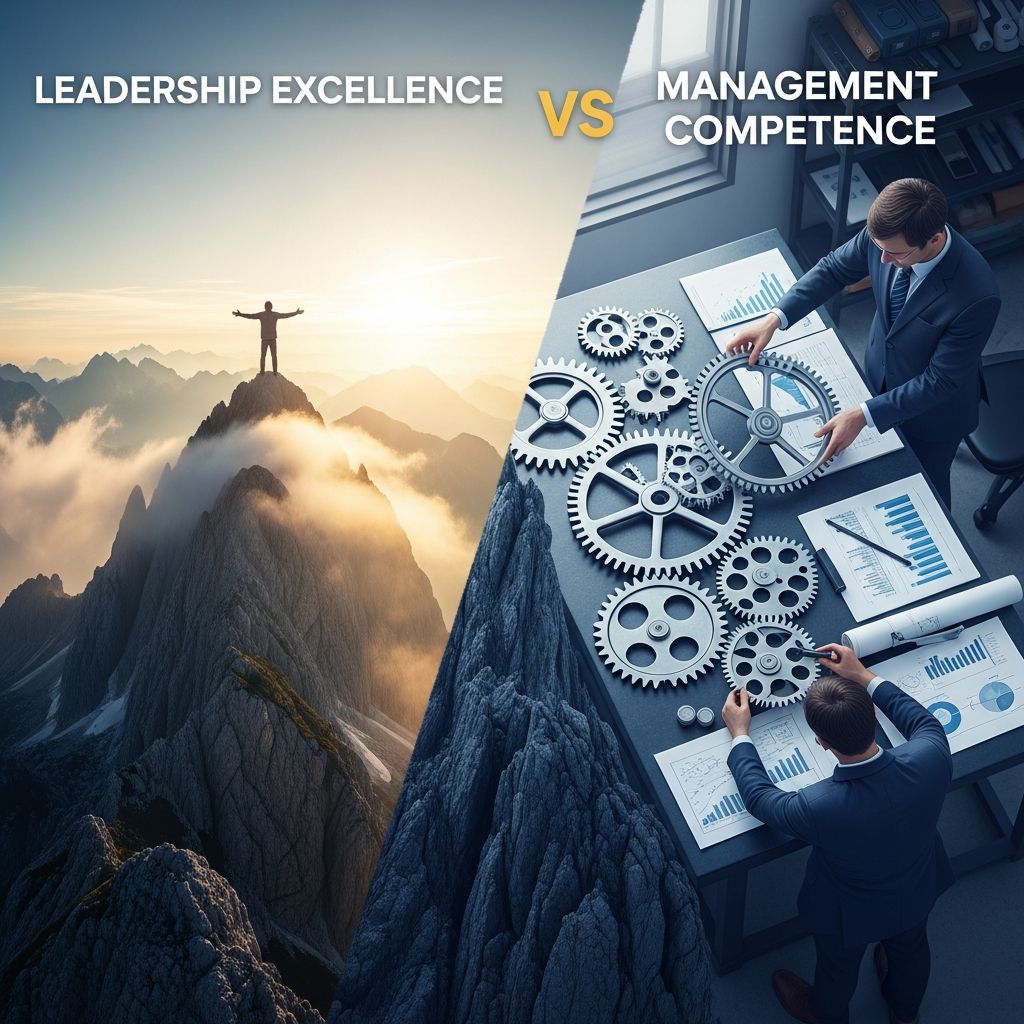
Organizations function most effectively when they recognize and leverage the distinct contributions of both leaders and managers. While these terms are often used interchangeably, they represent fundamentally different orientations toward organizational success. Understanding these differences is essential for anyone aspiring to advance their career or improve their organization’s performance. A truly exceptional leader and a highly competent manager bring complementary strengths that, when combined, create the foundation for sustained organizational growth and employee engagement.
The Foundational Distinction: Present vs. Future Orientation
The most fundamental difference between these two roles lies in their temporal focus. Managers concentrate on the present moment, addressing immediate challenges, maintaining operational efficiency, and ensuring that day-to-day tasks are completed on schedule and within budget. Their mindset is rooted in the here-and-now, where they monitor workflows, allocate resources, and solve problems as they arise. This present-focused approach is invaluable because organizations require someone to keep the machinery running smoothly and consistently.
Leaders, conversely, maintain their gaze firmly fixed on the horizon. They contemplate where the organization should be heading, what opportunities await in the marketplace, and what transformations might be necessary to ensure long-term competitive advantage. Leaders think in terms of years and decades, envisioning possibilities that may not yet exist and charting courses that others might not yet recognize as necessary. This future-oriented perspective enables organizations to anticipate market shifts and position themselves proactively rather than reactively.
Strategic Vision vs. Tactical Execution
A critical distinction emerges when examining how each role approaches organizational objectives. Great leaders are architects of vision and strategy. They define the organization’s purpose, establish compelling missions, and articulate long-term strategic directions. Leaders pose foundational questions: What should we become? What value do we create? How do we want to be remembered? These visionary leaders create the intellectual and emotional frameworks that guide organizational decision-making at every level.
Managers, in their role as executors, take these broad visions and translate them into concrete action plans. They break down strategic objectives into manageable goals, assign responsibilities, establish timelines, and track progress against measurable milestones. A manager’s expertise lies in converting abstract ambitions into structured processes and deliverable outcomes. Where leaders ask “why” and “what,” managers focus intently on “how.” This division of cognitive labor allows organizations to maintain both inspiration and implementation.
Innovation Cultivation vs. Process Refinement
The relationship with change represents another defining characteristic. Exceptional leaders thrive in environments of uncertainty and actively champion transformation. They encourage their teams to challenge conventional wisdom, explore uncharted territories, and develop novel solutions to emerging problems. Leaders foster a culture where experimentation is valued, where calculated risks are encouraged, and where creative thinking is celebrated. This innovative mindset is what pushes organizations beyond their current capabilities toward breakthrough achievements.
Managers maintain a different relationship with change: they are stewards of continuity and stability. While leaders are comfortable disrupting existing systems, managers work to maintain reliable processes that have proven effective. They optimize workflows, standardize procedures, and implement controls that minimize errors and unpredictability. Rather than viewing change as inherently desirable, managers evaluate each change against clear efficiency and stability criteria. Both approaches are essential—without leadership innovation, organizations stagnate; without managerial consistency, innovation becomes chaotic.
Influence Mechanisms: Inspiration vs. Authority
How these two types of professionals exert influence over their teams differs substantially. Leaders inspire through personal conviction, vision articulation, and authentic belief in a compelling future state. They move people through emotional connection and inspired purpose rather than formal authority. When a leader speaks of where the organization is heading and why it matters, people feel motivated to contribute their best efforts. This inspirational approach creates intrinsic motivation—people work toward goals because they genuinely believe in them, not primarily because of rewards or sanctions.
Managers influence primarily through their formal position and established authority. They have responsibility for hiring decisions, performance evaluations, compensation adjustments, and disciplinary actions. This legitimate authority allows managers to direct work assignments, establish expectations, and ensure accountability. While managers certainly benefit from being likeable and respected, their ability to influence depends significantly on their positional power. Managers direct and supervise; leaders motivate and empower. Both forms of influence are necessary—people need both the inspiration that pulls them forward and the structure that clarifies expectations.
Risk Philosophy: Embracing Uncertainty vs. Minimizing Variance
Another revealing distinction surfaces in how these professionals approach risk and uncertainty. Leaders understand that meaningful progress requires venturing into the unknown. They accept that some initiatives will fail, that markets may respond unpredictably, and that transformational change carries inherent uncertainty. Rather than viewing risk as something to be eliminated, leaders see it as an unavoidable component of growth and innovation. They encourage their organizations to pursue ambitious goals despite incomplete information and unproven approaches.
Managers, by contrast, naturally gravitate toward risk mitigation and proven methodologies. Their responsibility for operational continuity means they prefer established processes, documented procedures, and approaches with demonstrated track records. Managers ask rigorous questions about potential negative outcomes and work to minimize disruption. This cautious mindset prevents organizational chaos and protects against preventable failures. The tension between leadership risk-taking and managerial risk-aversion creates a productive dynamic—leaders push organizations to grow while managers ensure that growth doesn’t destabilize essential operations.
Decision-Making Philosophy and Perspective
When faced with significant decisions, leaders and managers tend toward different analytical frameworks. Leaders think systematically about the organization as an integrated whole, recognizing how decisions in one area ripple through the entire system. Their decisions are informed by broad strategic considerations and have implications across multiple departments and levels. A leader’s choice to enter a new market, for instance, affects not just the sales function but also product development, operations, human resources, and finance.
Managers typically focus their decision-making within their functional domain or department. They ask how a decision affects their team’s ability to execute current responsibilities and maintain established performance standards. While managers certainly consider organizational strategy, their primary purview involves decisions related to their specific operational area. This more bounded decision-making authority allows managers to act more quickly on operational matters while staying within their scope of responsibility.
Communication Approaches and Messaging
The ways these professionals communicate with their teams reflect their different roles and objectives. Leaders use communication as a tool to inspire, motivate, and paint vivid pictures of desired futures. Effective leaders communicate with passion and conviction, helping their audience envision possibilities and feel emotionally connected to organizational direction. Leadership communication tends toward the motivational and aspirational, designed to energize people and align them around common purpose.
Managers use communication to clarify expectations, provide instruction, and build operational alignment. Their messaging tends to be more specific and instructional, focusing on timelines, responsibilities, and measurable outcomes. When a manager communicates, the audience understands exactly what is expected, by when, and how success will be measured. While less emotionally stirring than leadership communication, managerial communication provides the clarity that allows coordinated effort to occur efficiently.
Key Characteristics Comparison
| Dimension | Exceptional Leaders | Competent Managers |
|---|---|---|
| Time Horizon | Long-term (years/decades) | Short-term (months/years) |
| Primary Focus | Strategic vision and direction | Operational efficiency and execution |
| Approach to Change | Initiate and champion innovation | Maintain stability and continuity |
| Influence Method | Inspiration and conviction | Authority and structure |
| Risk Orientation | Comfortable with uncertainty | Risk-averse and cautious |
| Decision Scope | Organizational-wide implications | Departmental or functional focus |
| Communication Style | Motivational and visionary | Clear, detailed, and instructional |
Why Organizations Need Both Roles
A common misconception suggests that organizations benefit primarily from exceptional leaders, with managers playing merely supporting roles. This perspective misses a crucial reality: both types of professionals are essential for organizational success. Leadership without strong management results in compelling visions that never materialize into concrete results. Employees become inspired but frustrated when grand strategies never translate into actual achievements. Conversely, excellent management without leadership produces efficient operations that slowly become obsolete, as the organization optimizes itself for markets and conditions that are gradually disappearing.
The most successful organizations cultivate both leadership excellence and managerial competence throughout their structures. They recognize that these functions can exist at various levels—leadership can emerge from middle managers, and managerial competence strengthens senior executive effectiveness. By valuing and developing both capabilities, organizations create the conditions for sustained competitive advantage.
Developing Yourself in Either Direction
Understanding these distinctions helps professionals chart their career development paths intentionally. Those with entrepreneurial instincts and comfort with ambiguity might cultivate leadership capabilities by studying market trends, developing strategic thinking skills, and practicing persuasive communication. Professionals who thrive on systematic problem-solving and organizational clarity might strengthen managerial competencies by mastering project management methodologies, financial acumen, and operational excellence practices.
The most adaptable professionals, however, develop capabilities in both domains. Leaders benefit from understanding operational realities and constraints, while managers enhance their effectiveness by adopting broader perspectives and encouraging innovation within their domains. This hybrid capability makes professionals more valuable and organizations more resilient.
Frequently Asked Questions
Q: Can someone be both a great leader and an effective manager?
A: Absolutely. While these roles emphasize different capabilities, exceptional professionals develop competence in both domains. Such individuals can provide both inspirational direction and operational excellence, making them exceptionally valuable to organizations.
Q: Is leadership more important than management?
A: Both are critically important for different reasons. Leadership ensures organizational relevance and growth, while management ensures operational effectiveness and stability. Organizations need both to succeed sustainably.
Q: Can managers become leaders?
A: Yes. Managers can develop leadership capabilities by broadening their perspective beyond their immediate domain, engaging more deeply with organizational strategy, and cultivating their ability to inspire and motivate through vision rather than authority.
Q: What skills are unique to leadership?
A: Leadership-specific skills include strategic visioning, change management, inspirational communication, and the ability to navigate ambiguity and uncertainty while maintaining conviction about future direction.
Q: How do I know if I’m suited for management vs. leadership?
A: If you find satisfaction in creating order, meeting established goals, and optimizing processes, management may suit you well. If you’re energized by imagining future possibilities, championing change, and inspiring others toward new horizons, leadership may be your strength.
References
- Management vs. Leadership: What’s the Difference? — Olivet Nazarene University. Accessed January 2026. https://www.ollusa.edu/blog/management-vs-leadership.html
- Management vs. Leadership: Similarities and Differences — Wilson Online, Regent University. Accessed January 2026. https://online.wilson.edu/resources/management-vs-leadership/
- Leadership vs Management: 7 Core Differences to Know — Rollins College Crummer Graduate School of Business. Accessed January 2026. https://crummer.rollins.edu/resources/leadership-vs-management/
- Leadership vs Management: Key Differences and Examples — Simplilearn. Accessed January 2026. https://www.simplilearn.com/leadership-vs-management-difference-article
- Leadership vs. Management: The 5 Main Differences — Haiilo Blog. Accessed January 2026. https://blog.haiilo.com/blog/leadership-management-differences/
- Leaders vs Managers: Key Differences and Commonalities — Fisher College of Business, Ohio State University. Accessed January 2026. https://fisher.osu.edu/blogs/leadreadtoday/leaders-vs-managers-key-differences-and-commonalities
- Leading vs. Managing: What’s the Difference? — Program on Negotiation at Harvard Law School. Accessed January 2026. https://www.pon.harvard.edu/daily/leadership-skills-daily/leading-vs-managing-whats-the-difference/

Medha Deb is an editor with a master's degree in Applied Linguistics from the University of Hyderabad. She believes that her qualification has helped her develop a deep understanding of language and its application in various contexts. Medha specializes in the areas of beauty, health, sports, and wellness and is committed to ensuring that the content on the website is…