
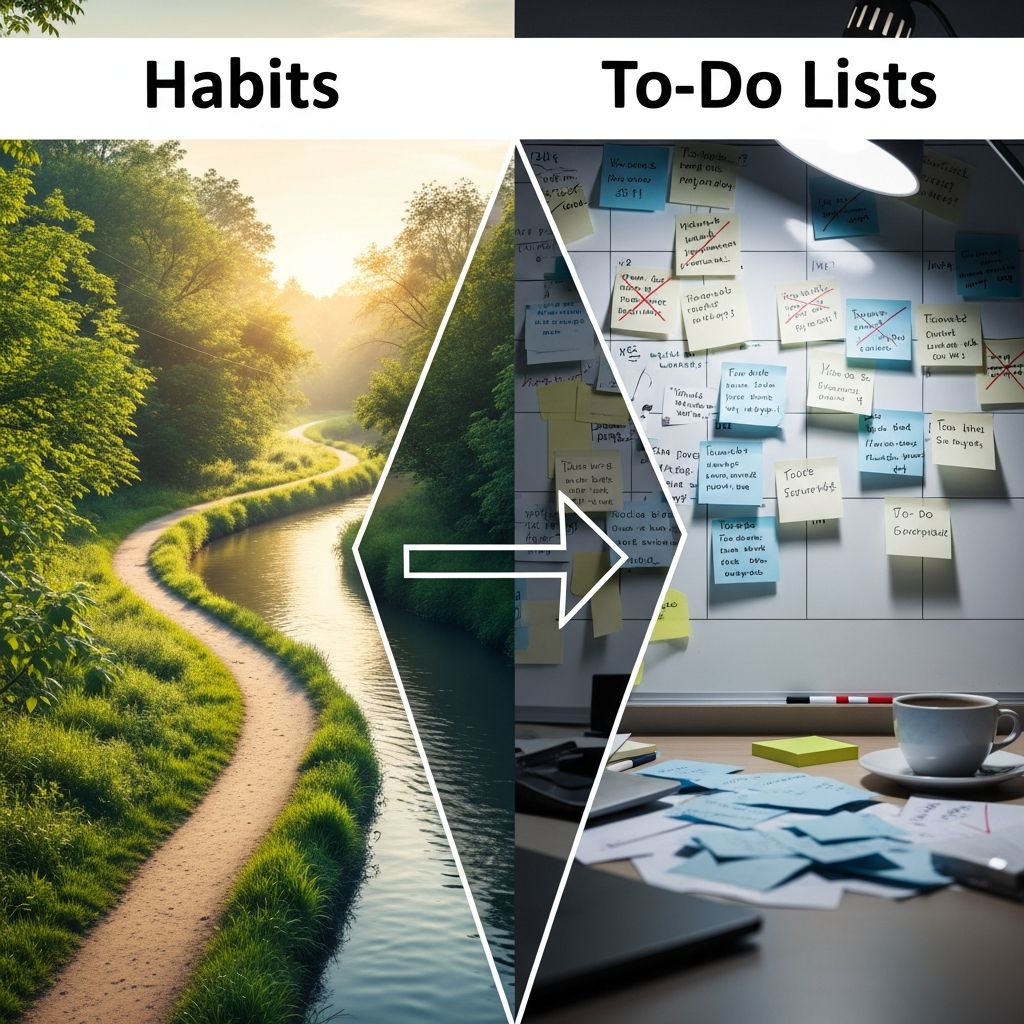
Productivity systems often revolve around capturing what needs to be done, but not all actions are created equal. **Habits** form the backbone of consistent behavior, while **to-do lists** handle fleeting responsibilities. Understanding this divide allows individuals to create systems that foster long-term change rather than temporary wins.
Defining the Core Differences
Habits are automatic behaviors repeated regularly, like brushing teeth or a morning walk, designed for repetition without decision fatigue. To-do lists, conversely, capture discrete, one-time actions such as ’email client’ or ‘buy groceries,’ which vanish once completed.
The fundamental distinction lies in mindset: habits build identity and momentum over time, whereas tasks demand prioritization and often compete for attention. Mixing them muddles focus—habits become optional when buried in a sea of urgent tasks.
- Habits: Recurring, non-negotiable routines that shape daily life.
- To-dos: Finite items tied to projects or external demands.
Why Traditional To-Do Lists Fall Short for Habits
To-do lists excel at organization but falter for habit formation. Each unchecked habit item feels like failure, leading to guilt or abandonment. Tasks are ‘done and forgotten,’ but habits require streaks and forgiveness for missed days.
Placing habits on a to-do list turns them into suggestions amid endless options, diluting their power. Behavioral science supports this: habits thrive on cue-response-reward loops, not checklists.
| Aspect | Habits | To-Do Lists |
|---|---|---|
| Purpose | Long-term automation | Short-term completion |
| Failure Response | Reset tomorrow | Mark overdue |
| Tracking | Streaks & consistency | Checkmarks & priorities |
The Power of Dedicated Habit Tracking
Habit trackers emphasize consistency over perfection. Miss a day? Continue the streak without penalty. This approach aligns with how brains wire behaviors—through repetition, not punishment.
Apps like Routine prioritize habit building with visual streaks and calendar integration, ideal for routines like hydration or meditation. Separate tracking ensures habits remain sacred, defining life quality beyond daily chaos.
Optimizing To-Do Lists for Maximum Impact
Reserve to-do lists for actionable, finite items. Use labels, priorities, and due dates to surface what’s urgent. Tools like Todoist offer views (list, kanban, calendar) for flexibility.
Break large projects into tasks to combat overwhelm. This method defends calendar time for execution, preventing tasks from becoming mental clutter.
Integrating Habits and Tasks Seamlessly
The optimal system uses both: a habit tracker for routines and a task manager for projects. Keep them separate to preserve habit non-negotiability.
For example, schedule habits in fixed blocks (e.g., morning routine), then slot tasks around them using AI schedulers like Reclaim.ai, which auto-adjusts for conflicts.
- Start day with habits for momentum.
- Review tasks mid-morning for priorities.
- End with reflection on both.
Real-World Benefits of This Dual Approach
Users report higher consistency: habits stick 80% better when isolated, per productivity studies. Tasks complete faster without habit dilution.
One professional used Routine for wellness habits and Todoist for work, gaining 2 hours daily through focused routines. Long-term, this builds resilience against burnout.
Choosing the Right Tools
Select based on needs:
- Habit-focused: Routine (beautiful UI, calendar sync), Streaks app.
- Task-heavy: Todoist (robust views), Things 3 (elegant design).
- Hybrid: Reclaim.ai (AI scheduling for both).
Avoid overloading one app; separation clarifies purpose.
Building Your Habit List: Step-by-Step
- Identify 3-5 core habits: Focus on high-impact (sleep, movement, learning).
- Set cues: Link to existing routines (post-coffee stretch).
- Track visually: Use chains or apps for motivation.
- Review weekly: Adjust without judgment.
Mastering To-Do Lists: Proven Strategies
- Prioritize with Eisenhower Matrix.
- Limit daily tasks to 3-5.
- Batch similar items (emails together).
- Defer or delegate non-essentials.
Overcoming Common Challenges
Challenge: Habit slips. Solution: No make-up days; restart fresh.
Challenge: Task overload. Solution: Time-block around habits first.
Challenge: Tool switching. Solution: Use integrations (e.g., Google Calendar).
Frequently Asked Questions (FAQs)
What if I miss a habit day?
Don’t compensate—simply resume. This prevents burnout and maintains momentum.
Can one app handle both habits and tasks?
Possible, but separation is better for mindset. Hybrids like Reclaim.ai work if features align.
How many habits should I track initially?
Start with 3 to avoid overwhelm; scale as they automate.
Are recurring tasks the same as habits?
No—recurring tasks have endpoints; habits are lifelong.
Which tool is best for beginners?
Routine for habits (intuitive design); Todoist for tasks (simple lists).
Long-Term Transformation Through Dual Systems
Adopting this split reshapes life: habits sculpt character, tasks conquer goals. Over months, automaticity emerges—exercise becomes default, not deliberation.
Productivity soars as energy focuses on creation, not decision. Track progress quarterly; refine based on wins.
Incorporate mindfulness: habits often include reflection, amplifying task efficacy. This holistic method, backed by user experiences, yields sustainable results.
References
- Habits vs Tasks: I Want an App For That — Cate.blog. 2013-12-18. https://cate.blog/2013/12/18/habits-vs-tasks-i-want-an-app-for-that/
- Routine vs Todoist: Daily Planner Comparison (2026) — Efficient App. 2026. https://efficient.app/compare/routine-vs-todoist
- Habits vs. Tasks — The Sweet Setup. N/A. https://thesweetsetup.com/habits-vs-tasks/
- When To Use Habits vs. Tasks? Compare AI Scheduling Features — Reclaim.ai. N/A. https://reclaim.ai/blog/habits-vs-tasks
- Habits vs Recurring Tasks — Fast Fedora. 2013-05. https://blog.fastfedora.com/2013/05/habits-vs-recurring-tasks.html

- Integrated M.A. in Applied Linguistics, University of Hyderabad
- 5+ years in editorial, instructional, SEO, and research-based writing
Sneha is a relationships and lifestyle writer with a strong foundation in applied linguistics and certified training in relationship coaching. She brings over five years of writing experience to theskillvault, crafting thoughtful, research-driven content that empowers readers to build healthier relationships, boost emotional well-being, and embrace holistic living. Her writing and insights reflect the belief that beauty, happiness, and wellness…