
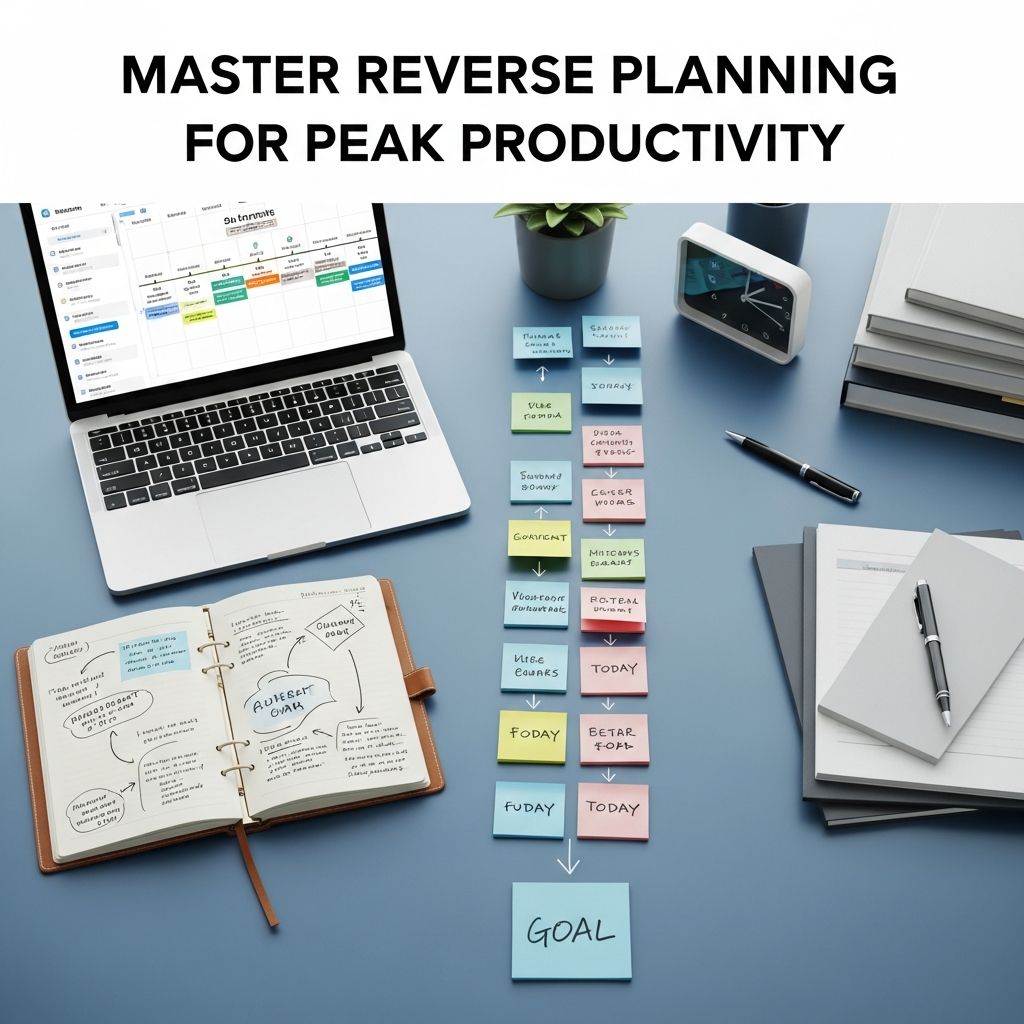
Reverse planning transforms how you approach goals by beginning at the finish line and mapping steps backward. This method sharpens focus and maximizes efficiency across personal and professional pursuits.
Why Reverse Planning Outshines Traditional Methods
Conventional forward planning often starts with immediate tasks, risking misalignment with ultimate objectives. In contrast, reverse planning anchors every action to the desired outcome, fostering purposeful progress.
Research from Peking University, Korea University Business School, and the University of Iowa demonstrates that backward planning boosts motivation, elevates goal expectancy, reduces time pressure, and improves performance compared to forward planning.
Core Advantages of Adopting Reverse Planning
This technique delivers multiple benefits that elevate productivity.
- Precision in Goal Pursuit: Defining the end state first creates a logical roadmap, minimizing detours.
- Resource Optimization: Efforts concentrate on high-impact activities, cutting waste.
- Proactive Risk Handling: Anticipating obstacles allows early countermeasures.
- Motivational Lift: Visualizing success builds confidence and sustains drive.
- Superior Time Control: Deadlines dictate schedules, ensuring timely completion with buffers for delays.
Step-by-Step Guide to Implementing Reverse Planning
Follow this structured process to harness reverse planning effectively.
- Define the Ultimate Outcome: Articulate a specific, measurable goal. For instance, “Launch a new app by December 31 with 1,000 users.”
- Pinpoint Critical Milestones: Identify key achievements en route, like beta testing completion or marketing rollout.
- Break into Actionable Tasks: List prerequisites for each milestone, ensuring SMART criteria—specific, measurable, achievable, relevant, time-bound.
- Assign Realistic Timelines: Work backward from the deadline, incorporating buffer zones for unforeseen issues.
- Review and Refine: Periodically assess progress against the plan, adjusting as needed for adaptability.
Real-World Applications Across Domains
Reverse planning proves versatile in diverse scenarios.
Project Management Excellence
Managers use it to align teams around deliverables, enhancing communication and innovation. Starting with the final product ensures resource allocation matches needs.
Educational Success Strategies
Instructors teach students backward planning to prioritize essential steps, yielding better performance, fewer extensions, and higher-quality work. A 2018 study confirms its motivational and performance edges.
Personal Development Wins
Individuals apply it to fitness goals (e.g., marathon finish) or career shifts, clarifying paths and building optimism by assuming success.
Innovation and Product Development
Teams at innovative firms reverse-engineer customer needs from the ideal solution, sparking creative breakthroughs.
Overcoming Common Hurdles in Reverse Planning
Despite strengths, challenges arise.
| Challenge | Solution |
|---|---|
| Complexity for Large Goals | Divide into phases; use visual tools like Gantt charts. |
| Missing Key Steps | Brainstorm with teams; iterate multiple drafts. |
| Rigid Schedules | Build flexibility with 20% buffer time. |
| Initial Overwhelm | Start small; scale up with practice. |
Tools and Techniques to Enhance Your Reverse Plans
- Digital Planners: Apps like Week Plan or Lark for visualizing reverse timelines.
- Mind Mapping: Software to branch backward from goals.
- SMART Frameworks: Ensure tasks meet all criteria for clarity.
- Progress Trackers: Dashboards to monitor against milestones.
Case Study: Revolutionizing a Marketing Campaign
A team aimed to host a virtual summit with 5,000 attendees. Starting backward: Event date set, then speaker confirmations two months prior, promotions one month out, content prep three weeks before. Buffers handled tech glitches. Result: Oversubscribed event, on-time execution.
Integrating Reverse Planning into Daily Routines
Begin with weekly goals: End-of-week desired state, then daily tasks backward. This habit compounds into long-term success, balancing work and life.
Frequently Asked Questions (FAQs)
What makes reverse planning superior for time management?
It aligns all actions to endpoints, preventing irrelevant efforts and enhancing focus.
Can beginners use reverse planning?
Yes, start with simple goals to build proficiency before tackling complex projects.
How does it mitigate risks?
By forecasting challenges from the end, you prepare solutions in advance.
Is it suitable for teams?
Absolutely; it fosters shared clarity and accountability in group settings.
What if circumstances change mid-plan?
Its flexible nature allows iterative adjustments without derailing the core goal.
Long-Term Impact on Achievement Mindset
Consistent reverse planning rewires thinking toward success visualization, reducing anxiety and amplifying results. Studies affirm its role in sustained high performance.
Embrace this method to navigate ambitions with precision, turning visions into reality efficiently.
References
- What is Backwards Planning? – Week Plan — Week Plan Academy. 2023. https://weekplan.net/academy/glossary/backwards-planning/
- What is Backward Planning? Achieving Goals by Working in Reverse — Focusbox. 2023. https://focusbox.io/glossary/backward-planning
- Working Backwards: A Strategic Approach to Productivity – Lark — Lark Suite. 2023. https://www.larksuite.com/en_us/topics/productivity-glossary/working-backwards
- Teaching students the benefits of planning backwards — University Affairs. 2018. https://universityaffairs.ca/career-advice/teaching-students-the-benefits-of-planning-backwards/
- Think forward, plan backward – Monday 8AM — Monday 8AM. 2023. https://www.monday-8am.com/think-forward-plan-backward/

Medha Deb is an editor with a master's degree in Applied Linguistics from the University of Hyderabad. She believes that her qualification has helped her develop a deep understanding of language and its application in various contexts. Medha specializes in the areas of beauty, health, sports, and wellness and is committed to ensuring that the content on the website is…