
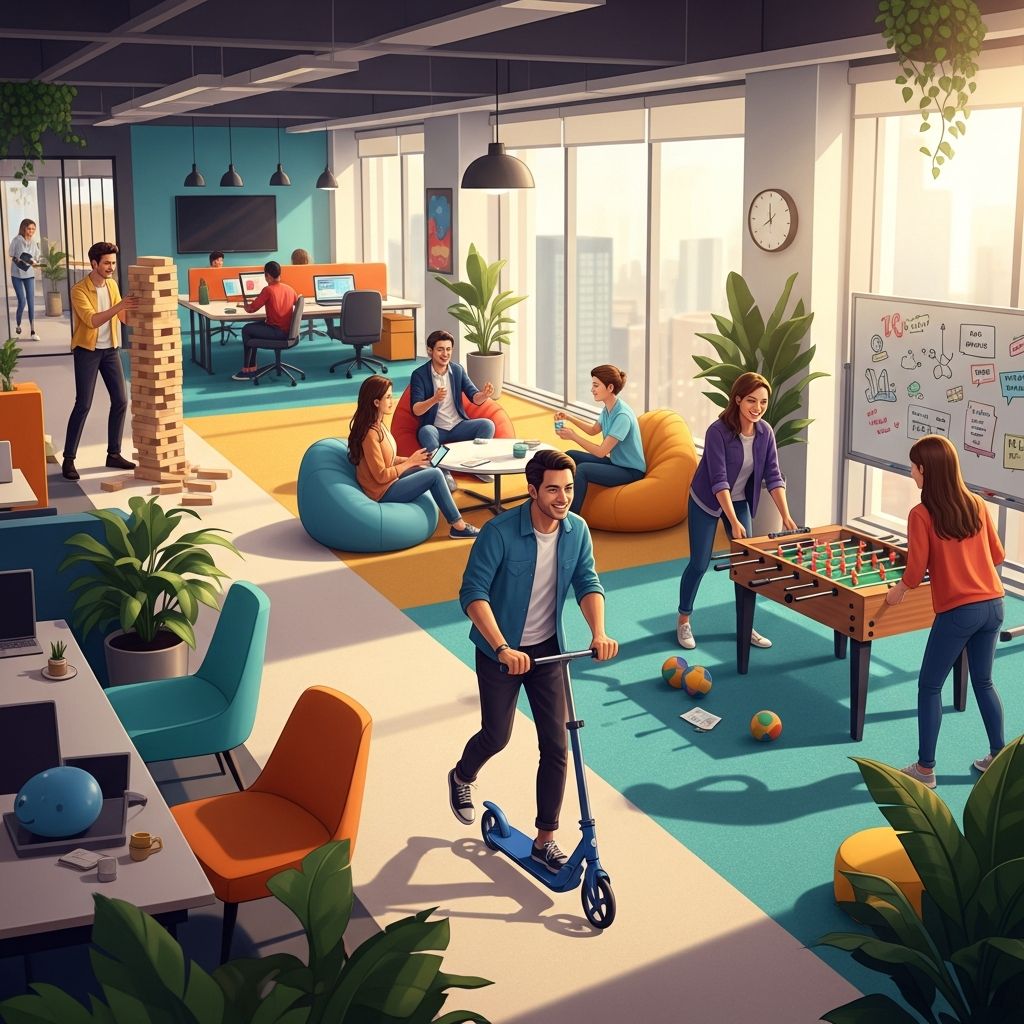
Modern workplaces thrive when leaders prioritize not just productivity but also joy and creativity. By weaving playful elements into daily routines, organizations can cultivate environments where employees feel energized, connected, and motivated. This approach shifts traditional hierarchies toward collaborative spaces that spark innovation and reduce burnout.
Understanding the Role of Play in Professional Settings
Play transcends childhood games; it serves as a powerful tool for adult learning and bonding. In professional contexts, structured play encourages risk-taking without fear of failure, fostering adaptability essential for today’s fast-paced business world. Research highlights that environments embracing lighthearted activities see higher retention rates and creative output.
Organizations adopting playful norms report up to 20% improvements in team cohesion, as playful interactions build trust and psychological safety. Leaders must recognize play as a strategic asset, not a distraction, aligning it with core objectives like innovation and resilience.
Benefits of a Play-Infused Work Culture
Integrating fun yields measurable gains across multiple dimensions. Employees in playful settings exhibit enhanced problem-solving skills, as games simulate real-world challenges in low-stakes scenarios. This mirrors findings from change models emphasizing behavioral reinforcement through engaging rituals.
- Boosted Creativity: Play stimulates divergent thinking, leading to novel solutions.
- Improved Morale: Fun activities combat monotony, reducing stress and absenteeism.
- Stronger Collaboration: Shared games break silos, promoting cross-functional teamwork.
- Higher Retention: Joyful workplaces attract and retain top talent.
These outcomes align with frameworks like Kotter’s 8-Step Model, where short-term wins from fun initiatives build momentum for broader cultural shifts.
Strategies for Introducing Playful Elements
Begin by assessing current culture through anonymous surveys to identify pain points and enthusiasm levels. Gather honest feedback to spot trends in engagement and ensure diverse voices contribute, building trust from the outset.
Daily Micro-Play Rituals
Incorporate brief, recurring activities like morning icebreakers or end-of-day appreciations. These rituals, akin to McKinsey’s “shake it up” approach, embed new norms without overwhelming schedules. For instance, a 5-minute “win of the day” share-out reinforces positive behaviors.
Game-Based Team Challenges
Launch themed competitions such as innovation sprints or puzzle-solving relays. Tie these to business goals, rewarding collaboration over individual wins, much like recognition tools that link fun to cultural values.
| Activity Type | Description | Expected Impact |
|---|---|---|
| Escape Room Challenges | Team-based puzzles requiring cooperation | Enhances problem-solving and bonds |
| Virtual Game Tournaments | Online multiplayer sessions | Supports hybrid teams, boosts remote engagement |
| Creative Workshops | Art or improv sessions | Sparks innovation, reduces inhibitions |
Leadership’s Pivotal Role in Fostering Fun
Executives must model playfulness to signal its legitimacy. Participate visibly in activities, demonstrating vulnerability and approachability. This echoes Harvard’s emphasis on leaders enrolling teams rather than assigning tasks, making change feel personal and inclusive.
Form guiding coalitions of enthusiastic champions across levels, per Kotter’s model, to propagate fun organically. Train managers in facilitation techniques to ensure activities feel authentic, not forced.
Overcoming Obstacles to Playful Adoption
Resistance often stems from perceptions of unprofessionalism or time constraints. Address this by piloting small-scale initiatives, showcasing quick wins like improved meeting energy. Use data from sentiment tracking to refine approaches, identifying barriers early.
Physical redesigns, such as adding game zones or flexible lounges, symbolize commitment, similar to NovaTech’s office transformations that eased hierarchical pushback. Communicate benefits transparently, explaining how play aligns with strategic goals like agility and performance.
Measuring Success and Sustaining Momentum
Track progress with metrics beyond output: engagement scores, turnover rates, and innovation indices. Regular pulse surveys reveal patterns, ensuring equal representation and open dialogue.
- Pre- and post-initiative surveys for sentiment shifts.
- Participation rates in fun events.
- Correlation between play exposure and productivity spikes.
Sustain gains by institutionalizing play in onboarding, performance reviews, and rewards. Update hiring to seek playful traits, embedding it into organizational DNA as per change-ready culture strategies.
Real-World Examples of Playful Transformations
Companies like Unilever have redesigned spaces for creativity, integrating flexibility with fun zones that encourage serendipitous interactions. Others, inspired by McKinsey’s bold moves, introduced ritualistic game days, reorganizing teams around fun challenges to break silos.
In one tech firm, weekly “play labs” led to a 15% patent increase, proving fun’s ROI. These cases illustrate Lewin’s refreeze stage, where reinforced behaviors become the norm.
Tools and Resources for Implementation
Leverage platforms for virtual play: tools like those for recognition (e.g., integrating gamified badges) amplify impact. Wellbeing apps support balanced fun, preventing overload.
For hybrid setups, prioritize inclusive digital games ensuring remote parity, fostering belonging per inclusion strategies.
Frequently Asked Questions (FAQs)
What if my team resists fun activities?
Start small with voluntary opt-ins and share success stories. Address concerns through dialogues, explaining ties to performance, as in change adaptation steps.
How much time should play take in a workday?
Aim for 5-15% of time via micro-rituals; evidence shows it enhances, not detracts from, output.
Can play work in serious industries like finance?
Yes; tailored simulations build skills without compromising professionalism, per distributed leadership models.
How do I budget for play initiatives?
Low-cost options like DIY games yield high returns; scale with ROI data to justify investments.
What about measuring fun’s long-term effects?
Use longitudinal surveys and KPIs like eNPS; sustain via ongoing rituals.
Building Long-Term Playful Resilience
Embed play into crisis response: fun rituals during disruptions maintain morale. Holistic wellness integration ensures play supports mental health, allowing authentic self-expression.
Regular culture audits, per Wharton’s steps, align fun with evolving strategies. Celebrate milestones with epic events, reinforcing the cycle of positivity.
Ultimately, a playful culture equips teams for uncertainty, turning workplaces into launchpads for human potential.
References
- Cultural Transformation: The Complete 2026 Guide for HR Leaders — AIHR. 2026. https://www.aihr.com/blog/cultural-transformation/
- How to Build — and Improve — Company Culture — Harvard Professional Development. 2023. https://professional.dce.harvard.edu/blog/how-to-build-and-improve-company-culture/
- Five bold moves to quickly transform your organization’s culture — McKinsey & Company. 2023. https://www.mckinsey.com/capabilities/people-and-organizational-performance/our-insights/five-bold-moves-to-quickly-transform-your-organizations-culture
- Building a Change-Ready Culture: Strategies for Sustainable… — Duke Fuqua School of Business. 2024. https://www.fuqua.duke.edu/programs/executive-education/leading-dynamic-organizational-transformation/building-a-change-ready-culture
- Leading Successful Organizational Transformation Through Culture — Harvard Business School Online. 2024. https://online.hbs.edu/blog/post/organizational-transformation/

Medha Deb is an editor with a master's degree in Applied Linguistics from the University of Hyderabad. She believes that her qualification has helped her develop a deep understanding of language and its application in various contexts. Medha specializes in the areas of beauty, health, sports, and wellness and is committed to ensuring that the content on the website is…