
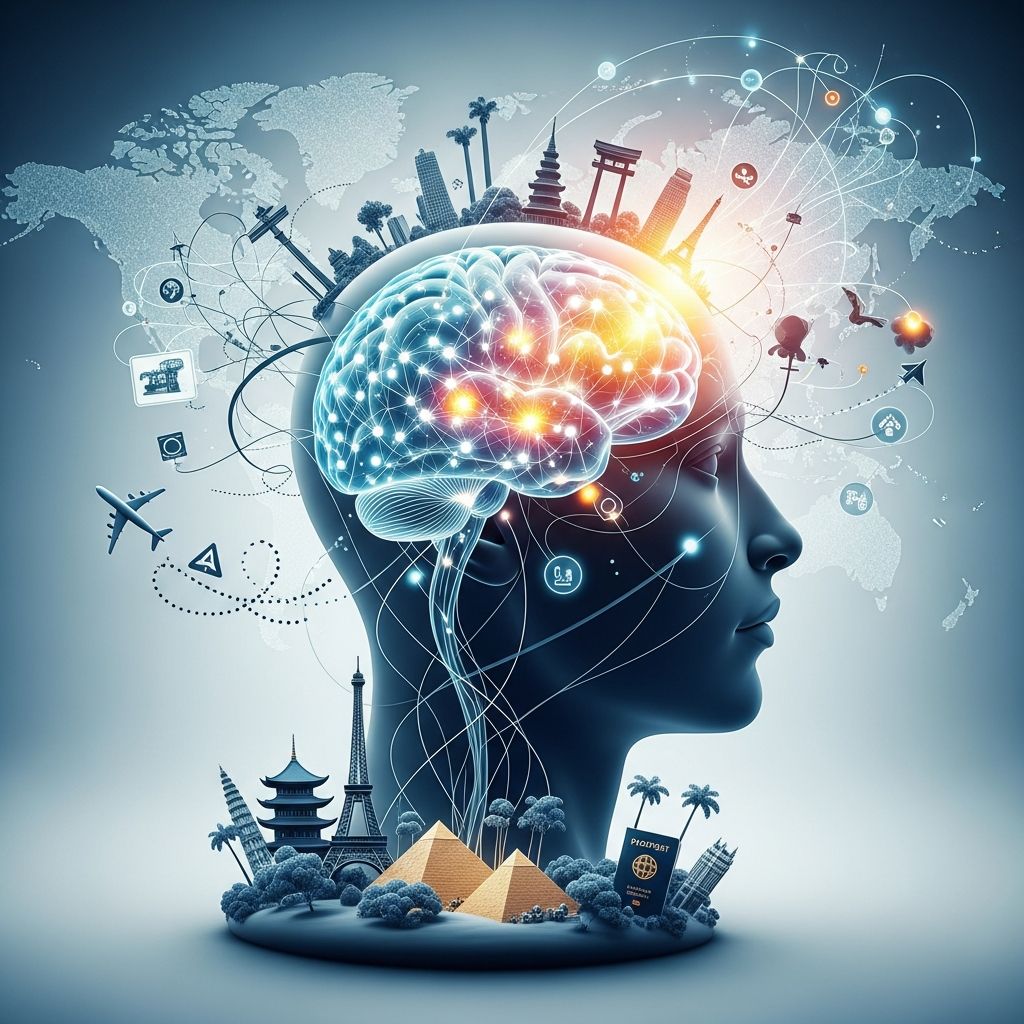
The Transformative Power of Living Abroad on Your Mental Capacity
When you step into a foreign land, you’re not just changing your geographical location—you’re embarking on a journey that fundamentally rewires how your brain processes information, solves problems, and understands the world. The act of immersing yourself in an unfamiliar culture triggers a cascade of neurological adaptations that extend far beyond the duration of your stay. Research consistently demonstrates that individuals who have lived abroad exhibit measurable improvements in cognitive function, emotional intelligence, and creative thinking capabilities.
The brain, much like a muscle, responds to new challenges and stimuli by strengthening its neural pathways and forming new connections. International living provides precisely this type of intensive mental workout, pushing your cognitive systems to operate at heightened levels as you navigate language barriers, cultural differences, and unfamiliar social systems. These experiences create lasting changes in how you think, make decisions, and interact with others.
Unlocking Enhanced Creative Thinking Through Cultural Immersion
One of the most profound transformations that occurs when living abroad is the remarkable expansion of your creative capacity. When your brain encounters novel environments, unexpected social norms, and unfamiliar ways of approaching everyday challenges, it begins developing what cognitive scientists call cognitive flexibility—the ability to shift perspectives rapidly and connect disparate ideas in innovative ways.
The mechanism behind this enhancement is straightforward: creativity emerges when your mind has access to diverse conceptual frameworks and novel information patterns. By living in a culture distinctly different from your own, you expose your brain to alternative solutions for common problems, different social hierarchies, and unconventional approaches to tasks you previously assumed had only one correct method. This constant exposure to “another way of doing things” provides your brain with abundant raw material for generating creative insights.
Studies in cognitive psychology demonstrate that extended cultural immersion increases the depth and breadth of your associative networks—the mental connections that allow you to recognize patterns across seemingly unrelated domains. This enhanced capacity directly translates to improved performance in creative problem-solving, innovation challenges, and situations requiring novel thinking. Professionals who have lived abroad frequently report experiencing breakthrough insights in their careers and demonstrating superior performance in creative tasks.
Language Acquisition as a Catalyst for Brain Development
While traveling abroad allows for cultural observation, actually living abroad creates an urgent necessity for language learning that transforms this from an optional intellectual exercise into an essential survival mechanism. This fundamental difference creates profound neurological benefits that casual tourism cannot replicate.
When you immerse yourself in a foreign language as a daily necessity, your brain activates multiple cognitive systems simultaneously: auditory processing, pattern recognition, memory consolidation, and real-time problem-solving. Unlike classroom language learning, where mistakes carry minimal social consequences, living abroad creates meaningful stakes for linguistic accuracy and comprehension, driving deeper neural engagement.
The cognitive benefits extend throughout your lifespan. Research indicates that bilingual individuals—particularly those who acquired their second language through immersive living experiences—demonstrate delayed onset of age-related cognitive decline, including significant protection against dementia and Alzheimer’s disease. The constant mental exercise of switching between linguistic systems appears to build cognitive reserve, a buffer against age-related mental deterioration.
Beyond protective effects, active language use strengthens multiple cognitive domains: enhanced working memory, improved executive function, and heightened attentional control. The mental discipline required to think, communicate, and problem-solve in a non-native language effectively acts as a comprehensive brain training program.
Developing Superior Decision-Making Capabilities
Your native language doesn’t simply communicate ideas—it shapes the very structure of how you think. Linguistic relativity research reveals that different languages encode different conceptual categories, emphasizing certain distinctions while de-emphasizing others. When you learn to think in another language, you gain access to entirely different cognitive frameworks for approaching decisions.
International living research demonstrates that individuals who regularly think in multiple languages show reduced susceptibility to certain cognitive biases that trap monolingual thinkers. The act of mentally switching between languages requires you to consider alternative frameworks and perspectives, naturally countering the tendency toward confirmation bias and groupthink.
In professional contexts, this enhanced decision-making capacity proves invaluable. When facing complex problems, individuals with international living experience demonstrate superior ability to evaluate options dispassionately, consider stakeholder perspectives, and craft solutions that work across diverse contexts. This capacity to hold multiple viewpoints simultaneously without defaulting to a single framework represents a tangible competitive advantage in leadership roles and strategic decision-making.
Cultivating Deeper Self-Understanding and Identity Clarity
Perhaps paradoxically, living in a radically different cultural context leads to profound clarity about who you actually are. When your familiar cultural environment—the backdrop you’ve always taken for granted—is suddenly absent, you become acutely aware of how much your identity is constructed through cultural conditioning rather than personal essence.
The process of navigating a foreign culture forces continuous reflection: Why do I react negatively to this practice that seems normal here? What aspects of my thinking are genuinely mine versus absorbed from my culture? Which values do I maintain even when no social pressure requires them? These questions create what cross-cultural psychology researchers term “self-discerning reflections”—deliberate introspection about your authentic preferences, values, and identity boundaries.
Research involving thousands of participants across multiple studies confirms that individuals with international living experience report significantly greater self-concept clarity—a more defined, coherent understanding of who they are fundamentally. This clarity proves particularly valuable when making significant life decisions, from career choices to relationship commitments, as you’re operating from a stronger foundation of self-knowledge rather than default social expectations.
Building Enhanced Problem-Solving Through Cultural Bridge-Building
Living abroad teaches you that most problems don’t have single correct solutions—they have solutions that work better or worse within specific cultural and contextual frameworks. This realization fundamentally reshapes how you approach challenges throughout your life.
When navigating daily life in a foreign country, you encounter situations where your culturally-ingrained approach simply doesn’t work. This forces you to seek alternative solutions, negotiate between different value systems, and synthesize approaches that honor multiple perspectives. Over months or years of living abroad, you develop sophisticated mental models for integrating seemingly contradictory approaches into workable solutions.
This enhanced perspective-integration capability proves invaluable in collaborative environments, international business contexts, and any situation involving stakeholders with differing worldviews. You develop the mental flexibility to understand why intelligent, well-meaning people reach different conclusions—a capacity that dramatically improves your ability to find creative common ground and innovative solutions.
Expanded Worldview and Enhanced Perspective-Taking
Television documentaries and travel blogs provide information about other cultures, but living abroad provides direct embodied experience of how different cultural systems actually function in practice. You witness firsthand how different cultures solve universal human problems, how they define success and failure, and what they prioritize in human relationships.
This direct experience creates what psychologists call “perspective-taking ability”—the capacity to genuinely understand how situations appear from another person’s viewpoint. Unlike intellectual understanding of cultural differences, living abroad builds this ability through continuous practice: explaining yourself to people who don’t share your assumptions, observing how locals solve problems differently, and experiencing situations where your cultural expectations prove completely wrong.
The result is a more nuanced, less dogmatic worldview. You develop appreciation for genuine cultural differences rather than viewing them as deficiencies, and you recognize that what appeared to be universal human nature actually varies significantly across contexts. This expanded perspective reduces ethnocentrism and increases openness to novel ideas—psychological traits consistently associated with higher intelligence measures and greater life satisfaction.
Strengthening Adaptive Capacity and Cognitive Resilience
Living abroad is, fundamentally, a prolonged exercise in adaptation. You adapt to new transportation systems, different social norms, unfamiliar food environments, alternative business practices, and countless small behavioral expectations that differ from your origin culture. This constant adaptation builds what researchers call “adaptive capacity”—your ability to maintain functioning and psychological equilibrium during uncertainty and change.
Each adaptation your brain executes—from learning new public transportation routes to understanding new social hierarchies—represents a neurological workout that strengthens your general adaptive capacity. Over time, this translates into improved resilience in facing life changes generally: job transitions, relationship shifts, health challenges, and other significant disruptions become less cognitively overwhelming because your brain has developed sophisticated neural systems for managing novel situations.
This enhanced resilience appears particularly important for cognitive aging. Research suggests that individuals with substantial international experience maintain better cognitive function later in life, partly because their brains developed stronger neural plasticity—the ability to form new connections and reorganize existing networks—during their international years.
Developing Sophisticated Empathy and Social Intelligence
While empathy often feels like an emotional capacity, it’s fundamentally a cognitive skill involving accurate theory-of-mind reasoning: understanding what others believe, desire, and perceive. Living abroad provides intensive training in this capacity because you must constantly infer the mental states of people whose cultural backgrounds differ dramatically from your own.
In your native culture, you often correctly predict others’ reactions based on shared implicit understanding. Living abroad removes this safety net. You must explicitly reason through why people react the way they do, what values might be driving their behavior, and what assumptions they might be operating from—all skills that sharpen your general social intelligence.
Beyond professional benefits, this enhanced empathy produces psychological advantages. Research consistently demonstrates that individuals with greater ability to understand multiple perspectives report higher life satisfaction, maintain higher-quality relationships, and experience greater sense of connection to humanity broadly. The worldview shift that accompanies living abroad—from viewing your culture as the standard against which others are measured to viewing all cultures as internally coherent systems—fundamentally increases your capacity for genuine connection with diverse individuals.
Linguistic Relativity and Alternative Cognitive Frameworks
Language doesn’t merely express thoughts—it structures them. Different languages grammatically encode different concepts as fundamental, build different temporal relationships, and emphasize different aspects of reality. When you learn to think in another language through immersive living experience, you gain access to these alternative cognitive structures.
A language that grammatically marks evidentiality (whether you witnessed something directly or learned it secondhand) trains your mind to habitually distinguish evidence sources—a cognitive skill directly applicable to critical thinking and discernment of reliable information. A language that treats time cyclically rather than linearly provides different mental frameworks for understanding cause and effect. These aren’t merely different ways to express identical thoughts; they’re different ways to structure thoughts themselves.
This access to alternative cognitive frameworks enhances your perceptual acuity. You become more attuned to subtle distinctions encoded in language, more aware of metaphorical patterns that structure thinking, and more capable of identifying valuable information that your native language’s structure might have rendered invisible.
Career Advancement and Professional Cognitive Advantages
Organizations increasingly value international experience not merely as a credential but as evidence of demonstrated cognitive capabilities. Individuals who have successfully lived abroad have proven they can learn complex new systems, adapt to ambiguous situations, and maintain functioning under stress—capabilities that directly translate to professional performance.
The cognitive enhancements from international living—enhanced creativity, superior decision-making, expanded perspective-taking, and improved problem-solving—directly address the capabilities most valued in modern professional contexts. Leadership research specifically identifies international experience as a reliable indicator of executive capability, partly because it requires and develops so many crucial cognitive competencies.
Beyond advancement prospects, the cognitive changes themselves improve professional performance. Individuals who have lived abroad demonstrate superior ability to work across cultural teams, navigate complex international negotiations, and innovate in rapidly changing environments—precisely the skills driving professional success in globalized economies.
Long-Term Mental Health and Psychological Benefits
The cognitive enhancements from international living produce lasting psychological benefits. Enhanced self-concept clarity supports better mental health decision-making. Improved problem-solving capacity reduces stress and anxiety in facing life challenges. Expanded worldview reduces anxiety about encountering difference. Enhanced empathy strengthens relationships and social connection—powerful protective factors against depression and anxiety.
The sense of accomplishment accompanying successful international living—managing in a foreign language, navigating unfamiliar systems, building meaningful relationships across cultural boundaries—provides lasting confidence benefits that generalize to other life domains. You develop genuine belief in your capacity to handle challenges, a psychological state researchers term “self-efficacy” that predicts successful outcomes across numerous life domains.
Frequently Asked Questions
Q: How long must someone live abroad to experience cognitive benefits?
A: Research suggests that significant cognitive changes begin accumulating after several months of immersive living abroad. However, even shorter periods of intensive engagement can produce measurable effects on creativity and perspective-taking. The depth and duration of cultural immersion appears more important than calendar time.
Q: Can tourists or short-term visitors experience similar cognitive benefits?
A: While travel provides valuable experiences, the comprehensive cognitive changes associated with living abroad require sustained engagement with daily navigation of a foreign system. The necessity for functional language use and continuous cultural adaptation appears crucial for generating the neurological changes observed in research.
Q: Do cognitive benefits persist after returning home?
A: Yes, research consistently demonstrates that cognitive enhancements from international living experience persist throughout life. Enhanced creative capacity, improved decision-making frameworks, and expanded self-concept clarity remain stable personality changes long after repatriation.
Q: At what age do people most benefit from living abroad?
A: While international experiences benefit individuals across all age groups, younger individuals show particularly robust cognitive changes, partly due to greater neuroplasticity. However, older adults derive significant cognitive and psychological benefits, particularly regarding cognitive reserve and dementia prevention.
Q: Does the specific country destination matter for cognitive benefits?
A: The degree of cultural difference between origin and destination appears more important than specific location. Greater cultural distance creates more substantial cognitive challenges and thus more significant neurological adaptations and cognitive benefits.
References
- 7 Surprising Ways Living Abroad Can Benefit Your Brain — The Intern Group. Retrieved January 2026. https://theinterngroup.com/our-blog/7-reasons-why-travel-is-good-for-you-and-your-brain
- Living abroad: a focus on well-being and building an international network — IE University Center for Health and Well-being. Retrieved January 2026. https://www.ie.edu/center-for-health-and-well-being/blog/living-abroad-a-focus-on-well-being-and-building-an-international-network/
- Living abroad increases self-concept clarity — Maddux, W. W., et al. Organizational Behavior and Human Decision Processes, Vol. 145, 2018, pp. 16-29. https://willmaddux.web.unc.edu/wp-content/uploads/sites/15846/2018/02/OBHDP-Culture-and-Self.pdf
- The Relationship Between Living Abroad and Creativity — Maddux, W. W., & Galinsky, A. D. Journal of Personality and Social Psychology, Vol. 96, No. 4, 2009, pp. 797-810. https://www.apa.org/pubs/journals/releases/psp9651047.pdf

- Integrated M.A. in Applied Linguistics, University of Hyderabad
- 5+ years in editorial, instructional, SEO, and research-based writing
Sneha is a relationships and lifestyle writer with a strong foundation in applied linguistics and certified training in relationship coaching. She brings over five years of writing experience to theskillvault, crafting thoughtful, research-driven content that empowers readers to build healthier relationships, boost emotional well-being, and embrace holistic living. Her writing and insights reflect the belief that beauty, happiness, and wellness…