
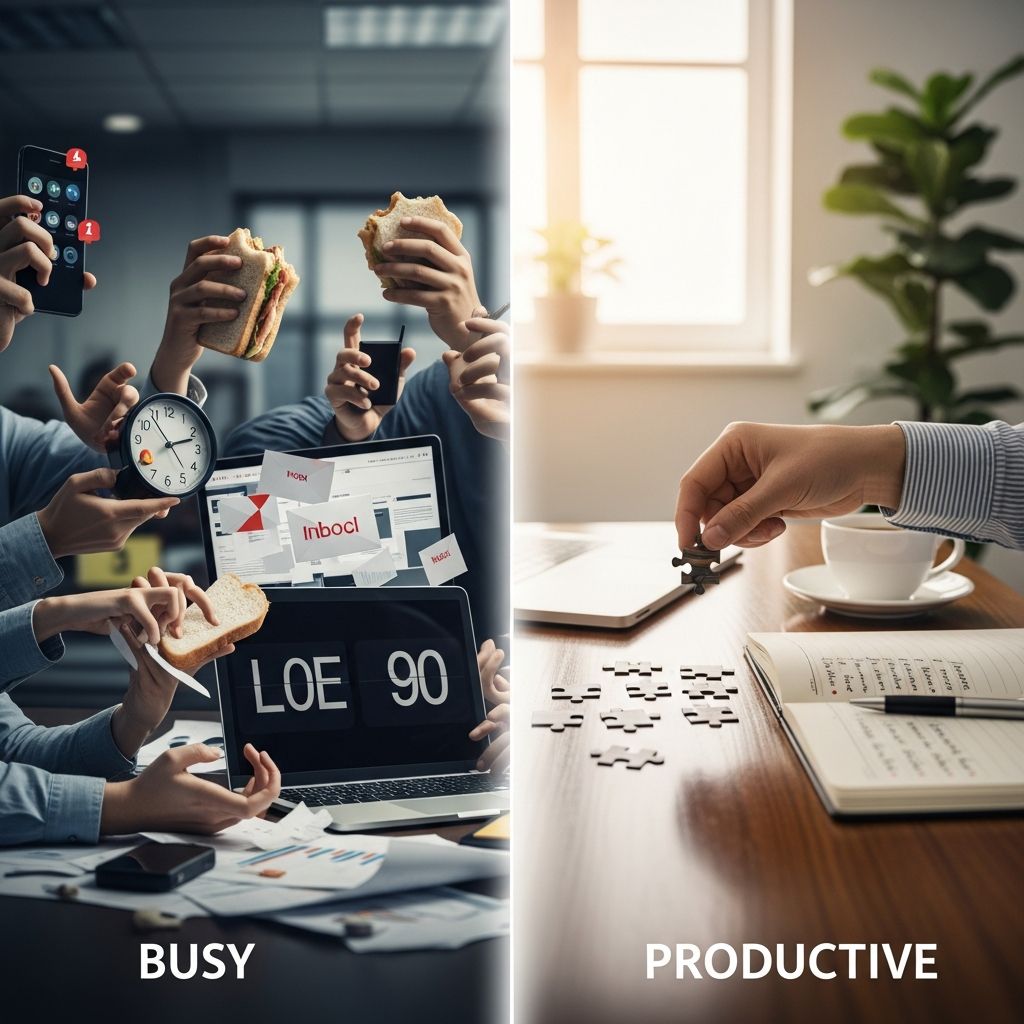
In today’s fast-paced world, many confuse relentless activity with real progress. True productivity stems from intentional actions aligned with meaningful outcomes, not just filling every moment with tasks. This article delves into the fundamental contrasts between those who stay perpetually occupied and those who deliver substantial results, offering actionable insights to shift your habits.
Defining the Core Distinction
Busyness involves handling numerous tasks, often low-impact ones that create an illusion of advancement. Productive individuals, however, channel their energy into high-value activities that drive long-term success. Research highlights that constant task-switching leads to significant time loss, with interruptions alone costing up to 23 minutes of recovery per disruption. Productive approaches emphasize effectiveness over mere efficiency, ensuring every effort contributes to broader objectives.
Consider a typical scenario: a busy professional juggles endless emails and meetings, ending the day exhausted yet unfulfilled. In contrast, a productive counterpart blocks time for strategic work, completing key deliverables ahead of schedule. This shift requires recognizing that activity does not equal achievement.
Goal Clarity: The Foundation of Progress
Productive people operate with crystal-clear goals, breaking them into actionable steps. They set long-term visions and align daily tasks accordingly, outperforming peers by focusing efforts precisely. Companies with clear goal-setting practices see 4.2 times higher performance and 30% greater revenue growth. Busy individuals, lacking this focus, scatter their energy across vague or numerous aims, achieving little of substance.
- Productive mindset: One to three daily priorities, each tied to a larger mission.
- Busy trap: Overloaded lists exceeding 20 items, diluting impact.
To cultivate this, start by auditing your objectives. Ask: Does this task advance my key goals? Tools like time blocking help schedule deep work sessions, protecting time for what matters most.
Prioritization: Saying No to the Non-Essential
With finite time, productive people master the art of prioritization, adhering to principles like the Pareto rule where 20% of efforts yield 80% of results. They ruthlessly decline low-priority requests, freeing space for high-impact work. Busy people accept everything, spreading themselves thin and fostering a reactive cycle.
| Aspect | Busy Approach | Productive Approach |
|---|---|---|
| Priorities | Many competing demands | Few, laser-focused |
| Response to requests | Yes to all, leading to overload | Strategic no’s to protect time |
| Outcome | Fragmented progress | Targeted achievements |
Implement this by categorizing tasks using Eisenhower matrices: urgent-important grids that highlight what truly deserves attention.
Deep Focus Over Multitasking Myths
Multitasking is a productivity killer; what seems like efficiency is rapid task-switching, consuming up to 40% of time in cognitive reconfiguration. Peer-reviewed studies confirm it impairs memory, self-control, and performance, especially under stress. Productive people embrace single-tasking, using techniques like Pomodoro—25-minute focused bursts followed by short breaks—to sustain concentration.
Busy individuals bounce between tabs, emails, and calls, compounding errors and fatigue. Switch to batching similar tasks, such as checking communications at set intervals, to reclaim hours lost to distractions—averaging 127 hours yearly for knowledge workers.
Time Mastery: Creating Space Intentionally
Productive people don’t complain about lacking time; they craft it by eliminating waste. They plan meticulously, using calendars not just for meetings but for focused blocks and even rest. Busy people fill schedules reactively, running out of hours amid constant urgencies.
- Delegate non-core tasks to teams or tools.
- Employ asynchronous communication to reduce meeting overload.
- End days early by front-loading high-energy work.
A sample productive day: Morning deep work on top priority, afternoon for collaborations, evening review. This contrasts sharply with back-to-back frenzy, yielding sustainable output.
Measuring What Matters: Beyond Hours Worked
Effort alone deceives; productive metrics track impact, not busyness. Evaluate output quality, uninterrupted focus blocks (key to 80% of results), decision speed, and energy sustainability. Busy people log hours as success, ignoring alignment with goals—a paradox where more work yields diminishing returns.
Shift by defining personal KPIs: Did this advance strategy? Was focus sustained? Track weekly to refine habits.
Collaboration and Systems Thinking
Productive individuals build systems and leverage teams, amplifying results beyond solo efforts. They design processes—like Henry Ford’s assembly innovations—for scalability, rather than perfecting isolated tasks. Busy people toil in silos, multitasking without synergy.
Foster this by clarifying roles, encouraging input, and automating routines. Result: Collective momentum toward shared victories.
Energy Management for Sustained Output
Productivity demands vitality; busy schedules drain it through fragmented attention. Productive habits include recovery periods, nutrition, and sleep prioritization. High performers maintain clarity by aligning work with peak energy windows.
Avoid the trap of glorifying exhaustion—busyness as status often masks inefficiency. Instead, aim for challenging yet energizing days.
Overcoming the Busyness Culture
Society rewards appearances of hustle, but data shows it erodes results. Break free by communicating boundaries and celebrating outcomes. Leaders modeling productivity inspire teams to prioritize impact over activity.
Frequently Asked Questions (FAQs)
Q: How can I tell if I’m busy or productive?
A: Review your week: If tasks align with top goals and yield measurable progress, you’re productive. Endless to-do’s without advancement signal busyness.
Q: What’s the best way to stop multitasking?
A: Use Pomodoro timers for 25-minute focus sprints, batch emails, and silence notifications during deep work blocks.
Q: How many priorities should I have daily?
A: Limit to 1-3 high-impact items to ensure completion and momentum.
Q: Does working fewer hours mean I’m less productive?
A: No—quality trumps quantity. Time blocking and focus yield more in less time.
Q: How do I say no without offending others?
A: Frame it positively: “I’d love to help, but I’m prioritizing X right now—can we revisit later?”
Practical Steps to Transform Your Habits
Begin today: Audit your calendar, set 3 priorities, block focus time, and track impact weekly. These shifts turn busyness into breakthroughs, fostering fulfillment alongside achievement.
References
- Busy vs Productive: Maximizing your Time and Productivity — Nibol. 2023. https://www.nibol.com/en/blog/busy-vs-productive-maximizing-time-and-productivity
- Busy vs productive: What actually drives results — Superhuman Blog. 2023. https://blog.superhuman.com/busy-vs-productive/
- 11 Differences Between Busy People And Productive People — Lifehack.org. 2023. https://www.lifehack.org/articles/productivity/11-differences-between-busy-people-and-productive-people.html

- Integrated M.A. in Applied Linguistics, University of Hyderabad
- 5+ years in editorial, instructional, SEO, and research-based writing
Sneha is a relationships and lifestyle writer with a strong foundation in applied linguistics and certified training in relationship coaching. She brings over five years of writing experience to theskillvault, crafting thoughtful, research-driven content that empowers readers to build healthier relationships, boost emotional well-being, and embrace holistic living. Her writing and insights reflect the belief that beauty, happiness, and wellness…